
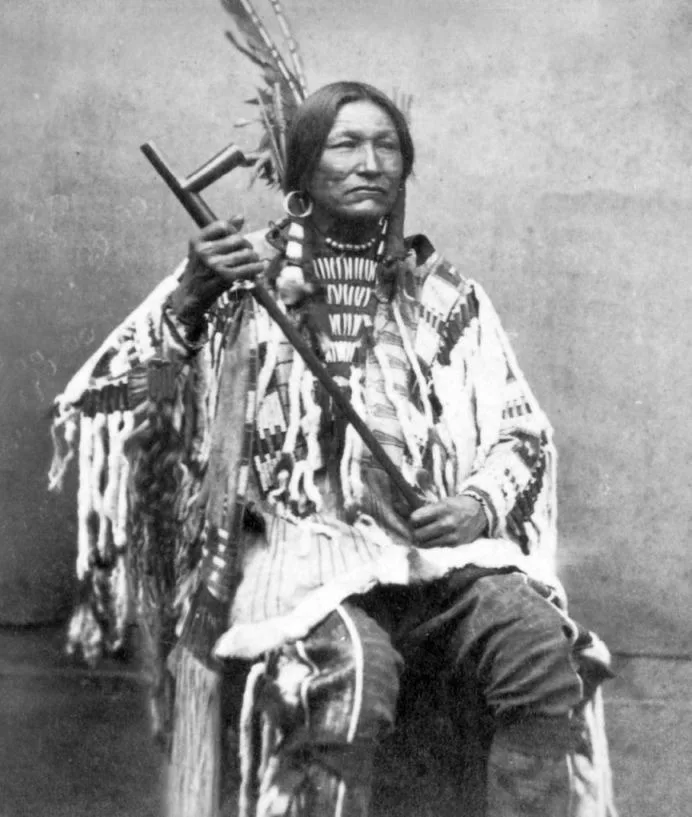
White Bull, known in Lakota as Tȟatȟáŋka Ská, was a renowned Minneconjou Lakota warrior, leader, and witness to one of the most consequential periods in the history of the Oceti Sakowin. Born in April 1849 near the northern edge of the sacred Black Hills, he entered the world when his people still lived with the buffalo, moved freely across their ancestral homelands, and organized their lives through the sacred circle of family, ceremony, generosity, and responsibility.
White Bull came from a distinguished Lakota family. His father, Makes Room, was a respected Minneconjou chief, while his mother, Good Feather, was the sister of the great Hunkpapa Lakota spiritual leader Sitting Bull. White Bull was therefore Sitting Bull’s nephew, although the depth of Lakota kinship made their relationship far greater than a simple English genealogical term can express. Sitting Bull was an uncle, teacher, protector, spiritual guide, and beloved elder relative whose example profoundly shaped White Bull’s life.
White Bull’s brother was One Bull, another respected Lakota warrior connected with Sitting Bull and regarded as his adopted son. Together, White Bull and One Bull belonged to a family whose members carried important responsibilities for protecting the people, preserving their spiritual life, and defending the sacred lands entrusted to them by the Creator.
As a young boy, White Bull was known as Bull-Standing-with-Cow. His development as a warrior began when he watched. At approximately sixteen years of age, he distinguished himself through remarkable courage, counting coup upon enemy scouts and returning with captured horses, and was bestowed with the name White Bull.
Among the Lakota, becoming a warrior was not simply a matter of fighting. A true warrior was expected to show courage, generosity, endurance, self-discipline, and a willingness to put the people’s survival above personal safety. White Bull was raised with this understanding. His courage was not his alone. His courage belonged to the people and was exercised on their behalf.
As soldiers, miners, and railroad surveyors entered Lakota territories, White Bull stood with those who defended the land and the people’s right to live freely. He participated in several confrontations during the long struggle against the invasion of Lakota homelands. He witnessed firsthand the relentless pressure placed upon the Lakota to surrender their territories, abandon the buffalo way of life, and submit to confinement on reservations.
White Bull was also present during a famous act of courage associated with Sitting Bull. During a confrontation with United States soldiers, Sitting Bull calmly sat down within range of enemy fire, filled his pipe, and shared it with several warriors. At the same time, bullets struck the ground around them. White Bull was among those present. The action was not an empty display of recklessness —spiritual—the capacity to remain centered and fearless even while surrounded by danger.
White Bull’s name became inseparably connected with the Battle of the Little Bighorn on June 25, 1876. There, Lakota, Northern Cheyenne, and Arapaho families defended an enormous village containing women, children, Elders, and thousands of horses. When Lieutenant Colonel George Armstrong Custer and the Seventh Cavalry attacked, the warriors responded with tremendous speed and determination.
White Bull fought courageously in the battle and later described engaging in close combat with a soldier whom some historians believed may have been Custer. Over the years, stories circulated claiming that White Bull had killed Custer. Yet White Bull himself did not build his reputation upon such a claim. His greatness does not depend upon identifying one individual opponent. His true distinction lies in the courage with which he defended his relatives and in the firsthand knowledge he preserved about what occurred that day.
The victory at the Little Bighorn was followed by overwhelming military retaliation. The United States government sent additional forces into Lakota country, destroying villages, seizing horses, diminishing access to the buffalo, and attempting to force the remaining free Lakota bands onto reservations. White Bull stood firm through this painful and transformative period.
Following the battle, White Bull joined his uncle Sitting Bull and other relatives who traveled northward into Canada. They sought refuge around Wood Mountain in what is now Saskatchewan, hoping to preserve their freedom and protect their families from military pursuit. Life there was extremely difficult. Buffalo herds were disappearing, food became scarce, and the people endured hunger, cold, political pressure, and deep uncertainty.
Through these hardships, White Bull remained connected to Sitting Bull and to the spiritual determination that sustained their people. They were not simply fleeing an enemy; they were striving to preserve a way of life rooted in sacred relationships among the people, the buffalo, the land, and the Great Mystery.
Eventually, changing conditions and the near destruction of the buffalo compelled White Bull and many of his relatives to return south. The world to which they returned had been profoundly altered. The Lakota were being confined to reservations, children were increasingly taken into foreign educational systems, ceremonies were suppressed, and traditional leadership was government-controlled institutions displaced traditional leadershiprrender his identity or abandon his responsibility. He adapted to reservation life while continuing to serve his people. He became a Minneconjou chief after his father’s death. He later served as a judge in the Court of Indian Offenses, working within an imposed system while protecting his relatives’ well-being and advocating for Lakota rights in the sacred Black Hills. He understood that the Black Hills were not merely property or a commodity. They were—and remain—a sacred center of Lakota spiritual, cultural, and national life. His support for the Lakota claim to the Black Hills reflected an enduring responsibility to the ancestors, the living generations, and those yet to come.
In his later years, White Bull became an invaluable keeper of historical memory. He shared accounts of his life, the old buffalo days, the conflicts with the United States military, the Battle of the Little Bighorn, and his relationship with Sitting Bull. Through these recollections, later generations received testimony from someone who had not merely studied these events, but had lived through them.
White Bull survived nearly a century of near-total change. He was born into a world where the Lakota still moved freely across their homeland, and he lived into the age of automobiles, airplanes, radio, and global warfare. Through it all, he retained the living memory of his people’s freedom, their spiritual strength, and their resistance to dispossession.
He passed into the Spirit World on Soltice, June 21, 1947. His long life bridged the dreaming buffalo nations of his childhood and the Lakota descendants whose people’s truth is for dignity, sovereignty, cultural renewal, and the protection of sacred lands.
White Bull’s legacy is not only the legacy of a great warrior. It is the legacy of a human being who showed courage without losing humility, endured profound upheaval without forgetting who he was, and carried his people’s truth forward so future generations would remember.
His story reminds us that courage is not the absence of fear. Courage is remaining faithful to what is sacred even when the world around us is changing. Leadership is not the pursuit of personal recognition. Leadership is accepting responsibility for people’s survival and well-being.
Victory is not only upon a battlefield. Sometimes victory is found in preserving the truth, keeping the sacred memory alive, ensuring that the voices of the ancestors continue to guide the generations yet unborn.—Tȟatȟáŋka Ská—stood with his beloved uncle Sitting Bull during one of the most difficult chapters in the history of the Lakota Nation. He defended his relatives, protected his people’s sacred inheritance, adapted his identity, and carried his knowledge across nearly one hundred years.
He remains an enduring example of bravery, resilience, responsibility, and spiritual strength—a great Lakota warrior whose life continues to speak to all who seek the courage to stand for their people, protect Mother Earth, and walk faithfully in the ancestors’ footsteps.
White Bull lived for 98 years, from April 1849 to Soltice, June 21, 1947, carrying the living memory, spiritual strength, and unconquered dignity of the Lakota people across nearly a century.