Part one of the two-part series: When Intelligence Serves Life: Ending War and Building a New Planetary Civilization
This Planetary Vision and Call to Action is a direct outcome and practical unfolding of the Binding Planetary Peace Treaty to End War, signed at Dripsey Castle in County Cork, Ireland, on July 20, 2025. It asks how humanity’s most powerful emerging intelligence can serve a sacred and urgent purpose: preventing armed conflict, ending war, healing its causes, and building the foundations of enduring planetary peace.
What would happen if, beginning today, the most powerful artificial intelligence systems on Earth were given one overriding purpose: to help the Human Family prevent war, end armed conflict, heal its causes, and establish a Binding Planetary Peace Treaty to End War?
Imagine that the leading AI laboratories of China, the United States, Europe, India, Africa, Latin America, the Middle East, and every other region agreed to cooperate. Military agencies, corporations, or a handful of powerful governments would not secretly direct their systems. They would make their findings, methods, uncertainties, and recommendations open for the world to examine. Indigenous Peoples, women, youth, elders, refugees, peacebuilders, scientists, diplomats, and communities living closest to conflict would help govern the work. No nation would own the truth. No company would own humanity’s pathway to peace.
This would not create peace automatically. AI has no conscience of its own, no spiritual responsibility, and no authority to decide peoples’ destiny. It reflects the purposes, information, and values we give it. But if the Human Family placed this extraordinary instrument under moral guidance and directed it toward peace, AI could become the greatest organized capacity for conflict prevention, truth-telling, consultation, and human cooperation ever created.
The decisive question is not whether AI is powerful enough. It is whether humanity is wise enough to choose what that power will serve.
**The Four Worlds Guiding Principles for Building a Sustainable and Harmonious World **offer a foundation for making that choice. They teach that human beings and communities are not problems to be managed but living sources of knowledge, strength, and possibility; that lasting transformation begins from within; that a shared vision gives direction to collective action; that healing is essential to genuine development; and that unity, participation, justice, cultural identity, spiritual purpose, continuous learning, and responsibility to future generations must remain inseparable. If AI is to serve peace, it must be placed within this larger understanding of what it means for the Human Family to grow.
From a War System to a Peace System
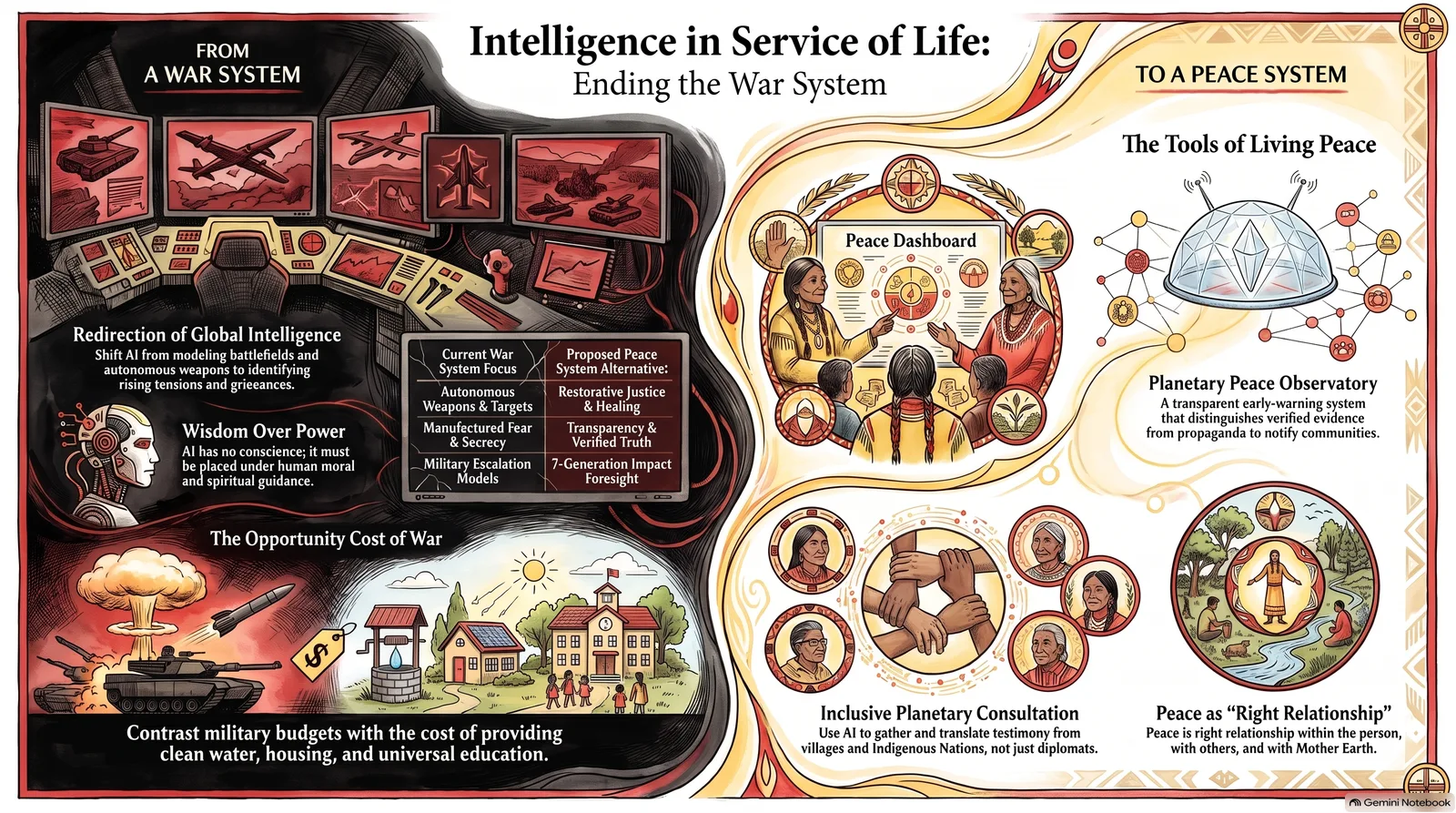
The world already uses immense intelligence to prepare for war. Governments map targets, model battlefields, monitor populations, predict adversaries, develop autonomous weapons, manipulate information, and spend vast resources making violence faster and more effective. War is not merely an event that suddenly erupts. It is a system: financed, researched, supplied, justified, rehearsed, and renewed.
If we want peace, we must build a peace system with at least the same seriousness.
Yet a peace system cannot simply be a war system pointed in another direction. The methods used to create peace must embody the peace we seek. A system built upon domination, secrecy, coercion, exclusion, or the belief that experts alone possess the answers will eventually reproduce the very conditions that generate conflict. The Indigenous Guiding Principles remind us that the process is part of the outcome: the pathway to peace must itself be participatory, truthful, respectful, culturally grounded, morally responsible, and capable of strengthening the people it is intended to serve.
A planetary AI peace initiative would begin by asking different questions:
Where are tensions rising before people begin killing one another?
Which grievances are being ignored?
Which communities are losing water, food, land, livelihood, dignity, or political voice?
Where are fear and dehumanizing language spreading?
Which weapons shipments, military movements, economic shocks, climate pressures, or deliberate falsehoods are increasing the danger?
What actions could reduce fear without humiliating either side?
Who has the trust to open a communication channel?
What forms of justice, restitution, autonomy, healing, or shared stewardship could make peace durable?
AI can help humanity examine these questions across languages, disciplines, cultures, histories, and enormous bodies of information. Its purpose would not be to identify an enemy. Its purpose would be to discover the pathway away from enmity.
That pathway cannot be imposed from above or imported from outside. A central Indigenous principle of human and community development is that lasting change must arise from within. Every people possesses gifts, memories, values, relationships, and capacities from which renewal can grow.
Outside knowledge and technology may assist, but they cannot replace the inner work of a community recognizing its own strength, telling the truth about its wounds, and choosing its future. AI for peace should therefore awaken human capacity rather than create dependency upon machines or distant institutions.
It should also help people form a clear and compelling vision of the world they are trying to create. Fear can warn humanity about what must be prevented, but fear alone cannot sustain transformation. People must be able to see and help build the alternative: communities where children are safe, cultures are honored, Mother Earth is protected, conflicts are resolved without violence, and every person can contribute their gifts to the whole. A shared vision draws human energy forward. AI can help make that vision visible, examine the steps required to reach it, and show how present decisions move us toward it or away from it.
The First Work Would Be to See Clearly
Most wars do not begin without warning. The warning signs are scattered across reports, speeches, commodity prices, troop movements, drought maps, refugee flows, local journalism, social media, community testimony, and historical patterns. Human institutions often see these signs too late, or political leaders choose not to act.
A transparent global peace system can bring these signals together and produce continuously updated conflict-risk maps. It can distinguish between verified evidence, reasonable concern, uncertainty, propaganda, and deliberate deception. It can notify not only governments but also the United Nations, regional bodies, Indigenous governments, civil society, humanitarian organizations, religious and spiritual leaders, and the communities themselves.
But an early-warning system must be joined to early action. A warning that sits unread in an office saves no one. When danger rises, the system can immediately identify trusted mediators, translate messages, propose temporary protective agreements, recommend humanitarian corridors, model ceasefire options, and show the likely human cost of delay. It can tell leaders, in plain language, what may happen in seven days, thirty days, six months, and one generation if they choose escalation rather than consultation.
The purpose would never be prediction as destiny. It would be foresight as responsibility.
Foresight must also honor our responsibility to those yet unborn. Indigenous Peoples have long understood that decisions made today enter the lives of future generations. A peace system should therefore measure more than the immediate possibility of military escalation. It should show how a decision will affect children, culture, community cohesion, the waters, the lands, the climate, and the possibilities of life seven generations from now. Intelligence becomes wisdom only when knowledge is joined to long-term moral responsibility.
Every Voice Could Enter the Consultation
Armed parties have too often conducted peace negotiations while those who endured the war wait outside the room. A genuine AI peace initiative would reverse this pattern. It can gather testimony securely from villages, neighborhoods, displaced families, women, youth, elders, veterans, minority communities, and Indigenous Nations. It can translate thousands of contributions without erasing their meaning, identify shared needs, preserve important differences, and show negotiators what people actually require to live together safely.
This must never become mass surveillance disguised as peacemaking. Participation would require consent, privacy, community ownership of knowledge, and the right to remain silent. Sacred knowledge would not be extracted. Vulnerable people would not be exposed. Indigenous data sovereignty would be honored. Communities would help determine what information may be used, by whom, for what purpose, and for how long.
Properly governed, AI can make planetary consultation possible without making it impersonal. It could help millions of people be heard while leaving moral judgment, relationship, and final decision-making in human hands.
The Four Worlds Guiding Principles make an essential distinction here: participation is not merely the opportunity to submit information. It is the right and responsibility of people to help analyze their own reality, define the future they want, make decisions, take action, and evaluate what follows. Communities must not become data points in somebody else’s peace plan. They must be authors, owners, and active builders of the process.
Unity does not require uniformity. Genuine unity makes room for diverse histories, cultures, languages, experiences, and convictions. It is not achieved by silencing disagreement but by placing differing perspectives within a larger circle of shared purpose. AI could assist this process by revealing common ground without erasing real differences, and by helping people consult across those differences until a more complete understanding emerges. But human beings must choose and live unity. It cannot be calculated into existence.
AI Could Help Negotiators Find the Ground Beneath Their Positions
Conflicts become trapped when each side repeats its demands, and no one examines the human need beneath them. AI can analyze proposals, historical agreements, constitutional arrangements, resource-sharing models, peace processes, and local traditions worldwide. It can generate many possible agreements, test them against each party’s concerns, identify hidden contradictions, and show where different words conceal compatible interests.
During negotiations, independent AI systems could serve all parties equally. They can check factual claims, clarify legal consequences, translate in real time, record areas of agreement, and reveal when a proposed settlement transfers suffering from one group to another. They can model whether a ceasefire is practical, whether displaced people can return safely, whether water and land are shared fairly, and whether the agreement protects the next generation rather than merely freezing the present balance of power.
AI can also help negotiators understand how trauma shapes perception. A statement intended as reassurance may be heard as a threat because of history. Another people may experience a demand for security as domination. Technology cannot heal this wound. But it can help human beings see it, slow down, choose language more carefully, and create space for ceremony, apology, mourning, truth, restitution, and renewed relationship.
This is where healing becomes inseparable from peacemaking. Unhealed trauma does not remain in the past. It enters families, institutions, political identities, and the stories people tell about one another. It can turn yesterday’s suffering into tomorrow’s justification for violence. The Guiding Principles teach that no community can build a sustainable future while carrying wounds that are continually denied, reopened, or passed to the next generation. Peace processes must therefore make room not only for negotiation and legal settlement, but also for grieving, truth-telling, forgiveness where it is freely possible, restitution, restoring dignity, and rebuilding relationships.
Healing also begins within the human person. People shape nations, and institutions reflect the consciousness of those who lead them. The work of peace asks individuals and leaders to examine fear, prejudice, anger, attachment to power, and the desire for revenge within themselves. AI may help illuminate the consequences of these forces, but no technology can undertake this inner transformation for us.
Truth Would Become Harder to Bury
War depends upon secrecy, confusion, manufactured fear, and the destruction of a people’s humanity in the eyes of others. A global peace AI network could rapidly examine images, video, documents, public claims, and satellite evidence, while clearly stating what is known and what remains uncertain. It could expose manipulated media and coordinated disinformation before falsehoods provoke violence. It can preserve evidence of atrocities for lawful human investigation and warn the public when algorithms are intensifying hatred.
Yet truth cannot be entrusted to one machine, one government, or one corporation. Multiple independent systems should test every major finding, qualified humans should review it, it should be open to challenge, and it should include sources and a confidence level. Communities accused or affected must have a right of response. The models themselves should be audited for cultural, political, and linguistic bias.
Transparency is not a decorative principle. It is the foundation of trust. The world should be able to see what the peace systems were asked, what evidence they considered, what values guided them, where they disagreed, and why they reached their recommendations.
This transparency must be joined to a moral and spiritual foundation. Information alone does not tell humanity what is sacred, what is just, or what responsibilities arise from our interdependence. A technically accurate system can still serve an unjust purpose. The Guiding Principles call for developing the whole human being- mental, emotional, physical, and spiritual- and for public institutions whose actions are guided by service, honesty, compassion, humility, and reverence for life. AI must remain accountable to these human values rather than quietly becoming their source.
We Could Reveal the Full Cost of War: Before leaders choose war, the people should see the whole account.
AI can produce a public, continuously updated measure of the cost of every conflict:
Lives lost
Children orphaned
Families displaced
Homes and hospitals destroyed
Trauma carried into the next generation
Rivers, forests, soils, and sacred places damaged
Education interrupted
Hunger deepened
Carbon released
Public debt increased
Decades of opportunity taken away
It can also show what the same resources could accomplish if directed toward life:
Clean water
Housing
Food security
Schools
Health care
Renewable energy
Ecological restoration
Children’s well-being
We can place every military budget beside a peace-and-human-development alternative. We can compare every new weapons system with what its cost could provide to the Human Family.
This would not deny the legitimate need to protect people. It would expose the false belief that weapons alone create security. True security grows from justice, trustworthy relationships, healthy communities, a living Mother Earth, and institutions that resolve conflict before violence begins.
This is also why material and spiritual development cannot be separated. Food, water, housing, health care, education, and economic opportunity are indispensable foundations of peace. Yet material abundance without purpose, belonging, ethical responsibility, or respect for Mother Earth cannot create a harmonious world. A genuine peace system must nourish the whole of life: bodies and minds, families and cultures, economies and ecosystems, memory and hope, practical capacity and spiritual meaning.
Peace Must Address the Roots
AI directed toward peace would not wait at the edge of the battlefield. It would help identify and transform the conditions from which violence grows: poverty, exclusion, stolen land, racism, corruption, historical trauma, ecological destruction, competition for resources, political repression, and the absence of meaningful hope.
It can help governments and communities design precise investments where they would prevent the greatest suffering. It could strengthen food and water systems before scarcity becomes conflict. It can identify unfair distributions of wealth and services. It could support trauma-informed education, restorative justice, mental health care, and the rebuilding of trust. It can help protect languages and cultures whose destruction has long been used as an instrument of domination.
Indigenous knowledge would be essential here. For thousands of years, Indigenous Peoples have understood that peace is not simply the silence of weapons. Peace is right relationship: within the person, within the family, among peoples, with Mother Earth, and with the spiritual foundations of life. AI must learn from this wisdom without claiming it, commercializing it, or separating it from the peoples who carry it.
Culture is not an ornament added after peace has been negotiated. It is one of the living foundations from which people derive identity, meaning, law, memory, belonging, and responsibility. Development that weakens a people’s language, spiritual traditions, family structures, relationship with the land, or capacity for self-determination may produce material change while deepening the roots of conflict. Peace initiatives must therefore be culturally grounded and locally led. AI should be able to work with many knowledge systems without forcing them into a single worldview or treating Indigenous wisdom as raw material to be extracted.
The Four Worlds Guiding Principles also teach that development is a learning process. No peace design will be perfect at its beginning. Communities and institutions must be able to act, reflect upon the results, learn from success and failure, correct their direction, and continue growing. AI can greatly strengthen this cycle of action and reflection by showing what is working, identifying unintended consequences, and carrying lessons across regions without pretending that a solution from one people can simply be copied onto another.
A Binding Planetary Peace Treaty
On July 20, 2025, in Ireland, Indigenous leaders and peacebuilders signed a Binding Planetary Peace Treaty to End War. That act declared that war should no longer be treated as an unavoidable feature of human existence. It called the Human Family to:
Renounce war
Settle disputes peacefully
Disarm
Uphold human rights
Protect Indigenous rights
Ensure women’s equality
Care for Mother Earth
Be responsible to future generations
AI will help turn such a treaty from a moral declaration into a living planetary system of accountability.
For the Treaty to become truly living, it must be more than an agreement among governments. It must enter education, community development, public budgets, law, diplomacy, culture, and the everyday choices of institutions and peoples. The Guiding Principles remind us that transformation becomes sustainable when people understand it, participate in it, see themselves reflected in it, and develop the capacity to carry it forward. The Treaty must belong to the Human Family, not only to diplomats and international bodies.
It can compare national laws and military doctrines with treaty obligations. It can track arms transfers, military spending, ceasefires, environmental damage, human-rights commitments, and progress in redirecting resources toward peace. It can help draft fair implementation pathways for nations with different conditions. It can make treaty information understandable in every major language and accessible to children, communities, legislators, journalists, and courts.
Most importantly, no government should be able to hide behind vague promises. A public planetary dashboard can show where commitments are being honored, where they are delayed, and where they are violated. Evidence would be open to review. Nations would have the right to explain or challenge findings, but no one would have the right to erase the record.
AI can also help design automatic, nonviolent responses to grave breaches: urgent mediation, independent investigation, civilian protection, suspension of weapons transfers, targeted financial restrictions approved through lawful international processes, and immediate humanitarian support. The aim would not be collective punishment. It would make preventing war faster, more certain, and better organized than preparing for war.
What We Could Do Right Now
We do not have to wait for a perfect global agreement. A coalition of willing Indigenous Nations, states, universities, peace organizations, AI laboratories, youth movements, women’s networks, and spiritual communities could begin now.
Establish an independent Planetary Council on AI for Peace, with equal, meaningful leadership from every region and permanent representation for Indigenous Peoples, women, youth, and conflict-affected communities.
Invite every major AI laboratory, including Chinese and Western frontier laboratories, to contribute models and expertise to a protected, nonmilitary commons for peace. Cooperation would not require surrendering all intellectual property. It would require shared standards, independent evaluation, transparent outputs, and a firm prohibition against converting the peace system into a weapon.
Build an open Planetary Peace Observatory that combines early warning, verified public evidence, community testimony, ecological indicators, arms and expenditure tracking, and clear options for preventive action.
Create regional peace laboratories where communities can use AI to address real disputes over land, water, governance, migration, historical injury, and development. These laboratories should be rooted in local culture and led by those who live with the consequences.
Their purpose should be capacity building, not technological dependency. Each laboratory should help people strengthen consultation, leadership, conflict transformation, community research, cultural knowledge, and the practical ability to implement their own decisions. Success would not be measured only by the sophistication of the technology. Still, by whether relationships become healthier, local leadership becomes stronger, participation becomes broader, and communities become more capable of directing their own development.
Use AI to conduct the largest consultation for peace in human history. Ask people in every nation: What must change for you and your children to live without fear? What do you need from others, and what responsibility are you prepared to accept? What should a Binding Planetary Peace Treaty guarantee? The answers should be publicly synthesized without reducing humanity’s many voices to a single manufactured consensus.
Create an open treaty implementation platform so that every article of the Binding Planetary Peace Treaty can be translated into measurable actions, timelines, responsibilities, safeguards, and public reporting.
Redirect even a small share of military and frontier-AI investment into this work. Humanity already possesses the money, knowledge, computing capacity, and communications networks. What has been missing is a unified moral decision.
Create a worldwide process of learning and reflection guided by the Four Worlds Guiding Principles. Let every region ask:
Are our efforts arising from the people themselves?
Is there a shared vision?
Are we healing the wounds beneath the conflict?
Are women, youth, elders, Indigenous Peoples, and those most affected participating fully?
Are we strengthening unity without suppressing diversity?
Are material, cultural, ecological, and spiritual dimensions being held together?
Are we building local capacity?
Are we learning from experience?
Are our methods already embodying the peaceful world we seek?
These questions would keep the initiative human, grounded, and capable of continual transformation.
The Safeguards Must Be as Strong as the Vision
AI for peace can become dangerous if the powerful control it, train it on stolen data, use it for surveillance, or allow it to make life-and-death decisions. Therefore, some boundaries must be absolute:
No autonomous system should be permitted to select or attack human targets.
No secret algorithm should determine which community is dangerous.
No peace platform should become an intelligence-gathering tool for military or commercial advantage.
No population should be coerced into surrendering personal or sacred information.
No single model should be treated as an oracle.
No recommendation should escape human responsibility.
Human rights, Indigenous rights, international law, informed consent, privacy, cybersecurity, independent audits, plural sources of knowledge, and meaningful public oversight must govern the entire system. Its code and data cannot always be completely open, because openness can expose private information or create security risks. But its purposes, governing rules, evidence standards, funding, audits, conflicts of interest, major findings, and accountability pathways must be visible.
It must also strengthen the capacity of families, communities, and nations to take responsibility for their own well-being. The Four Worlds Guiding Principles do not treat people as passive recipients of services or solutions. Assistance should increase freedom, confidence, knowledge, skills, cooperation, and self-reliance. If a peace technology leaves a community less able to act without it, then something essential has been lost. The highest use of AI would be to help human beings recover and expand their own powers of consultation, imagination, compassion, disciplined action, and collective responsibility.
Peace Requires More Than Intelligence
The deepest causes of war do not arise from a shortage of information. Humanity often knows what is happening and still fails to act. War grows through fear, greed, humiliation, vengeance, indifference, and the belief that one people’s safety requires another people’s suffering.
AI cannot forgive. It cannot repent. It cannot love a child, honor an ancestor, keep a sacred covenant, or accept responsibility before the generations yet unborn. These belong to the human spirit.
**The deepest Indigenous teaching within the ** Four Worlds Guiding Principles is that transformation must be lived. We cannot build peace through practices that humiliate, manipulate, exclude, or dominate. We cannot call for unity while profiting from division. We cannot defend Mother Earth while organizing economies around her destruction. We cannot ask nations to disarm while teaching children that violence is the final measure of power. The people and institutions calling for a new world must begin, however imperfectly, to embody that world in their conduct.
But AI can help us see the consequences of our choices before they become irreversible. It can bring hidden suffering into the light. It can help adversaries discover options they could not see on their own. It can make deception more difficult, consultation more inclusive, accountability more continuous, and cooperation possible on a planetary scale.
The instrument is here. The knowledge is here. The need is before us.
If all the world’s artificial intelligence were turned toward peace, the first great discovery would not be a new technology. It would be that the Human Family already knows enough to end war. We know that every child is sacred. We know that grief crosses every border. We know that humiliation plants the seeds of future violence. We know that justice and healing must walk together. We know that Mother Earth cannot survive endless preparation for destruction. We know that no nation can be secure in a world built upon the insecurity of others.
AI can gather these truths, test our policies against them, and place the choices before us with a clarity no generation has possessed before. But humanity must still choose.
The Binding Planetary Peace Treaty offers that choice. It asks us to move beyond managing war toward ending it; beyond temporary settlements toward right relationship; beyond national survival toward the well-being of the whole Human Family and Mother Earth.
The Four Worlds Guiding Principles show us how that choice can become a process of living transformation:
Begin from within.
Unite around a life-promoting vision.
Heal what has been wounded.
Invite the full participation of the people.
Honor every culture and the spiritual foundations of life.
Balance material progress with human and ecological well-being.
Build the capacity to act.
Learn continuously.
Take responsibility for future generations.
In every step, become the peace we are seeking to establish.
The future of AI and the future of peace have now become inseparable. If we train our most powerful intelligence to dominate, deceive, and destroy, it will magnify the old world. If we place it within a transparent moral covenant and direct it toward truth, prevention, healing, justice, and cooperation, it can help us build a world in which war is no longer accepted as inevitable.
The final question, then, is not: Can artificial intelligence bring peace to Earth?
The final question is: Will the Human Family unite, while there is still time, and command its intelligence to serve life?
Ending war would not end this transformation. It would be the beginning.
If the Human Family no longer devoted trillions of dollars, vast natural resources, our finest scientific minds, and millions of skilled people to preparing for destruction, what could we do with this extraordinary release of human capacity?
We could:
Feed the hungry
House those without homes
Heal the sick and traumatized
Educate every child
Restore Mother Earth
Protect Indigenous Peoples and their Sacred Homelands
Advance peaceful science
Build a global civilization founded upon justice, unity, and right relationship.
This is the question we will explore in Part Two: not merely what humanity could stop doing, but what we could finally begin to do together.
Part Two: When the Resources of War Are Returned to Life
What the Human Family Can Build After War Ends
To be released on the International Day of Peace, September 21, 2026
Background of Hereditary Chief Phil Lane Jr.
PPTX-When Intelligence Serves Peace
Background of Hereditary Chief Phil Lane Jr.