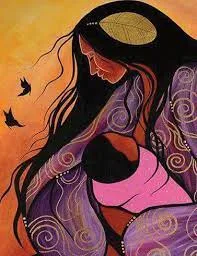
"Wakanjeja: Honoring the Sacred Gift from the Creator"
In Dakota culture and many other Indigenous cultures, the care and support for the journey of the soul in the womb world of the mother begin with the understanding that life is sacred and interconnected.
When conception is known, the mother and child are treated with the utmost kindness, love, and gentleness. This approach recognizes the significance of the child's early experiences and their impact on their future well-being.
The expectant mother is encouraged to nurture positive thoughts and feelings. This is not only for her own well-being but also because it is believed that the emotions and energy she radiates can influence the developing child within her womb. Emphasizing positive emotions helps create a harmonious environment for the child's growth.
The mother is also encouraged to engage with the natural world, surrounding herself with the beauty of songs, the changing seasons, and the gentle touch of soft things. In Dakota culture, the natural world is deeply respected, and the belief in the interconnectedness of all living beings is prominent. By immersing herself in the natural environment, the mother acknowledges her connection to the Creator and the sacredness of the child she carries.
The unborn child is regarded as Wakanjeja, a Sacred Gift from the Creator. This term embodies the belief that each child is unique and special, carrying within them a sacred essence. As such, negativity or criticism around the mother is forbidden, as it is understood that this can affect the child's spiritual well-being.
Throughout the pregnancy, special songs are sung to the child. The power of sound is recognized, as it is believed that the frequencies of these songs can penetrate the womb wall and uplift the child's spirit. The intention is to create a positive and nurturing environment for the child's physical and spiritual development.
The support provided to the expectant mother extends beyond the songs. Mothers and grandmothers are significant in guiding the mother's journey to becoming a good mother. They share their wisdom and experiences, ensuring that the knowledge of caring for and raising a child is passed down through generations.
When the time for birth approaches, experienced grandmothers are present to provide assistance. Their presence signifies the importance of ancestral knowledge and the continuity of traditions. The birthing process is regarded as a sacred event, and the presence of the Grandmother brings comfort and strength to the mother.
When the new relative, the infant, arrives, they are not immediately separated from their mother. Instead, the umbilical cord is left uncut until the child is comforted on their mother's breast. This act symbolizes the continuation of the sacred connection between mother and child, representing their unbreakable bond.
Throughout this journey, the Dakota and other Indigenous cultures understand and cherish the presence of a Sacred Soul coming to join the Circle of the People. This perspective reflects the profound respect for life, the spiritual dimensions of existence, and the interconnection of all living beings within the web of creation. It is a testament to the wisdom and reverence for life passed down through generations, nurturing the sacredness of the child's journey from the womb world of the mother into the Circle of the People.
Although they knew the word epigenetic, they knew more than those who coined it.