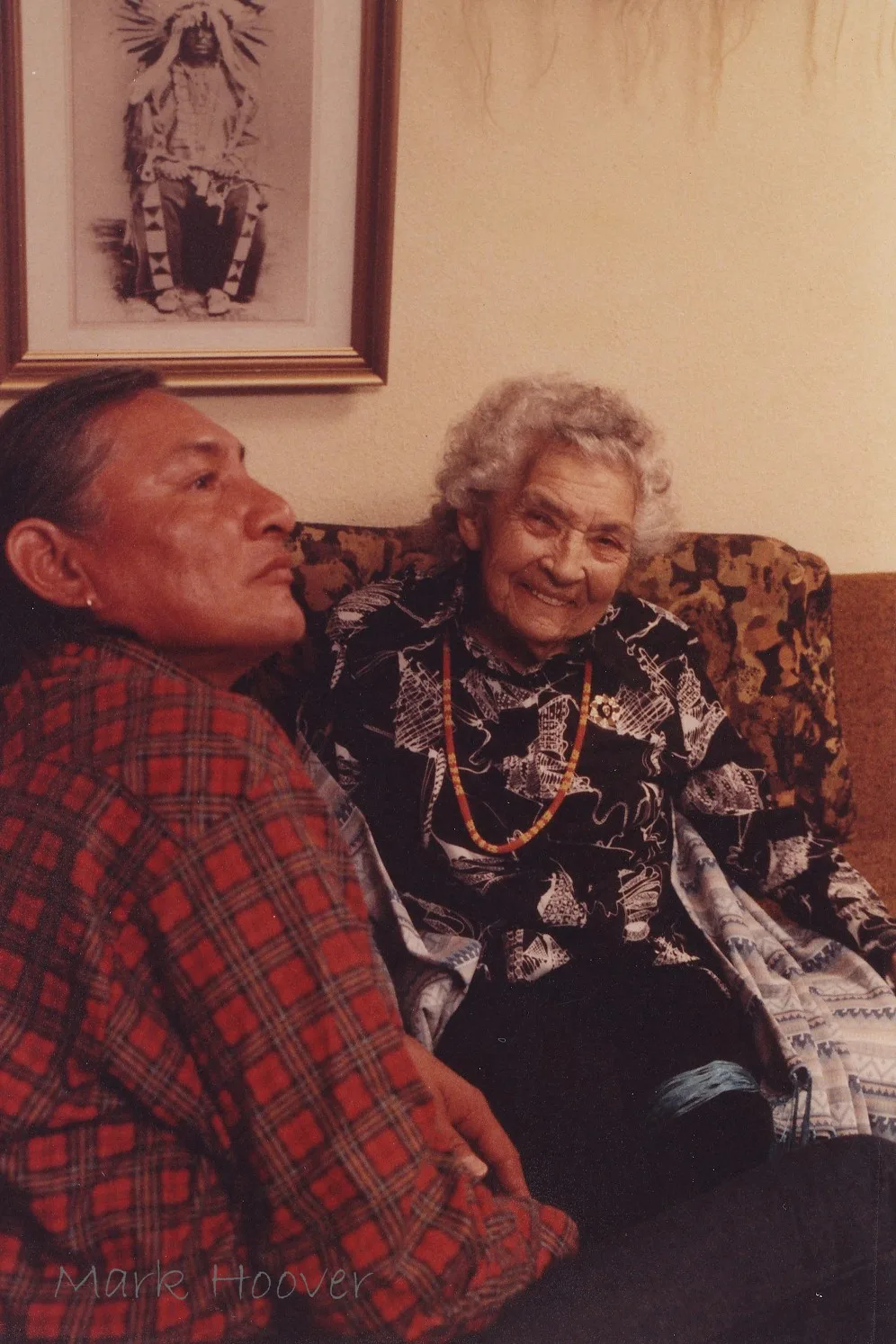
This is my Unchi Martina Sherwood at my parent's home in Walla Walla with my brother Will Sampson. Unchi Martina passed to the Other Side Camp when she was 99. She was my Unchi Lyma Deloria's best friend.
My Great-Great Grandfather Hinhan Wicasa, Owl Man, is in the picture behind them. His son Tipi Sapa, Philip Deloria, was adopted through a great Hunka Ceremony by Chief Gall as his misúŋ, his younger brother.
On this occasion, Chief Gall gave away a section of land, hoses, and cattle to establish St. Elizabeth's Church and School at Wakpala, where my father was born on Oak Creek and attended school as a young boy.
Until the US Congress passed the "American Indian Religious Freedom Act (AIRFA)" in 1978, it was against US Federal Law to practice Indigenous spirituality. So at St. Elizabeth's, they could visit, pray and sing in thier own language.
Also, down below St Elizabeth's, they would sing the old songs. My father said Tipi Sapa would stop his team and wagon, listen to them sing, and then proceed on his way, letting them know they had his full approval. So before Tipi Sapa died, he had been gifted with 33 men's death songs.
We were making the film series, Images of Indians with brothers Phil Lucas and Mark Hoover in 1978 when this picture was taken.
Unchi Martina told me many stories when I spent the summers with her at Sherwood Corners at Wakpala. She told me how she would sit on the lap of my Hunka great-grandfather, Pizi, Chief Gall. Along with Crazy Horse, he played a primary role in the Greasy Grass fight, where they eliminated General Custer and the 7th Calvary.
Unchi said his hands were huge, and he weighed almost 300 lbs. She said he was ferocious on the battlefield protecting the People, but at home, he was gentle and soft-spoken.
Unchi told me about a Ceremony for old men she attended when she was a young girl. One time they were able to attain and butcher a Bull Buffalo for the last time.
Her father invited five other old men, including grandfathers Chief Gall and Low Dog, who had worn down and had old teeth. The women would cut the Hump into six very tender pieces. Unchi said those old men immensely enjoyed themselves, eating the soft, tender meat from the Hump and reminiscing about the days when they rode free across the High Plains, days they knew were forever gone.
After eating, they took out their Hand Drums and sang old songs, and she danced for them.
General Custer found the ferocity of Chief Gall and his fellow warriors in short order. Along with Crazy Horse, he played a primary role in the Greasy Grass fight, where they quickly eliminated General Custer and the 7th Calvary.
Despite the victory, it was a very tough day for our Lala Chief Gall! Major Marcus Reno's initial attack on the southeast end of our encampment killed Gall's two wives and several children. He described it in these words: "My heart was very bad that day."
Chief Gall was among the few warriors to suspect that Custer's strategy was a two-pronged attack. He believed that determining the location of the other half of Custer's attacking force was critical to the defense of the People.
Chief Gall crossed the Little Bighorn and rode to the northeast, where he saw Custer's chief scout, Mitch Bouyer, returning to Custer from an overwatch of their encampment. After locating the main element of Custer's five companies, he correctly determined that they intended to force a river crossing and an entrance into the northern end of the village.
Riding back down from the bluffs, he told the Oceti Sakowin and Cheyenne's forces returning from replulsing Reno's attack of his understanding of what Custer was trying to do. Then, with Crazy Horse, he led forces north across the river to drive Company E and F due north up present-day Calhoun Couley to present-day Finley Ridge. There they forced three of Custer's companies to fight a primarily defensive battle.
Within minutes, Gall and his forces took a position northeast of Finley Ridge and poured withering fire down on Companies C, I, and L.
Then Crazy Horse charged through an opening between Lt Calhoun's Company L and Company I in a sudden surprise right envelopment attack.
Seeing that the two Cavalry companies no longer had the fire superiority, Chief Gall and his warriors attacked from the east. They soon finished off Companies C and L and forced survivors and some of Company I to flee towards Custer and his men north of the so-called "Last Stand Hill."
Soon they finished off Custer and his men in the remaining companies, C, E, and K.
The last approximately 28 survivors made a dash south for the river. They were trapped in the box canyon called "Deep Ravine." After killing them, they won the battle quickly, completely annihilating Custer's five companies.
There is more to the Battle of the Greasy Grass, shared with me by my father from when he would sit and listen to his Grandfather's Low Dog and Tipi Sapa visit during many long nights, but I will put a bookmark here for now.
My father used to tell me that Custer stated, "Give me the 7th Calvary, and I will ride clear through the Sioux Nation."
My father would laugh and say, "He was only half-right!"
Unchi Martina told me about a Ceremony for old men she attended when she was a young girl. One time they were able to attain and butcher a Bull Buffalo for the last time.
Her father invited five other old men, including Chief Gall, who had worn down old teeth. The women then cut the Hump into six very tender pieces.
Unchi said those old men immensely enjoyed themselves, eating the soft, tender meat from the Hump and reminiscing about the days when they rode free across the High Plains, days they knew were forever gone.
After eating, they took out their Hand Drums and sang old songs, and she danced for them. She would always weep when she told me this story, as I am now!
The 7th Calvary took thier revenge on December 29, 1890, when they massacred more than 300 defenseless children, elders, women, and men. Twenty soldiers were awarded the Medal of Honor for their role in the massacre.
Despite two resolutions by the National Congress of American Indians (NCAI) to the US Congress, these Medals of Honor have never been rescinded.
It is not over until it's over and is now a spiritual struggle. The first stage is, Unifying Our Human Family, Ending War, and Beginning Peace on Earth by 2030!