
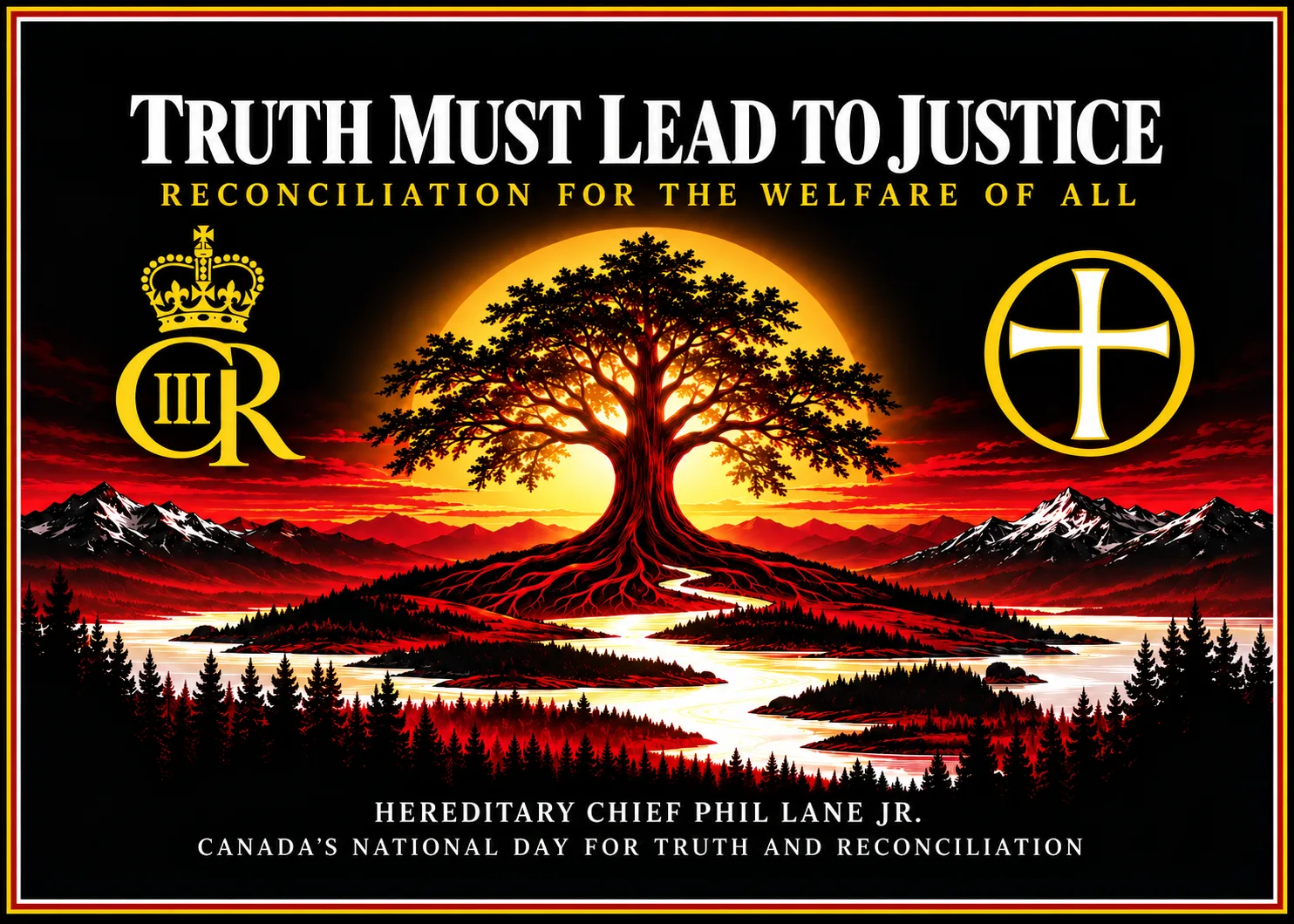
**A Statement by Hereditary Chief Phil Lane Jr.
National Day for Truth and Reconciliation, September 30, 2026**
Today, I speak as an Indigenous Elder and Hereditary Chief, a member of the Chickasaw and Ihanktonwan Nations, White Swan Oyate, living in White Rock, British Columbia, on the beautiful, unsurrendered, unceded territory of the Semiahmoo First Nation, within the broader homelands of the Coast Salish peoples. I have been honored to live among the Salish peoples for most of my adult life, except for the sixteen years I was honored to live in Lethbridge, Alberta, in the heart of the sacred lands of the Blackfoot Confederacy.
I was born at Haskell Institute in Lawrence, Kansas, where my mother and father were among Indigenous people brought together within a boarding-school system designed to assimilate us. Yet within that very system, our peoples also came together in unity, forming relationships across Nations and strengthening spiritual foundations that assimilation could not extinguish.
From the age of four, Umatilla, Oregon, was my home, where our family lived after my father’s time at Haskell. I grew up among the deep relationships of the Columbia Plateau, visiting the Yakama, the peoples of Warm Springs, and Celilo Falls, with especially close ties to the Umatilla people.
Later, we lived in Walla Walla, Washington—the place of many waters—which became my home, and our family home remained there. I grew up directly on the old Indian grounds on Mill Creek, where the Treaty of 1855 was signed. Growing up on those grounds, among those relationships, helped shape my understanding of our enduring connection to the land and our responsibilities to one another.
These beloved homelands carry the history of devastating epidemics, missionary intrusion, warfare, and dispossession. Smallpox and other introduced diseases brought terrible suffering throughout the region. In 1847, a measles epidemic devastated Cayuse families near the Whitman Mission.
As their people died and Whitman’s treatment appeared to help settlers more than their own relatives, some Cayuse came to believe that he was responsible for their suffering. A group of Cayuse men attacked the mission, seeking to stop what they understood to be a source of their people’s destruction. The killing of Marcus Whitman and others became a rallying point for retaliation and war. The grief and desperation of Indigenous families must also be part of the history we tell.
In the years that followed, warfare, treaty-making, and forced removal opened these homelands to settlers and drove Indigenous families onto reservations. Yet the Walla Walla, Cayuse, and Umatilla peoples remain, with distinct identities, relationships to these lands, and responsibilities to future generations.
Across these experiences, I have come to understand something that no colonial institution can overturn: you cannot colonize the Sacred. You cannot extinguish the Creator’s spiritual truth. Institutions can forbid a language, interrupt a ceremony, separate children from their families, and punish people for practicing their faith. They can cause suffering that reaches across generations. But the sacred foundation lives on through prayer, memory, love, and our relationships with one another and Mother Earth.
This is the ground from which I speak: a life shaped by these homelands, these relationships, these wounds, and the enduring spiritual strength of our peoples. I share this because we have a responsibility to tell the truth, to heal, and to leave our children something better than the injustices we inherited.
On this day, we honor the children who never returned, the Survivors who carried the truth, the families who continue to grieve, and the ancestors whose courage kept our peoples alive. Their lives require remembrance joined with action.
What does reconciliation actually look like?
It looks like truth changing how we live. It looks like justice changing who holds authority, who makes decisions, whose children are protected, and how the land is cared for. It looks like people accepting responsibility for repairing relationships damaged by dispossession.
In British Columbia, the great majority of the land was never surrendered through treaties. Existing treaties and each Nation’s distinct circumstances must be respected. At the same time, much of this province rests on unceded Indigenous territories.
These lands were never empty, awaiting government, religion, or civilization. Our Nations already had laws, governments, languages, economies, education systems, spiritual foundations, and sacred responsibilities to Mother Earth.
Unceded means never surrendered. The rights and responsibilities of the original peoples cannot be swept aside by repeating the language of ownership.
We must speak honestly about how colonial control expanded. During the devastating smallpox epidemic of 1862, under British colonial rule, knowledge of contagion, vaccination, and isolation already existed. Authorities and the public had access to information about the danger. Indigenous people were nevertheless expelled from the Victoria area and driven toward their home communities, spreading the epidemic.
Contemporary accounts describe the destruction of encampments and the use of colonial force to compel departure. They knew smallpox was deadly. They knew it could spread. That knowledge makes these decisions a matter of responsibility.
The BC Center for Disease Control recognizes intentional smallpox transmission within the history of colonial harm. In 2014, British Columbia’s premier acknowledged reliable historical accounts indicating that smallpox had been spread intentionally. This history must be examined with respect for Indigenous oral histories and the documentary record.
Direct evidence of deliberate intent appears elsewhere under British colonial authority. At British-held Fort Pitt in 1763, William Trent, a militia captain serving under the British commandant, recorded the distribution of items from the smallpox hospital:
“we gave them two Blankets and an Handkerchief out of the Small Pox Hospital. I hope it will have the desired effect.”
Those words document intent. Whatever uncertainty remains about the infections caused by that particular act, the intention to use disease against Indigenous people is written in the record.
Responsibility also reaches those who enabled cruelty, benefited from dispossession, or chose silence when they had reason to speak. Contemporary critics demonstrated that people could recognize wrongdoing and oppose it. Their example reminds us that each generation chooses what it will accept and what it will help change.
Religious responsibility must also be faced. Bishop George Hills described Indigenous suffering during the epidemic in terms of people being “handed over to judgment.” Such language placed spiritual blame upon people enduring catastrophic loss. No grieving mother, no dying child, and no devastated Nation deserved to have that suffering interpreted as evidence of spiritual unworthiness.
Some missionaries helped vaccinate and protect Indigenous people. Those actions demonstrate that care and protection were possible. The deepest teachings of faith required compassion, respect for life, and the courage to challenge harm.
Yet colonial authorities and churches also participated in a broader assault on Indigenous spiritual life. Ceremonies were suppressed, beliefs condemned, and children placed in institutions founded on the conviction that they had to be remade in someone else’s image.
The claim that Indigenous children needed to be “Christianized” helped justify separating them from the families, languages, and spiritual relationships that gave their lives meaning. The Truth and Reconciliation Commission identified the residential-school system as part of a policy of cultural genocide.
This responsibility crosses the border between Canada and the United States. It includes the Anglican Church of Canada’s operation of residential schools and the Episcopal Church’s involvement in Indigenous boarding schools in the United States, alongside the responsibilities of governments and other participating institutions.
The Episcopal Church itself has acknowledged the need to investigate its involvement and support truth-telling and healing. Every institution involved has a part in making the truth accessible and helping repair the harm.
INDIGENOUS WOMEN: SAFETY, DIGNITY, AND AUTHORITY
There can be no truthful reconciliation while Indigenous women and girls continue to disappear, suffer violence, and be denied protection and justice. Every missing or murdered woman belongs to a circle of relationships. Her absence reaches into the lives of children, parents, grandparents, partners, and entire communities.
In the teachings I received, women are sacred. Their dignity, wisdom, and authority are essential to people’s well-being. Across many Indigenous Nations, women held profound responsibilities in governance, diplomacy, food systems, family life, ceremony, and knowledge transmission. Colonial systems imposed patriarchal laws and attitudes that undermined those responsibilities and devalued Indigenous women’s lives.
The Indian Act’s sex discrimination is one expression of that history. Its consequences, and the broader consequences of colonial attitudes, cannot be separated from reconciliation.
We see continuing devaluation when a woman’s disappearance is dismissed, when a family cannot obtain an adequate investigation, when violence is excused, or when women lack safe housing and transportation. The National Inquiry into Missing and Murdered Indigenous Women and Girls connected this violence to persistent violations of human and Indigenous rights and to colonial structures and attitudes. The Inquiry concluded that the violence amounts to genocide and issued 231 Calls for Justice. Those findings require sustained action.
We cannot mourn the children taken from their mothers while failing to protect the mothers and daughters living among us today.
Our own communities also carry responsibilities. Colonial history explains profound wounds, but it does not excuse anyone who harms a woman or child. Men and boys must be part of ending violence, challenging degrading attitudes, supporting accountability, and expressing strength through care, honesty, and respect.
Reconciliation requires safe housing, dependable transportation, responsive investigations, accessible care, support for families, and sustained resources for Indigenous women-led organizations. It requires protection for Two-Spirit and gender-diverse people. It requires implementing the Calls for Justice with clear responsibilities, resources, and accountability.
Indigenous women must exercise full authority in the decisions shaping our future: land, water, resources, governance, education, healing, and economic development. Their knowledge must guide the work, and their participation must carry real decision-making power.
The safety of a daughter and a woman’s freedom to lead measure whether reconciliation is real.
Even the names surrounding us deserve examination: British Columbia, Victoria, Vancouver, New Westminster, Prince Rupert, King George Highway, the Strait of Georgia, and Stanley Park. They commemorate monarchs, imperial figures, and colonial relationships. Queen Victoria selected the name British Columbia. Colonial authority became familiar through everyday landscapes.
But these places had names long before authorities imposed them. The restoration of Haida Gwaii and Daajing Giids, and recognition of PKOLS in the name of PKOLS (Mount Douglas Park), demonstrate possibilities for restoring public recognition of Indigenous relationships with place. The Nations concerned must guide such work. Restoring names belongs alongside restoring language, history, land, and authority.
This brings us directly to Crown land.
British Columbia identifies approximately 94 percent of the province as provincial Crown land, with roughly another one percent under federal administration. These administrative categories do not establish that Indigenous title was surrendered. Calling land “Crown land” does not, by itself, answer whose land it is or how the Crown obtained authority over it.
I am speaking directly about government-administered forests, parks, watersheds, and other public lands. At a minimum, reconciliation requires meaningful co-management with the respective First Nations, supported by enforceable decision-making authority, adequate funding, and the practical means to care for their territories.
That minimum must begin a clear pathway toward land return and First Nations management, with the Nations themselves choosing those they wish to work alongside. Their own laws, governance systems, relationships, and shared territorial responsibilities must guide the process.
Decisions affecting Indigenous lands and resources must respect the free, prior, and informed consent of the Nations concerned, expressed through their own representative institutions. That consent must be freely given, sought before decisions are made, and grounded in full, accessible information, with respect for each Nation’s decision-making processes.
Co-management must never become a permanent barrier to restitution. There must be concrete commitments, timelines, and resources. Indigenous Nations must have the capacity to exercise the authority being recognized, and land return must proceed where possible.
No Nation should have to surrender its rights to obtain the necessities of life. Housing, clean water, education, health care, or development funding must never be made conditional upon abandoning title, accepting unwanted extraction, surrendering spiritual responsibilities, or remaining silent.
Mother Earth’s wellbeing is central to reconciliation. Forest destruction, water pollution, declining salmon, and loss of access to traditional foods and medicines damage the physical, cultural, and spiritual health of our peoples. When a salmon run disappears, a child can lose a food source, a place of learning, a relationship with grandparents, and a living connection to the Nation’s responsibilities.
The health of Mother Earth and the health of the people are inseparable.
Reconciliation therefore requires restoring watersheds and habitats, protecting sacred places, supporting Indigenous Guardians, renewing access to foods and medicines, and holding those responsible for environmental damage accountable for repair. Indigenous leadership must have the resources to protect life and restore what has been harmed.
The same commitment must reach everyday life: clean water, secure housing, food security, education, health care, language renewal, family unity, and support for Elders and youth. Investing in early childhood is investing in the whole future. Survivors and families must have access to records, and communities must receive support for their own decisions about searches, remembrance, burial places, and accountability.
The teachings of The Sacred Tree and the Sixteen Guiding Principles remind us that lasting development begins within. It requires healing, a clear vision, justice, unity, active participation, cultural integrity, and learning. Material wellbeing must be joined with spiritual and moral development. We must live the values we seek to establish.
These principles belong in budgets, institutions, and daily conduct. A government’s commitment shows in what it funds, what it protects, and whose decisions it respects. Our own leadership must meet the same standard. Development must strengthen people’s capacity to shape their own lives and sustain the wellbeing of generations yet to come.
Reconciliation in British Columbia must accompany reconciliation across Canada and throughout Mother Earth. The wounds of colonization extend across continents. Our response must uphold the dignity of all peoples and reject the idea that anyone’s prosperity requires another people’s dispossession.
A CALL TO RESPONSIBILITY, OFFERED WITH LOVE
To His Majesty King Charles III, the Archbishop of Canterbury, the Church of England, the Anglican Church of Canada, and the Episcopal Church in the United States: I speak with love, respect, and hope.
Your Majesty, I have seen your good heart expressed through your longstanding concern for Mother Earth. Your decades of advocacy for the natural world give me reason to believe that you understand how deeply our future depends upon restoring a respectful relationship with Mother Earth.
Most recently, your demonstrated concern and action to address the unwise use of artificial intelligence is very important, and I fully support and applaud it.
I also remember the honor the Kainai Nation, the Blood Tribe, extended to you in July 1977, when you were welcomed on their reserve in southern Alberta and received the name Red Crow as an honorary chief. That ceremony belongs to a history of relationships that still carries meaning. These are homelands close to my heart. Seen from afar, the great-great-grandfather of my beloved daughter belongs to that enduring Kainai history of leadership. I speak with a personal and family connection to the people who welcomed and honored you.
To my understanding, an honor of this kind carries a living responsibility to the relationship. It invites the person receiving it to remember the people, the land, and the generations whose future is bound to both. There is an opportunity now to give that relationship renewed strength through action.
You hold the title King of Canada, as your beloved mother held the title Queen of Canada. You stand at a moment when your voice, your example, and your commitment could help open a new chapter in the relationship between the Crown and Indigenous peoples.
I believe you have the opportunity to become the greatest monarch in the lineage from which you come—through the courage, humility, and lasting repair you help bring into the world. Such greatness would live in restored relationships, lands returned to the care and authority of their peoples, children growing up secure in their identities, and the renewal of Mother Earth.
More than five centuries of colonization across the Americas have left wounds that remain. You could help lead a turning toward healing whose significance would reach far beyond your reign. Working within your constitutional role, you can encourage governments, institutions, and those holding resources to join Indigenous Nations in the practical work of restitution, restoration, and justice.
Your care for Mother Earth can find profound expression in supporting the peoples whose responsibilities to these lands extend across generations. You can help make this change. You can help offer other former colonial powers an example of how to face history with courage, respect, generosity, and a willingness to repair what has been harmed. I offer these words because I believe that possibility deserves to be called forth with love.
To the Archbishop of Canterbury and the leadership and members of the Church of England, the Anglican Church of Canada, and the Episcopal Church in the United States: I speak in that same spirit.
Despite the suffering associated with church institutions, my family has always respected the Episcopal and Anglican churches. In fact, I was confirmed at St. Paul’s Episcopal Church in Walla Walla, Washington, where I served as an altar boy from the age of thirteen through sixteen. These relationships are part of my own life. That personal connection strengthens my desire to see the highest teachings of compassion, humility, truthfulness, and service expressed fully in institutional conduct.
Each institution must face its own history honestly: the Episcopal Church’s involvement in Indigenous boarding schools in the United States, the Anglican Church of Canada’s operation of residential schools, and the Church of England’s colonial legacy. The children, families, and Nations harmed by these systems deserve the full commitment of the institutions involved.
I recognize the significance of the apologies, truth-telling, and healing efforts already undertaken. In 2022, the then Archbishop of Canterbury acknowledged the Church of England’s colonial legacy and apologized for grievous harm in the context of residential schools. The Episcopal Church has committed to investigating its own boarding-school history and supporting healing. Let these commitments continue to deepen and bear lasting fruit.
Respect and accountability belong together. Faith finds its deepest expression when love becomes action and when those harmed help determine what healing requires.
This responsibility includes opening relevant archives, helping families obtain records, returning sacred belongings where appropriate, and committing resources to Survivor and descendant support, language revitalization, cultural renewal, and healing guided by Indigenous peoples themselves. It includes concrete support for the safety, dignity, and leadership of Indigenous women and girls.
Spiritual responsibility must be matched by material commitment.
The United Kingdom government and HM Treasury, together with the governments of Canada and British Columbia, the United States government for its own responsibilities, and the institutions involved, must act through their respective powers and processes to fund repair. Churches must likewise commit meaningful resources of their own. Constitutional and institutional responsibilities should make action clear and possible.
Every commitment must answer practical questions: Who will act? What resources will be provided? When will action occur? How will Indigenous Nations judge whether it has succeeded? Children, families, and communities must be able to experience the difference in their lives.
This is a call to responsibility, offered with love and confidence that people and institutions can choose to change. Let that change help heal the relationship between our peoples, protect Mother Earth, and serve everyone’s welfare.
On July 1, 1967, Chief Dan George of the Tsleil-Waututh Nation delivered his “Lament for Confederation” before approximately 32,000 people at Empire Stadium in Vancouver. He received a standing ovation, and his words drew national attention. Fifty-nine years later, Canada heard him—but how fully did Canada listen?
He spoke of dispossession: “I was stripped of my authority.” He called upon the strength of leadership: “Give me back the courage of the olden chiefs.” And he affirmed a future: “I shall rise again out of the sea.”
His vision joined cultural strength with education, knowledge, and his people’s determination to shape their own future. Our peoples have carried that vision forward. We see it in women leading, young people reclaiming their languages, Nations restoring their laws, and families renewing relationships interrupted by colonial institutions.
Applause must become action. Listening must become responsibility.
Despite all that has happened, as prophesied, Indigenous peoples are rising—stronger in voice, stronger in unity, and stronger in renewing our sacred responsibilities. That rising lives in ceremony, the return of language, the protection of water, women’s leadership, and young people discovering that they belong to something enduring.
At the same time, colonial systems reveal the consequences of their foundations. Injustice destroys trust. Dispossession wounds communities. Unrestrained extraction damages Mother Earth, upon whom every economy depends. A system cannot secure an enduring future by undermining the relationships that make life possible. Where those foundations are breaking down, we have a shared responsibility to build relationships grounded in justice.
What I am calling for is for everyone’s welfare. Every child needs clean water. Every family needs safety and belonging. Every community depends upon a healthy Mother Earth. The return of Indigenous authority and responsibility can help restore conditions from which all may benefit.
The peoples who have known and cared for these lands across generations have a vital responsibility to lead and to welcome others into respectful relationships of shared work. Those whose families arrived generations ago and those who arrived yesterday can each contribute to that healing.
In the spiritual sense, we are all Indigenous to Mother Earth. We all receive life through her gifts. That shared belonging asks us to honor the distinct histories, rights, laws, and responsibilities of Indigenous Nations and to recognize that our wellbeing is bound together.
Let us measure prosperity by the flourishing of life. Let us measure authority by the responsibility it accepts. Let us measure reconciliation by a safe child, a woman who can lead freely, an Elder who is cared for, a Nation exercising its rights, a river restored, and salmon returning home.
We cannot restore the lives that were taken. We can restore land, honor, authority, and the conditions for future generations to flourish.
May our Great Spirit give us the courage to tell the truth, the humility to listen, the love to heal our relationships, and the strength to live the justice we proclaim.
Mitákuye Oyás’iŋ. We are all related.
Hereditary Chief Phil Lane Jr.
Šuŋkamánu hé miyé do! Čhaŋnúpa Sápa hé miyé do!
**Member, Chickasaw and Iháŋktȟuŋwaŋ Nations, ** White Swan Oyáte
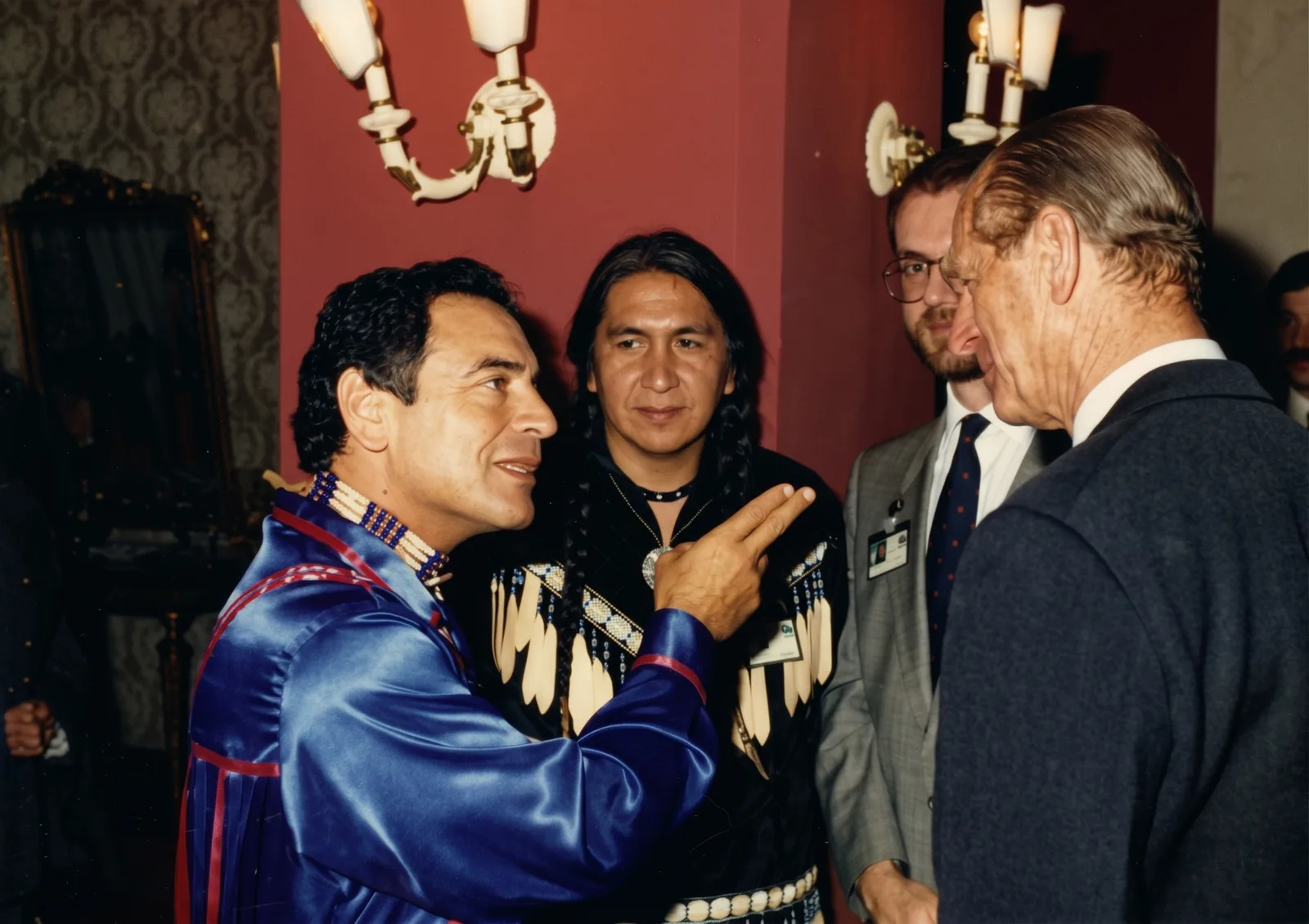
Sharing My Perspectives with Prince Philip, Duke of Edinburgh, World Wildlife Fund International Gathering, Assisi, Italy, September 28, 1986.