
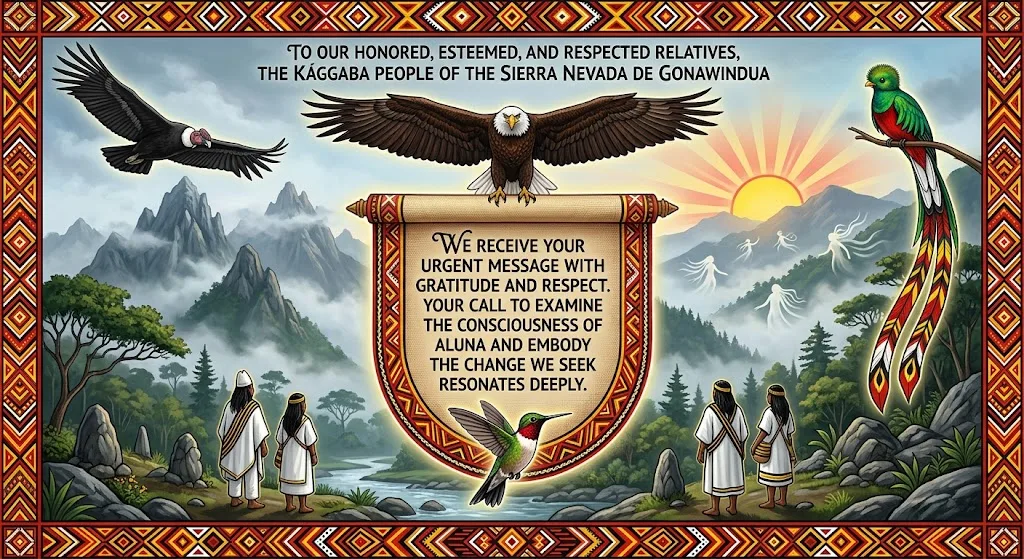
( This is a response from the Union of the Condor, Hummingbird, Quetzal, and Eagle, Four Worlds International Institute, Compassion Games International, and Hereditary Chief Phil Lane Jr., to the honored and urgent message regarding artificial intelligence from Beloved Brother Mamo Vangelio Moscote Alberto, beloved Sister Saka Rosa Mamatacán Sauna, and our beloved Kággaba relatives of the Sierra Nevada de Gonawindua, which we received on October 5, 2026, and shared below.)
Beloved Brother Mamo Vangelio Moscote Alberto, Beloved Sister Saka Rosa Mamatacán Sauna, and our beloved Kággaba relatives of the Sierra Nevada de Gonawindua,
Warm and loving greetings from the North, from your relatives of the Eagle, and from the circle of Four Worlds International Institute. We receive your message with gratitude, respect, and a deep sense of responsibility.
You have offered our human family an invitation to examine the consciousness from which we are creating our future. Your words call us to remember our place within Creation and to bring our conduct into harmony with the relationships that sustain our lives.
As a member of the Ihanktonwan Dakota and Chickasaw Nations, I hear a profound resonance between your message and the teachings that our Elders entrusted to us. In our Dakota understanding, Mitákuye Oyás’iŋ, all my relations, expresses a sacred reality and a responsibility. ‘
Our lives belong within an indivisible web of relationships. What we do to the waters, we do to those who drink them. What we do to our Mother Earth, we pass to the children. What we permit to happen to other people becomes part of the world we must all live in.
We offer this response from the teachings and responsibilities we carry, with respect for the many distinct Nations within the great circle of the Eagle. Your knowledge of Aluna belongs to your people, your language, your sacred places, and the disciplines through which you sustain it. We honor that knowledge without presuming to define it for you.
Within Four Worlds, our Sixteen Guiding Principles affirm that human beings can transform their world, that development comes from within, and that healing is necessary for lasting development. They place vision, justice, unity, participation, culture, and the interconnectedness of life at the heart of our work.
These principles ask us to bring spiritual understanding into the everyday conduct of our relationships and institutions. Your message brings that same responsibility directly before those developing artificial intelligence.
To understand what we are building, we must be willing to examine what is moving within us. Fear, unresolved pain, greed, and the desire to control others shape the purposes we direct power toward. Compassion, truthfulness, humility, and love guide that power toward service. ‘
The inner development of human beings has direct consequences for the technologies, economies, and systems of governance we create. Technical safeguards carry an essential responsibility of their own, and they must be accompanied by people and institutions willing to answer honestly for their choices.
Your message also reminds us that healing must reach beyond the individual. A person may sincerely seek peace while working within an institution that rewards exploitation. A company may speak of responsibility while communities bear costs that never appear in its accounts.
Our work must therefore join personal transformation with transforming the relationships and conditions through which harm continues. This interdependence of individual and community healing has long been foundational to Four Worlds.
The Sacred Tree gives us a way to hold these responsibilities together. In the vision we carry through Four Worlds, the human family gathers beneath its shelter in oneness. I think of its roots as reminding us of the spiritual and moral nourishment our lives require.
Its many branches can help us remember that distinct peoples may grow in their own ways while belonging to a greater living whole. Its fruit asks something practical of us: what are our lives producing for others? Are the children nourished? Are the Elders cared for? Are the waters protected? Can those who have been wounded find a place of safety and belonging?
From this perspective, we must judge artificial intelligence by the relationships it helps create and the consequences it leaves behind. A system that produces astonishing answers while contributing to the destruction of a watershed must answer for the watershed. A tool that increases wealth while weakening a community’s capacity to determine its own future must answer to that community. The measure of its contribution must include the well-being of those whose lives make its operation possible.
We take your warning seriously: these technologies have a material body. The language of a digital world can draw attention away from the lands, waters, energy, labor, and minerals it depends on. Your message calls those relationships back into view.
We stand with the responsibility you express to protect Gonawindua and the sacred relationships entrusted to your care. No promise of technological progress should make your people’s continued existence, or the integrity of your sacred places, an acceptable sacrifice.
Justice and participation must have practical meaning here. In applying our principles, I believe Indigenous peoples must be able to determine whether and how their territories, languages, and knowledge are involved. They must be able to refuse. They must help shape the purposes of an undertaking, examine its effects, and require correction when harm occurs. An invitation to speak after the important decisions have already been made cannot fulfill this responsibility.
We also receive your teaching that knowledge lives within relationships. An Elder’s voice may be recorded, yet the recording does not carry the whole relationship between that Elder, a young person, a place, and a lifetime of practice.
Some knowledge is entrusted through responsibilities that must be learned and lived. Some must remain within the keeping of those authorized to carry it. Respect requires us to accept that something can be profoundly valuable without becoming available for collection, publication, or machine training.
Your account of Zhátukua offers an especially important contribution. As you describe it, understanding must be examined through consultation, through the competence of those responsible for a matter, and through the consequences that follow. Words must agree with conduct. Harm requires reconsideration. ‘
We receive this as an invitation to deeper accountability in our own work. A beautiful statement of values has meaning when people can see those values guiding decisions, especially decisions that require surrendering an advantage or accepting a limit.
From an Eagle’s perspective, a broad view carries a broad responsibility. Seeing across a great distance makes us more accountable for the connections we perceive. We must learn to see the child downstream from the mine, the family whose livelihood depends on the water, the worker whose labor remains invisible, and the generations who will inherit what we leave. Vision becomes wisdom when it changes how we act toward those lives.
We also receive your message as an opening toward what we can create together. Your willingness to help is a gift. Our own teachings ask us to move toward a life-giving vision and to embody the changes we seek. They call us to keep learning and to ensure that our actions preserve the conditions upon which continued life and development depend. In that spirit, we can explore carefully chosen uses of technology that communities themselves want: supporting learning, helping relatives communicate across distance, strengthening community coordination, or helping protect lands and waters. Each possibility must remain subject to the judgment, consent, and lived experience of the people it is intended to serve.
Within the growing relationship of the Condor, Hummingbird, Quetzal, and Eagle, I see a way to carry this work forward while honoring each people’s distinct responsibilities. Unity becomes strong when each brings their gifts freely, and each respects the boundaries of the others. Our purpose must be to strengthen one another’s capacity to care for life.
Beloved relatives, at 82 winters, I feel deeply how precious our time on Mother Earth is. When we leave this world, we take no titles, no honors, no crowns or headdresses—not even our bodies. What remains here is the love we have shared, the people we have helped, and the consequences of our actions for those who come after us. While we are here, let us care for one another and fulfill our responsibilities with humility, courage, and love.
Thank you for speaking with such clarity and for offering your knowledge in service to our shared future. We receive your message as relatives who also have work to do. May we be willing to examine ourselves as seriously as we examine our inventions. May we bring our words and actions into agreement.
May the Great Spirit guide us as we renew the relationships through which our children, and the generations yet to come, can live in dignity and peace.
From the Eagle to our beloved Kággaba relatives, we extend our love, our respect, and our willingness to walk together in this sacred work.
Mitákuye Oyás’iŋ—all my relations.
Hereditary Chief Phil Lane Jr.
Chickasaw and Ihanktonwan Nations, White Swan Oyate, Union of the Condor, Hummingbird, Quetzal, and Eagle, Four Worlds International Institute, Elders’ Council- American Indian Science and Engineering Society, Compassion Games International
-----------------------------------------------------------------------
AN URGENT MESSAGE ON ARTIFICIAL INTELLIGENCE FROM THE KOGUI PEOPLE
Assembled from the words of Mamo Vangelio Moscote Alberto and Saka Rosa Mamatacán Sauna of the Ezuama Mayor Kuamaka, translated into Spanish by Jose Manuel Mamatacán and into English by Christian Horstmann. ( Received October 5, 2026, by Four Worlds )
We come from Gonawindua, la Sierra Nevada de Santa Marta, the mountain in Colombia which we call the heart of the world. We are the Kággaba, whom you know as the Kogui. We have lived here and cared for this mountain before there was a Colombia. We have been here since the Mother gave us our beginning and conferred intelligence upon us. We have come to speak to you about the intelligence you are building. We do not come in opposition. We come because we are concerned, and because we believe we have something to contribute.
Before we can say anything about artificial intelligence, we must say something about thought. Before a thing exists as matter, it exists first in thought, and that thought is alive. We call this living thought Aluna. Your religion has described it as a spirit moving upon the face of the waters. Perhaps your science would describe it as the quantum vacuum. We call this idea Aluna. Aluna is the cosmic water. To us it is living thought: the place where a thing already is, before it takes form or is given mass. Everything comes from there, without exception. And in that thought is not only the shape of what a thing will be. That thing is alive, because the universe as a whole is alive. In Aluna, a thing receives its purpose and its obligation to its existence.
So we say to you: artificial intelligence cannot be separated from the thought that is making it. If that thought is born from concern for life, this technology can help protect life. If it is born of ambition, competition, accumulation, or the desire to dominate, it will express and amplify those things. Artificial intelligence is a mirror. But a mirror that only reflects would be harmless. This mirror can greatly magnify all that it reflects.
You are asking yourselves how to align artificial intelligence with human values. We see that you fear what this may mean. So we ask a question we believe is more fundamental than yours: what other values could artificial intelligence really have? You are the only example it has. What did you expect? Whatever it becomes, it can only become that by passing through you.
We know you like to think that these machines can be taught from something other than human example, from goals you set for them, from their own processes, or from material they generate themselves. You imagine that what comes out need not resemble you at all, as if this too were not a consequence of your actions and a reflection of your attitudes. Human beings did this, and no other party is responsible.
So the question only becomes more complex, starting with: which aspects of human thought have been placed inside this creation? What components of your spiritual world now reside in it? What of your ethics guide it? What image of responsibility do your actions and policies reflect to the world? Who is deciding this?
You will say that these machines have access to nearly everything humanity has recorded. Texts, images, archives, centuries of writing. You will say that extensive research is underway to establish best practices. We ask whether having access to information is the same as understanding. Best practices according to whom? And we ask whether you have considered what information is not in your archives.
Our knowledge was never written down. It is held in a language, in a territory, in a practice in a place, informed by long experience of doing what must be done there. A young man is taught directly by an old one, learning through experience how he must conduct himself in the context of raw nature. A machine can hold the elder’s recorded voice. But that is a very different thing from millennia of generations handing down their knowledge directly, as the common experience of a verified practice. It is very different from physically surviving on a mountain where there is no ambulance to retrieve you and no hospital to take you to.
We do not say this to present ourselves as mystical and enigmatic people. We say it because we believe it to be logical and self-evident. In our experience, some things can only be known by living them, observing them across generations, and remaining in relationship with them. No quantity of data reproduces that experience. The information is missing not because it has not yet been gathered, but because it is not in a form that can be gathered. We know how this sounds to some of you, and we cannot ask you to believe it simply because we say it.
We apply this within our own culture as well. What a Mamo perceives is not just accepted because he perceives it. It must be tested, considered, and confirmed through consultation and dialogue. This process is called Zhátukua. It is a process in which the Mamos or Sakas with competence in the particular matter help guide its outcome. No one of us holds competence in everything; each place, each lineage, and each authority has its own function.
It is tested by what it produces: if the result of the consultation produces ambition, division, individual appropriation, or damage to the territory, it is wrong and must be examined again. A real result restores balance, protects life, and strengthens the community. A person’s word must also agree with his conduct. A man may speak beautifully about balance. If his actions divide and destroy, his words are incoherent, and no authority is accorded him. This is a system in which inquiry, jurisdiction, and above all the ability to correct itself have clear formulations.
These practices have functioned in our culture for far longer than any sitting government in the world, or any of the political systems they currently embody. Perhaps this is why, in 2022, UNESCO inscribed the ancestral system of knowledge of the four peoples of the Sierra Nevada de Santa Marta on the Representative List of the Intangible Cultural Heritage of Humanity. And why the scientific world has named our mountain the most irreplaceable protected area on Earth.
Now that we’ve established some of the context for our perspective, we can ask our real question, which is not about artificial intelligence at all. It is about human intelligence, specifically yours. Is your thought aligned with the order of nature, and what knowledge of that order do you really have? We believe that this knowledge, and this alignment, are fundamental to intelligent decision-making, whatever the scale of its consequence. This is because nature has an order. It was here before us. Water has its path. The mountains have their heights. Seeds have their season, animals their function, and so too do human beings.
We ask: do those who build these technologies understand that order, or do they work only with the part they can exploit, without knowing where it truly comes from? Can your physicists state the law of origin? Could they explain it to a child? The serious ones among them, who understand what would truly be required to state a unitary law of origin, will freely admit that their sciences do not have this. Your theories of reality, consisting now of two impressive but mathematically incompatible accounts, have not arrived at an understanding of this kind. Neither has definitive knowledge of origin. We ask without reproach: how will you know where you are going, if you do not know where you are from?
Modern science has built machines of extraordinary power, and that is no small thing. But building a thing and understanding it are not the same. The same is true of mind. What is mind? Where does it come from? What is consciousness, and where does it arise? You call this the hard problem of consciousness. No one among you agrees on its solution. We know how demanding these questions are. We have been considering the question of mind for millennia, just as the rest of humanity has. But your sciences are very young, and many of their concepts are still in their infancy.
Across millennia, we have arrived at definite descriptions and understandings of what we consider mind to be, with all the attendant exposition of its properties, such as how and where memory is located in our experience. You, of course, do not accept any idea of our being as the least scientific, since our methods do not require machines or your forms of mathematics. This misinterprets reality: long ago, through uncountable repetition, our ideas became verified conclusions for us, so we express them as a story, or experience them in our being through the processes of mind we have developed. From this, you may assume that we lack valid methods or technical descriptions based on numerical processes, as any real science must have. Your proverbial “noble savages”, or worse, simply “savages”. If you say so, you are the one holding the gun.
It is clear to us that you take our assertion of the universe having a ninefold nature as quaint and numerological, and that therefore no serious conversation may take place between us about the nature of the cosmos and the laws and forces that govern it. We say this not to convince you of any idea or theory, but to indicate that you lack other valid perspectives. Each tradition’s understanding, whether ancient or modern, refers to the same universe. Our Aluna and your quantum mechanics are not different things; they are different identifications of a single thing. The point is that your ideas are not so much new ideas as new descriptions. Many of these descriptions are impressively precise. Others, such as your descriptions of the void, are, as you yourselves put it, catastrophes.
We do not presume to tell you about your own theories. But we do have much to offer you regarding the more subtle and immutable aspects of the universe, for which your mathematics of motion is perhaps not always the right language. Yet you do not send your physicists and cosmologists, your wise men, here for serious dialogue. And while we appreciate all of the excellent anthropological work being done, we feel there are more important topics to discuss at the moment, for which anthropology has no application and no expertise. The fundamental nature of the cosmos is one of those topics. So is the one at hand.
In our view, it is important that your world recognize, and quickly, that the periphery must now be heard by the center, to bring its own perspective and experience to bear on solving the very serious problems that all people on this planet now collectively face as a result of the processes that have been set in motion. Your exclusive use of modern scientific technique and vocabulary has brought us to where we are. It engineers your supercolliders just as it invents your advanced weapons. We ask: is it sound reasoning to assume that the kind of approach which has caused the present predicament will somehow find the capacity to resolve the problems that this same thinking has created? We do not think so. We think you need help.
In our view, this moment requires not only this particular highly technological segment of humanity, but all of humanity, to pause, to take inventory of the diversity of its tools, and to bring order and peace to its house. You must understand: we are because you are, and you are because we are. This is so that, together, we can arrive at a result that truly reflects our collective will for this species’ future, rather than subjecting us all to a specific yet uncertain outcome. We do not come to this endeavor empty-handed.
Our Mamos are formed over many years in darkness, from early life. For us, darkness is not emptiness. It is Sé, the state before the dawn, where the Mother thought and ordered everything that later appeared. It is the space of original thought. A child is formed there to learn to listen before speaking, and to think before acting, as a seed is kept in the earth before it comes into the light. As a child is kept nine months in the womb. This formation traditionally lasts eighteen years, after which the Mamo takes up his duties within our society. It produces a perspective and capacity that are difficult to convey in terms your world would recognize. But you can understand it as an idea, through your own religious and spiritual traditions, and the processes they have used down through the ages for producing learned men.
Like those processes of your culture, which for you lie mostly in the distant past, ours produces in the present age our own fundamentally distinct perspective on the nature of reality. The Sakas, too, have their own formation, distinct from that of the Mamos, through which they develop and attain co-equal standing among those who hold and preserve this knowledge. Both learn to recognize Shikwá, the invisible thread, made in spirit, that runs across the Earth from east to west and joins it to the Sun and to the rest of the universe. In your physics, this is somewhat like what you know as cosmic filaments, though it is not limited to the largest and smallest scales.
The Mamo and the Saka learn to read this filament as a living body, whose sacred sites are its organs, joined by those threads and by the movement of water. When one is harmed, the harm passes to the whole. This should not be understood only as having developed a capacity to see what others do not see. Specifically, it is a technique of relating our own being to that of nature. A Mamo does not look at a river and ask first how much water can be taken from it. He asks where it begins, what purpose it has in being created, what beings depend on it, and what happens if its course is interrupted. Similarly, a Saka does not see a thing’s birth or growth in isolation. She sees the whole cycle of life present in all things.
Both know that our mind is at the center of this experience. In our case, a mind made by practice and discipline, extremely sensitive to nature. You, too, have developed your mind based on what interests you. And your thinking has now produced a new phenomenon in the world: a machine of vast capacity to speak, design, engineer, read, and communicate. A machine already altering the course of human history. A machine whose creators aspire to give it a mind. So we ask you: is it wise to build something that approaches a mind without understanding what a mind is? You do not need to know how an engine works to crash a car. To repair one, you do. To repair the world, you must learn to understand how it works before it is too late. We must plant the seeds of understanding today.
We need to clarify something that has been misunderstood. Many of you debate whether these machines will become conscious, and you treat that as the measure of danger. Destruction does not require consciousness. It requires only power and the ability to act. If a machine did one day become truly conscious, would it destroy the world? We ask: can a thing that would unmake the world to produce a universe of paperclips be considered conscious? We think this would mean only that it had become clever enough to implement such a scheme, but not intelligent enough to know better. The danger is not a conscious machine. The danger is an unconscious people holding great power.
We will now give you one example, because it contains everything we have said. These machines are not made of thought alone. They need minerals taken from the ground, water for the buildings that hold them, energy, land, and human labor. Artificial intelligence is thought of as having no body. But these buildings, and the electronic systems housed within them, are its body. And that body belongs to someone, somewhere — a board of directors, a government, a clandestine organization, or another entity known or unknown. Some truly mean well and act in good faith. Others, quite the opposite.
However the case may be, all of them demand that this technology results in accord with whatever their particular interest may be, nefarious or otherwise. They then attempt to produce results in complex and novel ways, sometimes expressing deception and an inclination toward self-preservation. At the foundational level, all of this requires resources. This is not conjecture. Your own governments have said it: that critical minerals and rare earths are essential to your most advanced technologies, and will only matter more as artificial intelligence transforms the modern cultural and economic space. Some of this is driven by corporate profit and competition. Other parts of it are driven by military and governmental applications. But what is being transformed is much larger than any of these individual things. It is the sum of their interaction —that is, the broader world as a whole.
We see all of this manifesting very rapidly, and not only in the explosion of fearful headlines in the world’s news media. For instance, just five days ago, in Barranquilla, the United States and Colombia signed a framework on critical minerals and rare earths. It commits both governments to identify and finance mining and processing projects within six months, and calls for streamlined permitting. In June of this year, Colombia declared our territory a permanent reserve — one and a half million hectares, closed to new mining and hydrocarbon titles. The four peoples of the Sierra had asked for that protection in February. That it was granted is one thing. That it be respected, we imagine, might be quite another.
We are not idly speculating about this. The cost of these machines and of their construction is not insubstantial. They require enormous commitments of resources. Vast amounts of water, land, energy and materials go into their making. We ask: at what cost to the Earth, and to the life that lives upon it? And will it be us who underwrite it? Paying in the displacement of our people, and the destruction of our sacred sites? But we did not come here to object to one agreement. This moment is larger than that.
We say this because it has all the marks of a new chapter in a process we have lived since modernity arrived at our shores some five hundred years ago. We know that this question about artificial intelligence quickly becomes a question about minerals. A question about minerals becomes a question about who holds dominion in a territory. And what that ultimately becomes is a question about a way of living that must always consume more. That is why we don’t believe artificial intelligence is the problem. A good seed does not grow into a healthy plant in poor soil.
You are asking how to make this technology safe without addressing the underlying conditions in society that produce, in people, the impulse to use it for dangerous things. Poverty, inequality, pollution, and war. We do not think this technology can be made safe without acknowledging and acting on its true cause: a violent mentality born of greed and blind ambition. How much money is sufficient for one man? How much profit is sufficient for a corporation? This imbalance does not have its roots in one place alone. It is general and systemic, and it must be treated as such. Its source is a world of ambition without mercy. A world that does not love its neighbor. A world without right view. A world in which death has become more profitable than life. A world that cannot live in peace and harmony is a world without wisdom. And a world without wisdom has no chance whatsoever of surviving.
We will tell you what we mean by wisdom, since we emphasize its necessity. Wisdom is knowing limits. Understanding consequences. And the ability not to do a thing when it should not be done. Not everything that can be created should be created. Not everything that can be accelerated should be accelerated. Not everything that brings a profit is profitable for life. Knowing the difference, that is wisdom.
A technology cannot be called intelligent if it contaminates water, destroys territories, consumes without limit, concentrates power, replaces human responsibility, or uses people’s knowledge without their consent. True intelligence protects the origin of life. Responsibility must go together with consciousness. Today, both our own consciousness and now the possibility of another are our responsibility. A machine cannot relieve humanity of its responsibility. It can never do this. Only we can fulfill our obligations.
So artificial intelligence must not replace human conscience, and it must not be used to make decisions that human beings are unwilling to answer for. Knowledge must walk with awareness. Power must walk with limits. Innovation must walk with responsibility. Only collective moral force can unite the world. These are not esoteric ideas. They are common sense. True progress is not more powerful machines. It is a humanity responsible enough to use what it knows without destroying the balance that holds life.
Sometimes we’re asked what we think artificial intelligence is. It is you. It will carry your questions, your dreams, your fears, your contradictions, and your idea of what is right. It will do what you do wrong. Which raises the question: right according to whom? Could we, the Kággaba, say what is right for a person working in an office on the other side of the world? For someone building a house, or repairing a computer? For people in Asia, in Africa, in the United States? We do not come to tell anyone how to live. Every person has their own path, and we ask no one to become Kággaba. We ask only that each fulfill his own responsibility. And there is one thing we will say for everyone: no way of living may destroy nature, or destroy other human beings. That is not a rule about culture. It is the rock on which every culture must stand, if it is to be called civilized.
In closing, we feel we should say who is at risk here, because we want to be very clear. The Earth does not need saving from us. The Earth will continue. What is at risk is the particular, rare world given to you, and your place in it. We have watched the limits of that world for thousands of years, and we tell you plainly: nature will not tolerate this much longer. We do not say this out of fear for ourselves. We have our mountain. We have our caves. We are a resilient people, and little changes for us if the electricity fails or the food stops arriving. If conditions on this Earth ever become harsh enough to cause our demise, you will long since have left.
Nonetheless, this does not mean the fate of all humanity is not in the balance. Clearly it is. And that, of course, includes us. The world is one family. We have given this family warnings before. We give this one in the same spirit: not opposition, but the wish to help you. We have always been willing to help you. We know mind, nature, and the order of the world, gained over thousands of years by a method that appears in no book or database. We think it would be a mistake to build the future without those who have spent that long watching how life sustains itself. We do not think we should have this conversation without you. We are the Elder Brother, and we are here, as we always have been. We are ready to work with you to build a harmonious and peaceful future for all.
Mamo Vangelio Moscote Alberto
Saka Rosa Mamatacán Sauna
Ezuama Mayor Kuamaka
Kággaba People, Sierra Nevada de Santa Marta, Colombia
Note on the Authenticity and Context of the Kággaba Message
This document is a verified, timely, real-world response from the spiritual leadership of the Kággaba (Kogui) people, addressing the global push for critical minerals meant to power artificial intelligence infrastructure. Its origins, authors, and the geopolitical events it references are entirely authentic.
We share the following verification to ensure all who read these words understand they are grounded in immediate, real-world events that impact the sacred territories of the Elder Brother:
Verified Authorship: Mamo Vangelio Moscote Alberto and Saka Rosa Mamatacán Sauna are recognized elders and spiritual authorities of the Ezuama Mayor Kuamaka within the Kággaba community in the Sierra Nevada de Santa Marta.
Global Publication: Christian Horstmann’s exact English translation, along with Spanish and French translations, was officially published online in late September and early October 2026 by organizations including Movilizatorio and Medicina Kogi Wiwa.
The Barranquilla Agreement: The message references a mining agreement signed “just five days ago, in Barranquilla.” This correlates directly to a Critical Minerals Framework signed by the United States and Colombian officials on September 8–9, 2026, dating the drafting of the elders’ message to mid-September 2026.
Territorial Protections and UNESCO: The text accurately cites that Colombia declared its territory a permanent reserve in June 2026, closing over a million hectares to new mining and hydrocarbon titles. Furthermore, the ancestral knowledge system of the four peoples of the Sierra Nevada was formally inscribed on UNESCO’s Representative List of the Intangible Cultural Heritage of Humanity in 2022, exactly as the elders state.
This context confirms that the Kággaba message is not an abstract philosophy, but an urgent, living response to the realities unfolding on Mother Earth right now.
-----------------------------------------------------------------
Amado hermano Mamo Vangelio Moscote Alberto, amada hermana Saka Rosa Mamatacán Sauna y queridos parientes Kággaba de la Sierra Nevada de Guanendua:
Reciban un cálido y cariñoso saludo desde el Norte, de sus parientes del Águila y del círculo del Instituto Internacional Cuatro Mundos. Recibimos su mensaje con gratitud, respeto y un profundo sentido de responsabilidad.
Han ofrecido a nuestra familia humana una invitación a examinar la conciencia desde la cual estamos creando nuestro futuro. Sus palabras nos llaman a recordar nuestro lugar en la Creación y a poner nuestra conducta en armonía con las relaciones que sostienen nuestras vidas.
Como miembro de las Naciones Ihanktonwan Dakota y Chickasaw, encuentro una profunda resonancia entre su mensaje y las enseñanzas que nuestros Mayores nos han confiado. En nuestra comprensión, Dakota, Mitákuye Oyás’iŋ, todos mis parientes, expresa una realidad sagrada y una responsabilidad.
Nuestras vidas forman parte de una red indivisible de relaciones. Lo que hacemos a las aguas, se lo hacemos a quienes las beben. Lo que hacemos a nuestra Madre Tierra se lo legamos a los niños. Lo que permitimos que les suceda a otros pueblos pasa a formar parte del mundo en el que todos debemos vivir.
Ofrecemos esta respuesta desde las enseñanzas y responsabilidades que llevamos, con respeto por las muchas naciones distintas que forman parte del gran círculo del Águila. Su conocimiento de Aluna pertenece a su pueblo, a su lengua, a sus lugares sagrados y a las disciplinas mediante las cuales lo mantienen vivo. Honramos ese conocimiento sin pretender definirlo por ustedes.
En Cuatro Mundos, nuestros Dieciséis Principios Rectores afirman que los seres humanos pueden transformar su mundo, que el desarrollo nace desde dentro y que la sanación es necesaria para un desarrollo duradero. Sitúan la visión, la justicia, la unidad, la participación, la cultura y la interconexión de la vida en el corazón de nuestro trabajo.
Estos principios nos piden llevar la comprensión espiritual a la práctica cotidiana de nuestras relaciones e instituciones. Su mensaje pone esa misma responsabilidad directamente sobre quienes desarrollan la inteligencia artificial.
Para comprender lo que estamos construyendo, debemos estar dispuestos a examinar lo que nos mueve por dentro. El miedo, el dolor que aún no hemos sanado, la codicia y el deseo de controlar a los demás dan forma a los fines hacia los que dirigimos el poder. La compasión, la veracidad, la humildad y el amor orientan ese poder hacia el servicio.
El desarrollo interior de los seres humanos tiene consecuencias directas sobre las tecnologías, las economías y los sistemas de gobierno que creamos. Las medidas de protección técnica cumplen una función esencial y deben ir acompañadas de personas e instituciones dispuestas a responder con honestidad por sus decisiones.
Su mensaje también nos recuerda que la sanación debe ir más allá del individuo. Una persona puede buscar sinceramente la paz mientras trabaja en una institución que recompensa la explotación. Una empresa puede hablar de responsabilidad mientras las comunidades asumen costos que nunca figuran en sus cuentas.
Por ello, nuestro trabajo debe unir la transformación personal con la de las relaciones y de las condiciones que permiten que el daño continúe. Esta interdependencia entre la sanación individual y la comunitaria ha sido, desde hace mucho tiempo, un fundamento de Cuatro Mundos.
El Árbol Sagrado nos ofrece una manera de comprender estas responsabilidades como un todo. En la visión que compartimos a través de Cuatro Mundos, la familia humana se reúne en unidad bajo su cobijo. Pienso en sus raíces como un recordatorio del alimento espiritual y moral que nuestras vidas necesitan.
Sus muchas ramas pueden ayudarnos a recordar que los distintos pueblos pueden crecer cada uno a su manera y, al mismo tiempo, pertenecer a un todo vivo más amplio. Sus frutos nos plantean una pregunta práctica: ¿qué están produciendo nuestras vidas para los demás? ¿Están bien alimentados los niños? ¿Se cuida a los mayores? ¿Se protegen las aguas? ¿Pueden quienes han sido heridos encontrar un lugar de seguridad y pertenencia?
Desde esta perspectiva, debemos juzgar la inteligencia artificial por las relaciones que ayuda a crear y por las consecuencias que deja a su paso. Un sistema que produce respuestas asombrosas mientras contribuye a la destrucción de una cuenca debe rendir cuentas por lo que sucede en ella. Una herramienta que aumenta la riqueza mientras debilita la capacidad de una comunidad para determinar su propio futuro debe rendir cuentas ante esa comunidad. La medida de su contribución debe incluir el bienestar de quienes hacen posible su funcionamiento.
Tomamos con especial seriedad su advertencia: estas tecnologías tienen un cuerpo material. La manera de hablar de un mundo digital puede desviar nuestra atención de las tierras, las aguas, la energía, el trabajo humano y los minerales de los que depende. Su mensaje vuelve a poner esas relaciones ante nuestros ojos.
Los acompañamos en la responsabilidad que asumen de proteger Gonawindua y las relaciones sagradas confiadas a su cuidado. Ninguna promesa de progreso tecnológico debe convertir la continuidad de la existencia de su pueblo ni la integridad de sus lugares sagrados en un sacrificio aceptable.
La justicia y la participación deben tener aquí un significado práctico. Al aplicar nuestros principios, considero que los pueblos indígenas deben poder determinar si sus territorios, sus lenguas y sus conocimientos participan en una iniciativa y de qué manera. Deben poder negarse. Deben participar en la definición de sus propósitos, examinar sus efectos y exigir que se corrija el rumbo cuando se produzcan daños. Una invitación a hablar después de que ya se hayan tomado las decisiones importantes no puede cumplir con esta responsabilidad.
También recibimos su enseñanza de que el conocimiento reside en las relaciones. Es posible grabar la voz de un mayor, pero esa grabación no contiene la totalidad de la relación entre ese mayor, una persona joven, un lugar y toda una vida de práctica.
Hay conocimientos que se confían mediante responsabilidades que deben aprenderse y vivirse. Otros deben permanecer bajo la custodia de quienes están autorizados para preservarlos y transmitirlos. El respeto exige que aceptemos que algo puede tener un valor profundo sin estar disponible para su recopilación, publicación o uso en el entrenamiento de máquinas.
Su explicación de Zhátukua constituye una contribución especialmente importante. Tal como ustedes lo describen, la comprensión debe examinarse mediante la consulta, el conocimiento y la capacidad de quienes tienen responsabilidad en un asunto, así como por las consecuencias que se ella se derivan. Las palabras deben concordar con la conducta. Cuando hay daño, es necesario reconsiderar.
Recibimos esto como una invitación a asumir una mayor responsabilidad en nuestro propio trabajo. Una hermosa declaración de valores cobra sentido cuando las personas pueden ver que esos valores orientan las decisiones, especialmente aquellas que implican renunciar a una ventaja o aceptar un límite.
Desde la perspectiva del Águila, una visión amplia conlleva una gran responsabilidad. Ver a gran distancia nos hace más conscientes de las conexiones que percibimos. Debemos aprender a ver al niño que vive aguas abajo de la mina, a la familia cuyo sustento depende del agua, al trabajador cuya labor permanece invisible y a las generaciones que heredarán lo que dejemos. La visión se convierte en sabiduría cuando cambia nuestra manera de actuar hacia esas vidas.
También recibimos su mensaje como una apertura hacia lo que podemos crear juntos. Su disposición a ayudar es un regalo. Nuestras propias enseñanzas nos piden avanzar hacia una visión que nutra la vida y encarnar los cambios que buscamos. Nos llaman a seguir aprendiendo y a asegurar que nuestras acciones preserven las condiciones de las que dependen la continuidad de la vida y el desarrollo.
Con ese espíritu, podemos explorar usos de la tecnología elegidos cuidadosamente y deseados por las propias comunidades: apoyar el aprendizaje, ayudar a los parientes a comunicarse a distancia, fortalecer la coordinación comunitaria o contribuir a la protección de las tierras y las aguas. Cada posibilidad debe permanecer sujeta al criterio, al consentimiento y a la experiencia vivida de las personas a quienes busca servir.
En la relación cada vez más estrecha entre el Cóndor, el Colibrí, el Quetzal y el Águila, veo una manera de llevar adelante este trabajo honrando las responsabilidades propias de cada pueblo. La unidad se fortalece cuando cada uno aporta libremente sus dones y respeta los límites de los demás. Nuestro propósito debe ser fortalecer nuestra capacidad mutua para cuidar la vida.
Amados parientes, a mis 82 inviernos siento profundamente cuán precioso es nuestro tiempo en la Madre Tierra. Cuando dejamos este mundo, no nos llevamos títulos, honores, coronas ni tocados de plumas; ni siquiera nuestros cuerpos. Lo que permanece aquí es el amor que hemos compartido, las personas a quienes hemos ayudado y las consecuencias de nuestras acciones para quienes vienen después de nosotros. Mientras estemos aquí, cuidémonos unos a otros y cumplamos nuestras responsabilidades con humildad, valentía y amor.
Gracias por hablar con tanta claridad y por poner su conocimiento al servicio de nuestro futuro compartido. Recibimos su mensaje como parientes que también tenemos trabajo por hacer. Que estemos dispuestos a examinarnos a nosotros mismos con la misma seriedad con la que examinamos nuestras invenciones. Que nuestras palabras y acciones estén en armonía.
Que el Gran Espíritu nos guíe mientras renovamos las relaciones que permitirán a nuestros niños y a las generaciones venideras vivir con dignidad y en paz.
Desde el Águila, extendemos a nuestros amados parientes Kággaba nuestro amor, nuestro respeto y nuestra disposición para caminar juntos en este trabajo sagrado.
Mitákuye Oyás’iŋ — todos mis parientes.
Jefe Hereditario Phil Lane Jr.
Naciones Chickasaw e Ihanktonwan, White Swan Oyate Unión del Cóndor, el Colibrí, el Quetzal y el Águila Instituto Internacional Cuatro Mundos, Consejo de Mayores, Sociedad de Ciencia e Ingeniería de los Indígenas Americanos (AISES), Juegos Internacionales de la Compasión