
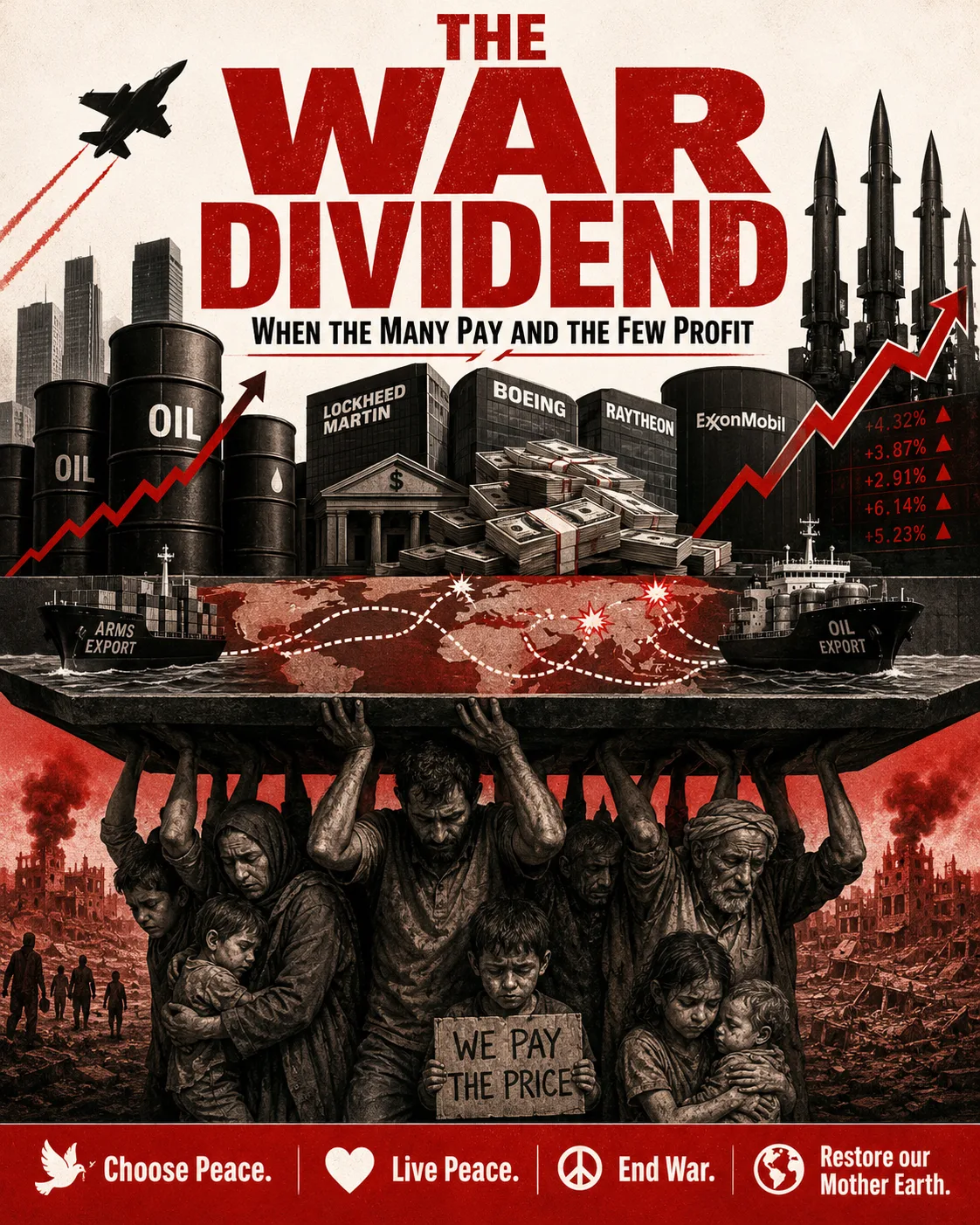
Following the Money Through the Iran War, the Oil Crisis, and the Permanent War Economy
There comes a time when we must stop looking only at the explosions, the missile launches, the military briefings, the political speeches, and the movement of armies, and begin following the movement of the money. We must ask not only who is fighting, but who is paying. We must ask who is dying, who is being displaced, who is making the decisions, who receives the government contracts, who owns the companies receiving those contracts, and who quietly becomes wealthier as the conflict continues.
We must examine not only the battlefield, but the financial system that surrounds the battlefield and converts fear, destruction, scarcity, and human suffering into revenue, contracts, market advantage, and private accumulation.
The central truth is not complicated: modern war frequently creates concentrated financial gains for a relatively small number of corporations, executives, investors, and contractors, while spreading the costs across millions of taxpayers, consumers, workers, families, and future generations. Those costs arrive through taxation, public debt, higher fuel prices, inflation, disrupted trade, reduced public services, environmental destruction, veterans’ care, and the immeasurable suffering of communities caught in war.
The economic pain is scattered so widely that many people experience only one part of it at a time. The profits, however, are concentrated, calculated, reported quarterly, and rewarded by financial markets.
The present war involving the United States, Iran, Israel, and a widening network of regional forces is a powerful example of this pattern. On July 20, 2026, Yemen’s Houthi movement declared what it called a maritime embargo against Saudi Arabia.
The declaration threatened the Bab el-Mandeb Strait, the narrow gateway connecting the Gulf of Aden to the Red Sea and, through the Suez Canal, to the Mediterranean. This occurred while the Strait of Hormuz, the principal maritime outlet from the Persian Gulf, was already severely disrupted by the United States-Iran war. The combination placed both of the Middle East’s major oil-export pathways under extraordinary pressure.
These are not distant waterways of concern only to military strategists or oil traders. They are vital arteries of the world economy. Before the present war, approximately 20 percent of the world’s petroleum supply moved through the Strait of Hormuz.
The United States Energy Information Administration reported that oil flows through Hormuz averaged about 20.7 million barrels per day in the fourth quarter of 2025, before falling to about 14.6 million barrels per day in the first quarter of 2026. The Bab el-Mandeb carried approximately 5.4 million barrels per day during that same first quarter.
By June, as Saudi Arabia diverted increasing quantities of oil away from Hormuz and toward its Red Sea port at Yanbu, petroleum movements through Bab el-Mandeb had reportedly risen to approximately 7.4 million barrels per day.
Those figures must be understood carefully. We cannot simply add all of the barrels associated with Hormuz to all of the barrels associated with Bab el-Mandeb and declare that this entire amount would disappear from world supply.
Some of the oil now moving through the Red Sea is the same Saudi oil that was diverted away from the Persian Gulf. Counting it twice would exaggerate the loss. Much of the oil would also not permanently disappear. Some oil could eventually be rerouted, drawn from inventories, supplied by other producers, or moved through limited pipeline alternatives.
If both pathways were effectively closed at the same time, the immediate logistical shock would be enormous because the world would lose access not merely to oil production, but to the routes needed to move that oil from producers to refineries and consumers.
This distinction between physical supply and accessible supply is essential. Oil may exist beneath the ground, inside storage tanks, or at a port, but it cannot support the world economy if it cannot safely reach the market.
A barrel stranded behind a military blockade is not the same as a barrel available to a refinery. A tanker that must travel thousands of additional kilometers around the Cape of Good Hope requires more fuel, more crew time, more insurance, more financing, and more ships to deliver the same volume of oil. The entire transportation system becomes less efficient at precisely the moment when the world needs it to become more efficient.
Reuters reported that more than three million barrels per day of Saudi crude being shipped through the Red Sea toward Asia could be forced onto much longer routes if Bab el-Mandeb were closed. Approximately 4.5 million barrels per day of crude oil and petroleum products had recently been shipped from Saudi Arabia’s Yanbu terminal, with roughly 70 percent destined for Asia.
Analysts estimate that some Asian refiners could wait approximately one additional month for cargoes forced to sail around Africa. European diesel refining margins had already risen above $65 per barrel, illustrating how disruptions do not affect crude oil alone. Diesel, jet fuel, gasoline, petrochemicals, fertilizer, shipping, farming, aviation, and virtually every supply chain dependent upon energy can be affected.
This is why analysts have warned that an effective Houthi closure of the Red Sea route, combined with continuing disruption in Hormuz, could push oil above $115 or $120 per barrel.
This is not a guaranteed forecast. Markets are shaped by diplomacy, inventories, demand, speculation, spare production capacity, military developments, and expectations about how long a disruption will last. But it is a credible warning about what could happen if traders and refiners conclude that the disruption is no longer temporary.
On July 20, Brent crude settled at $89.22 per barrel after briefly reaching $91.42, while West Texas Intermediate settled at $83.23 after reaching $85.39. At first glance, some people may ask why prices were not already far higher. If Hormuz was largely closed, ships were being attacked, and the Houthis were threatening Saudi shipping, why was oil not immediately at $115 or $130?
The answer is that financial markets do not price only what is happening today. They price what traders collectively believe will happen tomorrow, next week, and next month. On July 20, the price of oil reflected both the danger of escalation and the hope that mediators might achieve a temporary ceasefire.
Traders were also looking at approximately 1.35 billion barrels of crude oil reportedly already aboard ships, as well as substantial strategic and commercial inventories. The Energy Information Administration estimated that China held approximately 1.54 billion barrels in strategic inventories during the first quarter of 2026, while the United States held approximately 413 million barrels.
These reserves cannot solve a prolonged global disruption, and not all are immediately available or politically releasable, but they can postpone panic and soften the initial price reaction.
Therefore, a price of $89 does not mean the danger is small. It means the market, at that moment, had not yet concluded that the worst scenario was inevitable. A market price is not a moral judgment, a military assessment, or a prophecy. It is a temporary meeting point between fear and confidence, scarcity and inventories, present disruption and expected future supply.
If the expectation of a ceasefire collapses, if additional tankers are struck, if insurance companies withdraw coverage, or if the Houthis demonstrate that their declaration can be enforced, the calculation can change within hours.
While these prices move on computer screens, ordinary people experience them in their daily lives. Higher crude prices become higher gasoline, diesel, and aviation-fuel prices. Higher diesel prices raise the cost of operating trucks, tractors, fishing vessels, mining equipment, construction machinery, and emergency vehicles.
Those costs are passed into food, housing materials, consumer products, airline tickets, municipal services, and nearly every physical item that must be transported. Even families who do not own a vehicle pay the energy cost through bus fares, food prices, rents, utilities, and the cost of goods.
The financial burden produced by the Iran war was already substantial before the latest escalation. Brown University’s Costs of War Project reported that, as of May 18, 2026, Pentagon estimates placed the direct military cost of the war at as much as $29 billion.
The same research found that additional fuel costs imposed upon American consumers had exceeded $40 billion, or more than $300 for each household. These are separate categories. Taken together, they represented approximately $69 billion in documented military and consumer-energy costs by mid-May, without including many other consequences such as higher transportation expenses, increased food prices, business losses, medical costs, veterans’ care, future interest on war borrowing, environmental harm, or reconstruction.
The $40 billion in additional consumer fuel costs alone was larger than the estimated $31.5 billion required to replace and modernize the entire United States air-traffic-control system. According to the same Brown University analysis, it could have funded the federal Bridge Investment Program, which would repair and modernize more than 10,200 bridges. It was also more than twice the approximately $18.9 billion proposed for major federal electric-vehicle charging and electrification initiatives.
These comparisons do not mean that every dollar could automatically be transferred from one purpose to another. They reveal scale. They show what disappears from the realm of possibility when tens of billions of dollars are consumed by war and war-driven energy costs.
The public therefore pays twice, and often more than twice. The taxpayer pays for the aircraft, missiles, surveillance, deployments, fuel, contractors, and replacement munitions. The same person then pays higher prices at the gasoline station and grocery store.
That person may later pay through higher interest on the national debt, through reduced government investment in housing or healthcare, and through the lifelong cost of caring for veterans. Their children and grandchildren may inherit debts created by decisions in which they had no voice.
At the same time, several corporate sectors receive enormous financial benefits. When geopolitical conflict increases the global price of oil, a producer with secure operations outside the main area of disruption can sell much of the same product at a higher price. Its production costs do not necessarily rise in proportion to the selling price.
The difference greatly increases the cash flow and profit. A company does not have to create a war to benefit from it. It needs only to be positioned where conflict makes its existing assets more valuable.
Shell reported adjusted earnings of just under $7 billion during the first quarter of 2026 and more than $17 billion in cash flow from operations before working-capital changes. Shell itself stated that it had produced strong results during a period of volatility and uncertainty arising from the Middle East conflict. It also noted that its production in Oman, representing approximately 10 percent of its worldwide volumes, did not need to pass through the Strait of Hormuz. ExxonMobil reported first-quarter earnings of $4.2 billion and cash flow from operating activities of approximately $8.7 billion.
These figures do not prove that all of the earnings were produced by war, nor do they mean that every oil company benefited equally. ExxonMobil’s first-quarter earnings were actually lower than in the same quarter of 2025, and some energy producers have lost production, facilities, or access to markets.
The point is not that every oil company always wins. The point is that price shocks can create enormous gains for firms whose supplies remain secure, even while the same price shock harms millions of consumers.
This is the first essential distinction we must make. Revenue is not the same as profit; corporate profit is not distributed equally, and a rising oil price does not enrich every person who works in the energy industry.
Workers may still face layoffs, dangerous conditions, and rising household costs. Pension funds and retirement accounts may own shares, meaning that some corporate returns are broadly distributed. Yet the greatest benefits flow disproportionately toward those who own the most.
A family with a small pension account and a billionaire holding millions of shares do not benefit equally from rising corporate value. The language of “everyone benefits because pension funds own stocks” can conceal the enormous inequality in the ownership of financial assets.
The weapons industry operates through a different but related mechanism. Oil companies can benefit from scarcity and rising prices. Military contractors benefit when governments purchase weapons, replace weapons that have been used, expand inventories, build new production lines, and prepare for additional conflicts. Every interceptor fired, every missile launched, every damaged aircraft replaced, and every stockpile depleted can become a future government procurement request.
Again, this does not mean that every defense contractor wants civilians or soldiers to die. Engineers may sincerely believe they are designing systems that protect life. Factory workers may depend on those facilities to feed their families. Military personnel may urgently require defensive equipment. Some weapons systems may prevent attacks or save lives. A truthful analysis must acknowledge this.
The deeper issue is structural. A corporation that manufactures weapons earns revenue when governments buy weapons. A prolonged atmosphere of international fear produces stronger political support for higher military expenditures. A new conflict generates urgent requests to replenish stockpiles.
Expanding threats create demand for new generations of systems. The corporation does not need to manufacture the conflict secretly. The economic system already ensures that conflict, tension, and fear increase the market for what it sells.
The scale of that market is extraordinary. The fiscal year 2026 United States national-defense request was approximately $1.01 trillion, including about $961.6 billion for the Department of Defense. A trillion dollars is difficult for the human mind to comprehend.
Spread across a year, $1.01 trillion equals approximately $2.77 billion every day, $115 million every hour, $1.92 million every minute, and more than $32,000 every second.
This entire trillion dollars is not corporate profit. It pays military personnel, healthcare, housing, operations, maintenance, research, construction, fuel, and many other expenses. Nevertheless, a remarkably large portion flows to private companies.
Brown University researchers calculated that between 2020 and 2024, private firms received approximately $2.4 trillion in Pentagon contracts. That was about 54 percent of the Pentagon’s $4.4 trillion in discretionary spending during those five years, averaging approximately $480 billion in contracts per year.
During the 1990s, the contractor share was approximately 41 percent. The American military system has therefore become increasingly dependent upon private corporate suppliers.
Five corporations alone received approximately $771 billion in Pentagon contracts between 2020 and 2024. Lockheed Martin received about $313 billion. RTX, formerly Raytheon, received approximately $145 billion. General Dynamics, received approximately $116 billion. Boeing, recieved approximately $115 billion. Northrop Grumman, recived approximately $81 billion.
Together, those five companies averaged more than $154 billion per year in Pentagon contracts. For comparison, the total budget for diplomacy, development, and humanitarian assistance, excluding military assistance, was approximately $356 billion over the same five-year period.
Five weapons companies received more than twice as much government funding as the United States devoted to diplomacy, nonmilitary international development, and humanitarian aid.
That comparison reveals something fundamental about national priorities. We claim that diplomacy is the first line of defense, but our financial commitments suggest that preparing for conflict is valued far more highly than preventing it.
We fund the machinery of military response on a vastly greater scale than the patient work of relationship-building, mediation, humanitarian assistance, intercultural understanding, conflict prevention, and reconciliation.
Then, when diplomacy is underfunded, understaffed, or introduced too late, its failure is used as evidence that only military force is realistic.
Lockheed Martin reported $18 billion in sales and $1.5 billion in net earnings during the first quarter of 2026. These figures represent approximately $200 million in sales per day across that quarter and approximately $16.7 million in daily net earnings.
Once again, not all of this came from the war in Iran. Lockheed Martin operates long-term programs extending across many years and countries. The figures reveal the scale of the financial institution that stands ready to receive additional government orders whenever war consumes existing stockpiles.
This is where the phrase war dividend becomes useful. The war dividend is not limited to a single payment or one extraordinary quarter of profits. It describes the stream of financial opportunities generated by conflict: higher commodity prices, expanded military appropriations, emergency contracts, replenishment orders, accelerated production, research funding, maintenance agreements, export approvals, reconstruction contracts, private security arrangements, transportation contracts, and long-term debt payments.
A missile may be used in a few minutes, but the economic chain surrounding it can continue for years. The government first pays to research and develop the system. It pays to manufacture it, transport it, store it, maintain it, operate it, and eventually replace it. If the system requires a specialized aircraft, radar network, satellite service, data platform, or maintenance contract, additional streams of public money follow.
If conflict reveals that the stockpile is too small, governments may finance new factories and multiyear procurement agreements. What appears to the public as one military action may be connected to decades of corporate revenue.
The United States Government Accountability Office has repeatedly identified serious problems in the development and procurement of major weapons systems. In its 2025 assessment, the GAO found that cost estimates for 30 major defense programs had increased by approximately $49.3 billion in a single year.
More than $36 billion of that increase was associated with the Sentinel intercontinental ballistic-missile program. Cost increases do not automatically mean corruption; inflation, changed requirements, technical difficulties, and delays all play roles.
But when cost growth of nearly $50 billion can occur across a limited group of programs, the public has a right to ask whether the system is designed to control costs or to normalize their continuous expansion.
This is also why we must distinguish a conspiracy from a system. A conspiracy requires secret coordination. A system requires only incentives, institutions, habits, and unequal power.
We do not need to claim that oil executives, weapons manufacturers, military commanders, and political leaders gather secretly to create wars. Such a claim would require evidence. The documented reality is serious enough without exaggeration.
The system functions because each part responds rationally to its own incentives. Oil producers respond to higher prices. Defense contractors respond to government demand. Investors respond to expected returns.
Politicians respond to public fear, campaign pressure, lobbying, and the desire to appear strong. military organizations seek larger budgets to meet missions and prepare for worst-case scenarios.
Media organizations gain audiences during crisis. None of these actors needs to control the whole system. Their separate incentives can reinforce one another and create a momentum that becomes extremely difficult to stop.
The arms industry also possesses organized political influence. The Brown University study reported that the industry employed approximately 950 lobbyists in 2024, an increase of 220 since 2020. Lobbying is legal and does not prove that every policy decision was purchased. But it gives the industry continuous access to lawmakers, officials, committees, and the budget process.
The family paying higher taxes and fuel costs does not have hundreds of professional representatives walking the corridors of government each day to explain the cumulative burden of war upon its household. The corporation seeking a multibillion-dollar contract does.
The movement of individuals between government and private industry intensifies the imbalance. Officials who oversee military policies or procurement may later work for contractors.
Corporate executives may enter government positions. Retired officers may become consultants, board members, analysts, or representatives of the same industries whose products the military purchases.
Experience itself should not be disqualifying, and many individuals act honorably. But the revolving door can blur the boundary between public service and private advantage. Decisions made in the name of national security may also increase the value of the industries in which decision-makers, former colleagues, or future employers have an interest.
Fear becomes an economic resource within this system. When the public is frightened, urgency replaces deliberation. Normal budget procedures are shortened. Contracts may be accelerated. Skepticism is portrayed as disloyalty. Questions about alternatives are dismissed as weakness. Every attack becomes the reason for another attack, and every retaliation becomes the evidence that more weapons are required.
One side says, “We must strike because they struck us.” The other side uses the same reasoning. Both invoke their dead. Both describe their actions as defensive. Both insist that backing down would reward aggression.
Leaders begin to mirror one another, each responding to the other’s pride, fear, humiliation, anger, and unresolved pain. A cycle develops in which every action produces the justification for the next action.
This is precisely why the present confrontation is so dangerous. The leadership of Iran cannot honestly be described as innocent or entirely benevolent simply because Iran is under attack. The Iranian government has committed serious abuses against its own people and has supported armed groups throughout the region.
The United States and its allies cannot honestly describe every military action they undertake as morally pure simply because they possess greater military power or invoke self-defense. Truth does not require us to sanctify one side and demonize the other. Truth requires us to examine the actions, suffering, history, fears, and responsibilities of all sides.
When wounded leadership meets wounded leadership, the conflict can become a struggle not only over security but over identity, pride, legitimacy, and survival. Each escalation makes compromise more politically dangerous. Each death increases public anger. Each leader becomes afraid that restraint will be interpreted as defeat.
This is the psychological mirror at the heart of many wars: those who believe themselves fundamentally different from their enemies begin behaving in strikingly similar ways.
Meanwhile, the economic machinery continues operating. Oil is sold. Weapons are ordered. Stock prices move. Contracts are extended. Analysts discuss opportunities. The public is told that sacrifice is necessary. But the sacrifice is not shared equally.
Some people surrender their lives. Some surrender their children. Some lose their homes, farms, communities, health, education, and future. Soldiers and their families carry burdens that can last for generations.
Refugees lose the physical and cultural landscapes that gave meaning to their lives. Taxpayers carry the debt. Consumers pay the inflation. Yet others experience the same war as increased revenue, stronger demand, higher commodity prices, expanded production, and a rising investment portfolio. This is not shared sacrifice. It is unequal sacrifice accompanied by unequal reward.
The deeper cost does not end when the bombing stops. Brown University’s Costs of War Project estimates that the United States has spent or obligated approximately $8 trillion for the post-September 11 wars.
This includes about $5.8 trillion in appropriations and at least $2.2 trillion in projected obligations for the care of veterans over the coming decades. More than $1 trillion had already been spent on interest because much of the war effort was financed through debt rather than immediate taxation.
Borrowing makes war appear less expensive in the present because the government does not send each household an itemized war invoice. The debt is absorbed into the national balance sheet. Interest accumulates.
Future taxpayers pay for decisions made years or decades earlier. A missile may be destroyed on impact, but the debt incurred to purchase it may continue generating interest long after the officials who ordered it have left office.
This is one of the least visible transfers of wealth associated with war. Interest payments flow to the holders of government debt. The public receives no new school, bridge, hospital, water system, or renewable-energy facility from an interest payment.
It is the cost of having spent money that the government did not possess. When wars are financed through borrowing, future generations pay not only for the original war but for the cost of postponing payment.
The human consequences are even greater than the financial burden. Brown University estimates that at least 940,000 people have died directly from violence in the post-September 11 war zones and that indirect deaths caused by destroyed health systems, hunger, disease, displacement, damaged water systems, and social collapse may bring the total to between 4.5 million and 4.7 million. Approximately 38 million people have been displaced.
These are estimates, not exact counts, and the true totals can never be fully known. Yet they remind us that the financial language of budgets and contracts represents actual consequences within the lives of human beings.
From an Indigenous understanding, we cannot separate an action from its effect upon the whole circle of life. We cannot call a poisoned river successful because the company that poisoned it made a profit. We cannot call a destroyed forest prosperous because the timber was sold. We cannot call a war economically beneficial because corporate earnings increased.
Every barrel of oil, every aircraft, every missile, every ship, every computer system, every battery, and every military base ultimately comes from Mother Earth. The metals are taken from her mountains. The fuels are drawn from her ancient depths. The waters carry the ships. The workers contribute their time, intelligence, bodies, and lives. The public provides the money. Nothing is independently created.
When money rises upward while suffering flows downward, the circle has been broken. What appears as profit on one balance sheet may represent loss somewhere else: the loss of a home, a wetland, a public program, a human life, a child’s sense of safety, a veteran’s health, or an opportunity for peace.
Conventional economics records many of these consequences as “externalities,” meaning costs not fully carried by the party that created them. Indigenous understanding reminds us that nothing is truly external. Everything remains inside the circle.
There can be no lasting prosperity built upon the permanent suffering of the Human Family. There can be temporary accumulation. There can be rising share prices, enormous corporate revenues, and powerful individuals becoming even wealthier. But genuine prosperity must strengthen the life, dignity, relationships, health, and future of the whole.
To challenge war profiteering is not to deny the right of communities to defend themselves. It is not to condemn every soldier, engineer, factory worker, oil worker, or investor. It is to insist that the protection of life rather than the expansion of profit must govern public policy. It is to demand that no corporation be permitted to exercise disproportionate influence over decisions from which it stands to gain financially.
We need transparent accounting of every major military operation. Emergency appropriations should identify where the money goes and which companies receive it.
Contracts should be independently audited. Cost overruns should not be treated as an unavoidable law of nature. Lobbying and campaign contributions connected to military appropriations should be fully disclosed.
Officials responsible for procurement should face meaningful restrictions on accepting positions with companies they previously supervised. Extraordinary profits caused by war-related commodity shocks should be examined for possible windfall taxation, with revenue returned to households carrying the burden.
We must also protect the workers employed by military industries. They did not create the economic system, and they should not be treated as disposable. Their engineering, manufacturing, logistical, scientific, and technical skills are urgently needed to rebuild bridges, modernize public transportation, strengthen electrical grids, restore damaged ecosystems, develop clean energy, protect water systems, construct affordable housing, and prepare communities for natural disasters. A just transformation of the war economy must provide workers with secure pathways into an economy of life.
Most of all, we must correct the imbalance between preparing for war and building peace. Imagine if even a portion of the hundreds of billions of dollars flowing annually to military contractors were directed toward trained mediators, international youth exchanges, trauma healing, climate adaptation, Indigenous-led land restoration, universal education, food and water security, public health, and sustained diplomacy.
Imagine if peacebuilding possessed the institutional strength, professional status, technological resources, and guaranteed multiyear funding that weapons production receives.
We are often told that such investments are unrealistic or unaffordable. Yet the government that can request more than one trillion dollars for national defense can afford to protect children from hunger.
A nation that can spend approximately $2.77 billion every day on defense can afford clean drinking water. A society that can accept a $49.3 billion increase in the projected cost of 30 weapons programs can afford to repair its bridges, care for its Elders, support its veterans, and restore its lands.
The issue is not an absolute lack of resources. It is the direction of our priorities.
True security cannot be measured only by the number of missiles, aircraft, ships, or military bases a country possesses. A nation is secure when its children are fed, its people are educated, its waters are clean, its communities trust one another, its citizens receive healthcare, its veterans are cared for, its infrastructure is sound, and its relationships with other nations are founded upon justice and mutual respect.
Choosing peace does not mean ignoring aggression or abandoning those in danger. Peace is not passive. It requires courage, discipline, truth, accountability, restraint, preparedness, and protection. But peace also requires that we interrupt the cycle before retaliation becomes a permanent economic and political institution.
We must awaken to the reality that war is not sustained only by missiles and military forces. It is sustained through budgets, contracts, investments, debt, lobbying, propaganda, fear, political pride, and public silence. It is sustained when human beings feel powerless to question where their money is going. It is sustained when those who profit are highly organized, and those who pay are isolated from one another.
The question is no longer whether some people become wealthy through war. The evidence demonstrates that corporations and investors can receive enormous financial benefits from rising oil prices, expanded weapons production, and military contracting. The more important question is whether humanity will continue accepting an economic order in which destruction generates private reward while healing, prevention, diplomacy, and reconciliation struggle for adequate support.
We must follow the money without losing our humanity. We must demand truth without falling into hatred. We must refuse to turn any people into a faceless enemy. Iranian children, American children, Israeli children, Arab children, and all children are equally sacred. No corporate profit, political ambition, national pride, military strategy, or religious ideology can make the life of one child more sacred than another.
The hurt of one is ultimately the hurt of all. The healing of one strengthens the possibility of healing for all.
The time has come to transform the war economy into an economy of life. The time has come to invest as seriously in peacemakers as we invest in weapons makers. The time has come to ensure that those who carry the costs of public policy also have a meaningful voice in shaping it. And the time has come to declare, with courage and clarity, that the suffering of the many must never again be treated as an acceptable pathway to the enrichment of the few.
Choose Peace. Live Peace. End War.