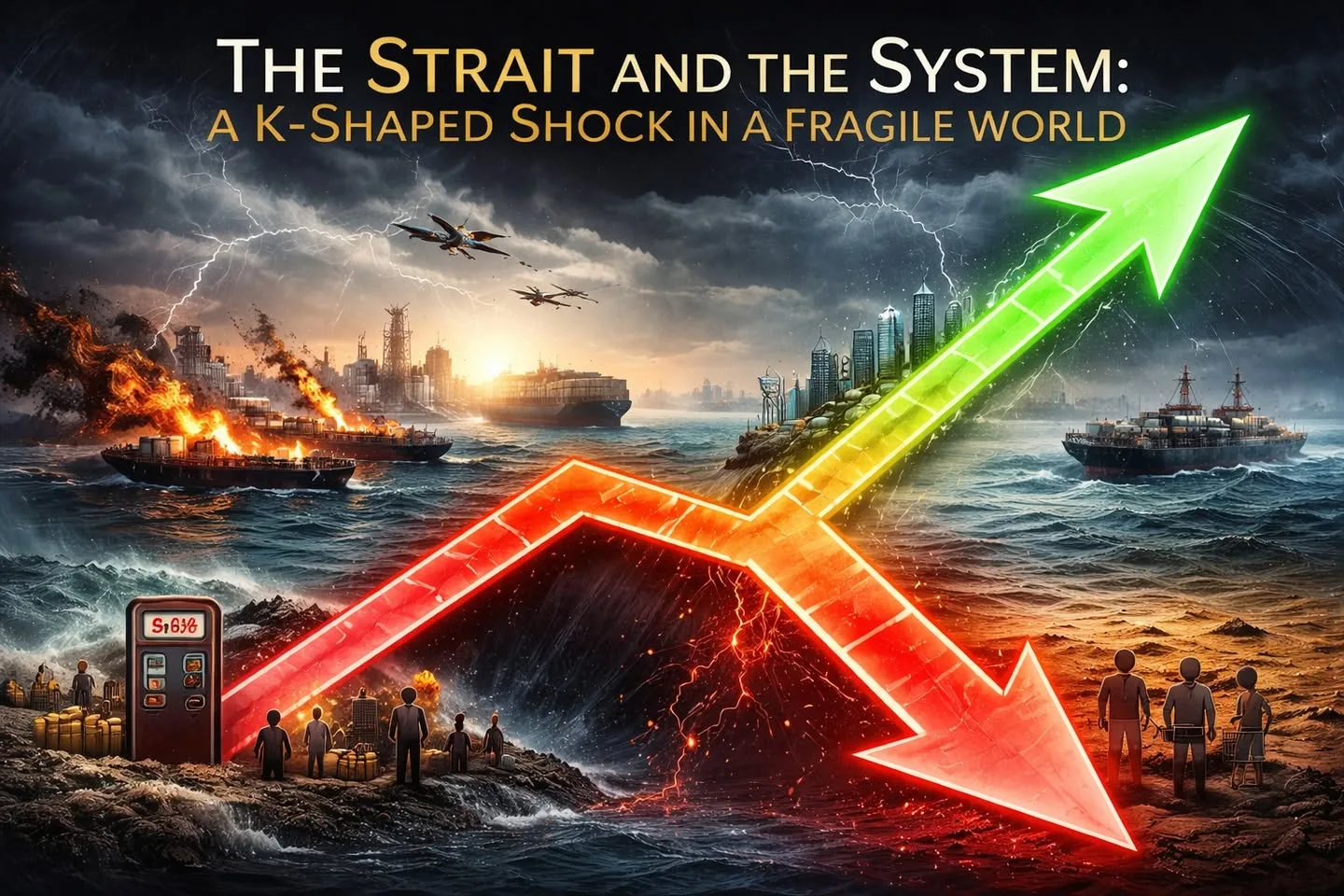
A K-shaped shock is an economic phenomenon in which a crisis widens the divergence between market perceptions and lived reality, resulting in an unequal distribution of impact across society.
This specific shock, now occurring in March 2026, is driven by a massive gap between the futures market, which remains relatively calm and hopeful, and the physical market, which is constrained by real-time disruptions in the Strait of Hormuz.
The shock affects different groups in the following ways:
Large Institutions and Financial Players: Situated at the "top" of the K-shape, these include multinational corporations, airlines, and large financial institutions. They are insulated from the immediate crisis because they can operate within the futures market, allowing them to hedge risks and lock in lower forward prices.
Households, Small Businesses, and Farmers: These groups represent the "bottom" of the K-shape and bear the disproportionate burden of the shock. Unlike large corporations, they live entirely in the physical market and must buy fuel, food, and electricity at today’s inflated prices without the ability to hedge against future costs.
Agricultural and Industrial Sectors: Farmers are specifically affected by interruptions in fertilizer supply (urea and ammonia), while constraints on sulfur threaten industrial processes for copper and nickel.
High-Tech and Energy Consumers: Global semiconductor supply chains are strained by helium shortages, and energy costs are rising for households across Europe and Asia due to disrupted liquefied natural gas (LNG) flows.
Ultimately, the K-shaped shock reveals a system designed to concentrate resilience at the top while intensifying vulnerability at the base, turning a geopolitical crisis into a mechanism that actively widens global inequality.