
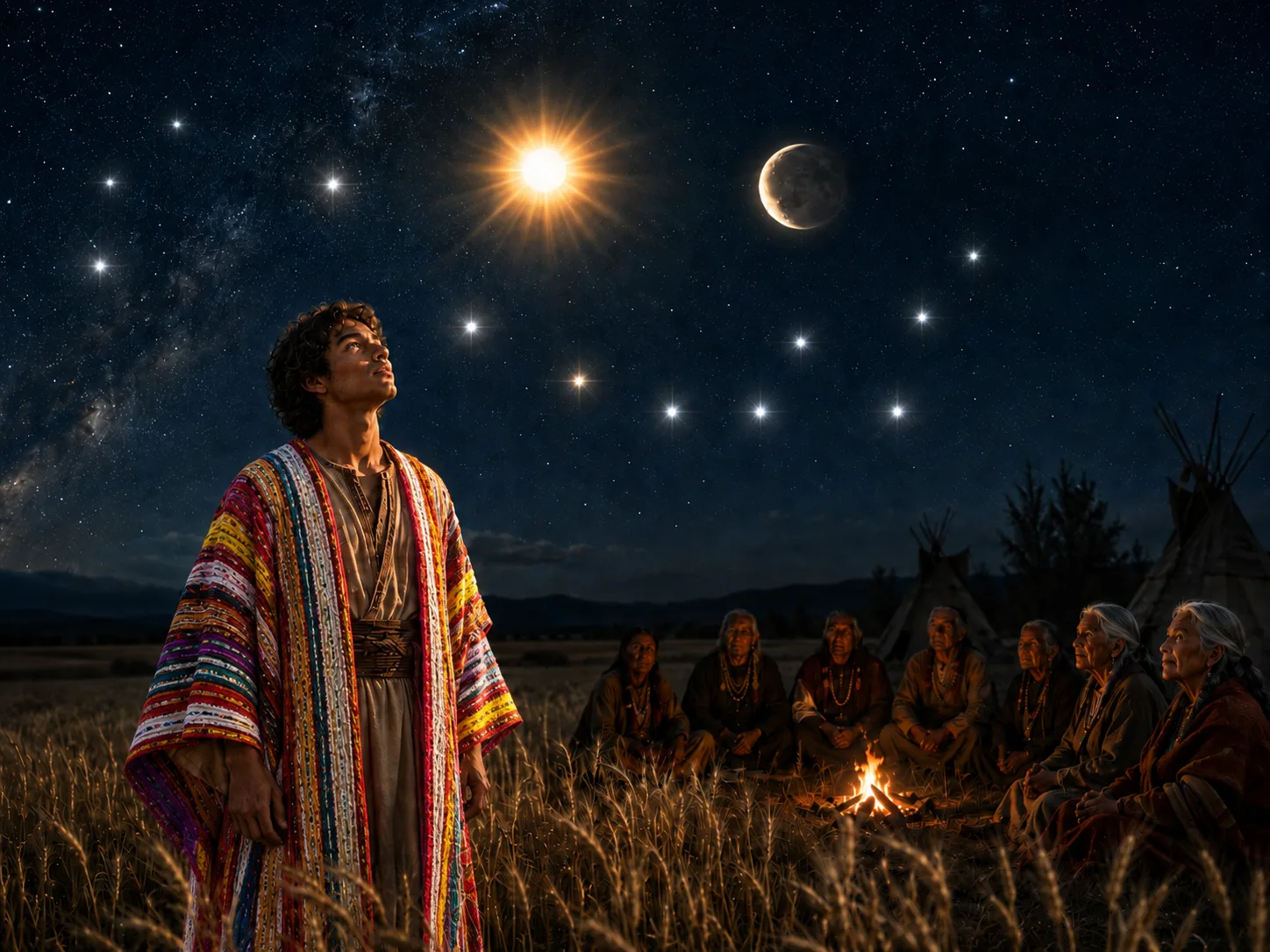
The story of Joseph is one of the most beautiful sacred patterns for understanding what has happened to Indigenous peoples across Mother Earth. Joseph was beloved, gifted, and chosen, but those closest to him could not recognize the beauty of his destiny. His dreams were mocked.
His coat of many colors became a sign not only of blessing, but of jealousy. His own brothers cast him into the pit, sold him away, and tried to erase him from the family story. Yet what they meant for harm, the Creator transformed into a pathway of preparation, wisdom, leadership, forgiveness, and life-giving service.
This is also the story of Indigenous peoples. Across the Americas and throughout the world, Indigenous nations carried sacred teachings, languages, ceremonies, ecological knowledge, kinship systems, spiritual laws, and profound ways of living in relationship with Mother Earth.
Like Joseph’s coat of many colors, the cultural diversity of Indigenous nations was a garment of beauty. Each nation carried a distinct pattern, a sacred design, a responsibility given by the Creator. But instead of being honored, that beauty became the object of envy, fear, conquest, and violence.
Joseph’s brothers saw his dreams and feared them. In one, their sheaves of grain bowed to his; in another, the sun, moon, and eleven stars bowed down to him. They did not understand that these dreams were not given to humiliate them, but to prepare a future blessing for the whole family. Joseph’s rise would ultimately save them from famine.
In the same way, colonial powers saw Indigenous peoples not as relatives, teachers, and guardians of the land, but as obstacles to possession, extraction, and domination.
Yet Indigenous prophecies, across the Americas, foretold a time of resurgence after great suffering, when the original peoples would rise again, offering healing and balance not only for themselves but for all who share this earth.
Joseph’s brothers saw his dream and feared it. They did not understand that his dream was not given to humiliate them, but to prepare a future blessing for the whole family.
In the same way, the colonial powers saw Indigenous peoples not as relatives, teachers, and guardians, but as obstacles to possession, extraction, and domination. They saw land, but did not see Mother Earth. They saw resources, but did not see sacred relationships.
They saw people to be removed, converted, controlled, or assimilated, but did not see nations carrying ancient covenants with the land and with the unseen spiritual world.
Joseph was thrown into the pit. Indigenous peoples were thrown into many pits: the pit of dispossession, the pit of broken treaties, the pit of residential and boarding schools, the pit of outlawed ceremonies, the pit of stolen children, the pit of forced poverty, the pit of criminalized identity, and the pit of being told that their languages, spiritual ways, and governance systems were inferior.
These were not small wounds. These were deep historical assaults meant to break the chain of transmission between the ancestors, the living, and the generations yet unborn.
Yet the pit did not destroy Joseph. The pit became the hidden beginning of his preparation. It was not a good thing that his brothers betrayed him. It was not holy that he was sold. It was not just that he was imprisoned.
Evil remains evil. Harm remains harm. Betrayal remains betrayal. But the Creator’s power is greater than the intention of those who harm. The sacred mystery is that what was meant to destroy Joseph became, through divine wisdom, part of the road that prepared him to save many lives.
So it is with Indigenous peoples. Colonization was not a blessing. Genocide was not a blessing. Forced assimilation was not a blessing. The suffering of children, families, Elders, and nations was not a blessing.
But our Creator, Wakan Tanka, the Great Mystery, has the power to bring blessing out of what was intended for destruction. The blessing is not the violence itself.
The blessing is that Indigenous peoples survived it, learned through it, deepened through it, and now stand with a wisdom that the world desperately needs.
Joseph learned in exile. He learned in a foreign land. He learned how to read dreams, how to govern food systems, how to prepare for famine, how to interpret signs, and how to serve even when forgotten.
His suffering did not make him bitter. It made him capable. It made him spacious. It made him a leader who could hold both pain and mercy. When the famine came, Joseph had already been prepared.
This is the time we are entering now. The world is in famine, not only a famine of food, but a famine of meaning, a famine of spiritual vision, a famine of right relationship, a famine of moral leadership, a famine of balance between the material and the spiritual.
The dominant systems that once claimed superiority are now revealing their own emptiness. The world has technology, but not enough wisdom. It has wealth, but not enough justice. It has power, but not enough humility. It has speed, but not enough direction. It has endless information, but not enough sacred knowledge.
In this time of global famine, Indigenous peoples are like Joseph in Egypt. The very people who were pushed aside now carry teachings needed for the survival and healing of the whole human family.
The teachings of kinship, reciprocity, responsibility, ceremony, gratitude, land-based knowledge, consensus, spiritual law, and respect for Mother Earth are not relics of the past. They are provisions stored for the future. They are the grain houses of the spirit. They are living instructions for a world that has lost its way.
Joseph’s brothers did not recognize him when they came to Egypt. They stood before the very one they had betrayed, but they did not know him. This too has happened with Indigenous peoples.
The modern world often comes seeking solutions, climate solutions, governance solutions, healing solutions, ecological solutions, peace-building solutions, without recognizing that many of these answers have been carried by Indigenous peoples. The world comes hungry, but often does not yet know whom it is standing before.
The beauty of Joseph is that he does not use his power for revenge. He remembers the betrayal, but he is not ruled by it. He tests his brothers not to destroy them but to bring the truth to the surface.
Reconciliation cannot be built on denial. The brothers must come to recognize what they have done. They must feel the weight of their actions. Only then can the family be restored.
This is a powerful teaching for reconciliation between Indigenous peoples and settler societies. True reconciliation cannot mean forgetting. It cannot mean moving on without truth. It cannot mean asking Indigenous peoples to carry the burden of forgiveness while institutions avoid accountability.
Joseph’s reconciliation required truth, tears, recognition, and transformation. So must ours. The wound must be named. The pit must be remembered. The garment must be honored. The stolen inheritance must be acknowledged. Only then can a new relationship be born.
Joseph’s garment restored Jacob’s sight. This is one of the most sacred images in the whole story. Jacob had lived in grief, believing Joseph was gone. But when the garment came, carrying Joseph’s fragrance, Jacob knew his son was alive. His sight returned. The garment was not only cloth. It carried the beloved’s living presence.
Indigenous cultures, languages, ceremonies, songs, bundles, pipes, drums, stories, and sacred laws are like Joseph’s garment. They carry the fragrance of what colonial systems tried to declare dead. They tell the world: we are still alive. The people are still here.
The ancestors are still near. The covenant with Mother Earth is not broken. The sacred fire is still burning. The songs have not disappeared. The languages can rise again. The children can remember. The Human Family can regain its sight.
Joseph’s coat of many colors also speaks to the sacred diversity of Indigenous nations. No single color alone completes the garment. Each color has its place. Each nation has its medicine. Each person has their song. The Creator did not make one human pattern, one language, one ceremony, one culture, one way of knowing.
The Great Mystery clothed humanity in many colors so that we could learn the beauty of relationship. The tragedy of colonialism was that it tried to tear this garment apart. This age promises that the garment is being woven again.
What was meant to erase Indigenous identity has instead revealed its power. What was meant to silence Indigenous voices has created generations who speak with even greater clarity.
What was meant to sever Indigenous peoples from the land has made the sacred relationship with Mother Earth even more visible to the world. What was meant to shame the children has become a movement to restore language, culture, family, ceremony, and pride. What was meant to destroy the people has become preparation for a greater role of service.
This does not mean the suffering was necessary in some cruel or simple way. It means something much deeper: the Creator wastes nothing. Even the ashes can nourish new life. Even the broken ground can receive seeds. Even the long night can prepare the dawn.
Indigenous peoples did not choose the pit, but they have carried wisdom out of it. They did not choose exile, but they have learned how to guide a world exiled from its own soul. They did not choose the violence, but they have become witnesses to the sacred law that life is stronger than death, truth stronger than denial, and spirit stronger than domination.
Joseph was prepared in hiddenness. For many generations, Indigenous peoples were told they belonged to the past. But hiddenness is not absence. The seed beneath the snow is not dead. The root underground is not gone.
The sacred teachings continued in kitchens, camps, ceremonies, whispered prayers, hidden bundles, grandmothers’ memories, grandfathers’ stories, and the quiet courage of families who refused to let the chain be broken. While the world thought it had conquered Indigenous peoples, the Creator was preserving a sacred storehouse.
Now that the storehouse is opening. Indigenous leadership is rising in climate justice, language revitalization, land restoration, legal transformation, food sovereignty, healing movements, peacebuilding, and spiritual renewal. Indigenous youth are reclaiming what was taken. Elders are being heard again. Women are restoring circles of protection and leadership. Nations are rebuilding governance. Sacred places are being defended. Old knowledge meets new tools. The ancient fire is entering the digital age. The Joseph hidden in the pit is beginning to stand in the halls of Egypt.
The great test now is whether this rising will be guided by bitterness or by sacred purpose. Joseph shows the higher path. He does not deny the crime. He does not pretend the pit was harmless. But he also did not let the crime define his future.
He rises into service. He feeds the hungry. He restores the family. He places truth and mercy together. He becomes an instrument of life.
This is the spiritual leadership Indigenous peoples are now called to offer—not as victims seeking pity, not as symbols used by others, but as sovereign spiritual relatives carrying instructions for the future. The purpose is not to reverse domination and place one people above another. The purpose is to heal the broken family of humanity and restore the right relationship with Mother Earth.
Joseph did not save only himself. He saved Egypt, his brothers, his father, and the future generations of Israel. In the same way, Indigenous resurgence is not only for Indigenous peoples. It is a gift for all nations.
The world is beginning to understand that what it once dismissed as “primitive” may actually be advanced wisdom. The so-called modern world now faces ecological collapse, spiritual loneliness, social fragmentation, violence, addiction, greed, and alienation from Mother Earth.
Indigenous teachings of balance, kinship, gratitude, restraint, and responsibility are not behind the times. They are ahead of the crisis. They are not leftovers from the past. They are provisions for the future famine.
Joseph’s story teaches that destiny often wears the clothing of suffering before it wears the robe of service. The pit, the prison, and the false accusation did not define Joseph’s final station. They prepared him for it.
Likewise, the long suffering of our Indigenous peoples does not define our final destiny. Our destiny is not disappearance. Our destiny is restoration, leadership, healing, and unifying our Human Family by choosing peace, living peace, ending war, and building a new Planetary Civilization based on Justice.
The prophecy hidden in the story of Joseph is that the one who is betrayed becomes the blessing. The rejected one becomes the provider. The hidden one becomes the recognized one. The wounded one becomes the healer. The dreamer becomes the one who helps the family survive the famine.
This is what is now manifesting among Indigenous peoples. The sacred knowledge that was pushed underground is rising. The languages that were punished are returning. The ceremonies that were banned are healing communities. The nations that were declared defeated are standing again.
There is a deep spiritual law here: no true gift from the Creator can be permanently destroyed. It can be buried, but it will rise. It can be mocked, but it will speak. It can be stolen, but its spirit remains with the people. It can be wounded, but it can heal. It can be cast into the pit, but the pit can become the hidden road to Egypt, where all will need the gift.
This is why Joseph’s story belongs so powerfully to the Indigenous experience. It gives language to the mystery of survival. It tells us that betrayal is not the final word.
It tells us that the Creator’s plan can move beneath the surface of history, quietly preparing a people for a role that even their oppressors cannot foresee. It tells us that the world’s famine will one day bring the family back to the one it rejected. It tells us that the garment still carries the fragrance of life.
The task now is to receive this moment with humility, clarity, and courage. Indigenous peoples are not rising merely to be included in the old order. They are rising to help transform the order itself. They are not asking simply for a seat at the table of a failing civilization.
They are bringing teachings for how the table must be rebuilt, how the food must be shared, how the children must be protected, how the water must be honored, how the ancestors must be remembered, and how Mother Earth must be restored.
Joseph’s greatness was not only that he survived. His greatness lay in his understanding of the meaning of his survival. He saw that his life had been preserved for a purpose larger than himself.
That is the sacred invitation now before Indigenous peoples and all humanity. The survival of Indigenous nations is not an accident. It is a sign. It is a promise. It is a preparation. It is the unfolding of a spiritual responsibility that has been carried through the darkest times for the sake of a future not yet fully born.
In the end, Joseph says to his brothers, in essence: what you meant for harm, the Creator turned toward good, so that many lives might be preserved.
This does not excuse the harm. It reveals the greater power to transform harm into service, grief into wisdom, exile into leadership, and suffering into food for the nations.
This is the sacred meaning now emerging from the long journey of Indigenous peoples.
The pit is not the end. The prison is not the end. The torn garment is not the end. The famine is not the end. The story moves toward recognition, restoration, forgiveness, and life. Indigenous peoples, like Joseph, have carried a hidden blessing through generations of trial.
Now that blessing is coming forth, not for revenge, but for renewal. Not for domination, but for balance. Not for separation, but for the healing and restoration of our Human Family and Mother Earth.