
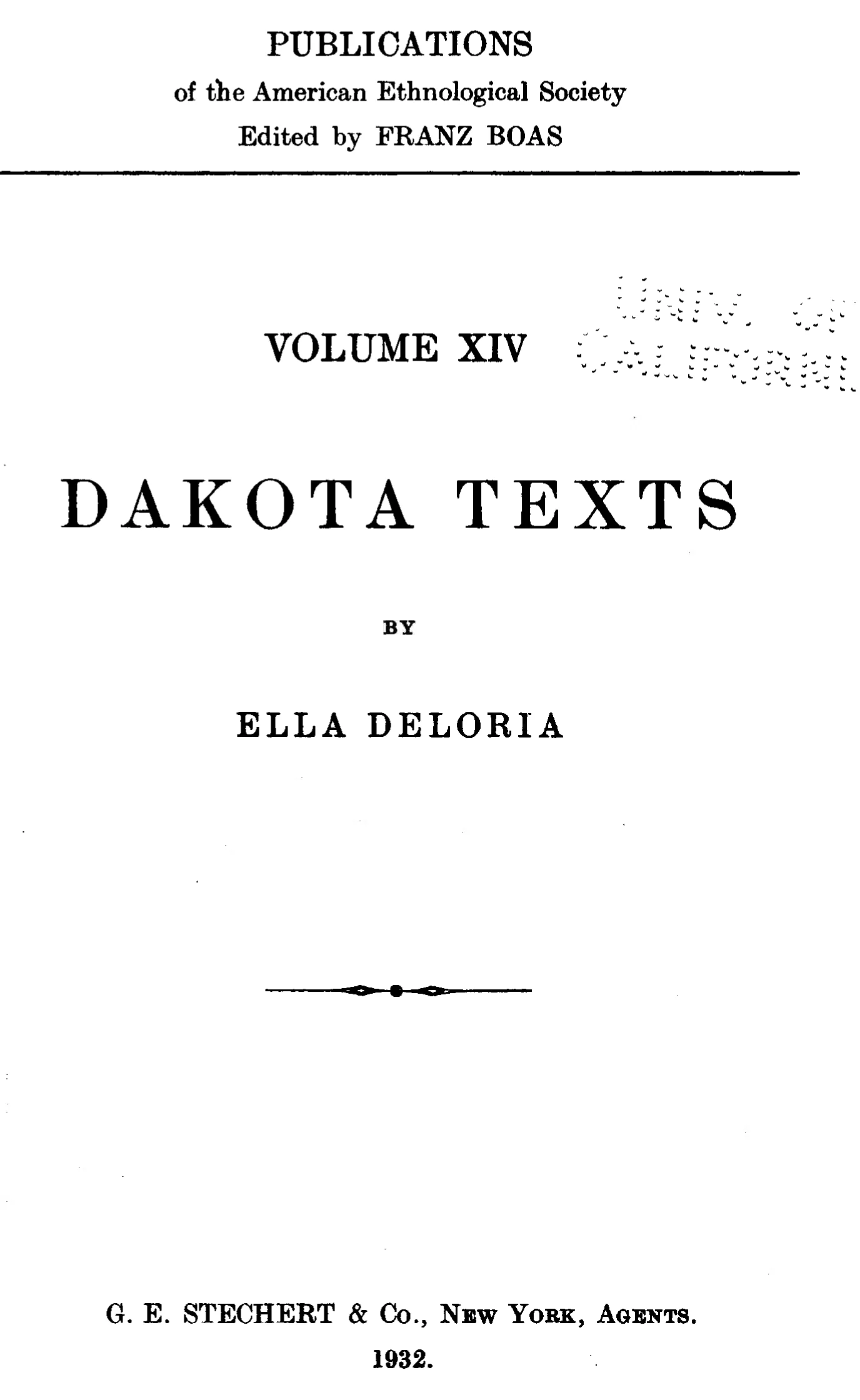
My Unchi, Ella Cara Deloria’s landmark book, Deloria Texts, was originally published in 1932 as Volume XIV of the Publications of the American Ethnological Society. Within its 279 pages, she preserved a remarkable collection of traditional stories in the Dakota, Lakota, and Nakota dialects, together with extensive linguistic, cultural, and explanatory notes.
Deloria Texts remains one of the most important works ever produced on our language, our stories, and the deeper patterns of thought carried within them.
From the earliest time I began to read, my father placed Dakota Texts in my hands. I was fascinated by it. I read those stories over and over again, trying to understand not only what they said, but the different way of seeing and thinking that moved within them.
Deloria’s texts became my childhood book of wonder, almost like a book of fairy tales, except these are our stories, arising from the lives, experiences, relationships, struggles, humor, dangers, and spiritual understandings of our own Peoples.
What made the book especially powerful for me was the way Unchi Ella presents the stories on three interconnected levels. We have all three before us. First comes the story in its original Dakota, Lakota, or Nakota language.
Then comes a direct English translation, following the original words, relationships, and sequence of thought as faithfully as English would allow.
Finally, there is a free English translation, in which the words and sentences are rearranged so the story reads cohesively and logically to an English-speaking person.
The difference between the direct and free translations was extremely important. The free translation conveyed the story’s general meaning in natural, conventional English. It allowed an English-speaking reader to understand what happened and to follow the narrative easily.
The direct translation does something quite different. It remains very close to the original placement and movement of the Dakota words.
Because it did not rearrange the thought into conventional English form, it let us see how the Dakota-speaking mind organized relationships, actions, time, responsibility, and meaning.
When I read the free translation, I could follow the story easily. But when I studied the direct translation beside the original language, I entered an entirely different way of thinking.
The words did not always appear in the order expected by the English-speaking mind. Actions, relationships, movement, and context carried the meaning. The story did not simply describe a world composed of separate objects; it revealed a living world continuously unfolding through relationships and processes.
The direct translation can sometimes seem unusual or even backward when viewed strictly through English grammar. Yet it was precisely through that different ordering of the words that the deeper structure of Dakota thought became visible.
The free translation shows us what the story meant in understandable English. The direct translation shows us how the original thought is patterned and how it moves.
And the original Dakota let us hear and enter the language itself, the living source from which both English translations were drawn. Together, the original Dakota, the direct English translation, and the free English translation made it possible to move between two profoundly different systems of language and thought.
We can understand the story in English, but we can also look beneath that English rendering and begin to recognize the relational worldview carried within the original language.
This is not simply a method of translation. This is a doorway into another understanding of reality.
This helped me understand from childhood that Dakota is not merely English expressed through different words. Our language carries its own intelligence and its own understanding of reality. It teaches us to see life as movement, relationship, responsibility, and continual becoming.
To rearrange everything into conventional English may make a story easier to read. Still, it can also conceal the original pattern of thought and the deeper worldview held within the language.
As a child, I was deeply affected by the stories themselves. They are sometimes humorous, sometimes mysterious, sometimes severe, and often filled with questions of fairness, justice, proper conduct, and the consequences of how people treated one another. Even the smallest story seemed to contain a teaching.
I often wondered whether these narratives reflected experiences our ancestors had encountered during their long journey through life, experiences remembered, transformed, and passed forward as stories so that succeeding generations could learn from them.
I read Dakota Texts so many times that its stories and patterns of thought became part of me. Somewhere in my house, I still have the copy I read, and I must now find it again. It is not simply an old book in my personal collection. It is part of my life’s foundation.
Through Unchi Ella’s extraordinary work, and through my father’s wisdom in placing that work before me at such an early age, I began to recognize that language holds an entire way of knowing.
Dakota Texts helped form my understanding of Indigenous thought, relational reality, justice, human development, and the living ‘Interconnectedness of all things.
Much of what I have sought to understand, teach, and carry forward throughout my life has roots in those childhood hours spent reading and rereading the stories that Unchi Ella so carefully preserved for us.