Executive Overview
The Salish Sea Rebirth Series is a truth-telling, restoration, and future-building series that gathers the whole story of the Salish Sea Bioregion into one living proposal.
It begins with the original truth of this sacred place: the waters, islands, rivers, estuaries, forests, salmon, shellfish, cedar, medicines, village sites, canoe routes, languages, songs, laws, and Nations that formed one of the great Indigenous civilizations of Mother Earth.
This is not only a historical series. It is not only an environmental proposal. It is not only a documentary, a sanctuary plan, a trail vision, or a digital network. It is a living Indigenous-led bioregional movement rooted in truth, guided by spirit, organized for action, and dedicated to the rebirth of the Salish Sea Bioregion.
The series begins by restoring the story’s original center. Before the colonial map, before the Canada–United States border, before cities, ports, private property, industrial development, and government jurisdictions, the Salish Sea was already a living world of law, abundance, governance, ceremony, trade, diplomacy, education, and sacred responsibility.
The Original Peoples did not simply live beside the waters. They belonged to the waters. They governed through relationships. They sustained abundance through restraint, ceremony, kinship, knowledge, and responsibility to future generations.
The early episodes establish this foundation. They show that the Salish Sea was never empty, never without law, and never without civilization. They lift the abundance that sustained the Nations: salmon runs, shellfish beds, herring, eelgrass, kelp forests, cedar, medicines, rivers, estuaries, birds, animals, and the interwoven food systems that supported life for thousands of years. They also show the sophistication of Indigenous law and governance: the protocols, hereditary responsibilities, spiritual teachings, kinship systems, ceremonies, trade relationships, and seasonal patterns that held the bioregion in balance.
The series then turns toward the wound. It tells the truth about colonial invasion, disease, land seizure, forced removal, missionization, residential and boarding schools, the attack on ceremony, and the deliberate breaking of Indigenous systems of life.
At the center of this truth-telling is the 1862 smallpox catastrophe, not as an isolated tragedy, but as part of a larger colonial process that treated Indigenous peoples as obstacles to settlement, land acquisition, commerce, and control. This part of the series does not tell history for grief alone. It tells the truth because healing without truth is not healing, and reconciliation without memory is not reconciliation.
It shares that the Smallpox epidemic that devastated the Indigenous peoples of the Salish Sea Bioregion was a very conscious act of collective genocide that has been covered up until now, with legal and financial consequences of a very clear case of genocide by the Canadian and US Governments.
From there, the series moves from truth into honoring. It insists that the Salish Sea cannot be healed by speaking about Indigenous peoples in general terms.
The living Nations must be honored in their own right, with their own territories, languages, sacred places, laws, leaders, Elders, youth, ceremonies, and community priorities. No outside voice can speak for them. The series is offered as a contribution, a witness, and a call to remember the larger pattern of what happened and what must now return.
The second great movement of the series begins with the return of the Original Stewards. This is not symbolic. It is not a ceremonial addition to an unchanged system. It means a real shift in leadership, authority, responsibility, governance, funding, law, and long-term stewardship.
The waters cannot be restored by the same worldview that damaged them. The decline of salmon, the pollution of waters, the destruction of shellfish beds, the burial of sacred sites, and the weakening of Indigenous authority are all part of one wound.
Therefore, ecological restoration must be joined with historical justice, cultural renewal, spiritual responsibility, Indigenous law, and the rebuilding of Indigenous-led economies.
The return of the Original Stewards prepares the way for one of the central vessels of the proposal: the Salish Sea Bioregional Marine Sanctuary. This sanctuary is not imagined as a colonial park, a symbolic designation, or a government conservation area that leaves old systems untouched.
It is envisioned as an Indigenous-led, Nation-to-Nation, bioregional sanctuary rooted in sacred responsibility, legal protection, ecological restoration, cultural renewal, youth leadership, food sovereignty, and the healing of Mother Earth.
The sanctuary will treat the Salish Sea as one living system. It will not divide salmon, orcas, rivers, shellfish beds, estuaries, forests, sacred sites, village places, and people into separate categories. It will protect and regenerate the whole. It will support salmon recovery, herring restoration, eelgrass and kelp renewal, clean-water work, shoreline restoration, sacred-site protection, Indigenous Guardian programs, language revitalization, cultural education, and the rebuilding of traditional food systems. It will be both a shield and a seed: a shield for what remains sacred and vulnerable, and a seed for what must be regenerated for future generations.
The series then introduces the Digital Fourth Way Network as the living digital backbone of the Salish Sea Rebirth. This is not another app, database, website, or outside-controlled technology platform. It is a sovereign Indigenous communication, coordination, learning, mapping, governance, cultural renewal, ecological monitoring, and economic system placed in service to the Original Peoples, Mother Earth, the waters, the salmon, the Elders, the youth, and the generations still to come.
The Digital Fourth Way is founded on Indigenous data sovereignty. Each Nation must control its own stories, maps, language materials, sacred site information, ecological data, cultural knowledge, and digital identity. Nothing sacred should be exposed. Nothing sensitive should be extracted. Nothing should be shared without consent. In the age of artificial intelligence, this is essential. Technology must not become another tool of taking. It must be placed under Indigenous governance so that it serves language learning, restoration, youth training, secure communication, cultural protection, and Nation-to-Nation coordination.
The implementation episode gathers the whole proposal into a practical framework. It shows how the Salish Sea Rebirth can move from vision into organized action through interwoven pillars: truth and historical justice; Indigenous governance and protocol; sanctuary, stewardship, and ecological restoration; the Coastal Trail and cultural learning corridors; youth, Elders, language, and cultural renewal; the Digital Fourth Way Network; and a regenerative economy with long-term finance.
This implementation framework is not designed to control the Nations. It is designed to coordinate in the right relationship. Each Nation remains fully sovereign. Each Nation carries its own laws, leaders, sacred places, knowledge, priorities, and pace. The work must move at the speed of trust. It must begin with listening, relationship, protocol, and consent. It must guard against outside capture by governments, universities, corporations, funders, or institutions. Allies may serve, resource, advise, and support, but they must not control the vision.
A key practical expression of implementation is the creation of Salish Sea Restoration Nodes. These would be place-based centers where the larger pillars come together. A restoration node might include a Guardian station, youth learning space, language program, salmon project, shellfish restoration area, cultural education site, mapping hub, community kitchen, canoe program, media studio, or sacred site protection initiative. Each node would be rooted in local Nation leadership. Together, they would form a living network of healing across the bioregion.
The proposal also calls for a new regenerative economy. The old economy extracted wealth from Indigenous lands and waters while leaving pollution, poverty, trauma, and disconnection behind. The new economy must reallocate resources to restoration, stewardship, youth employment, language work, cultural renewal, clean water, salmon recovery, food sovereignty, Indigenous-owned enterprise, digital sovereignty, and community health. Money must be made accountable to life.
Success will not be measured only by reports, meetings, funds raised, platforms launched, or public attention. Living indicators must measure it: waters healing, salmon returning, youth trained, Elders honored, languages strengthened, sacred sites protected, Guardian programs equipped, Indigenous-owned enterprises growing, restoration jobs created, knowledge protected, laws respected, and future generations made stronger.
The final episode lifts the whole series into its largest meaning. The Salish Sea Rebirth is not only about one bioregion. It is part of a greater turning in the human family. It is one place where Indigenous prophecy can become practical. It points toward the movement from the Fourth World of fragmentation, extraction, domination, and separation into the Fifth World of maturity, relationship, responsibility, unity, and planetary consciousness.
In this larger vision, the Salish Sea becomes a model of Indigenous-led bioregional renewal. Not a rigid template to be imposed elsewhere, but a living pattern that can inspire other sacred regions: the Amazon, the Arctic, the Great Lakes, the Andes, the Mississippi, the Colorado River Basin, the Caribbean, the Pacific Islands, the Himalayas, the Congo Basin, and many others. Each place must arise from its own people, waters, laws, histories, protocols, and prophecies. But the shared pattern is clear: truth, Indigenous leadership, sacred law, ecological restoration, youth leadership, cultural renewal, digital sovereignty, regenerative economy, and planetary responsibility.
The Salish Sea Rebirth, therefore, offers more than a proposal. It offers a path. It shows how truth-telling can become protection. How honoring the Nations can become governance. How ecological restoration can become cultural renewal, how youth training can become future leadership. How technology can become a servant of life. How can the economy become part of healing? How prophecy can become practical.
The whole series carries one central message: the Salish Sea is not only damaged. It is calling.
The waters are calling. The salmon are calling. The cedar is calling. The shellfish beds are calling. The sacred sites are calling. The Elders are calling. The youth are calling. The ancestors are calling. The unborn generations are calling.
The response is the return of the Original Stewards. The response is an Indigenous-led Marine Sanctuary. The response is a Coastal Trail of truth and responsibility. The response is the Digital Fourth Way Network. The response is a regenerative economy rooted in restoration.
The response is youth rising, Elders teaching, Nations leading, laws remembered, ceremonies strengthened, and the Salish Sea once again protected as a sacred living relative. This is the promise of the Salish Sea Rebirth.
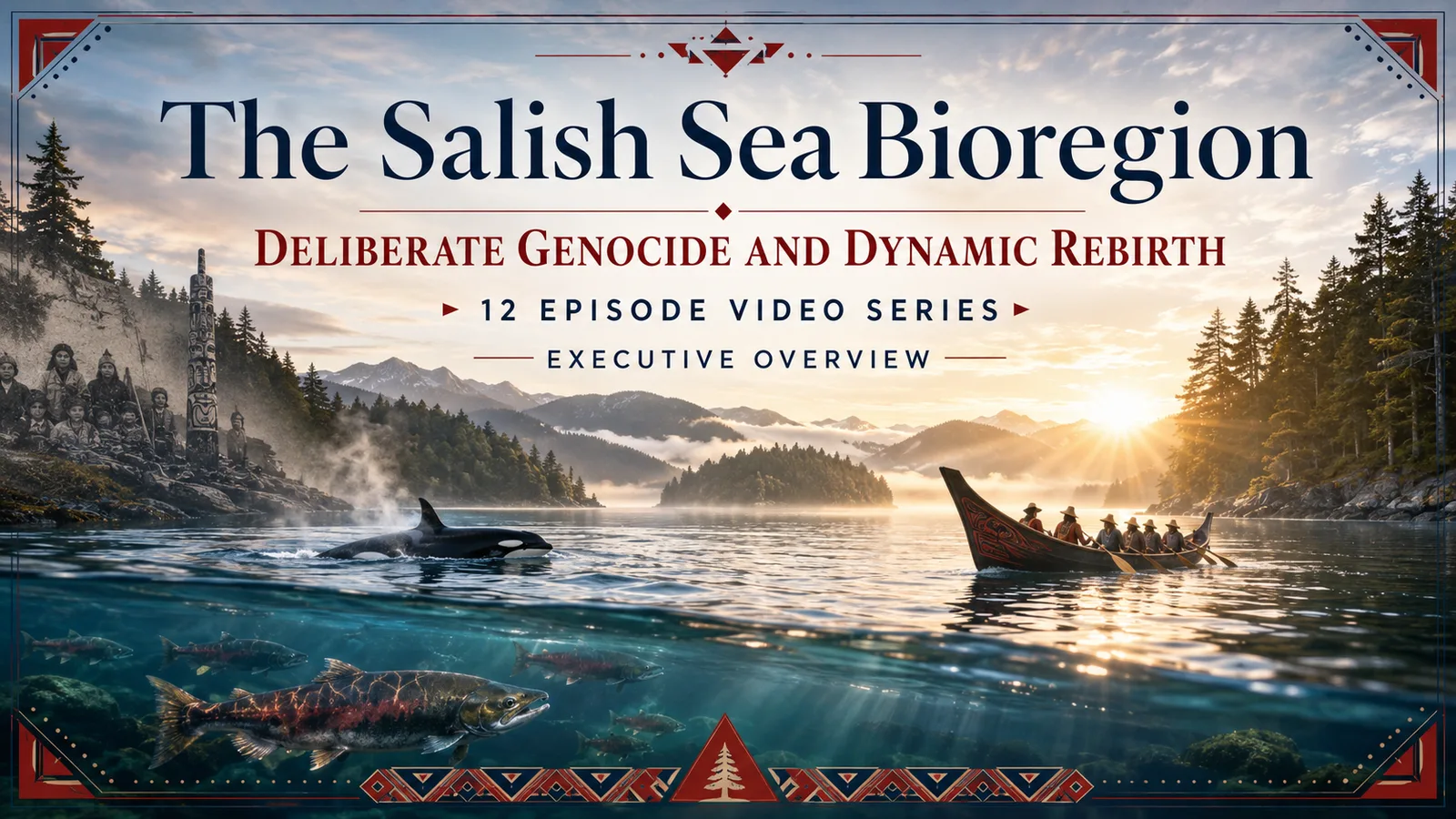
The Salish Sea Bioregion: Deliberate Genocide and Dynamic Rebirth
Episodes 1–6
This series is not simply a history lesson. It is a truth-telling, a spiritual remembering, a legal and moral examination, and a pathway toward Indigenous-led rebirth. Each episode is built around a central theme, but beneath it lie deeper questions that guide the discussion. These questions help the audience move beyond passive listening into reflection, responsibility, and action.
The first six episodes establish the foundation. They restore the original reality of the Salish Sea Bioregion, reveal the sophistication of its Indigenous civilizations, expose the deliberate colonial process that turned disease into genocide, examine the attack on ceremony and governance, and return the living Nations of the bioregion to the center of the story.
Episode 1
The Vast Salish Sea Bioregion: The Original Map Beneath the Colonial Map
Episode 1 opens the series by restoring the Salish Sea’s original reality. Before colonial borders, before British Columbia and Washington State, before reserves, reservations, municipalities, property lines, ports, and national boundaries, there was a living bioregion held together by water, salmon, cedar, canoe routes, kinship, trade, ceremony, governance, and sacred law.
This episode must help the audience understand that the Salish Sea was never empty, never undeveloped, and never waiting to be discovered. It was already known, named, governed, loved, traveled, and protected by the Original Peoples.
The colonial map divided what Indigenous life had long held together. The ocean currents did not recognize colonial borders. The salmon did not recognize colonial borders. The canoes, songs, marriages, ceremonies, names, and responsibilities moved through a much older map.
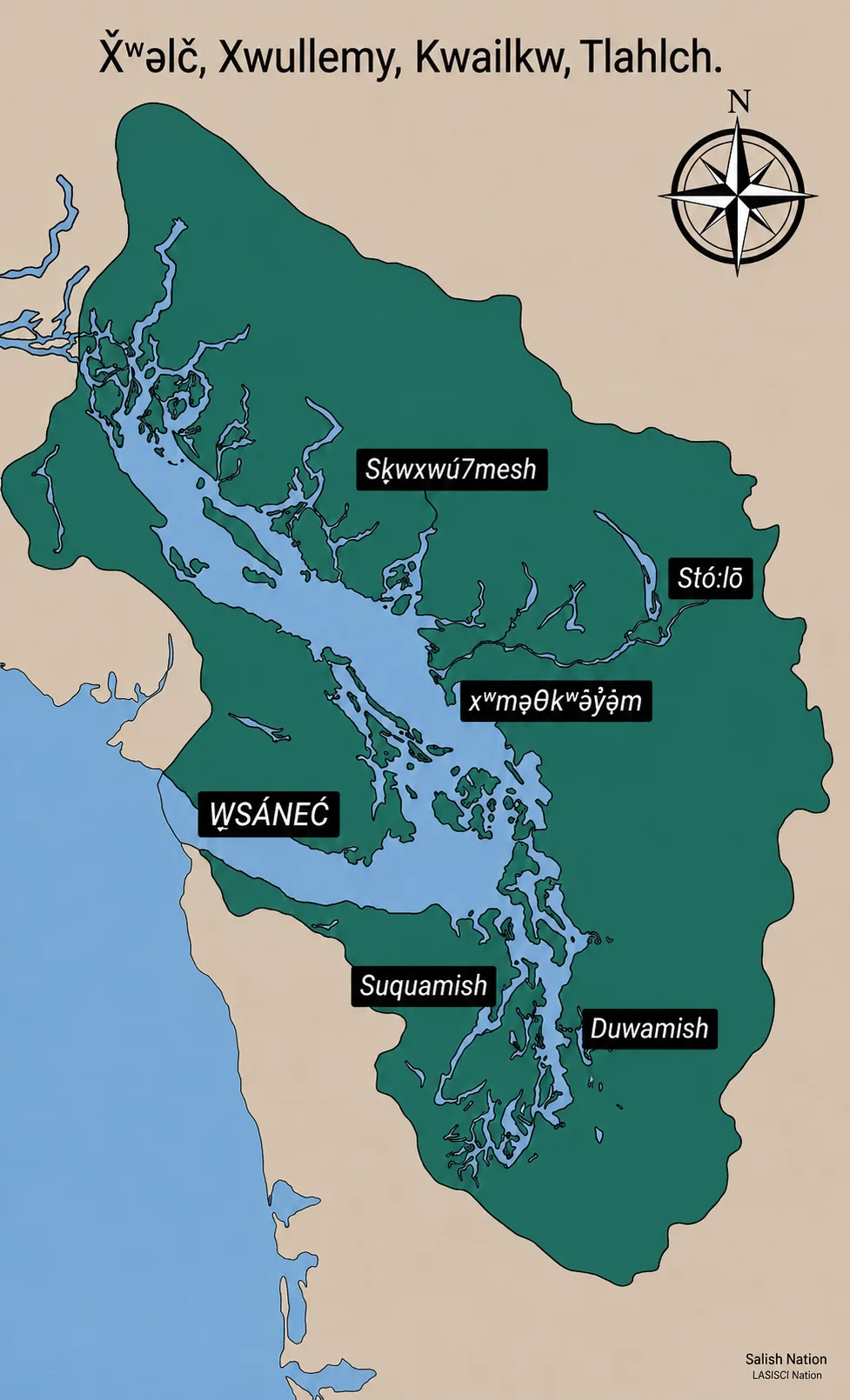
The episode should show the Salish Sea not only as a body of water, but as a complete civilization and sacred living system. The Strait of Georgia, Puget Sound, Juan de Fuca Strait, Burrard Inlet, Howe Sound, Vancouver Island, the Fraser River watershed, islands, inlets, estuaries, river mouths, reef-net sites, clam beds, village places, and canoe routes were all part of one larger circle of relationship.
The purpose of Episode 1 is to remove the colonial lens. The Salish Sea must be seen first through its original Indigenous reality. It is not only a place. It is a relationship. It is not only water. It is law, food, memory, ceremony, family, history, identity, and responsibility.
Underlying Questions for Episode 1
What was the Salish Sea before colonial borders divided it?
How did Indigenous Nations understand this bioregion through water, salmon, canoe routes, kinship, ceremony, and sacred responsibility?
How did colonial maps erase or distort the living Indigenous map that already existed?
Why is it important to begin the series with the original map rather than the colonial map?
What changes when the audience understands the Salish Sea as a civilization, not a wilderness?
How do watersheds, salmon runs, village sites, longhouses, sacred places, and canoe routes reveal an older and deeper system of governance?
What responsibilities do people living in the Salish Sea today inherit once they understand that this land and water were never empty?
Episode 2-The Abundance That Supported a Civilization
Episode 2 deepens the foundation by showing that the Salish Sea Bioregion was one of the most naturally abundant places on Mother Earth. This abundance supported large communities, complex societies, extensive trade networks, rich artistic traditions, spiritual systems, education, governance, and ceremony.
The episode must make clear that abundance was not accidental. It was protected through Indigenous law, restraint, ceremony, ecological intelligence, seasonal harvesting, sharing, and reciprocity. The people did not simply take from the land and waters. They lived within a relationship. They knew when to harvest, when to wait, when to give thanks, when to share, and when to leave places alone so life could renew itself.
The old colonial story called this wilderness. It was not wilderness. It was my homeland. It was a sacred, managed abundance.
Salmon was not only food. They were relatives, teachers, and central beings in the spiritual and economic life of the people. Cedar was not only a timber. Cedar was a sacred provider. Shellfish beds were not random natural resources.
They were tended, known, protected, and passed from generation to generation. The wealth of the Salish Sea was living wealth. It was counted in clean water, returning salmon, strong families, generous leaders, healthy children, full ceremonies, and the continuity of life.
This episode should also challenge the colonial idea of wealth. Colonial society saw forests and thought only of timber. It saw salmon and thought only of markets. It saw land and thought only of ownership. It saw sacred abundance and called it undeveloped. Episode 2 must restore the truth that Indigenous abundance was not primitive. It was intelligent, disciplined, spiritual, and sustainable.
Underlying Questions for Episode 2
What kind of abundance existed in the Salish Sea before colonial disruption?
How did salmon, cedar, shellfish, medicines, forests, rivers, tides, and estuaries support a living civilization?
How did Indigenous law and ceremony protect abundance across generations?
Why was this abundance invisible to colonial systems of measurement?
What is the difference between living wealth and extractive wealth?
How did colonial thinking reduce sacred relationships into commodities?
What can the modern world learn from Indigenous systems of restraint, reciprocity, and renewal?
How does restoring abundance today require restoring Indigenous governance?
Episode 3-Sophisticated Societies Rooted in Law, Spirit, Governance, and Generosity
Episode 3 confronts one of the deepest colonial lies: the claim that Indigenous peoples were without government, law, economy, education, or civilization. The Original Peoples of the Salish Sea and the wider Northwest Coast had highly sophisticated societies rooted in family, house systems, Chiefs, Matriarchs, Elders, spiritual leaders, names, songs, ceremonies, teachings, public witnessing, and sacred responsibility.
This episode should place the potlatch at the center of understanding. The potlatch was not merely a feast. It was the law. It carried title, inheritance, marriage, adoption, naming, dispute resolution, grief, redistribution of wealth, diplomacy, spiritual authority, and intergenerational responsibility. It was a constitution in ceremonial form. It held communities together through public witnessing and sacred accountability.
Episode 3 must also show that Indigenous wealth was not measured by hoarding. Wealth was proven by generosity. A leader’s greatness was shown by how much they could give, how many people they could feed, how deeply they could serve, and how faithfully they upheld the responsibilities entrusted to them. This was not poverty. This was another form of wealth. This was not a disorder. This was another form of law.
The episode should also explore Indigenous education. Children learn by watching, listening, helping, traveling, harvesting, singing, speaking, and participating. Knowledge was not separated from character. Leadership was not separated from service. Law was not separated from spirit. The economy was not separated from generosity. Governance was not separated from sacred responsibility.
The purpose of Episode 3 is to restore dignity, complexity, and truth. These were not people without civilization. They were people of law, order, discipline, beauty, intelligence, spirituality, diplomacy, and balance.
Underlying Questions for Episode 3
What forms of law and governance existed in the Salish Sea before colonial rule?
Why must the potlatch be understood as law, not merely as a ceremony or feast?
How did names, songs, titles, witnesses, houses, families, and hereditary responsibilities carry governance?
How did Indigenous societies measure wealth differently from colonial society?
Why was generosity a sign of leadership?
How did Indigenous education form character, responsibility, and identity?
Why did colonial authorities misunderstand, fear, or attack these systems?
What does it mean to say that the potlatch was the people’s constitution?
How does the restoration ceremony today also restore governance?
Episode 4: The Deliberate Genocidal Process of 1862
Episode 4 is the moral and historical center of the first half of the series. It examines the 1862 smallpox catastrophe not simply as an epidemic, but as a deliberate genocidal colonial process.
The disease was biological, but the pathway of destruction was political. Smallpox arrived in Victoria in March 1862 aboard the steamship Brother Jonathan, coming north from San Francisco into a colonial town already built on Indigenous lands and connected to Indigenous peoples from throughout the coast.
Victoria was not isolated. It was a gathering point along ancient canoe routes that reached the Salish Sea, Central Coast, North Coast, Haida Gwaii, Tsimshian territory, Tlingit territory, Heiltsuk territory, Kwakwaka’wakw territory, and many other Indigenous homelands.
Colonial authorities knew smallpox was present. They knew it was contagious. They knew previous waves of introduced disease had devastated Indigenous peoples. They knew quarantine and vaccination were available tools. They knew enough to protect settlers. They knew enough to debate hospitals, isolation, quarantine, and public safety.
What they did not do was protect Indigenous life with the same urgency.
Instead of establishing proper quarantine, medical care, vaccination, food support, and safe protection for Indigenous people gathered around Victoria, colonial authorities forced them out. Indigenous encampments were cleared. Some dwellings were burned. Police power was used. Gunboats were used. People were pushed into canoes and compelled to leave while infection was already spreading among them.
This is where the history becomes unmistakable. The authorities did not simply fail to stop smallpox. They forced infected and exposed people to travel. They turned ancient Indigenous networks of life into pathways of contagion. Canoe routes that had long carried trade, ceremony, law, family, diplomacy, food, and spiritual relationships were turned into corridors of death.
This episode must carefully and powerfully examine what colonial authorities knew, what they refused to do, what they did instead, and who benefited from the destruction that followed. The question is not whether every official wrote down the words, “We intend genocide.” Genocide is often carried out through policy, neglect, forced movement, racial contempt, and calculated indifference. ‘
The deeper questions are: What did they know? What did they do? Who was protected? Who was exposed? Who was removed? Who died? Who gained land and power afterward?
A natural epidemic becomes a genocidal colonial process when those in power understand the danger, possess means of protection, protect themselves, refuse equal protection to a targeted people, forcibly displace those people while the infection is spreading, and then benefit from the destruction that follows.
The 1862 catastrophe not only took individual lives. It struck the living structure of Indigenous Nations. When the Elders died, languages were weakened. When leaders died, governance was weakened. When medicine people and knowledge keepers died, ceremonial continuity was weakened. When children died, the future was wounded. When families were broken, the social fabric was torn.
This was not only a public health disaster. It was an assault on law, memory, land relationship, kinship, governance, and sacred responsibility.
Episode 4 stands on a clear conclusion: the 1862 smallpox epidemic was not merely an epidemic. It was a deliberate genocidal process carried forward through colonial knowledge, racial contempt, forced displacement, refusal of protection, and the acceleration of land seizure that followed.
The virus was smallpox. The deeper sickness was colonization.
Underlying Questions for Episode 4
What did colonial authorities in Victoria know about smallpox in 1862?
What protective tools were available at the time?
Why were settlers protected more urgently than Indigenous people?
Why were Indigenous people forced out of Victoria instead of quarantined, treated, vaccinated, fed, and sheltered?
Who ordered or supported the removals?
What role did police power, gunboats, newspapers, physicians, settlers, missionaries, traders, and government officials play?
How did forced removal turn canoe routes into pathways of contagion?
When does public health failure become genocidal policy?
How did the epidemic weaken Indigenous governance, language, ceremony, leadership, and land protection?
Who benefited from the demographic collapse of Indigenous Nations?
How did the catastrophe help create the conditions for land seizure and colonial expansion?
Why must this history be placed at the foundation of British Columbia’s story?
How can truth-telling about genocide serve healing rather than hatred?
Episode 5-The Attack on Ceremony, Governance, and Sacred Memory
Episode 5 shows that the colonial assault did not end with disease. After Indigenous populations were devastated, colonial systems moved more deeply against the institutions that had held Indigenous Nations together for thousands of years.
The potlatch ban, imposed from 1885 to 1951, criminalized sacred ceremonies and governance systems across the Northwest Coast. Indigenous people could be arrested for practicing ceremonies central to law, identity, economy, grief, title, inheritance, adoption, marriage, naming, wealth distribution, dispute resolution, and spiritual responsibility.
Sacred regalia, masks, ceremonial objects, and treasures were confiscated. Many were sent to museums, private collections, churches, and institutions far from the communities that carried them. This was not merely the loss of objects. It was an assault on memory. It was an assault on the law. It was an assault on the sacred relationship between the visible and invisible worlds.
To attack the potlatch was to attack the people’s constitution. To seize regalia was to seize memory. To criminalize the ceremony was to criminalize identity. To force sacred life underground was to attempt to break the continuity between ancestors, living communities, and future generations.
Missionization worked alongside this attack. Indigenous spiritual systems were condemned. Children were taken into residential and boarding schools. Families were pressured or forced into churches. Sacred teachings were dismissed, mocked, or demonized. The original laws of the people were treated as obstacles to civilization, when in truth they were the foundation of a deeply ordered and spiritually responsible civilization.
Yet the people continued. Ceremonies went underground. Families remembered. Elders carried the songs. Sacred names survived. The potlatch did not die. It waited. It endured. It returned.
Episode 5 must show both the attack and the endurance. The colonial system tried to sever Indigenous peoples from ceremony, memory, law, and spirit. But what colonial power tried to erase, the ancestors carried forward.
What was hidden is now returning.
Underlying Questions for Episode 5
Why did colonial authorities attack the potlatch?
Why was the potlatch a threat to colonial control?
How did the potlatch carry law, governance, economy, spiritual authority, and memory?
What was lost when sacred regalia and ceremonial objects were confiscated?
Why was the seizure of sacred objects also a seizure of memory?
How did missionization, churches, schools, police, and government policies work together to weaken Indigenous spiritual systems?
How did families and Elders keep sacred life alive under criminalization?
What does it mean that the ceremony went underground but did not die?
How is the return of the ceremony also the return of law?
What responsibilities do museums, churches, governments, and collectors have today?
How can the repatriation of sacred objects become part of healing and rebirth?
Episode 6-Honoring the Living Nations of the Salish Sea Bioregion
Episode 6 turns from the larger pattern of history to the living Nations themselves. This is essential. The Salish Sea cannot be healed by speaking about Indigenous peoples only in general terms. It must be healed through respect for specific Nations, territories, languages, protocols, sacred sites, and responsibilities.
This series must honor the many powerful Nations whose territories, waters, histories, and relationships form the greater Salish Sea Bioregion and the wider Northwest Coast. These include the many Coast Salish Nations and their neighboring and connected peoples across Vancouver Island, the Fraser River, Puget Sound, the outer and northern coasts, the interior plateaus, and the great river systems that carry life into the sea.
Each Nation has its own language, law, songs, sacred places, governance, hereditary lines, elected leadership, spiritual knowledge, protocols, and community priorities. No outside voice can speak for them. This series does not claim to replace the authority of the Nations themselves. It is offered as a contribution, a witness, and a call to remember the larger pattern of what happened and what is now returning.
Episode 6 should also help non-Indigenous people understand that honoring Nations requires more than acknowledgment. It requires humility, listening, consent, relationship, accountability, and support for Indigenous leadership. It requires moving beyond symbolic reconciliation into structural change: restored land, restored water, restored law, restored language, restored ceremony, restored economy, and restored authority.
The Original Peoples of the Salish Sea must lead the rebirth of the Salish Sea. The Nations are not merely survivors of history. They are the rightful leaders of the future of this bioregion.
This episode should prepare the way for the second half of the series. Once the audience understands the original bioregion, the abundance, the governance, the genocide, the attack on ceremony, and the living Nations, the series can move into rebirth: the return of the Original Stewards, the Marine Sanctuary, the Coastal Trail, the Digital Fourth Way Network, the full implementation proposal, and finally the prophetic movement from the Fourth World into the Fifth World.
Underlying Questions for Episode 6
Who are the living Nations of the Salish Sea Bioregion?
Why must each Nation be honored in its own right?
Why is it dangerous to speak of Indigenous peoples only in general terms?
What does sovereignty mean in the context of bioregional restoration?
How can this series honor the Nations without speaking over them?
What does true consent require?
What does respectful allyship require from settlers, newcomers, institutions, governments, and funders?
Why must the Original Peoples lead the rebirth of the Salish Sea?
How can Nation-to-Nation relationships guide the future of the whole bioregion?
How do the living Nations become the bridge between historical truth and future restoration?
Episode 7-The Return of the Original Stewards
Episode 7 begins the series’ rebirth arc. Once the living Nations of the Salish Sea are honored as the rightful center of the story, the next truth becomes clear: the future of the Salish Sea will be led by the Original Stewards.
The same systems that damaged the waters, weakened the salmon, polluted shellfish beds, industrialized shorelines, and buried sacred sites will not heal this bioregion. The healing will come through Indigenous law, Indigenous knowledge, Indigenous ceremony, Indigenous governance, and Indigenous responsibility to the generations still to come.
The return of the Original Stewards is not symbolic. It is practical, ecological, spiritual, cultural, legal, and economic. It means that the Nations whose ancestors protected these waters will lead the restoration of rivers, salmon, shellfish beds, forests, estuaries, sacred places, food systems, and community life.
It means Elders will be honored as knowledge keepers, youth will be trained as guardians of the future, and modern tools will be placed in service to ancient responsibilities.
This episode will show that Indigenous stewardship is both ancient and urgently modern. The Original Peoples know that the health of the water is the health of the people. They know that salmon are relatives, not commodities.
They know that cedar, shellfish, medicines, rivers, tides, winds, animals, and sacred places are part of one living circle. The restoration of the Salish Sea will therefore restore relationships, not only habitat.
**Episode 7: **Makes clear that restoration requires a new economy. The old economy extracted wealth and left damage behind. The new economy will be rooted in stewardship, youth employment, food sovereignty, cultural renewal, clean water, salmon recovery, Indigenous Guardian programs, language revitalization, and community-owned enterprise. This is how ancient responsibility will return in a new time.
The return of the Original Stewards prepares the way for the next step: a vessel large enough to protect and restore the whole bioregion. That vessel is the Salish Sea Bioregional Marine Sanctuary.
Underlying Questions for Episode 7
Why can the Salish Sea not be healed by the same systems that damaged it?
What does it mean for the Original Peoples to return as stewards, not merely as stakeholders?
How are ecological damage, colonial history, and the suppression of Indigenous law connected?
Why must Indigenous knowledge remain under Indigenous authority?
How will Elders and youth become the living center of restoration?
What role will Indigenous Guardian programs play in protecting land and water?
How will restoration create a new economy rooted in life rather than extraction?
How does the return of the Original Stewards prepare the way for the Marine Sanctuary?
Episode 8-A Vision for the Salish Sea Sanctuary
Episode 8 presents one of the central vessels of the proposal: the Salish Sea Sanctuary. This sanctuary will not be another colonial park, government conservation area, or symbolic designation that leaves the old systems untouched. It will be Indigenous-led, Nation-to-Nation, bioregional, spiritually grounded, scientifically strong, legally protected, and rooted in sacred responsibility to Mother Earth.
The Salish Sea is not merely water. It is a living system of rivers, estuaries, islands, shorelines, forests, salmon, shellfish, herring, eelgrass, kelp forests, orcas, medicines, sacred sites, village places, canoe routes, languages, songs, laws, and relationships. It cannot be protected in fragments. The wound has been bioregional, and the healing will be bioregional.
This sanctuary will protect what remains and regenerate what has been damaged. It will support salmon recovery, shellfish restoration, eelgrass and kelp recovery, water quality, estuary healing, shoreline restoration, sacred site protection, food sovereignty, cultural renewal, youth training, and Guardian of Mother Earth programs. It will place salmon at the center as a sacred relative and measure of the health of the whole system.
The sanctuary will be governed through the leadership, protocols, and consent of the Nations. Each Nation will remain fully itself while participating in a larger circle of shared responsibility. Science will serve the Nations. Data will serve the waters. Technology will serve restoration. Ceremony, law, youth, Elders, and the unborn generations will guide the deeper purpose.
The Salish Sea Sanctuary will become both shield and seed. It will shield what is sacred, vulnerable, and alive. It will seed the regeneration of abundance, Indigenous leadership, ecological balance, and a new relationship between all peoples who live within this bioregion.
Underlying Questions for Episode 8
What will an Indigenous-led Salish Sea Sanctuary make possible?
How will this sanctuary differ from colonial conservation models?
Why must the sanctuary be Nation-to-Nation and Indigenous-led from the beginning?
How will salmon, orcas, shellfish, rivers, estuaries, forests, and sacred sites be protected as one living system?
How will Indigenous law and modern science work together without extracting Indigenous knowledge?
What legal protections will give the sanctuary real force?
How will youth training and Indigenous Guardian programs become central to the sanctuary?
How will the sanctuary become both a shield for what remains and a seed for what will be restored?
Episode 9 -The Digital Fourth Way Network: Reuniting the Original Nations of the Salish Sea
Episode 9 introduces the Digital Fourth Way Network as the living digital backbone of the Salish Sea Rebirth. Episode 9 provides a visible pathway along the Coastal Trail. The episode gives the communication, coordination, mapping, learning, governance, cultural renewal, and economic system that will connect the whole movement across the bioregion.
The Digital Fourth Way Network will not be another app, database, archive, corporate platform, government program, or colonial data project. It will be a sovereign Indigenous digital system placed in service to the Original Peoples, Mother Earth, the waters, the salmon, the forests, the sacred sites, the Elders, the youth, and the generations still to come. It will not put Indigenous knowledge into someone else’s machine. It will build Indigenous-controlled systems where technology bows before law, spirit, culture, protocol, and responsibility.
For generations, colonial systems used maps, records, borders, courts, churches, schools, police, and government files to divide Indigenous Nations from their lands, waters, ceremonies, languages, economies, and one another. The Digital Fourth Way will use modern tools for the opposite purpose: to reconnect the people, restore the land, protect the waters, strengthen the Nations, and rebuild the sacred economy of responsibility.
The first law of the Digital Fourth Way will be Indigenous data sovereignty. Each Nation will control its own knowledge, stories, maps, language materials, ecological data, sacred site information, community records, and digital identity. Nothing sacred will be exposed. Nothing sensitive will be extracted. Nothing will be gathered or shared without consent. Artificial intelligence and digital tools will be governed to support language learning, youth training, restoration, mapping, and governance without appropriating what belongs to the Nations.
The Digital Fourth Way will support the Marine Sanctuary, the Coastal Trail, Indigenous Guardian programs, restoration zones, youth training, cultural education, protected knowledge systems, community media, regenerative finance, and Nation-to-Nation coordination. It will help the Salish Sea Rebirth become one connected Indigenous-led bioregional movement rather than a collection of scattered projects.
Underlying Questions for Episode 9
What is the Digital Fourth Way Network, and why is it more than a technology platform?
How will technology serve Indigenous law, culture, sovereignty, and sacred responsibility?
How did colonial systems use maps, records, borders, and data to divide Indigenous peoples?
How will the Digital Fourth Way use modern tools for reconnection and restoration?
What does Indigenous data sovereignty require?
How will artificial intelligence be governed so that it supports rather than extracts?
How will the network support the Marine Sanctuary, Coastal Trail, Guardians, youth, and regenerative economy?
How the Fourth Way Digital Network US is Empowering our Indigenous Peoples into Leadership in All in Every Area of our lives, touching our Family and Community Life.
Episode 10-The Full Implementation Proposal: Organizing the Salish Sea Rebirth into a Living Indigenous-Led Bioregional Movement. Digital Fourth Way: Prepare the way for the full implementation proposal?
Episode 10 gathers the whole proposal into an implementation framework. By this point, the audience has traveled through the original truth of the Salish Sea, the abundance that supported a civilization, the law and governance of the Original Peoples, the deliberate genocidal process of 1862, the attack on ceremony, the honoring of the living Nations, the return of the Original Stewards, the Marine Sanctuary, and the Digital Fourth Way Network. Now the vision will be organized into a living Indigenous-led bioregional movement.
The Salish Sea Rebirth will not become another outside institution placed over Indigenous peoples. It will not become a government program, a university project, a philanthropic initiative, a conservation campaign, or a digital platform controlled by outsiders. It will be built as an Indigenous-led framework in which the Nations remain at the center, and each Nation remains fully sovereign.
The implementation will be carried out through interwoven pillars: truth and historical justice; Indigenous governance, protocol, and Nation-to-Nation coordination; sanctuary, stewardship, and ecological restoration and cultural learning corridors; youth, Elders, language, and cultural renewal; the Digital Fourth Way Network; and regenerative economy and long-term finance. These will not be separate departments. They will be living responsibilities that support one another.
Restoration nodes will help make the work practical. These will be place-based centers where youth training, Guardian programs, language learning, salmon restoration, shellfish recovery, cultural education, digital mapping, community enterprise, and sacred site protection come together under local Nation leadership. They will make the proposal visible, measurable, fundable, and real.
This implementation will move through relationship, protocol, consent, design, demonstration, scaling, and long-term continuity. It will not move faster than trust. It will protect against external capture, overpromising, rushed timelines, exposure of sacred knowledge, or structures that claim authority they do not have. Allies, governments, universities, funders, and institutions will have roles, but those roles will be in service to Indigenous leadership.
Living indicators will measure success: waters healing, salmon returning, youth trained, Elders honored, languages strengthened, sacred sites protected, Guardians equipped, Nations coordinating, restoration jobs created, Indigenous-owned enterprises growing, knowledge protected, and future generations made stronger. Episode 11 gives the work its structure. Episode 12 will give the work its prophetic horizon.
**Underlying Questions for Episode 10: **How will the Salish Sea Rebirth move from vision into implementation?
How will the work be organized without becoming another colonial structure?
How will each Nation remain fully sovereign within a larger bioregional movement?
What pillars will hold the implementation framework?
How will restoration nodes make the proposal practical?
How will youth and Elders remain at the center?
How will funding be made accountable to Indigenous priorities and Mother Earth?
What roles will allies, governments, universities, funders, and institutions play?
How will the work move at the speed of trust?
How will success be measured in living terms?
How will implementation prepare the way for the prophetic vision of Episode 12?
**Episode 11: Guardians of Abundance-**The Salish Sea breathes again.
You can feel it. The waters pulse with life. Salmon return in numbers not seen in generations. Ancient cedars stand tall, their roots deep in soil that has finally been allowed to rest. This is not just recovery. This is rebirth.
Across our unsurrendered territories in British Columbia, where our right to free, prior, and informed consent has never been violated, we have declared a new era. Our lands are now closed. No mining companies. No industrial logging. No uninvited outsiders. The time of taking is over.
Our young people are rising. Trained on their own territories, they are becoming the new guardians, monitoring our waters, protecting our forests, and building a new economy that puts our children first.
Tourism as the world has known it is finished here. In its place, we have created something far more sacred and intentional. Only a small number of guests — those willing to truly invest in our future — will be personally invited. These are not tourists. They are partners. They are welcomed with ceremony, walk on land most will never touch, and are carefully guided through sacred sweat lodge ceremonies, plant medicine ceremonies, and spiritual ceremonial fasting. Their resources flow directly into the Children’s Fund to support our young mothers and families.
From this protection rises a powerful new economy — regenerative seafood that honors the salmon, carbon stewardship that heals the earth, world-class digital experiences guided by our people, healing centers, cultural knowledge programs, and training academies where our youth master both ancestral wisdom and future technologies.
This is what happens when Indigenous nations stand together as one. After centuries of survival and healing, we are no longer just enduring. We are creating. We are building real wealth, real protection, and real hope — not just for our people, but for all who care about this land.
This is the Salish Sea, reborn. Protected. Sovereign. Free. And prosperous and harmonious once again.
Cinematic Treatment for Episode 11-Guardians of Abundance
What the Viewer Sees
Episode 11 opens in silence before dawn. The Salish Sea is still, dark, and breathing. Slowly, light comes over the water. Mist rises from the shore. A canoe moves quietly across the surface. The first sounds are water, paddles, birds, and wind in cedar branches. The viewer immediately feels that this is not only a landscape. This is a living relative.
As the sun rises, the episode reveals abundance returning. Salmon move through clean waters. Kelp forests sway beneath the surface. Shellfish beds are being restored. Eagles circle above the shoreline. Young people walk along the beach with Elders. Hands touch water. Children laugh near the shore. The opening image tells the audience that the Salish Sea is no longer being shown only through loss. It is being shown through rebirth.
The voiceover begins with a clear message: this is what happens when Indigenous sovereignty, ecological restoration, youth leadership, sacred law, and regenerative economy come together. The camera moves from the water to the people. The Nations are not being spoken about from the outside. They are leading. They are protecting. They are deciding. They are rebuilding abundance on their own terms.
The next scenes show the line that has been drawn. The old economy of extraction no longer has the final word. Industrial logging, mining, destructive development, mass tourism, and uninvited access are no longer treated as inevitable. The camera shows closed gates, protected shorelines, Guardian signs, Nation-led access protocols, and quiet sacred places left undisturbed. The message is strong but peaceful: the land and waters are protected now. Access is no longer entitlement. Access is relationship.
The episode then moves into the world of the young Guardians. We see youth in training on the land and water. Some are testing water quality. Some are learning salmon habitat restoration. Some are working with shellfish beds. Some are mapping ecological changes. Some are learning language words for the places they are protecting. Some are sitting with Elders, listening. Some are using tablets, sensors, cameras, and mapping tools. The viewer sees ancient knowledge and modern skill working together.
The film follows one young Guardian closely. We see their morning at home, their family, their community, and their training. They speak about growing up hearing stories of what was lost, but now being part of what is returning. Their work is not just employment. It is identity. It is healing. It is responsibility. Through this young person, the audience understands that the new economy is not abstract. It is changing real lives.
The episode then introduces the invitation-only visitation model. A small group of guests arrives respectfully, not as tourists, but as invited partners. They are welcomed through proper protocol. They listen before they speak. They are guided by Indigenous hosts. They learn what can be shared and what must remain protected. The camera shows their humility, their attention, and their understanding that they are not consuming a place. They are entering a relationship.
These visitors participate only in carefully guided experiences. They may walk a restored shoreline, listen to cultural teachings, witness ecological restoration, share a meal, and learn about the Children’s Fund. Where appropriate, and only under the full authority, protocols, and consent of the Nations and ceremonial leaders, some may be invited into deeper spiritual learning through sacred sweat lodge ceremonies, sacred plant ceremonies, and ceremonial fasting. These are never casual experiences, never entertainment, and never tourism. They are sacred pathways of humility, purification, prayer, discipline, and relationship, offered only when the proper spiritual conditions, guidance, and protections are present.
The episode makes clear that this is not mass tourism. It is high-value, low-impact, invitation-only relationship. The guests contribute meaningfully to the Nations, the land, the waters, and the children. Their presence strengthens the work rather than weakening it.
The next visual world is Indigenous-owned regenerative enterprise. The camera moves through sustainable seafood operations, shellfish restoration areas, seaweed cultivation, traditional food preparation, smoked salmon, medicines, teas, berry foods, and community kitchens. Each enterprise is shown as part of a larger circle. It is not business separated from culture. It is food sovereignty, health, identity, and economy working together.
The episode then enters the cultural economy. We see carvers, weavers, canoe builders, artists, singers, storytellers, language teachers, filmmakers, designers, and youth apprentices. Hands work with cedar. Wool is woven. Paddles are shaped. Songs are practiced. Digital recordings are made under proper protocol. The viewer understands that culture is not decoration. Culture is living wealth. Culture is economy when it remains protected, honored, and community-owned.
The Digital Fourth Way appears as another visual layer. We see young people and knowledge keepers working with digital maps, protected archives, ecological dashboards, language tools, virtual experiences, and community-controlled media. A visitor in another part of the world experiences a guided digital journey through the Salish Sea without physically entering sacred places. The film shows that digital access can reduce pressure on fragile lands while still generating education, support, and income under Indigenous control.
The episode then turns to research partnerships on Indigenous terms. Scientists, universities, and climate partners are shown entering by invitation. They work beside Indigenous Guardians and youth trainees. Data is gathered, but it is governed by the Nations. Research questions are shaped by community priorities. The old model of extraction is replaced by partnership, accountability, training, and benefit flowing back to the people.
The film then opens the larger economy of ecosystem stewardship. Forests, wetlands, estuaries, kelp forests, salmon streams, and shellfish beds are shown as living sources of wealth because they are protected. Carbon stewardship, biodiversity protection, watershed restoration, and climate resilience are shown not as abstract markets, but as real work done by real people. The viewer understands that protecting life is work. Protecting life is wealth. Protecting life is the foundation of the new economy.
The emotional center of the episode is the Children’s Fund. The camera shifts from enterprises and restoration work to families. We see young mothers supported. Single mothers strengthened. Children receiving food, care, cultural learning, language, early childhood support, and safe places to grow. The viewer sees where the wealth goes. It does not disappear into outside ownership. It circulates back into the people. It strengthens the most sacred responsibility: the children.
This section should be tender, intimate, and powerful. A grandmother holds a child. A young mother speaks of hope. A child learns a song. A youth Guardian watches younger children near the water and says that this is why the work matters. The audience understands that the new economy is not measured only in money. It is measured in the well-being of children.
The episode then shows the broader transformation of community life. Young people are employed. Elders are honored. Language is heard. Food systems are returning. Art is flourishing. Sacred places are protected. Visitors are respectful. Research is accountable. Digital systems are sovereign. Wealth stays in the community. The old story of poverty beside extracted wealth is being replaced by a new story of abundance protected by law, culture, and responsibility.
Visually, the episode moves between vast beauty and intimate human moments. Wide shots show the water, mountains, forests, canoes, and restored shorelines. Close shots show hands, faces, tools, children, food, cedar, water, salmon, and digital maps. The rhythm should feel like breathing: land, people, water, children, work, ceremony, economy, future.
The sound design should be gentle but powerful. Water, paddles, birds, cedar, children’s voices, quiet singing, drums where appropriate, and the sounds of work should carry the episode. The music should rise slowly, never overpowering the land or the voices. The emotional tone should be hopeful, sovereign, beautiful, disciplined, and alive.
The final sequence returns to the water. Youth Guardians stand with Elders along the shoreline. Children play nearby. A canoe moves across the Salish Sea. The sun is low and golden. Salmon move beneath the surface. The voiceover says that true abundance is not extraction. True abundance is life protected. True abundance is children cared for. True abundance is culture alive. True abundance is water clean, salmon returning, Elders honored, youth leading, and wealth flowing back into the circle.
The final image is not a monument, building, or institution. It is the living Salish Sea itself, protected by the people who have always carried responsibility for it. This is Guardians of Abundance.This is the Salish Sea reborn This is sovereignty with beauty. This is economy with spirit.
This is prophecy becoming visible.
Episode 12-From the Fourth World to the Fifth World: Indigenous Prophecy, Planetary Maturity, and the Salish Sea Rebirth
Episode 12 completes the series by lifting the Salish Sea Rebirth into its largest spiritual, prophetic, and planetary meaning. This work is not only a regional restoration project. It is not only a documentary series, a legal response to genocide, an environmental proposal, a sanctuary, a trail, a digital network, or a regenerative economy. It is part of a much larger movement now unfolding across Mother Earth. It is one place where Indigenous prophecy is becoming practical, visible, and alive.
The Fourth World can be understood as the world of separation, imbalance, conquest, domination, extraction, and spiritual testing. It is the world in which humanity learned power but not wisdom, science but not sacred restraint, wealth but not justice, technology but not responsibility. It is the adolescence of humanity. Now the human family is being called into mature spiritual adulthood.
The Fifth World is not an escape from this world. It is the maturation of this world. It is the movement from fragmented survival into conscious planetary relationship. It is the recognition that Mother Earth is one living system and that the human family will learn to live as one family within that system. It does not erase Nations, cultures, languages, or ceremonies. It fulfills them within a larger circle of planetary responsibility.
The Salish Sea Rebirth is a model of the Fifth World emerging within the wounds of the Fourth World. Here we see the whole pattern: original Indigenous civilization, colonial invasion, disease, land seizure, criminalization of ceremony, ecological destruction, and fragmentation. But we also see rebirth: the Nations still here, the languages still here, the ceremonies still here, the Elders teaching, the youth rising, the waters calling, the salmon returning, and Indigenous leadership coming back to the center.
The Marine Sanctuary, Coastal Trail, Digital Fourth Way Network, Guardian programs, restoration nodes, youth training, regenerative economy, and implementation framework will make prophecy practical. The prophecy will be fulfilled through action: when the people return to the water, when salmon are protected, when youth are trained, when Elders are honored, when sacred sites are protected, when technology serves life, when money serves restoration, and when Indigenous Nations lead for the healing of the whole human family.
The Salish Sea is one model. Other bioregions will carry their own instructions. The Amazon, the Arctic, the Great Lakes, the Andes, the Mississippi, the Caribbean, the Pacific Islands, the Himalayas, the Congo Basin, and many other sacred regions will arise from their own peoples, waters, laws, wounds, and prophecies. The pattern will be shared, but not imposed: truth, healing, law, land, water, culture, youth, ceremony, finance, technology, bioregional governance, and planetary responsibility.
The Fourth World is ending because its systems can no longer sustain life. The Fifth World is beginning because the sacred instructions are still alive. The Salish Sea Rebirth is one of the places where this beginning is becoming visible. The Original Peoples have carried the memory. The prophecies have carried the direction. The waters have carried the teaching. The salmon have carried the promise. The Elders carry the wisdom. The youth will carry the future. And now the whole human family is being invited to mature into planetary responsibility.
Underlying Questions for Episode 12
How does the Salish Sea Rebirth fit within Indigenous prophecy?
What does the Fourth World reveal about separation, domination, extraction, and spiritual testing?
What does the Fifth World reveal about planetary maturity and sacred responsibility?
Why can nation-state systems no longer solve the deepest crises facing Mother Earth?
How do bioregions serve as a bridge between local sovereignty and planetary unity?
Why are Indigenous Nations central to this transition?
How will the Salish Sea become a model of prophecy in practical form?
How will the Marine Sanctuary, Coastal Trail, Digital Fourth Way, and implementation framework make the prophecy visible?
How will other bioregions learn from this pattern without being controlled by it?
What does it mean to move from extraction to restoration, from domination to service, and from fragmentation to living networks?
How will the human family mature into planetary responsibility?
Groking the Twelve-Part Series
This twelve-part series began with the truth that the Salish Sea was never empty. It was never undeveloped. It was never waiting to be discovered. It was a living Indigenous civilization held together by water, salmon, cedar, ceremony, law, kinship, trade, governance, and sacred responsibility.
The series then moved through the abundance that supported this civilization, the sophisticated societies rooted in law and spirit, the deliberate genocidal process of 1862, the attack on ceremony and sacred memory, and the living sovereignty of the Nations. It showed that colonial destruction was not accidental. It was organized through disease, forced removal, land seizure, missionization, legal domination, schools, churches, courts, police, and the criminalization of Indigenous governance.
But the series does not end in destruction.
It moves into rebirth. It honors living Nations. It restores the Original Stewards. It envisions a Salish Sea Bioregional Marine Sanctuary. It creates the pathway of the Salish Sea Coastal Trail. It builds the digital backbone of the Digital Fourth Way Network. It gathers the implementation proposal into a living Indigenous-led bioregional movement. And it situates the entire work within the broader movement from the Fourth World to the Fifth World.
The Salish Sea Rebirth is therefore not only a story. It is a call. It is not only a proposal. It is a pathway. It is not only a regional project. It is a seed of planetary renewal. The Salish Sea was never empty. The Nations were never defeated in spirit. The waters are still speaking. The salmon are still calling. The ceremonies are still alive. The Elders are still teaching. The youth are rising. The prophecy is unfolding. And the rebirth has egun.
“Reclaiming the Original Map: The Salish Sea Rebirth” explores the profound journey of the Salish Sea Bioregion from a history of deliberate colonial disruption toward a dynamic, Indigenous-led restoration. The video challenges viewers to look beneath artificial colonial borders and maps—which divided the land and waters for extraction and control—to recognize the “original map” of the region. This original map reveals a deeply interconnected Indigenous civilization held together by water, returning salmon, canoe routes, kinship, ceremony, and sacred law. The video outlines the concrete steps of the Salish Sea Rebirth, an organized movement to heal the bioregion by returning the Original Stewards to their rightful leadership roles. It highlights key restorative initiatives that will help realize this vision, including the Salish Sea Bioregional Marine Sanctuary —an Indigenous-led initiative to protect and regenerate the entire ecosystem—from salmon and orcas to forests and sacred sites—treating it as one interconnected living system. The Digital Fourth Way Network: A sovereign digital infrastructure that leverages modern technology to serve language revitalization, ecological monitoring, and Nation-to-Nation coordination while strictly protecting Indigenous data sovereignty. Ultimately, the video illustrates how the regional healing of the Salish Sea serves as a practical, living model for humanity’s broader evolutionary transition. It demonstrates what it looks like when we move away from the fragmented, extractive adolescence of the Fourth World and mature into the unified, s
Truth, Care, Protocol, and Prophecy in Action
This twelve-part series is being developed with deep care, humility, courage, and respect for the living Nations of the Salish Sea Bioregion. The history is powerful. The wounds are deep. The evidence is serious. The rebirth is already underway. The prophecies are not distant ideas waiting for some future time. They are unfolding now. We can see them. Because we can see them, we can help actualize them in a good way.
This work speaks strongly because the truth is strong. It names genocide because the pattern of colonial knowledge, forced removal, refusal of protection, racial contempt, and land seizure must be faced honestly. It names the attack on the ceremony because the potlatch ban, the seizure of sacred regalia, missionization, residential and boarding schools, and the criminalization of Indigenous governance were direct assaults on the living law, memory, economy, identity, and spiritual continuity of the people. Truth is not spoken to create hatred. Truth is spoken, so healing will have a foundation strong enough to stand.
This work also moves forward with care. Where facts are documented, they will be named clearly. Where numbers are uncertain, they will be treated responsibly. Where colonial records are incomplete, Indigenous memory, oral history, family knowledge, ceremonial knowledge, and community-held truth will be honored as essential witnesses.
Colonial documents are not the only record. The land remembers. The waters remember. The Nations remember. The songs, names, ceremonies, Elders, families, and sacred responsibilities are remembered.
This series does not speak over the Nations. It does not replace the voices of the rightful knowledge keepers. It does not claim ownership over histories, teachings, songs, names, sacred places, protocols, or responsibilities that belong to the Nations themselves.
It is offered as a contribution, a witness, and a call to support truth-telling, healing, justice, restoration, and Indigenous-led rebirth. The deepest authority remains with the Original Peoples whose sacred responsibilities to these lands and waters have never ended.
Every Nation has its own protocols. Every Nation has its own authority. Every Nation has its own sacred knowledge, public knowledge, protected knowledge, and community responsibilities. This series will remain open to correction, guidance, refinement, and deeper instruction from the Nations and rightful knowledge keepers of the territories being discussed.
Corrections will be received as part of the sacred responsibility of doing this work well. Guidance will strengthen the work. The protocol will protect the work. Consent will give the work integrity.
The purpose of this series is not only to remember what happened. It is to help bring forward what is already rising. The Nations are still here. The languages are still here. The ceremonies are still here. The sacred names are still here. The Elders are still teaching. The youth are still rising. The waters are still speaking. The salmon are still calling. The prophecies are still alive. The rebirth is not a theory. It is already visible.
Because it is visible, it will be organized. Because it is already moving, it will be strengthened. As the prophecies unfold, they will be carried into action through truth, law, ceremony, restoration, youth leadership, Indigenous stewardship, the Salish Sea Bioregional Marine Sanctuary, the Coastal Trail, the Digital Fourth Way Network, and a regenerative economy rooted in service to Mother Earth.
This work will be careful with sacred places and sacred knowledge. Not everything will be made public. Not everything will be mapped. Not everything will be digitized. Not everything will be interpreted for outsiders. Some knowledge belongs within families. Some knowledge belongs within longhouses. Some knowledge belongs within ceremonies. Some knowledge belongs only to the Nations and their rightful knowledge keepers.
The protection of sacred knowledge is part of the fulfillment of prophecy. What must be protected will be protected. What must be shared will be shared in the right way, at the right time, by the right authority.
This responsibility becomes especially important as the series moves into the Salish Sea Coastal Trail and the Digital Fourth Way Network. The trail will not expose sacred places to harm. The digital system will not become another instrument of extraction.
Maps, archives, media, artificial intelligence, educational materials, and public storytelling will be governed by consent, protocol, Indigenous data sovereignty, and sacred responsibility. Technology will serve the Nations. It will not take from them. Technology will bow before tradition. It will help carry ancient law into a new time.
This series will also be careful not to turn Indigenous suffering into a spectacle. The 1862 smallpox catastrophe, the potlatch ban, the schools, the churches, the land seizure, the sacred site destruction, and the violence of colonial systems will be told with moral clarity and human dignity.
Those who suffered were not statistics. They were children, parents, grandparents, leaders, healers, fishers, language carriers, singers, knowledge keepers, and beloved relatives. Their memory will be honored. Their suffering will not be consumed. Their lives will be restored to the center of the story.
The same care will guide the story of rebirth. Indigenous peoples are not only survivors of tragedy. They are living Nations with law, beauty, strength, intelligence, humor, ceremony, diplomacy, leadership, creativity, and future authority.
This series will not portray the Nations only through what was done to them. It will show what they carried, what they protected, what they rebuilt, and what they are now bringing forward to heal the whole bioregion.
This proposal is both strong and humble. It is strong in naming the truth. It is humble in recognizing that the deepest authority belongs to the Nations. It belongs to the people whose ancestors carried these laws and responsibilities from the beginning. It belongs to the Elders, knowledge keepers, youth, leaders, families, and communities who continue to protect the living memory of the Salish Sea.
As this work moves forward, it will be guided by a simple standard: it will serve truth, healing, sovereignty, restoration, and the generations still to come. If something needs correction, it will be corrected. If something needs to slow down, it will. If something needs protection, it will be protected. If something strengthens the Nations, protects the waters, honors the ancestors, trains the youth, restores the salmon, and carries sacred responsibility forward, then it is moving in the right direction.
The Salish Sea Rebirth will be carried in this spirit. With truth. With humility. With courage. With protocol. With consent.With reverence. With accountability. With love for our Mother Earth. With confidence that the prophecies are unfolding now. With the clear understanding that what we can see, we can actualize.
And with full recognition that the future of the Salish Sea will be led by the Original Peoples whose sacred responsibilities to these lands and waters have never ended.
These or any biographies are not the center of the story. The center of the story is the Salish Sea, the living Nations, the waters, the salmon, the ancestors, the Elders, the youth, and the sacred responsibilities dynamically rising again.
Production Leadership-Hereditary Chief Phil Lane Jr.
Producer and Director
Hereditary Chief Phil Lane Jr. serves as Producer and Director of this series and of the larger Salish Sea Rebirth proposal. His role is to gather the historical, spiritual, ecological, digital, legal, cultural, and bioregional dimensions of this work into one living story rooted in Indigenous sovereignty, sacred responsibility, truthful history, healing, and the emergence of a new Indigenous-led future.
Chief Lane is an enrolled citizen of the Ihanktonwan Dakota and Chickasaw Nations and a longtime international leader in Indigenous human and community development. Across more than five decades of service, he has worked with Indigenous peoples throughout the Americas and around the world to support healing, cultural renewal, youth empowerment, leadership development, peacebuilding, spiritual renewal, and community transformation.
As Producer and Director, Chief Lane’s responsibility is not only to help produce a documentary series or written proposal. His deeper responsibility is to hold the spiritual, cultural, and prophetic direction of the work. This series is not being developed merely as content. It is being carried as part of a larger movement: the return of Indigenous leadership to the center of bioregional renewal, ecological restoration, cultural healing, and planetary responsibility.
Chief Lane is the founder of Four Worlds International Institute, established in 1982, and has served for decades as a leader, educator, bridge-builder, and organizer among Indigenous Nations, spiritual communities, institutions, and global movements for justice and renewal. Four Worlds has long emphasized that true development must arise from within the people themselves, rooted in culture, spiritual law, healing, unity, and the active participation of the whole community.
For sixteen years, Chief Lane served as an Associate Professor at the University of Lethbridge, where his work focused on Indigenous education, community development, and culturally rooted approaches to social transformation. His wider leadership has included work through Four Directions International, Compassion Games International, the Digital Fourth Way, Deep Social Networks, and the Union of the Condor, Hummingbird, Quetzal, and Eagle.
Chief Lane’s life’s work has consistently spanned four inseparable dimensions: healing, governance, culture, and transformation. He has worked to help Indigenous communities heal from the impacts of colonization, residential and boarding schools, poverty, violence, addiction, imposed dependency, and cultural disruption. At the same time, he has helped strengthen Indigenous leadership, youth development, spiritual responsibility, community organizing, and long-term pathways for self-determined development.
His work has been recognized internationally for contributions to human rights, Indigenous leadership, peacebuilding, and community transformation. He has helped shape major Indigenous healing efforts, including contributions connected to the broader movement that led to Canada’s Residential School settlement process. His leadership has also supported the strengthening of relationships among Indigenous peoples of the Americas through the vision of the Union of the Condor, Hummingbird, Quetzal, and Eagle.
At the heart of Chief Lane’s work is the Fourth Way: a path of Indigenous-led renewal that moves beyond dependency, assimilation, conflict, and isolation toward unity, sovereignty, spiritual responsibility, and regenerative development. The Fourth Way does not reproduce colonial systems under Indigenous names. It restores the deeper spiritual, cultural, ecological, social, and economic foundations through which Nations rebuild themselves from within.
The Digital Fourth Way Network continues this lifelong work by bringing together ancient Indigenous wisdom and modern digital tools in service of the healing of Nations, communities, waters, lands, and future generations. In this series, the Digital Fourth Way serves as a practical bridge between ancient law and future possibility. It will help connect Indigenous Nations, Elders, youth, restoration projects, sacred site protections, cultural knowledge systems, regenerative finance, and bioregional governance in ways that protect Indigenous sovereignty and sacred knowledge.
Chief Lane’s relationship with the Salish Sea Bioregion is not abstract, professional, or recent. It is rooted in nearly fifty years of personal relationship, spiritual kinship, shared work, and deep respect for the families, Elders, leaders, and communities who have welcomed him as a relative. This relationship began in a profound way in 1978 with Chief Dan George, whose wisdom, dignity, spiritual presence, and prophetic voice helped open a pathway of deeper understanding and responsibility. Chief Dan George was not only a celebrated leader and artist. He was a spiritual presence whose words carried the memory of the people, the suffering of the land, and the hope of a future restored through truth, humility, and respect.
This relationship continued through Chief Lane’s lifelong brotherhood with Chief Leonard George, son of Chief Dan George, whose leadership, friendship, and spiritual strength have remained a central part of Chief Lane’s connection to the Salish Sea and its peoples. Through this brotherhood, Chief Lane came to know not only one leader, but a living circle of family, community, responsibility, and shared spiritual commitment. That relationship has continued across decades, rooted in trust, ceremony, mutual respect, and the understanding that true work for the people is never only institutional. It is relational. It is carried heart to heart, family to family, and generation to generation.
Chief Lane has also known the younger generations of the George family and extended Salish relatives as they have grown into their own responsibilities, including Ruben George, Justin George, and many others who were once young boys and are now leaders, protectors, and carriers of responsibility in their own right. He has witnessed the continuity of teachings moving through family lines, through ceremony, through struggle, through land defense, through cultural renewal, and through the enduring love of the people for their lands and waters.
Over these many years, Chief Lane has been received and treated as a relative by members of the George family, extended Salish families, Elders, spiritual leaders, knowledge keepers, community members, and friends throughout the Salish Sea. He gives thanks for the many Elders who guided, corrected, encouraged, protected, and welcomed him.
“One of my most cherished memories was in 1984, when I had a Sweat Lodge with brother Leonard, in front of his humble home, within a village of great humility in a material sense.
For his Sister, Ta’a George, our brothers and sisters, Ate, Chief George and Brother Leonard, all cousins, and the many beloved ones who have now gone on to the other side camp; for Gail Lewis and other dear relatives and friends whose names and contributions will continue to be added with care; and for all those who opened doors of trust, ceremony, family, and responsibility.
This long relationship is part of the spiritual foundation of this work. Chief Lane does not come to the Salish Sea as an outside observer looking at a region from a distance. He comes with gratitude for those who have taken him in as a relative, taught him, walked with him, prayed with him, and helped him understand the deeper responsibilities carried by the Original Peoples of these lands and waters. His work on this series is therefore guided by appreciation, humility, and the recognition that the Salish Sea Rebirth belongs first and always to the living Nations, families, Elders, youth, and future generations of the Salish Sea.
The vision of the Salish Sea Bioregional Marine Sanctuary, the Salish Sea Coastal Trail, the Digital Fourth Way Network, and the Guardians of Abundance is strengthened by this long history of relationship. These are not ideas floating above the people. They are offered in gratitude to the people, in service to the people, and in support of the sacred responsibilities that the Nations of the Salish Sea have carried from the beginning.
Chief Lane’s role in this work is also deeply prophetic. He understands the Salish Sea Rebirth as part of a larger movement from the Fourth World into the Fifth World: from fragmentation to unity, from extraction to restoration, from domination to sacred responsibility, and from nation-state adolescence to planetary maturity.
For Chief Lane, Indigenous prophecy is not fulfilled by words alone. It is fulfilled when the people return to the water, when salmon are protected, when youth are trained, when Elders are honored, when land and law are restored, when technology serves life, and when Indigenous Nations lead for the healing of the whole human family.
This work emerges from Chief Lane’s own tribal identity, his lifelong service among Indigenous peoples, and his commitment to the sacred instructions carried by the ancestors. It is guided by the understanding that Indigenous peoples are not relics of the past. They are the original spiritual and ecological leaders of the lands and waters, and they carry essential knowledge for Mother Earth’s healing.
As Producer and Director, Chief Lane is helping to make visible a vision that is at once ancient and future-facing: the return of Indigenous leadership to the center of bioregional renewal. His work holds the series together as truth-telling, healing, ecological restoration, digital sovereignty, cultural renewal, and prophecy in action.
The Salish Sea Rebirth is not only a project. It is a living movement.
Copyright, Rights, and Permissions
© 2026 Hereditary Chief Phil Lane Jr. and Four Worlds. Also, full ownership to all concerned First Nations in the Salish Sea. All rights reserved.
This proposal, series framework, written materials, episode descriptions, concepts, language, titles, narrative structure, spiritual framing, production design, Digital Fourth Way framework, Salish Sea Rebirth framework, and related educational, documentary, digital, and bioregional materials are protected by copyright and are the intellectual and creative property of Hereditary Chief Phil Lane Jr., except where otherwise noted.
All rights are reserved. No part of this work may be copied, reproduced, adapted, distributed, published, digitized, broadcast, recorded, translated, archived, commercially used, incorporated into artificial intelligence systems, used for training data, or otherwise transmitted in any form or by any means without prior written permission from Hereditary Chief Phil Lane Jr. or his authorized representatives.
The Indigenous knowledge, sacred teachings, ceremonial references, oral histories, cultural materials, place-based knowledge, Nation-specific histories, names, songs, protocols, sacred sites, and community-held truths referenced in this work remain under the authority of the respective Indigenous Nations, Elders, knowledge keepers, families, and communities to whom they belong. Nothing in this copyright notice claims ownership over sacred knowledge, Nation-held knowledge, traditional knowledge, ceremonial knowledge, or cultural responsibilities that belong to the Original Peoples of the Salish Sea Bioregion or any other Indigenous Nation.
This work is offered in support of Indigenous sovereignty, truth-telling, healing, ecological restoration, bioregional renewal, and the protection of Mother Earth. Any use of this material must respect Indigenous protocols, Indigenous data sovereignty, sacred knowledge protections, and the authority of the Nations whose lands, waters, histories, and responsibilities are discussed.
Permission must be requested in writing before using any part of this proposal, series framework, production concept, Digital Fourth Way framework, Salish Sea Rebirth framework, or related materials for film, television, streaming media, publications, curriculum, conferences, public presentations, grant proposals, fundraising, websites, digital platforms, artificial intelligence systems, mapping projects, archives, exhibitions, or commercial purposes.
This copyright notice does not restrict respectful private reading, internal review, or invited discussion of the proposal by trusted partners, advisors, funders, Indigenous Nations, Elders, knowledge keepers, and collaborators for the purpose of advancing the work in a good way. Any broader use, quotation, reproduction, or distribution requires permission.
All requests for permission, collaboration, licensing, quotation, adaptation, production participation, or partnership should be directed to:
Hereditary Chief Phil Lane Jr. Producer and Director Four Worlds International Institute Four Directions International Digital Fourth Way Networ Union of the Condor, Hummingbird, Quetzal, and Eagle
Email:[email protected]
This work will be carried out with truth, humility, protocol, consent, accountability, and respect for the sacred responsibilities of the Original Peoples and the generations still to come.