
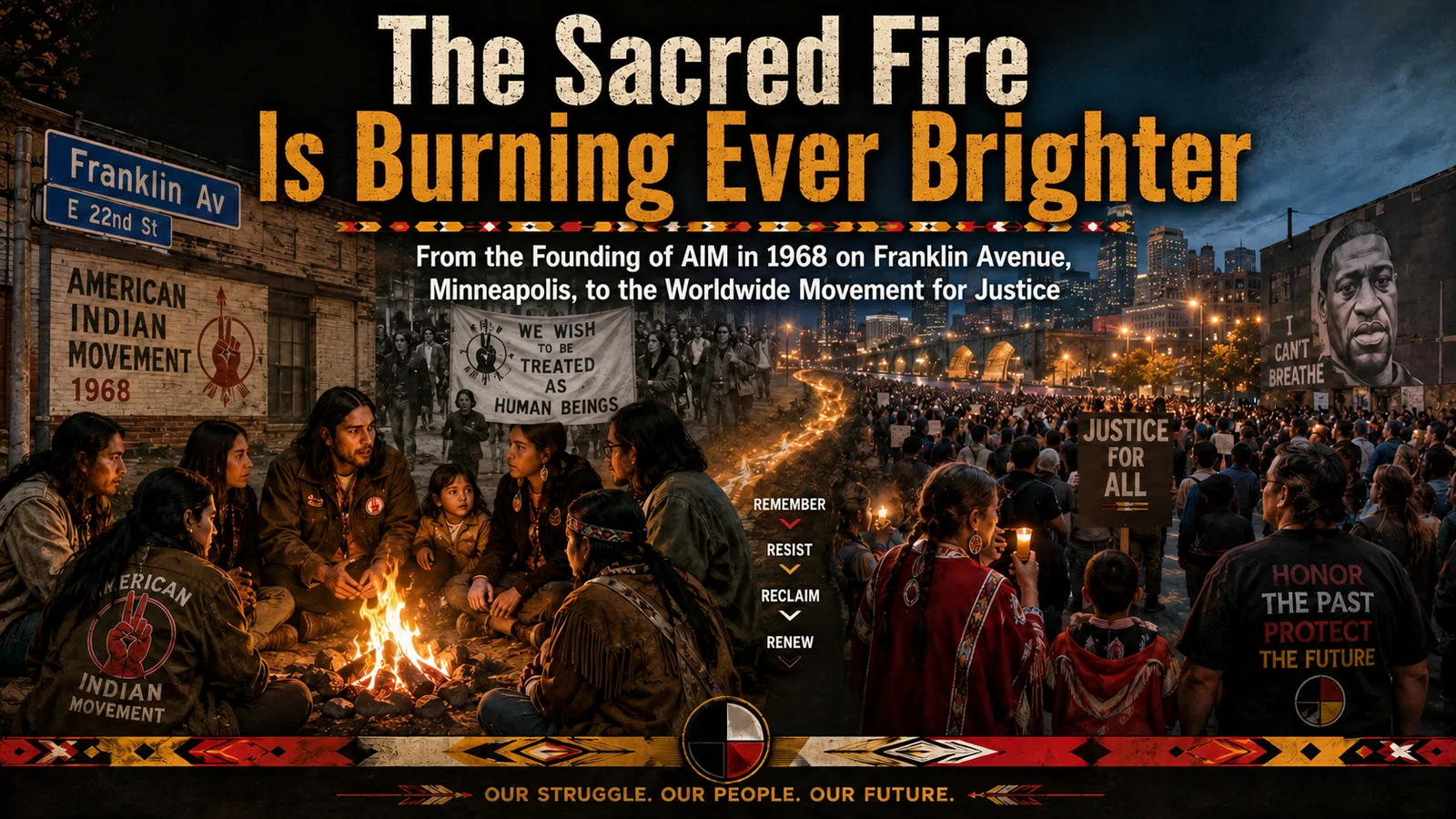
The modern history of Minneapolis cannot be fully understood without first recognizing that the city stands upon the ancestral and continuing homelands of the Dakota people. Long before Minneapolis became known for public demonstrations, peace conferences, civil rights campaigns, or international gatherings, this land was already a sacred place of relationship, responsibility, ceremony, and Indigenous nationhood. Minneapolis remains home to Dakota people and Indigenous relatives from many different Nations.
The names Minnesota and Minneapolis both begin with the Dakota word mní, meaning “water,” reminding us that this region has always been known through its rivers, lakes, waterfalls, and sacred relationship with water. Minnesota comes more directly from the Dakota words Mní Sóta, commonly understood as “clear, sky-tinted water” or “the water that reflects the sky.” Minneapolis, however, is a blended name created later by joining the Dakota word mní, meaning water, with the Greek word polis, meaning city.
Minneapolis therefore means “Water City” or “City of Waters.” This is important because even within the modern name Minneapolis, the ancient Dakota presence remains. The name itself carries a living reminder that the city stands within Mní Sóta Makȟóčhe, the Dakota homeland, the land where the waters reflect the sky.
When we examine Minneapolis as a place where people have repeatedly risen against injustice, we must not begin the story with the murder of George Floyd in 2020, nor with the establishment of the Nobel Peace Prize Forum. We must go further back. We must remember the Indigenous people who gathered in Minneapolis during the 1960s and declared that silence in the face of injustice was no longer acceptable.
The movement that visibly emerged after the mid-1960s had deeper roots. During the federal termination and relocation era, thousands of Indigenous people were encouraged or pressured to leave their reservations and move into cities such as Minneapolis.
They were promised employment, housing, education, and opportunity. Far too often, what they encountered instead was racism, poverty, inadequate housing, unemployment, cultural isolation, police harassment, and separation from their ceremonies, languages, lands, and extended families.
Yet the people did not simply disappear into the urban population, as federal assimilation policies intended. They found one another. They renewed their kinship. They began rebuilding Indigenous community in the heart of the city.
The people brought their memories, spiritual teachings, languages, responsibilities, and love for their Nations with them. Although many had been displaced from their original homelands, the sacred fire of their identity had not been extinguished.
An important cultural and spiritual foundation was already forming by 1962, when Clyde Bellecourt and Eddie Benton-Banai met inside Stillwater State Prison and helped establish the Indian Folklore Club. Even behind prison walls, Indigenous men were reaching back toward their stories, identities, songs, spiritual teachings, and responsibilities.
They understood that physical imprisonment did not have to become spiritual imprisonment. That awakening became part of the foundation from which the American Indian Movement would later arise.
In July 1968, approximately two hundred Indigenous people gathered in Minneapolis. The leading organizers included George Mitchell, Eddie Benton-Banai, Dennis Banks, and Clyde Bellecourt. The larger founding circle included Pat Bellanger, Alberta Downwind, Russell Means, Vernon Bellecourt, and many other mothers, fathers, veterans, young people, workers, spiritual leaders, and community members whose names may never appear in conventional histories.
It is important to remember that only one or two famous individuals did not create the American Indian Movement. It was born from a people. It came out of kitchens, sidewalks, community meetings, courtrooms, jails, and the streets surrounding Franklin Avenue. It arose from the lived experiences of Indigenous families who were tired of seeing their relatives mistreated, arrested, beaten down, and denied their dignity.
What has often been called the Red Power movement was much more than a political protest movement. It was an Indigenous Sovereignty and Spiritual Renewal Movement. Indigenous people were not simply demanding civil rights or seeking inclusion within the American system. They were rising from within their own Nations, ceremonies, treaty memories, spiritual laws, ancestral responsibilities, and sacred relationships with the land.
They declared that Indigenous peoples were not defeated, vanished, or merely minorities awaiting recognition. They were original Nations with living rights, living treaties, living ceremonies, and living responsibilities to future generations.
One of the first actions of the American Indian Movement was not a march on Washington or an occupation of federal land. It was the protection of Indigenous people in Minneapolis. Indigenous residents were experiencing police harassment, mistreatment, and unjust arrests, particularly in the Franklin Avenue area. The people understood that they could no longer wait for outside institutions to protect them. They had to organize themselves.
AIM established a citizen patrol along Franklin Avenue. Volunteers observed encounters between police officers and Indigenous residents, documented arrest procedures, helped de-escalate conflicts, and made themselves available when relatives needed assistance. They carried cameras, radios, tape recorders, and notebooks. They did not simply protest injustice after it happened. They placed themselves between vulnerable community members and possible harm.
This was an ancient Indigenous responsibility taking a new urban form. The patrol was an expression of kinship in action. We protect the people because their lives are sacred, and because no relative should be abandoned when confronted by a powerful institution. The Indigenous people of Minneapolis were among the first in that era to establish a sustained, organized, community-based response to police injustice.
AIM understood that police violence was not an isolated problem. The poverty of urban Indigenous families was connected to the taking of Indigenous lands and the destruction of traditional economies. Family separation was connected to boarding schools, child-removal policies, and forced relocation. Cultural alienation was connected to laws and policies that had suppressed ceremonies, languages, and spiritual practices. The urban wound and the treaty wound were parts of the same historical injury.
Indigenous people were not the only people confronting racial injustice in Minneapolis. African American churches, civil rights organizations, neighborhood groups, labor organizers, and Black community patrols also challenged discrimination and police mistreatment. The complete history must honor all these movements.
Nevertheless, AIM was the earliest sustained Indigenous-led urban movement in the United States to monitor police conduct while connecting local injustice with the larger history of colonization, broken treaties, land theft, forced assimilation, and cultural destruction.
The American Indian Movement did not remain only a protest organization. The people understood that resistance without reconstruction would not be enough. They began creating institutions that answered immediate human needs.
The Indian Health Board provided culturally grounded health services. The Legal Rights Center helped Indigenous and low-income people defend themselves within the legal system. The Heart of the Earth Survival School taught Indigenous children that they were not social problems to be corrected, but sacred human beings carrying the inheritance of living Nations.
These institutions expressed a deeper principle of Development from Within. The people did not wait for outside authorities to rescue them. They recovered their own vision, organized their own resources, restored their relationships, and created structures rooted in their cultural identity. They transformed pain into purpose and resistance into healing.
From Minneapolis, the movement expanded across the continent. AIM became involved in the Trail of Broken Treaties, the occupation of Wounded Knee, treaty-rights campaigns, the restoration of spiritual practices, and the formation of the International Indian Treaty Council.
What began as urban community protection grew into a national and international assertion that Indigenous peoples were not simply racial minorities asking for acceptance. They were original Nations possessing inherent sovereignty, living treaties, spiritual responsibilities, and rights that domestic governments could not legitimately erase.
Within only a few years, the fire kindled in Minneapolis traveled across the continent and eventually reached the United Nations. AIM, Alcatraz, Fort Lawton, the occupation of Wounded Knee, the survival schools, the United Indians of All Tribes Foundation, and the International Indian Treaty Council can be understood as branches of one living tree. The people remembered who they were, organized themselves, protected one another, reclaimed their spiritual foundations, and carried their treaty memory before the world.
The movement later experienced internal divisions, government surveillance, repression, personal conflicts, and organizational fragmentation. Some of the oounders traveled different paths, and different groups continued to use the AIM name. Yet the deeper movement could not be confined to a single organization, office, personality, or historical period. Its legacy lived in the institutions it established, the ceremonies it helped restore, the young people it awakened, the treaties it carried before the world, and the courage it inspired in other communities.
This is where the later history of Minneapolis must be understood. Forty-four years after the founding of AIM, the Nobel Peace Prize Forum became permanently established in the Minneapolis–Saint Paul area in 2012, bringing Nobel laureates, peacebuilders, students, educators, Indigenous representatives, and international leaders together to examine peace, justice, dialogue, human rights, and nonviolence.
That institutional peace work is important, but the moral ground had been prepared much earlier by ordinary people who stood against injustice before the city was internationally celebrated for peacebuilding. Long before internationally recognized peace leaders came to the city, Indigenous people were already demonstrating that peace cannot be separated from justice.
The founders of AIM showed that peace is not passive silence while people are being harmed. True peace requires truth, protection of the vulnerable, accountability for abuses of power, healing of historical wounds, and restoration of right relationship. Peace without justice is often only the temporary quiet created when the suffering of the people has been ignored.
In this sense, AIM helped establish a moral tradition within Minneapolis. When institutions fail to protect the people, the people must organize. When injustice is hidden, witnesses must bring it into the light. When communities are wounded, protest must be joined with healing, education, spiritual renewal, and institution-building.
That moral tradition did not develop in a perfectly straight line, nor did AIM alone create every later justice movement. Each people and each generation brought its own history, suffering, leadership, and vision. Nevertheless, the Indigenous uprising of the 1960s established an important example of community-led resistance to police mistreatment and institutional injustice.
More than fifty years later, on May 25, 2020, George Floyd was murdered by a Minneapolis police officer. His death awakened grief and outrage throughout the world. Minneapolis again became the center of a global demand for justice, police accountability, racial equality, and recognition of the sacred value of every human life.
George Floyd Square became both a place of mourning and a continuing symbol of community resistance, memory, and public conscience. People gathered not only to condemn one terrible act, but also to confront a long history of racial injustice, unequal treatment, institutional violence, and the repeated failure to protect vulnerable communities.
We should not say that AIM directly caused the movement that followed the murder of George Floyd. History is more complex than that. The African American struggle for freedom and justice possesses its own deep history, leadership, sacrifices, and spiritual foundations. Yet there is a profound historical continuity in Minneapolis that deserves recognition.
In 1968, Indigenous people patrolled the streets of Minneapolis because police were mistreating their relatives and no one in authority seemed willing to protect them. In 2020, community members lifted their phones, documented what was happening, gathered in the streets, protected one another, created mutual-aid networks, and carried the evidence of injustice before the world.
The technologies were different, the communities possessed distinct historical experiences, and the circumstances were separated by more than half a century. Yet the underlying principle was similar. When official systems refuse to see the suffering of the people, the people must become the witnesses. When institutions refuse to hear the cries of the wounded, communities must lift those cries until the whole world listens.
The deeper story of Minneapolis is not simply that it became a city famous for protest. It is that communities repeatedly refused to accept the normalization of injustice. Indigenous people, African Americans, immigrants, faith communities, young people, labor organizers, peacebuilders, and many others have added their voices to this continuing moral awakening.
At the same time, we must not romanticize Minneapolis. A place does not become just merely because people protest there or because it hosts an international peace forum. Minneapolis remains a place of both courageous resistance and continuing inequality. Its identity as a center of justice was born precisely because so much injustice had been experienced there.
The true honor belongs not primarily to the city as a government or institution. It belongs to the people who stood up when standing carried a cost. It belongs to the Indigenous families who gathered in 1968, the founders, the unnamed relatives who walked the Franklin Avenue patrols, the mothers who protected the children, the spiritual leaders who kept the ceremonies alive, the young people who entered the survival schools, and the community members who transformed suffering into institutions of healing.
It also belongs to every community that has continued to insist that another human being’s suffering must never become invisible. The moral strength of Minneapolis has not come from buildings, awards, or official declarations alone. It has come from human beings willing to stand beside one another in moments of danger, sorrow, and awakening.
From the Indigenous Sovereignty and Spiritual Renewal Movement, through the Nobel Peace Prize Forum, and into the worldwide awakening following the murder of George Floyd, Minneapolis has become a meeting place of painful contradiction and moral courage. Its history teaches us that justice does not descend from powerful institutions as a gift. It rises from within the people through memory, relationship, spiritual strength, organized participation, sacrifice, and a shared refusal to abandon one another.
The original Indigenous founders lit a fire in Minneapolis during the 1960s. That fire declared that the people were still here, that their rights were living, that their treaties were living, that their ceremonies were sacred, and that injustice would no longer pass unseen. Other communities have since carried their own sacred fires of justice, remembrance, and transformation.
Together, these fires have made Minneapolis not merely a place where injustice occurred, but a place from which the Human Family has repeatedly been called to awaken.