
BY HEREDITARY CHIEF PHIL LANE JR.
Member-Ihanktonwan and Chickasaw Nation
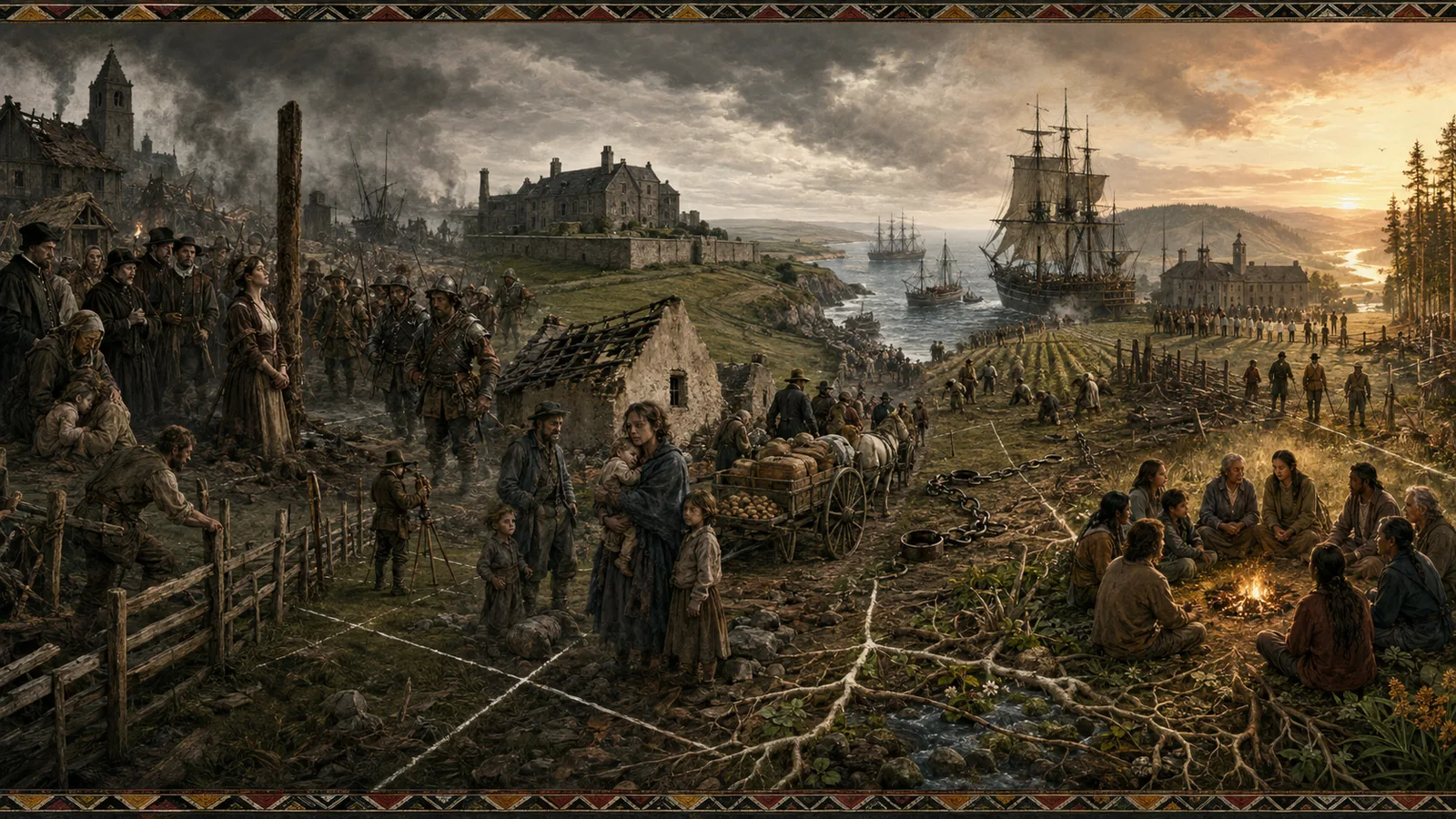
Colonialism did not begin when European ships crossed the Atlantic. Those voyages carried colonialism outward, but its deeper patterns had been developing within Europe for many centuries.
Long before European powers colonized Indigenous Peoples in Africa, Asia, the Pacific, and the Americas, European societies had repeatedly conquered, displaced, enslaved, persecuted, and stratified one another. Monarchs, aristocracies, churches, and emerging commercial interests concentrated land in their hands. Peasants were bound to estates, women were subordinated, religious minorities were expelled or massacred, children were subjected to severe discipline, and armies repeatedly marched across civilian communities.
Colonialism was therefore never simply a geographical project. It was an organized pattern of relationships—a way of understanding power, land, wealth, spirituality, knowledge, and human worth. It grew from the assumptions that those with greater military power may rule those with less power; that land can be converted from a sacred relationship into property; that rulers may define the identity of the ruled; that one religion, culture, race, or civilization may declare itself superior to another; and that human beings, animals, forests, minerals, and waters may be classified primarily as resources.
These ideas did not suddenly appear in 1492. Europe had rehearsed them for generations. The European colonial project eventually combined them with ocean-going ships, firearms, commercial corporations, centralized governments, financial institutions, religious authority, mapping, record-keeping, and racial ideology. Colonialism became prejudice organized through power.
Understanding these roots does not excuse European empires, erase responsibility, or suggest that suffering automatically produces oppression. Most traumatized people do not become colonizers. Human beings also respond to suffering through compassion, courage, solidarity, spirituality, creativity, and service. But unhealed trauma can help explain how fear becomes control, humiliation becomes supremacy, emotional hardness becomes militarism, and insecurity becomes endless accumulation.
This inquiry is not meant to condemn European peoples. It is to understand how unhealed wounds, hierarchical institutions, deliberate economic interests, and ideologies of superiority converged to produce colonial systems that have never entirely disappeared.
Europe Was Also a Continent of Conquered Peoples
There has never been one uniform European people. Europe contains many ancient peoples, languages, territories, spiritual traditions, and histories. Celtic, Slavic, Baltic, Germanic, Nordic, Mediterranean, Basque, Roma, Jewish, Sámi, and many other peoples experienced profoundly different power relationships.
Some European nations became imperial powers. Others were invaded, divided, assimilated, impoverished, or dispossessed by those powers. Within the same society, ruling classes might benefit from empire while peasants and laborers endured exploitation at home. A person could be oppressed within one relationship and later recruited into the oppression of another people.
The Roman Empire established an enduring model of centralized rule, taxation, military expansion, slavery, road building, legal classification, and cultural assimilation. Rome did not invent empire, but its institutional legacy influenced later European kingdoms. Conquered peoples could be absorbed, taxed, enslaved, displaced, or granted conditional membership within the imperial order.
After Rome’s decline, Europe did not become peaceful. Feudal societies developed around fortified power, hereditary hierarchy, land control, military obligation, and obedience. Kings claimed territories, nobles controlled estates, peasants supplied labor and food, and religious institutions frequently legitimized political authority. Human dignity was arranged vertically. Some were born to command, while others were expected to obey.
This vertical arrangement became one of colonialism’s deepest foundations: the belief that humanity naturally forms a hierarchy and that those placed at the top are entitled to determine the lives of those below.
Spiritual Authority Joined to Imperial Power
The teachings of Jesus contain profound calls to love, mercy, humility, justice, and care for people experiencing poverty. Nevertheless, after Christianity became closely joined to imperial and state power, religious authority was frequently used to enforce political conformity.
European rulers learned that controlling belief could help control populations. People declared heretics, pagans, witches, apostates, or enemies of the faith could be imprisoned, expelled, tortured, or killed. The Crusades, inquisitions, forced conversions, religious wars, and persecution of minority communities helped normalize the idea that violence could be sanctified when directed against people classified as spiritually or culturally dangerous.
This does not mean that every Christian participated or agreed. Many Christians defended the oppressed, challenged slavery, cared for the sick, protected Indigenous Peoples, and resisted imperial violence. The danger arose when spiritual authority, centralized government, economic ambition, and military force became intertwined.
Once rulers could declare that conquest served God, they could present domination as salvation. When European authorities later encountered Indigenous medicine people, ceremonial leaders, women knowledge keepers, and land-based spiritual traditions, they frequently used categories already developed within Europe: witchcraft, superstition, savagery, idolatry, and devil worship.
Papal documents including Dum Diversas of 1452, Romanus Pontifex of 1455, and Inter Caetera of 1493 supplied language later used by competing Christian powers to justify claims over non-Christian lands. In 2023, the Vatican repudiated the legal and political concept known as the Doctrine of Discovery, acknowledged the terrible consequences of dispossession and forced assimilation, and rejected the belief that one culture is entitled to consider itself superior to another.
That repudiation is significant, but the laws, property systems, boundaries, institutions, and national stories built through the colonizing worldview have not automatically disappeared.
The Black Death and a Continent Overwhelmed by Loss
Between 1347 and 1351, the Black Death killed an immense proportion of Europe’s population, commonly estimated at approximately one-quarter to one-third, although its effects varied by region. It also devastated communities across Asia, the Middle East, and North Africa.
The emotional reality is almost impossible to comprehend. Villages were emptied, families disappeared, children lost parents, parents buried children, crops were abandoned, and existing spiritual explanations seemed unable to contain the catastrophe.
Europe possessed rituals of mourning, traditions of mutual care, and communities of faith. But there were no widespread trauma services or publicly supported processes through which millions of survivors could safely grieve and understand what had happened. Terror was also expressed through silence, fatalism, punishment, and scapegoating.
Jewish communities were falsely blamed for spreading the plague and subjected to massacres and expulsions. Other marginalized people were blamed for disasters they had not caused. A pattern emerged that would return repeatedly: when a society cannot understand or heal overwhelming fear, it may project that fear onto a designated outsider.
The unhealed question becomes: Who can we blame so that we do not have to face our helplessness? That question lies beneath many later persecutions and colonial projects.
The Witch Hunts and the Destruction of Women’s Authority
From approximately 1450 to 1750, tens of thousands of people were executed for witchcraft in Europe, the great majority of them women. Modern historical estimates commonly place the number of executions between 40,000 and 60,000.
The witch hunts were not merely random outbreaks of superstition. They occurred within societies struggling with religious conflict, economic transformation, political centralization, disease, crop failure, social anxiety, and profound uncertainty. Poor, elderly, widowed, isolated, unconventional, or socially vulnerable women were especially exposed.
Traditional healing, midwifery, land-based knowledge, and women’s informal authority could become objects of suspicion. However,h it would be historically inaccurate to say that every accused woman was a healer or knowledge keeper. The wider pattern was unmistakable: fear was regulated through accusation, surveillance, forced confession, punishment, and public violence.
A society that teaches people to distrust women’s knowledge, fear the natural world, suppress the body, and interpret difference as dangerous is already constructing part of the psychological architecture of colonialism. What had first been directed inward was later carried outward.
War, Militarization, and the Formation of the Colonial State
European nations were shaped through centuries of warfare. Borders moved repeatedly. Populations were taxed, conscripted, displaced, starved, and disciplined to sustain armies.
The Thirty Years’ War from 1618 to 1648 was among Europe’s most destructive conflicts. Vast areas of Central Europe suffered through battle, famine, disease, displacement, and the collapse of local economies. The First and Second World Wars later carried industrialized European warfare to an almost unimaginable scale, leaving tens of millions dead and entire populations traumatized.
War did more than kill. It helped form the modern centralized state. Governments developed stronger systems of taxation, borrowing, record-keeping, surveillance, conscription, policing, and administration because they needed to finance and organize increasingly expensive military campaigns.
These same capacities became instruments of empire. Naval forces protected commercial expansion. Tax systems extracted wealth from colonies. Censuses classified colonized populations. Maps converted homelands into imperial territories. Schools reshaped children’s identities. Police and armies suppressed resistance. Bureaucracies made dispossession appear legal and orderly. Financial systems spread the costs of conquest while concentrating its profits.
Colonialism was not simply an attitude of superiority. It was superiority equipped with ships, weapons, corporations, banks, churches, courts, schools, maps, prisons, and administrative records.
From Enclosing European Lands to Seizing Indigenous Homelands
Within Europe, especially in Britain, commonly used lands were gradually enclosed and converted into exclusive private property. Families that depended on customary relationships with fields, forests, and pastures were separated from those lands and increasingly forced into wage labor, migration, poorhouses, factories, or military service.
The relationship between European enclosure and overseas colonization should not be reduced to a single cause. Nevertheless, both expressed a growing worldview in which land could be surveyed, fenced, titled, commodified, and controlled by those recognized by the state as its lawful owners.
Indigenous Peoples did not lack land tenure systems. They maintained sophisticated laws, responsibilities, boundaries, seasonal agreements, kinship obligations, and relationships with particular territories. But these did not always resemble European individual property systems. European powers therefore frequently declared that Indigenous lands were empty, unused, insufficiently developed, or available for occupation.
The colonizer first changed the definition of land. Once land became merely property, the people’s sacred relationship with it could be made legally invisible.
Mother Earth was no longer approached primarily as a living relative and sacred trust. Land became real estate, forests became timber, animals became commodities, rivers became power, mountains became minerals, and human beings became labor.
It was within this developing European world that Ireland became one of the clearest and most consequential examples of colonialism practiced upon a European people.
IRELAND: COLONIALISM PRACTISED WITHIN EUROPE
An Ancient People Subjected to a Long Colonial Process
Ireland offers a powerful example of how colonial methods were developed and rehearsed within Europe before being carried across the Atlantic. The Irish were an ancient people with their own languages, laws, clan relationships, spiritual traditions, educational systems, political authorities, and profound connection to particular territories.
Their experience shows that colonialism was never based solely on skin color. At its heart, colonialism is a system in which one people claims authority over another people’s land, government, culture, economy, identity, and future.
English involvement in Ireland began with the Anglo-Norman invasion during the twelfth century, but conquest was not a single event. It unfolded unevenly over centuries. English-controlled territory expanded and contracted, while much of Ireland continued under Gaelic laws, clan relationships, and traditional leadership.
From the sixteenth century onward, the English Crown intensified its effort to bring the entire island under centralized control. The objective was not merely to defeat Irish armies. It had to break Gaelic political authority. The Crown had to replace clan and community land relationships with titles it recognized. Irish legal traditions were subordinated to English law. The Irish language and traditional systems of learning were marginalized. Loyalty to the monarch and conformity with the established religious order became measures of political acceptability.
Land was central because it underpinned sustenance, identity, governance, kinship, and continuity. Once the Crown claimed authority to redefine Irish land according to English law, relationships that had existed for centuries could be declared invalid.
The colonial power changed the definition of ownership and then used that new definition to declare itself the lawful owner.
Plantation: A Model of Settler Colonialism
Following military resistance, large areas of Irish land were confiscated and transferred to English and Scottish settlers through organized plantations. These were not simply agricultural developments. They were settler-colonial projects designed to establish populations whose land, economic security, religious identity, and political interests would bind them to the Crown.
The Plantation of Ulster became especially consequential. Settlers, primarily from England and Scotland, were granted lands formerly controlled by Gaelic Irish leaders and communities. Settlers established new towns, property systems, institutions, and authorities. Indigenous Irish families were displaced, reduced to tenants, confined to poorer lands, or compelled to live under an order created without their consent. Settlers were not a uniform group, and their descendants cannot be held personally responsible for decisions made before their birth. Many settler families also endured insecurity, political manipulation, and violence. Nevertheless, the colonial structure gave them a different relationship to land and governing power than the dispossessed population.
Ireland reveals the method clearly. The state declared Indigenous political authority illegitimate, redefined the land under its own laws, transferred it to a population connected to the colonial power, and protected the new arrangement through soldiers, courts, churches, and administrative institutions.
Resistance to dispossession was then described not as defense of a homeland but as rebellion, disorder, criminality, or fanaticism. Colonial violence became invisible because it was carried out through recognized institutions, while Irish resistance was presented as the only violence.
The Cromwellian Conquest and Mass Dispossession
The Cromwellian conquest during the 1640s and 1650s was among the most traumatic episodes in Irish history. Massacres, the killing of captured soldiers and Catholic clergy, destruction of crops and infrastructure, famine, disease, forced transportation, and enormous population loss accompanied warfare.
Civilian suffering was not merely incidental. The destruction of food, shelter, infrastructure, and the means of community survival became part of the military process. Famine and disease devastated entire regions.
Following victory, extensive lands belonging to Irish Catholics were confiscated. Thousands of landowners, families, and dependants were displaced, particularly from fertile eastern territories. Protestant soldiers, creditors, and settlers received confiscated estates. Irish men, women, and children were transported across the Atlantic, including to Caribbean colonies, where many endured extreme conditions as prisoners or indentured laborers.
Military conquest was followed by legal dispossession. Legal dispossession was followed by settlement. Settlement was protected through a hierarchy that placed the colonizer above the colonized.
The Irish were increasingly portrayed as backward, disorderly, violent, irrational, and incapable of governing themselves. If the Irish could be represented as inferior, confiscating their land could be called improvement. If their resistance could be represented as primitive violence, colonial violence could be called civilization.
The Penal Laws and a Hierarchy of Belonging
Conquest was reinforced through laws that made religious identity a basis for political, economic, and social privilege. The Penal Laws imposed serious restrictions upon Roman Catholics and, during some periods, Protestant dissenters.
Catholics faced restrictions involving land ownership, inheritance, education, voting, public office, law, weapons, and religious practice. The laws changed over time and were not enforced uniformly. Still, their cumulative effect preserved political and economic power in the hands of the Protestant Ascendancy and prevented the Catholic majority from regaining control of Ireland’s land and institutions.
This created a hierarchy of belonging. One portion of the population enjoyed greater access to land, education, authority, employment, and legal protection. Another lived under systematic restriction and insecurity.
Colonial power governed by distributing vulnerability and protection. It offered selected people security as long as their interests remained tied to the system’s continuation. The dispossessed feared the institutions that had taken their lands and suppressed their identity. Settler communities feared that losing colonial protection might mean losing their security, culture, property, or lives.
Political leaders could then manipulate those fears and persuade each community that the other was the principal danger. The colonial structure that created the unequal relationship disappeared from view.
Divide and Rule
Divide and rule does not mean a colonial government invents every difference among a people. Ireland already contained regional, political, class, linguistic, and religious differences. Colonialism hardened those differences, attached unequal power to them, and repeatedly used them to prevent a united challenge to external control.
Catholics were set against Protestants, tenants against landlords, settlers against the dispossessed, English speakers against Irish speakers, and communities seeking independence against communities fearful of what independence might mean.
Not every Protestant was a colonizer,r and not every Catholic held the same political beliefs. Many Protestants supported Irish independence, social equality, land reform, and reconciliation. Some Catholics entered governing and property systems. Human lives cannot be reduced to two opposing categories.
The colonial pattern operated by making identity politically decisive. Instead of asking what system had placed them in an unequal relationship, people were encouraged to ask which neighboring community threatened them.
Political divisions became family memories. Family memories became collective identities. Collective identities became sacred stories about innocence, suffering, betrayal, and danger. Each generation inherited not only an account of what happened but an emotional instruction on whom to fear.
The Great Hunger: One Million Dead and a People Scattered
The Great Hunger—An Gorta Mór—from 1845 to 1852 must be understood in human terms. Before the catastrophe, Ireland had approximately 8.2 million people. Within only a few years, about one million human beings died from starvation and famine-related disease. At least another million fled during the central Famine years. Across the broader Famine decade, approximately 1.5 to 2 million people left Ireland.
Within roughly a decade, Ireland lost close to one-quarter of its people through death and migration. This was not gradual demographic change. It destroyed and dispersed families, villages, parishes, language communities, and ways of life.
The population fell from approximately 8.2 million in 1841 to about 5.4 million by 1871. In the territory that later became the Republic of Ireland, the population fell by about half between 1841 and 1901. Decline continued into the twentieth century. The Republic’s population did not begin recovering consistently until after 1961 and did not exceed five million again until 2022.
National figures conceal local devastation. County Mayo’s population fell from 388,887 in 1841 to 274,830 in 1851, almost 30 percent in ten years. Some localities lost far more. Homes became empty, children disappeared from communities, and families whose ancestors had lived in the same places for generations were scattered worldwide.
Approximately one person out of every eight died. Another one out of every eight—or more—left during the immediate catastrophe. These were not statistics. They were farmers, fishers, storytellers, musicians, knowledge keepers, mothers, fathers, Elders, young people, and children.
The Blight Was Natural; Mass Death Was Political
The potato blight was real. Britain did not create it, and it affected crops elsewhere in Europe. But other countries did not experience the same combination of mass starvation, eviction, and population dispersal.
The blight explains why the potato failed. It does not adequately explain why approximately one million people died within a country that continued producing food and was governed by the wealthiest empire in the world.
A famine is not simply an absence of food. It occurs when human beings lose access to food. Millions of Irish people depended on very small rented holdings. Potatoes could sustain a family from a small area of poor soil, while rent and other agricultural production served landlords and commercial markets. When the potato failed, families lost their main food source. They had little money, insecure land rights, and almost no power over the institutions governing their survival.
Ireland continued producing grain, cattle, butter, and other foods. Exports declined in some categories and imports eventually rose, particularly maize. It would therefore be inaccurate to say that every source of food was exported or that no food entered Ireland.
Nevertheless, considerable food continued to leave while people starved. More than three million live animals were exported between 1846 and 1850. In Black ’47, calf exports to Britain were approximately one-third greater than the year before.
The essential issue was ownership and access. Food moved according to property rights and commercial demand. Starving families lacked the money to buy it and the political authority to stop it from leaving. People starved beside fields, livestock, roads, ports, and ships carrying food.
Britain possessed the money, ships, administration, military power, and international reach necessary to prevent mass starvation. Relief measures were undertaken and saved lives. But authorities repeatedly subordinated survival to property rights, market doctrine, fiscal restraint, and a determination to restructure Irish agriculture.
Was the Catastrophe Used Deliberately?
There is no reliable evidence that the British government created the potato blight or began the Famine through a secret plan to exterminate the Irish population. Most historians therefore do not classify the entire Great Hunger as genocide in the strict modern legal sense, which requires evidence of an intention to destroy a protected group as such.
But this does not settle the deeper question. There is compelling evidence that officials knew mass death, eviction, consolidation of land, and emigration were occurring. There is also evidence that influential officials interpreted the catastrophe as an opportunity to reconstruct Irish society and continued policies that facilitated the disappearance of impoverished smallholders from the land.
The evidence does not clearly establish: “We created this famine to kill the Irish.” It does support a chillingly different conclusion: “This catastrophe is removing the population and land system we consider undesirable, and we should not interfere too greatly with that transformation.”
That distinction matters legally, but it offers little moral comfort to the dead.
A Famine Regarded as an Opportunity
Sir Charles Edward Trevelyan, the senior Treasury official most closely associated with administering Famine relief, is central to understanding official thinking. He did not publicly call for extermination and sometimes stated that people should not be permitted to starve. The government supported measures that saved many lives.
At the same time, Trevelyan interpreted the Famine as a providential opportunity to transform Ireland. In his 1848 defense of government policy, The Irish Crisis, he described the Famine as a “sharp but effectual remedy” for what he regarded as Ireland’s social disorder.
These words show that the senior administrator did not see the catastrophe only as a human emergency to be stopped. He also saw it as a force capable of destroying an Irish agricultural and social systemthat British policymakers wanted changed.
Influential officials believed that Ireland contained too many small tenant farmers. They wanted holdings consolidated, agriculture commercialized, landlord obligations reorganized, and the rural population reduced or redirected into wage labor and emigration.
A starving family became part of a “surplus population.” A community’s ancestral relationship with land became an inefficient holding. Removing families became estate improvement. Emigration became a solution to overpopulation. Colonial language translated suffering into an administrative problem and described disappearance as progress.
Trevelyan’s private correspondence indicated that the departure of small farmers and transfer of estates to people with capital might produce a more satisfactory settlement of Ireland. This does not prove a plan to murder one million people. It does show that a leading official viewed the disappearance of small farmers as a potentially beneficial outcome.
The objective was not necessarily to remove every Irish person. It was to remake Ireland into a society considered more commercially productive, politically manageable, and compatible with British assumptions about property. In practice, this required enormous numbers of low-income families to cease occupying the land. Some died, some entered workhouses, some became landless laborers, some were evicted, and others emigrated.
These human tragedies were absorbed beneath the language of restructuring.
Relief Was Possible—and Then Restricted
The British government did do nothing. Prime Minister Robert Peel’s government purchased Indian corn from the United States, supported public works, and altered trade policy. Private organizations, spiritual communities, international donors, and ordinary people also gave essential help.
In 1847, a temporary soup-kitchen system fed approximately three million people at its height. This demonstrates that large-scale direct relief was possible. When food was provided without forcing people already weakened by starvation to perform punishing labor, millions could be reached.
But the soup kitchens were temporary. They closed after only several months even though the emergency continued. Responsibility was shifted increasingly to the Irish Poor Law and local taxation, placing the burden upon districts whose people and economies were already devastated.
Britain sought to restrict the imperial Treasury’s long-term responsibility. Ireland, already starving, was increasingly expected to finance its own survival. The principle was often summarized as “Irish property must pay for Irish poverty.” But much Irish property had been accumulated and controlled through conquest, confiscation, plantation, and unequal landholding. Those in greatest need possessed little or none.
The government placed the cost of relief on the very structure that was collapsing,d then treated the collapse as evidence that Ireland required more restructuring.
Relief in Exchange for Land
One of the clearest examples of relief facilitating land clearance was the Poor Law Extension Act of 1847 and its Gregory Clause, also called the quarter-acre clause.
Under this provision, a person occupying more than one-quarter acre generally could not qualify for public relief. A starving tenant faced an impossible choice: retain the small piece of land representing the family’s only future security, or surrender almost all of it to become eligible for help that might preserve life today.
Some refused and starved. Others surrendered their land only to find aid inadequate or unavailable. In some cases, dwellings were demolished after families left to seek assistance so they could not return.
Historical scholarship widely recognizes that the clause helped landlords clear estates of impoverished tenants who could not pay rent. This was not an unintended effect of plant disease. Legislation was debated, enacted, and enforced during mass starvation.
The law connected food relief to surrendering land. When a government tells a starving colonized family to relinquish its remaining land before receiving food, the resulting dispossession cannot honestly be described as a natural disaster.
Evicted While Starving
Even as people died, tenants unable to pay rent were removed from their homes. Landlords tore away roofs and demolished dwellings so families could not return. People weakened by hunger were forced onto roads, into overcrowded workhouses, toward ports, or aboard ships leaving Ireland.
Landlords did not all behave alike. Some made sincere efforts to assist tenants. Some became financially overwhelmed. Others carried out brutal clearances. The system itself, however, permitted families to be dispossessed at the moment when they were least capable of surviving removal.
Official police records counted nearly 250,000 people evicted between 1849 and 1854, but systematic recording began after the catastrophe was already underway and excluded many pressured into supposedly voluntary surrender. Some historical estimates suggest more than half a million may have been evicted or compelled to relinquish their holdings during the Famine and its aftermath.
Landlords sometimes financed emigration because sending a family across the Atlantic could cost less than supporting it through local poor rates. This could be described officially as assisted or voluntary emigration. But when the choices were starvation, eviction, a workhouse, or departure, the word voluntary loses much of its meaning.
A person may board a ship without being physically carried aboard. But if the conditions necessary to remain alive at home have been withdrawn, departure is not truly free. Colonial systems frequently conceal compulsion behind the appearance of consent.
A People Scattered Across the World
The Irish traveled to England, Scotland, Canada, the United States, Australia, New Zealand, Argentina, South Africa, and many other places. Some crossed the Atlantic aboard overcrowded vessels remembered as coffin ships because disease, hunger, and terrible conditions killed passengers during the voyage. Survivors often arrived impoverished, grieving, and unwelcome. They did not carry only suitcases. They carried memories of empty homes, mass graves, eviction, hunger, separation, and helplessness. They carried the names of places they might never see again. Parents carried guilt over relatives left behind. Children carried stories of grandparents they had never known. Families carried fear that someone could take away food, land, security, and belonging again.
This helps explain why Irish identity became so widespread and strongly preserved. Music, storytelling, dance, faith, humor, political organization, family loyalty, and communal gathering places kept Ireland alive when millions could no longer remain upon Irish land.
Today an Irish pub can be found in almost every major city and in many distant corners of the world. Its worldwide presence is not statistical proof, but it is a living cultural sign of an extraordinarily dispersed people. At their best, such gathering places offered emigrants and descendants a piece of home where Irish names, stories, music, humor, sorrow, and belonging could survive.
The Irish did not spread across Mother Earth only because they were adventurous travelers. Millions were driven outward by starvation, eviction, landlessness, political subordination, and destruction of the conditions required to remain at home.
Cultural Suppression and the Survival Decision
Colonialism also wounded the Irish language and transmission of culture. English became increasingly necessary for government, commerce, education, employment, and emigration. Irish became associated with poverty and exclusion, while English became associated with advancement and survival. The Famine struck especially hard in western and southern districts where the Irish language remained strong.
Some families stopped teaching Irish to their children not because they hated their language but because they feared it would condemn the next generation to poverty. What appeared to be voluntary cultural change occurred under profound inequality.
This pattern would later appear throughout the colonial world. Parents learned that children might survive more easily if they spoke the colonizer’s language, accepted the colonizer’s education, adopted the colonizer’s religion, or concealed their Indigenous identity.
One generation’s survival strategy became the next generation’s cultural loss. Colonialism induced people to participate in assimilation by making abandonment of identity appear to be the price of protecting their children.
Genocide, Colonial Atrocity, and Responsibility
Because no conclusive evidence has been found of a governmental plan to destroy the Irish people as a national or ethnic group, most academic historians do not define the entire Great Hunger as genocide in the strict legal sense. Other scholars, legal commentators, and descendants of survivors argue that destructive intent can be inferred from official knowledge, anti-Irish prejudice, continued lethal policies, food movement, land clearances, and statements welcoming the transformation produced by the catastrophe.
Whatever conclusion is reached about the word genocide, the debate must not conceal what is certain. The Great Hunger was a colonial mass-death catastrophe involving preventable death, structural violence, forced displacement, land clearance, cultural destruction, and policies that placed property, markets, ideology, and fiscal restraint above human survival.
Britain did not cause the fungus. Britain governed the people who were dying from it. The British government controlled law, trade policy, relief administration, taxation, military power, and the landholding framework. It possessed the resources of a global empire. It knew people were starving, families were being evicted, food was moving through Irish ports, workhouses were overwhelmed, and ships were carrying away a desperate population.
Yet its leaders repeatedly chose restricted relief, fiscal restraint, market discipline, property protection, land consolidation, and landlord-centered restructuring.
The authorities did not have to write an order saying, “Kill the Irish.” When a government knowingly preserves conditions producing mass death because those same conditions are producing a desired economic and political transformation, responsibility is already present.
The blight created the emergency. Centuries of dispossession created the vulnerability. British policy transformed vulnerability into catastrophe. Influential officials then used the catastrophe to accelerate removal and dispersal.
This was more than incompetence and more than indifference. It was colonial social engineering conducted in the presence of foreseeable and observed mass death.
How Colonial Trauma Turned Irish People Against One Another
Centuries of conquest, plantation, religious privilege, land inequality, rebellion, repression, famine, and displacement left communities with different collective memories. Catholic and nationalist communities remembered conquest, confiscation, suppression, starvation, eviction, and denial of self-government. Protestant and unionist communities, particularly in Ulster, often carried fears that separation from Britain would leave them threatened, powerless, dispossessed, or subject to retaliation.
Both could understand themselves as endangered, and political forces mobilized those fears. Partition in 1921 did not create every division, but it drew a boundary through a land already carrying centuries of unresolved trauma. People became political majorities or minorities according to which side they occupied.
The conflict later known as the Troubles cannot be reduced to ancient religious hatred. Religion had become intertwined with land, settlement, civil rights, policing, economic opportunity, sovereignty, political power, national identity, and collective memory.
This is the terrible effectiveness of divide and rule. Long after formal colonial arrangements change, divided people may continue conflict among themselves. The outside power no longer needs to create every confrontation because trauma has been internalized.
A wound that began between colonizer and colonized becomes a wound between neighbors. It enters families, schools, workplaces, churches, political parties, commemorations, neighborhoods, and stories told to children. Each community remembers what was done to its people while struggling to hear the other’s full suffering.
The Colonized Can Be Recruited into Colonization
Being colonized does not automatically free a person from colonial behavior. Many Irish emigrants became allies of Indigenous Peoples, abolitionists, labor organizers, and justice advocates. Others joined colonial armies, police forces, churches, governments, and settler societies. Some participated in the displacement and assimilation of Indigenous Peoples.
A person can be oppressed within one relationship and become an oppressor within another. A people can carry genuine wounds while some members wound others.
Unhealed trauma does not always produce solidarity. It may create a desperate search for acceptance within the dominant society. An immigrant treated as inferior may seek safety by distancing themselves from another people placed lower within the colonial hierarchy. The unspoken bargain becomes: If I prove that I belong, perhaps I will no longer be treated as unwanted.
Colonial hierarchies reproduce themselves by offering conditional advancement to some oppressed people if they accept the continued subordination of others.
Yet Irish history also contains profound compassion across cultures. The gift the Choctaw people sent to assist the Irish during the Great Hunger became an enduring sign of solidarity between peoples who recognized suffering across a vast distance. That sacred relationship reminds us that historical trauma does not have to end in competition or repeated domination. It can become a foundation for kinship and mutual care.
Ireland’s Intergenerational Wound and Healing
The Great Hunger became an intergenerational trauma carried throughout Ireland and its global diaspora. Survivors learned that security could disappear without warning and that land, food, livelihood, and belonging could be taken. Families developed commitments to land ownership, education, financial security, political organization, and family loyalty. These could be healthy resilience, but they could also become fear-driven when grief remained unspoken.
Silence became part of the inheritance. Families did not always speak openly about starvation, eviction, humiliation, the death of children, or the circumstances under which relatives departed. Descendants could inherit the emotional atmosphere without knowing the complete history.
One million deaths were not merely one million individual tragedies. Every death affected parents, children, siblings, grandparents, neighbors, and descendants. One million emigrants were not merely one million travelers. Their departure created countless broken family circles, and relationships stretched across oceans.
The Irish survived, but survival and healing are not identical. Their music, humor, stories, spirituality, political determination, languages, family bonds, and love for Ireland survived. Beneath this magnificent resilience remained immeasurable grief: a people living upon a fertile and beautiful homeland had been left unable to feed, house, and protect their own children.
Ireland shows that colonialism wounds everyone within its field, though not equally or in the same way. The dispossessed carry the direct wounds of conquest, poverty, cultural suppression, famine, eviction, and displacement. Settler communities may inherit fear, defensiveness, isolation, and dependence upon structures of privilege. Later generations inherit stories telling them who suffered, who belongs, who betrayed whom, and whom to fear.
Healing requires more than changing a flag or government. It requires transforming the relationships conquest created. The Irish peace process demonstrates that even conflicts reinforced by centuries of grief can change when people recognize one another’s humanity, establish fair political arrangements, protect different identities, confront inequality, and replace domination with dialogue.
Healing remains incomplete, but movement away from widespread violence shows that history is powerful without being destiny. Unity cannot be imposed by suppressing difference or demanding forgetfulness. It must be built through truth, justice, equality, consent, cultural respect, and protection of every community’s dignity.
Ireland is therefore both a warning and a source of hope. It warns that unhealed conquest can remain within a people for centuries. It also shows that divided peoples can tell the truth without using history as a weapon, remember their dead without creating new graves, honor distinct identities without denying shared humanity, and refuse to pass the full burden of inherited fear to the next generation.
Ireland makes visible the bridge between Europe’s internal systems of domination and the colonial structures later projected worldwide.
FROM IRELAND TO GLOBAL EMPIRE
Commerce Joined Conquest
European colonialism was made possible by a powerful partnership among monarchies, armies, navies, investors, banks, churches, and chartered corporations.
Organizations such as the British and Dutch East India Companies were not ordinary businesses. They could maintain armies, negotiate treaties, control territories, collect taxes, monopolize trade, and wage war. Private accumulation and national expansion became mutually reinforcing.
Ireland had already demonstrated how land could be confiscated, planted with settlers, protected by state power, and reorganized for external interests. The Atlantic world expanded these practices across vastly greater territories and joined them to racial classification and commercial slavery.
The transatlantic slave trade depended upon European law, finance, shipping, insurance, military protection, and markets. It was not merely a collection of cruel acts. It became an economic system supported by states and foundational to wealth accumulation in parts of Europe and the Americas.
A profound moral separation became necessary. European societies celebrated liberty, Christianity, civilization, and reason while benefiting from Indigenous dispossession and African enslavement.
A nation could call itself civilized while committing violence at its boundaries. A church could proclaim universal love while participating in forced assimilation. A family could enjoy goods produced through slavery without seeing the suffering that made those goods possible.
This resembles the division trauma can create between outward appearance and inner reality. Public ideals concealed the human cost that built prosperity.
Colonialism as Unhealed Trauma Organized into Power
Trauma alone does not cause colonialism. Colonialism required conscious decisions, material interests, doctrines of superiority, political institutions, military technologies, and people willing to benefit from domination. Responsibility cannot be erased by saying colonizers were wounded.
But trauma helps us understand how domination became normalized and transmitted. A child taught never to cry may convert grief into hardness. A people repeatedly invaded may believe that security requires controlling others. A society organized through hierarchy may mistake obedience for unity. A nation terrified of disorder may construct systems of surveillance and punishment. A population taught that difference means danger may demand cultural conformity. A ruling class measuring worth through property and status may treat accumulation as proof of superiority.
When these patterns become institutionalized, personal woundedness becomes political structure. Fear becomes militarism. Insecurity becomes accumulation. Humiliation becomes supremacy. Spiritual disconnection becomes material conquest.
Colonialism can therefore be understood in part as unhealed trauma organized into institutions and projected onto other peoples. This understanding explains behavior but does not excuse it. Healing must always include responsibility, justice, and transformation.
Colonialism Changed Form but Did Not Disappear
Formal colonial rule ended across much of the world, but formal independence did not automatically dismantle colonial relationships. The United Nations continues to identify seventeen Non-Self-Governing Territories whose peoples have not completed decolonization.
More importantly, colonial patterns survive through unequal trade, debt, corporate extraction, military domination, technological dependency, cultural control, imposed development, information power, and international institutions in which some nations possess far greater authority than others.
Colonialism also continues within former settler colonies through land law, resource extraction, child-welfare systems, prisons, education, policing, and policies treating Indigenous jurisdiction as secondary to the authority of the colonial state.
The flag may change while the relationship remains. The language may change from civilizing to developing, from conquering to stabilizing, or from empire to security. The fundamental question remains: Who possesses the power to decide, and whose consent, knowledge, land, and life can be disregarded?
Colonialism persists wherever powerful institutions assume they may determine what is best for other peoples without those peoples’ full and equal participation.
We Must Not Transfer Collective Guilt
European people alive today did not personally create every crime associated with European empires. Many descend from peasants, laborers, refugees, religious minorities, persecuted women, and peoples who were themselves colonized or displaced.
Healing cannot be constructed by reversing the hierarchy and declaring European people inherently violent or morally inferior. That would reproduce colonial thinking in another form.
The present generation’s responsibility is not inherited personal guilt. It is inherited relationship and responsibility. People inherit institutions, laws, wealth, advantages, national stories, silences, fears, and patterns without personally choosing their origins. Once we recognize those inheritances, however, we must determine what needs to be healed, corrected, returned, repaired, transformed, or ended.
The purpose of truth is not humiliation. It is liberation from unconscious repetition.
THE HEALING OF COLONIALISM
Truth Before Reconciliation
Europe and the European diaspora need healing processes equal in seriousness to the damage colonialism caused. This healing must never replace justice for colonized peoples or recentre Europe as the primary victim. European healing becomes meaningful when it helps end domination and restore right relationships.
Healing must begin with truth. European nations need to teach their complete histories—not only exploration, empire, national greatness, and scientific accomplishment, but enclosure, religious persecution, slavery, stolen land, forced labor, cultural destruction, famine policy, racial ideology, and resistance.
Historical truth must include both individual complexity and structural clarity. Some members of colonizing societies resisted injustice, while some members of oppressed peoples participated in colonial institutions. These complexities do not erase the larger systems that distributed power, land, vulnerability, and advantage.
Truth makes it possible to distinguish guilt from responsibility. It lets descendants acknowledge what happened without pretending they personally committed it and accept responsibility for transforming what remains.
Grieving What Europe Never Grieved
European communities need spaces in which descendants of conquerors and conquered peoples can acknowledge centuries of war, plague, religious terror, poverty, displacement, patriarchy, industrial exploitation, and emotional suppression. Little evidence shows Europe ever undertook a healing process on a scale commensurate with these accumulated wounds. Societies endured catastrophe, rebuilt institutions, expanded economies, and carried on. Survival was often achieved through silence, discipline, emotional restraint, nationalism, militarization, or projection of pain onto outsiders.
Unacknowledged grief may become fear. Fear may become control. Control may become violence. The inability to mourn can become the compulsion to dominate.
Healing does not mean remaining trapped in sorrow. It means creating safe ways to acknowledge loss so it no longer unconsciously governs behavior. It means learning again that tears are not weakness, tenderness is not surrender, and vulnerability does not remove dignity.
Justice, Restitution, and Right Relationship
Healing cannot consist only of emotional reflection. It requires responsibility in the material world. This includes treaty implementation, recognition of Indigenous sovereignty, restoration of land and sacred belongings where possible, reparative measures, fair economic relationships, institutional reform, and ending policies that continue dispossession.
If trauma is treated without confronting the structures that reproduce it, society removes symptoms while protecting their causes. Colonial healing must therefore address both the wound and its surroundings.
Justice does not oppose reconciliation. Justice creates the conditions for genuine reconciliation. Unity imposed without truth, protection, or equitable relationships is performative unity. It asks wounded people to enter the same room while the structure that injured them remains untouched.
Restoring Relationship with Mother Earth
Colonialism will continue as long as the natural world is treated primarily as an inventory of commodities. Ecological healing requires a transformation from unlimited ownership toward sacred responsibility within limits.
This does not require rejecting science, technology, trade, or all forms of property. It requires restoring right relationship among human needs, the rights of peoples, the living systems of Mother Earth, and the generations yet to come.
Indigenous knowledge offers essential guidance because it begins from relationship rather than separation. Land is not merely a possession. Water is not merely a commodity. Animals are not merely units of production. The Earth is a living community to which human beings belong.
Healing Masculinity and Restoring Women’s Authority
Generations of European men were trained for war, conquest, labor, competition, and emotional silence. Boys were often taught that tenderness was weakness, grief was shameful, and dominance was strength. Colonial systems carried these teachings into families, schools, armies, workplaces, and governments.
Healing requires restoring men’s capacity to grieve, nurture, listen, cooperate, and protect life without controlling it. Strength must be separated from domination.
Healing also requires restoring women’s authority and honoring suppressed forms of knowledge. The memory of women persecuted during the witch hunts should become part of a wider reconciliation with the body, birth, healing, land, intuition, and women’s spiritual and community leadership.
Patriarchy and colonialism reinforced one another by concentrating decision-making power and treating relationship-based knowledge as inferior. Their healing must therefore be interconnected.
Recovering European Identity Beneath Empire
European peoples do not need to hate their ancestors or abandon their cultures. They need to recover the parts of their cultures that existed beneath and alongside empire: village cooperation, relationship with land, traditional arts, ancestral languages, mutual responsibility, spiritual humility, resistance to tyranny, and reverence for life.
This is not romantic nostalgia. Every culture contains contradictions. The purpose is to free identity from the need for supremacy. A people should not require another people’s inferiority to possess dignity.
Healthy cultural identity says: We know who we are; we honor what is life-giving in our inheritance; we tell the truth about what caused harm; and we meet other peoples as relatives rather than subjects.
Restoring the Circle
Colonialism arranged existence vertically. It placed rulers above people, humanity above Mother Earth, men above women, one religion above another, property above relationship, and colonizer above colonized.
Healing restores the circle—not by making everyone identical but by affirming equal dignity, reciprocal responsibility, and every people’s right to develop from within.
Identity is relational. We belong before we achieve. We possess dignity before anyone recognizes us. We are part of families, peoples, Mother Earth, the natural world, our ancestors, generations yet to come, and the entire human family. Ourancestors’‘ sufferings are part of our history, but it does not have to govern our future. What happened must be remembered, but it need not define who we are.
From Survival to Wholeness
European civilizations made extraordinary contributions in philosophy, art, medicine, science, law, literature, music, democratic thought, and human rights. These gifts should neither be denied nor used to conceal conquest.
Like every human culture, Europe carries beauty and woundedness. Some institutions called progress were also built through unprocessed fear, hierarchy, extraction, and violence. What appeared outwardly as mastery sometimes concealed insecurity armed with ships and cannons. What appeared as superiority sometimes concealed spiritual disconnection. What appeared as limitless expansion sometimes reflected an inability to feel that there was already enough.
European ancestors who survived plague, persecution, war, famine, enclosure, industrial exploitation, and forced migration deserve compassion. But compassion for their suffering cannot excuse what colonial powers inflicted upon others.
We honor them by completing the healing they were not given the safety or resources to complete. We honor Indigenous, African, Asian, Pacific, Middle Eastern, Jewish, Roma, Irish, and other peoples harmed by colonial systems through truth, justice, restitution, restored relationship, and self-determination.
The strategies that protected one generation may constrain the next. Silence may have helped a family survive danger and later prevent its descendants from processing grief. Emotional hardness may have helped an ancestor survive war and later make tenderness difficult. Accumulation may have provided security after deprivation and later become an endless substitute for belonging.
Survival asks, “How do we remain alive?” Healing asks, “How do we become whole?”
The deepest healing will come when our European relatives can say: We do not need to be dominant to be safe. We do not need to accumulate endlessly to be worthy. We do not need to erase other people to know who we are.
We can grieve what happened to our ancestors without passing their wounds onward. We can remember what our nations did without becoming imprisoned by guilt or denial. We can return what was taken, repair what was damaged, and enter the human circle as relatives rather than rulers. Colonialism began with broken relationships. Its healing must therefore be relational.
Starting from within, working in a circle, and proceeding in a sacred manner, our European relatives can heal themselves, their relationships with other peoples, and their relationship with Mother Earth. This healing does not belong to Europe alone. It is part of the healing and transformation of the entire human family.
EUROPE IN 2026: WHAT REMAINS AFTER EMPIRE?
Where, then, is Europe in 2026? After centuries in which several European powers accumulated extraordinary wealth through conquest, enslaved labor, land seizure, unequal trade, and control of resources across Mother Earth, what has all that power finally produced at home?
The honest answer must avoid two opposite errors. Europe is not ruined, and its people should not be described as though they are receiving some form of collective punishment. Europe remains one of the wealthiest, most highly educated, technologically capable, and institutionally developed regions in the world. It has great universities, public health systems, cultural treasures, democratic traditions, social protections, scientific achievements, and millions of people devoted to peace, justice, human rights, and care for Mother Earth. Many Europeans resisted empire when it was being built, and many are working to heal its consequences today.
Yet the wealth and power accumulated through empire did not create lasting security, unity, or spiritual wholeness. In 2026, Europe is materially wealthy but deeply unsettled. The great colonial empires have largely disappeared, the centre of global economic power has shifted, and European nations that once governed enormous portions of Mother Earth now face slow growth, energy vulnerability, social inequality, political division, an ageing population, climate disruption, and renewed fear of large-scale war.
The European Commission’s Spring 2026 forecast projects growth of only 1.1 percent across the European Union, together with inflation of 3.1 percent following a new energy shock. These figures do not describe collapse, but they do reveal fragility. A region that once drew food, minerals, labor, taxes, and wealth from vast colonial territories now struggles with high energy costs, industrial competition, supply-chain dependence, and uncertainty about its place within a changing world economy.
The benefits of Europe’s wealth are also distributed very unevenly. In 2025, approximately 92.7 million people—20.9 percent of the European Union’s population—were at risk of poverty or social exclusion. More than 46 million Europeans were affected by energy poverty, and millions could not adequately heat their homes. Housing costs have risen sharply in many cities and regions, leaving young people, low-income families, migrants, Elders, and people with disabilities especially vulnerable. Europe possesses enormous wealth, but many of its own people still live with insecurity. This reveals a central weakness of the colonial economic pattern: accumulation at the centre does not automatically create justice, belonging, or well-being even within the centre itself.
Europe is also growing older. At the beginning of 2025, 22 percent of the European Union’s people were sixty-five years of age or older, and the median age had reached 44.9 years. By January 2026, the European Union’s population had grown only slightly, and that growth occurred because migration outweighed the fact that deaths exceeded births. Europe increasingly needs migrants to sustain communities, services, agriculture, health care, and the workforce, yet migrants are often treated as threats. In 2025, 45.3 percent of non-European Union citizens living in the EU were at risk of poverty or social exclusion. People invited or compelled by economic necessity to help sustain European society may still encounter exclusion, suspicion, and racial hierarchy.
This is one of the clearest ways in which colonialism continues in altered form. During empire, European powers crossed borders, entered other peoples’ homelands, claimed resources, reorganized economies, imposed foreign languages and institutions, and moved labor wherever imperial interests required it. Colonial economies were often designed to export raw materials and serve distant markets rather than to nourish self-determining, locally sustainable societies. Borders were drawn across peoples and ecological regions. Existing governments and systems of knowledge were displaced, manipulated, or subordinated. When formal independence arrived, many nations inherited economies, borders, debts, administrative systems, and international relationships shaped for colonial purposes.
It would be too simple to say that every colonized society had been peaceful or prosperous before Europeans arrived, or that every present difficulty was caused by Europe. Every people has its own conflicts, choices, leaders, responsibilities, and history. It would be equally false, however, to pretend that centuries of extraction, enslavement, imposed borders, political interference, cultural disruption, and unequal trade left no enduring consequences. Many countries gained a flag without gaining full freedom from the economic structures created under empire.
Now people are moving along the very pathways empire established. A person from a former British colony may already speak English, understand British institutions, have relatives in Britain, and live within an economy historically connected to London. A person from a former French colony may speak French, have been educated through French-derived systems, use a currency or commercial network shaped by France, and have family ties in Paris, Marseille, or another French city. The same patterns connect people to the Netherlands, Belgium, Portugal, Spain, and other former imperial powers. Research has repeatedly found that colonial ties and shared language strongly influence where migrants go. Empire connected the colonies to the imperial centre; migration follows those connections back.
This is not reverse colonization. Migrants are not arriving with imperial armies, declaring European sovereignty invalid, confiscating whole nations, prohibiting European languages, removing children into foreign institutions, or shipping Europe’s wealth abroad under military rule. Most are seeking safety, work, education, family reunion, or a future for their children. They include refugees, professionals, caregivers, laborers, students, entrepreneurs, and families. They are human beings making decisions under conditions they did not create alone.
Yet the historical reversal is impossible to ignore. European powers once entered other peoples’ territories without invitation and expected those societies to absorb the consequences. They moved resources, labor, and human beings across the world to serve Europe’s needs. Now some European governments and citizens express outrage that people from lands once controlled, reorganized, or impoverished by European empires are arriving at Europe’s borders. The descendants of peoples once governed from European capitals may be welcomed when their labor is needed and rejected when they ask to belong as equals.
What, honestly, did the former imperial powers expect? They cannot create centuries of political, linguistic, military, commercial, and human connection and then declare that connection meaningless when movement begins to flow toward Europe. They cannot benefit from a global system built to carry wealth toward European centres while treating the movement of human beings along those same routes as though it appeared from nowhere. The ships, directions, and conditions have changed, but the relationship remains.
Not all migration into Europe comes from former colonies, and no single history explains every migrant’s journey. War, authoritarian rule, family, education, labor demand, inequality, and climate disruption all matter. European countries also actively recruited people from abroad to rebuild after the Second World War and continue to depend upon migrant labor. But empire remains one of the deep structures beneath the present. Europe is encountering within its own cities the human family whose lands and histories it once drew into its empires.
The just response is not guilt, panic, open hostility, or the denial that migration creates real practical challenges. Communities require housing, schools, health care, language support, fair employment, public safety, and genuine processes of integration. Newcomers also carry responsibilities to respect the peoples, laws, and human rights of the places where they live. But these challenges must be approached through truth and relationship rather than racial fear. Europe cannot heal colonialism by turning the descendants of colonized peoples into a new internal underclass.
Racism therefore cannot be treated as a finished chapter. The European Union Agency for Fundamental Rights reported in 2026 that racial discrimination, harassment, and violence against people of African descent remained persistent and had increased in the countries it studied since 2016, reaching extremely high levels in some places. Anti-Muslim hatred, antisemitism, anti-Roma discrimination, hostility toward migrants, and racialized policing also continue. The old colonial categories have changed their language, but the habit of arranging human beings into hierarchies of belonging has not disappeared.
At the same time, fear is again turning Europe toward militarization. Russia’s invasion of Ukraine brought terrible death, displacement, destruction, and insecurity back to the continent on a scale many Europeans hoped never to witness again. European nations have a responsibility to protect human life and to address genuine security dangers. Yet by 2026, European NATO members and Canada had increased core defence expenditure by nearly 20 percent in real terms in a single year, and NATO members had committed themselves to a long-term goal of devoting 5 percent of gross domestic product to defence and security-related expenditure by 2035. At the 2026 Ankara Summit, NATO allies pledged €70 billion in military equipment, assistance, and training for Ukraine during 2026.
This presents Europe with a profound moral question. Security cannot be reduced to weapons alone. A continent can increase military budgets while people cannot afford housing, heat, food, or care. It can prepare for war while neglecting the conditions required for peace. Europe’s history shows where fear, humiliation, arms races, nationalism, and dehumanization can lead. Defence may sometimes be necessary, but militarization cannot heal the wounds that make recurring conflict possible.
Europe is also experiencing the consequences of a worldview that treated Mother Earth as property and resources as limitless. The European Environment Agency reported in 2026 that Europe is warming about twice as fast as the global average. Record heat, droughts, fires, floods, water stress, crop losses, and ecological disruption are already affecting communities, while adaptation remains uneven. The same extractive logic that removed forests, minerals, labor, and wealth from colonized lands also damaged European rivers, soils, air, and communities. The consequences have returned to the centre because Mother Earth recognizes no imperial border.
Colonialism itself has not ended. Many territories around the world remain under the authority of European states, and financial, legal, military, corporate, and cultural systems created during empire continue to shape global relationships. European museums and institutions still hold ancestral remains and sacred belongings taken from Indigenous and colonized peoples. Corporations headquartered in wealthy countries continue to benefit from minerals, labor, land, and production located elsewhere, while many social and environmental costs remain with the communities from which the wealth is drawn. Colonialism has often moved from governors and flags into contracts, debt, trade rules, supply chains, military arrangements, intellectual property, data, and control of strategic resources.
Yet Europe is not one mind, one history, or one moral condition. Ireland, the Sámi homelands, Wales, Scotland, the Basque Country, Catalonia, Friesian, Eastern Europe, the Balkans, the Mediterranean, and many other places carry different experiences of conquest, empire, resistance, poverty, migration, and survival. European workers, women, children, religious minorities, Jewish communities, Roma, Indigenous Sámi, and others have themselves suffered persecution and dispossession. Responsibility must therefore be precise. The purpose is not to blame every European person for every act of empire. It is to understand how institutions and inherited patterns continue to operate, who benefits from them, who bears their costs, and how all people can participate in transformation.
The deepest crisis in Europe in 2026 may therefore be neither economic nor demographic. It may be a crisis of relationship and purpose. For centuries, national greatness was often measured by territory controlled, wealth accumulated, armies deployed, markets commanded, and peoples subordinated. When empire recedes, what understanding of greatness takes its place? If identity was built partly upon being above others, equality can feel like loss. If security was built upon control, interdependence can feel dangerous. If wealth was built through extraction, sufficiency can feel like failure.
But this moment also carries a great opportunity. Europe has the knowledge, institutions, resources, and moral traditions necessary to choose another path. It can tell the complete truth about empire; return stolen lands, sacred belongings, and ancestral remains where possible; honor treaties and Indigenous sovereignty; establish reparative relationships; reform trade and financial systems; welcome migrants as human relatives; confront racism and antisemitism. Invest in peacebuilding as seriously as military preparedness. Protect Mother Earth; and measure prosperity by the well-being of people, communities, future generations, and the natural world.
The question is not whether Europe can recover the dominance it once possessed. The deeper question is whether Europe can transform power itself. Can it move from control to relationship, from extraction to reciprocity, from superiority to equal dignity, from fear to mature responsibility, and from empire to membership in the human circle?
The story of Europe in 2026 is therefore not simply a story of decline. It is a story of consequences, reckoning, and choice. The colonial age promised that domination would produce permanent security. It did not. It produced great material accumulation for some, but it also produced wounds, dependencies, inequalities, resistance, and cycles of violence that remain alive within Europe and throughout the world.
Europe’s future will not be secured by attempting to restore an imperial past. It will be secured when our European relatives undertake the healing that conquest postponed: grieving their own historical wounds, accepting responsibility for the wounds carried into other lands, repairing relationships, and joining the human family without needing to stand above it.
Starting from within, working in a circle, and proceeding in a sacred manner, Europe can transform its inheritance. Its greatest contribution in the twenty-first century may not be another empire, another market, or another military alliance. It may be the courage to demonstrate that a civilization can tell the truth about the power it once held, repair what it can, relinquish domination, and choose to become a trustworthy relative to all peoples and to Mother Earth.
Sources Utilized
Central Statistics Office of Ireland. Historical census materials and population change, 1841–2022.
National Museum of Ireland. Irish emigration, rural Ireland, and the Great Famine.
Cambridge University Press. Research on European state formation, the Cromwellian conquest, the Great Famine, the Gregory Clause, and the partition of Ireland.
History Ireland. Research on Famine relief policy and food exports during 1846–1847.
University College Cork, Corpus of Electronic Texts. Charles Edward Trevelyan, The Irish Crisis (1848).
United Nations. Decolonization and the remaining Non-Self-Governing Territories.
UNESCO. The transatlantic slave trade, slavery, historical memory, and colonial legacies.
World Health Organization. Trauma, violence, and intergenerational cycles of harm.
Holy See Press Office. Joint Statement on the Doctrine of Discovery, 30 March 2023.
European Commission. Spring 2026 Economic Forecast: growth, inflation, energy pressures, and economic uncertainty.
Eurostat. Population structure and aging; population change; poverty and social exclusion; and migrant integration statistics, 2025–2026.
European Commission. Affordable Energy and the European Affordable Housing Plan, 2026.
European Union Agency for Fundamental Rights. Fundamental Rights Report: Challenges and Achievements in 2025, published 2026.
European Environment Agency. Climate Resilience in Europe 2025—Progress and Challenges, published 2026.
North Atlantic Treaty Organization. Defense investment, the 5 percent commitment, and support for Ukraine, 2025–2026.
Organization for Economic Co-operation and Development. Research on colonial ties, shared language, migration destinations, and European migration patterns.
International Organization for Migration. Research on migration, development, and colonial legacies in Africa and Europe.