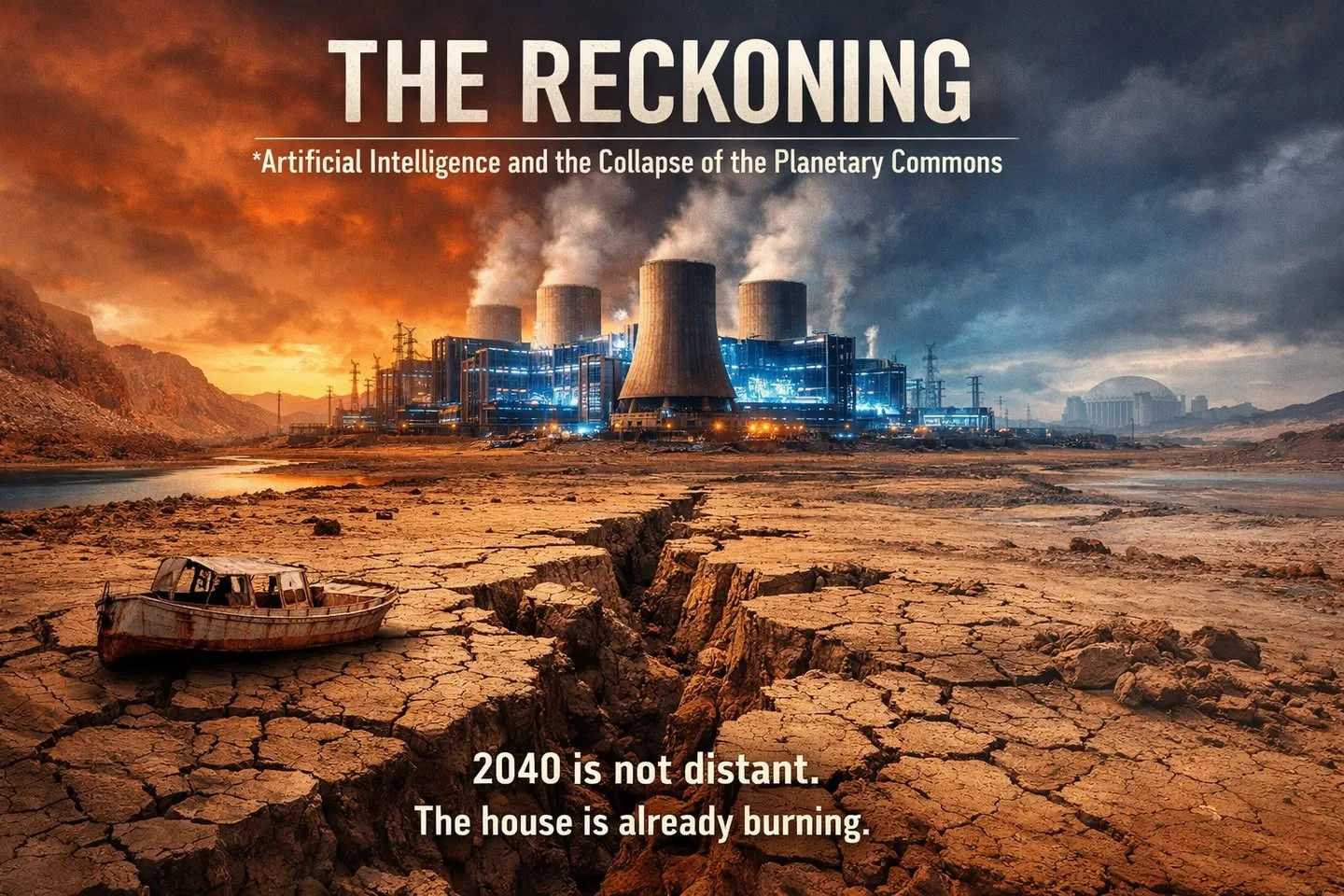
The Reckoning: Artificial Intelligence and the Collapse of our Planetary Commons
We stand at the edge of a precipice, not tomorrow, not in some distant century, but fourteen years from now. The year is 2040.
Our home is already burning: Lake Mead, once the lifeblood of the American Southwest, lies at thirty-four percent capacity, its cracked bed exposing rusted hulls and a mineral scar climbing canyon walls like a warning.
Phoenix sinks, six inches a year in places like Willcox Basin, where collapsing aquifers fracture under relentless pumping. Fissures split the desert floor ten feet deep. Roads buckle. Foundations tilt. Over a million people live atop land that is literally deflating. This is not prophecy. This is 2026. And into this fire steps Artificial Intelligence, not as a savior but as an accelerant.
The numbers are merciless. Data centers today consume 415 terawatt-hours of electricity, more than Japan's entire grid. Artificial Intelligence accounts for nearly half of that surge, driven by hyperscalers whose cooling towers evaporate five million gallons per day per facility, enough to supply twenty thousand homes.
By 2040, under projected 15–20% annual growth cited by Goldman Sachs and the International Energy Agency, AI alone will demand 3,800 terawatt-hours, roughly the electricity used by the United States today.
Grids strain. Rolling blackouts threaten cities like New York, London, and Mumbai. Hospitals prepare diesel backups. Coal plants in China and India are restarting to meet demand, adding millions of tons of carbon dioxide annually, even as AI systems promise to “model” the climate, they intensify it. This is structural escalation, not innovation.
Water tells the darker story. Current hyperscaler demand is estimated at hundreds of billions of liters annually. By 2030, projections approach six trillion liters — equivalent to the annual flow of ten Colorado Rivers.
By 2040, estimates rise toward fifteen trillion liters, comparable to draining the Nile. Los Angeles consumes roughly one billion liters daily. AI will outdrink Los Angeles, Chicago, and Houston combined.
Aquifers will empty. Rivers will divert. Cape Town, already rationing at “Day Zero,” trucks water hundreds of miles while server farms glow in desert basins.
Drought zones birth ghost clusters in Nevada, Punjab, and Texas, because no aquifer means no compute. Every query and every generated image consumes water. Billions daily. This is not efficiency. It is an extraction at the planetary scale.
Debt binds the crisis. Global public debt exceeds $93 trillion, over 100% of global GDP, while total public and private obligations surpass $315 trillion, approximately 235% of global output.
There is no surplus capital for desalination infrastructure, levees, regenerative grids, or solar fields at the necessary scale. When heatwaves shut down server complexes, taxpayers absorb trillion-dollar rescues that exceed the inflation-adjusted Marshall Plan.
Municipal utilities beg for rate hikes. Pension systems are strained. Agricultural collapse drives food inflation.
Meanwhile, valuations of firms powering the AI surge approach multi-trillion dollar territory. Markets cheer “upside” until bond spreads widen and grids flicker. This is systemic exposure masquerading as growth.
Climate locks us in. At 2.5°C warming, potentially 3°C if permafrost methane accelerates, destabilization intensifies. Wildfires engulf California. Floodwaters threaten Miami. Heat kills in Delhi. Artificial Intelligence amplifies feedback loops: coal-powered compute spikes emissions; hotter air demands more cooling; drought shrinks hydropower. Solar efficiency falls under dust saturation.
Ocean acidification accelerates. Coral reefs collapse. Fisheries destabilize. By 2040, so-called “climate havens” like Vancouver and Seattle will face wildfire smoke, infrastructure strain, and migration pressure. Runaway risk compounds.
Social fracture follows environmental fracture. Civil unrest rarely erupts over abstract degrees Celsius. It erupts when tap water runs brown while servers on campus hum. “AI tax” protests escalate. Cyber-theft markets stolen GPU cycles.
Cities declare digital sovereignty. By 2040, absent intervention, we confront ghost agricultural regions, orphaned satellites, and grids too fragile for sustained human or machine continuity. This is the collapse trajectory of the Planetary Commons.
Yet the path is not sealed. The fork lies before us, fourteen years wide and narrowing.
The Binding Planetary Peace Treaty, initiated at the World Peace Gathering, July 2025, at Dripsey Castle, Cork, by Indigenous elders, spiritual leaders, and global peacebuilders, proposes structural redirection: end armed conflict, reallocate trillions from military expenditure toward ecological restoration, submit to the United Nations General Assembly, and open for global ratification, by all members of our Human Family.
Without coordinated governance, Artificial Intelligence becomes a force multiplier for surveillance, digital enclosure, and fortified compute enclaves. With coordinated restraint, we reclaim the Planetary Commons: water for life, equity, energy, and computation for restoration rather than extraction.
This is not a prophecy. This is arithmetic. We have fourteen years, not generations, to decide whether Artificial Intelligence accelerates collapse or supports planetary stabilization. The biosphere does not negotiate. The algorithm does not care who pays the cost.