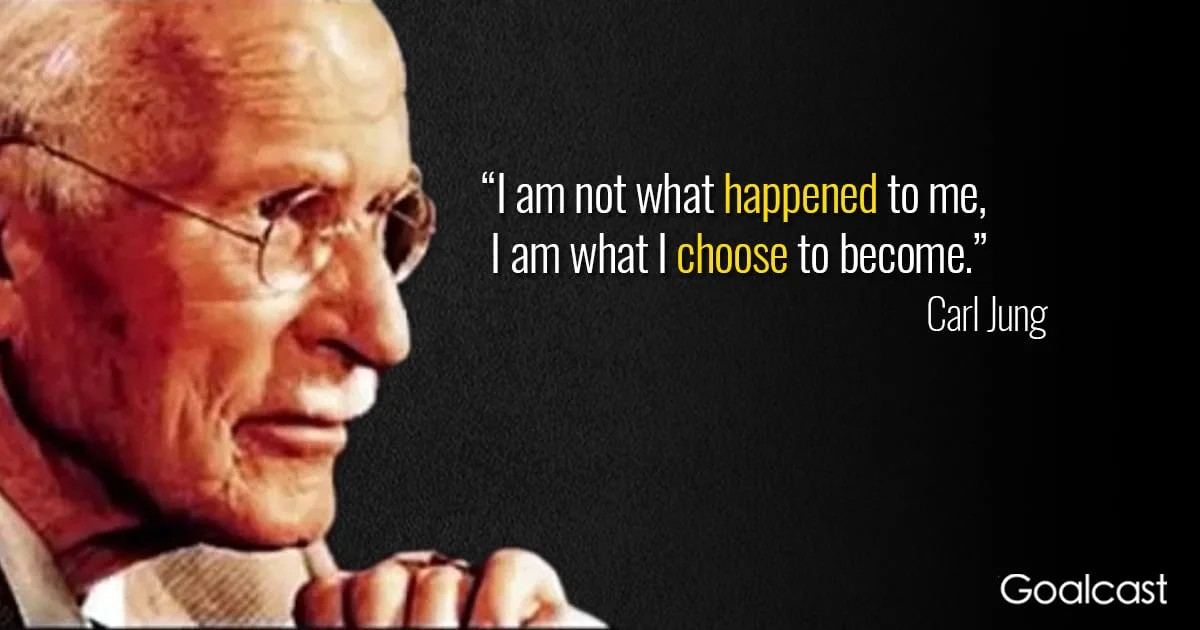
THE PSYCHOLOGY OF DR. CARL GUSTAF JUNG – A DAKOTA PERSPECTIVE-1978
In 1963, after I returned home from my first psychology class at the University of Washington, my father and I had an immediate disagreement. My psychology professor had stated that human beings are simply a product of our environment and that the only inheritance we have from the past was an instinctive fear of falling. This fear the professor explained, came from the distant past when humanity’s simian forefathers were living in trees.
My father’s position was that even though the environment affects us, we are also influenced genetically. A combination of nature and nurture. Today, from my father's perspective, is called "epigenic, " a combination of environmental and genetic influences- nature and nurture.
When I compared my father’s and my professor’s academic backgrounds in the area of psychology, I concluded that my father was sadly misinformed. This was the beginning of a period in my life of great conflict and disagreement between what I had been told about life from the time I was very young by my parents and elders and what I was now being told at the university.
To say that this five-year period of personal, cultural and intellectual conflict was tremendously painful is a gross understatement. By the time it finally began to dawn on me that my parents and elders were correct in what they had told me about life, I had consumed enough alcohol, drugs, self-hatred, and doubt to have died ten times over.
My first reaction to my regained understanding was to hate everything about the mainstream culture, which I perceived to be the source of my self-contradictions and conflicts. This attitude didn’t bring me much comfort because my Chickasaw and Dakota teachings told me that I must try to love, respect, and understand all living things.
My next response was to try and tolerate mainstream society as much as I could. Through this toleration and the resulting growing spiritual, intellectual, and emotional understanding, I began to realize that a conflict was going on, not only within myself but in human beings all around me. This was a conflict of values and life concepts, rather than strictly a racial-cultural conflict.
As I begin to open myself up to new experiences, this time utilizing my cultural background as a touchstone, I began to find that there were other people who also disagreed with the thinking that I had initially encountered at the University of Washington and in many other parts of mainstream society. Such a person is Carl Jung.
It is no wonder that I found agreement with Jung, for, when I reflect on Jung’s life, I could see many of the influences that, also inspired our Dakota understandings of life.
Throughout Jung’s life, he was surrounded by the awesome Alps. He experienced the eternal struggle of life seeing the frequent death of a fisherman in the treacherous waterfall he lived close to as a boy. Just as my great-grandfather Joshua Lowdog, saw death at twelve when he killed his first man, Jung was six when, following a flood, he discovered the corpse of a man half-buried in the sand. Jung, himself, faced his own death on a number of occasions during his life.
As is the case with many of our great Dakota warriors and medicine people, Jung had in his heritage an illustrious grandfather. He was a Professor of Medicine at the University of Basel, after whom Jung was named. Throughout his life, Jung was a great lover of nature, and, through his experiences, he came to understand the spiritual power of symbols and the role they play in human and community development.
One of the greatest difficulties I’ve faced in my academic life in trying to compare and contrast the Dakota viewpoints with the mainstream academic perspective, such as the case of the psychological perspectives of Jung, is that my cultural knowledge and understanding has been developed primarily through the personal experience of the Sweat Lodge, Vision Quest, Sacred Pipe, Sun Dance, the telling of oral traditions and teachings, as well as, the examples of my parents and elders.
These were not learned from “academically” researched and written papers. Whenever I’ve tried to express my Dakota perspective on various topics, I’ve usually been asked to quote my academic source. But Dakota culture is transferred orally through your parents and elders and is not written down.
Most of what is written by anthropologists and other academic researchers of Dakota culture is from a primarily intellectual, external, and non-experiential perspective, except for my Grandmother, Dakota Anthropologist, and Linguist Ella Deloria. Other researchers information and understanding are limited, as it is rare that any information, of any substance, has been shared by Dakota Elders with non-Indians, and then with only a trusted few. This is beginning to change.
With no apologies and with the greatest respect, I cite my “academic” sources in my Dakota perspectives of Jung’s understanding of myth, the anima and animus, the shadow, and the goal of human development, as my beloved parents, elders, and the rich oral traditions of our Dakota people.
“MYTHS”
Until reading Carl Jung, I was unable to find a European who really understood the power of oral traditions. In the traditional Dakota educational system, the telling of oral traditions is as great as can be found anywhere, including the Bible and other “Holy Books” of any of the world’s religions. Yet, most mainstream society insists that the oral traditions of “primitive” people” are ''myths,” in a half-truth connotation.
If you don’t understand what this connotation of “myth” has in regard to “truth”, go to a Christian church after Sunday service and tell the minister that you enjoyed hearing about the “myth” of Jesus. Your understanding will be greatly illuminated by the irate Christian Minister.
Carl Jung’s understanding of myth is quite different than that of most people.
“The man who thinks that he can live without myth, or outside it is an exception. He is like one uprooted, having no true link either with the past, or with the ancestral life which continues within him, or yet with contemporary human society. He does not live in a house like other men, does not eat and drink like other men, but lives a life of his own, sunk in a subjective mania of his devising, which he believes to be a newly discovered truth.”
In contrast to many of his contemporaries who said that myths are a “fragment preserved from the infantile psychic life of the race”, Jung said, “They are the most mature product of that young humanity.” It is as the old people have said, “when the young people stop singing the old songs and there are no more dreams and visions of greatness, there is no more power!”
ANIMUS AND ANIMA
Jung realized that within each human being there are both masculine and feminine dimensions. Elders also have told me that within each one of us is a grandmother and grandfather, a mother and father and a son and daughter, and a grandson and granddaughter. In Jung’s terms, the anima is a representation of the psychological tendencies of our feminine side. Our feminine side is typified in its positive form by intuition, personal love, feeling for nature, and our relationship to the unconscious.
Many examples of Jung’s understanding can be found within the Dakota culture. The Sacred Pipe, our most powerful spiritual tool and symbol, was brought to us by the White Buffalo Calf Maiden. Women always have a primary role in our religious ceremonies, our culture, with its priority on spiritual and emotional development, is matriarchal.
I’ve heard my father and grandmother speak many times, especially during the early 1900s when our people’s intuitive powers were not so obscured by concrete, radio, and television, when someone’s wife awoke in the middle of the night and instructed her husband that they must go immediately to the home of a relative. Never a question was asked! The team and wagon were immediately mobilized and they would arrive just in time to help, their relative, at a time of difficulty.
A good example of how the anima is experienced as an inner force in our being is found within the Healers of the Eskimo and other arctic tribes. During Ceremonies, some of the male Healers wear women’s clothes and symbols of women’s breasts to manifest and touch their feminine side - the part of us that enables us to contact the spiritual world.
Just as Jung describes the positive side of the anima, so does he also describe the negative side, “the anima who infatuates young men and sucks the life out of them.” Likewise, when our two young Dakota warriors first met the White Buffalo Calf Maiden, one of the young men realized she was sacred, bowed his head in respect, and eventually was given the Sacred Pipe.
The other young warrior became infatuated with her beauty, forgot the people, and his sacred mission, and, when he tried to possess her selfishly, white clouds surrounded him. When the white clouds cleared away, all that was left was a skeleton with snakes and bugs crawling over it. Such is the respect of the Dakota for the powers of the anima, our feminine side.
The animus, on the other hand, is a representation of the psychological tendencies of our masculine side typified in a positive sense by nationality, analytical thought, and “sacred” conviction. Just as the character of a man’s anima is formed by his mother, so the animus in a woman basically influenced by her father. In Dakota oral traditions there are many examples of a woman with an underdeveloped animus who weaves intrigue and kills with her tongue. This is understood as a fault that comes from the father.
As in Jung’s description of the development of the animus, the development of a complete Dakota man is said by the elders to have four stages:
1)The first stage is the development of physical power through athletics, fasting, the Sweat Lodge, and the Sun Dance.
2)The second stage of development is the ability to carry out a planned activity in the responsibilities of your extended family.
3)The third stage is that of leadership in protecting the people, peace, hunting, religious ceremonies, and the responsibilities of chieftainship.
4)The fourth stage of development achieved by only a few is that of the Holy Man, Seer, and Wise Elder. Contrary to most of the thinking of mainstream society, Dakotas look to old age and eldership as a paramount good of life. The integration of the anima and animus as a unified whole was seen by the Dakota and Jung as a primary task of life.
My ninety-year-old grandmother, Martina Sherwood, who knew both my great-grandfather’s Tipi Sapa, Gall as well as Sitting Bull, and other distinguished warriors of those days, typifies them and the other elders she knew as fearless in battle, wise in peace, deep in spirituality, shrewd in hunting and bargaining, but extremely kind, sensitive, tender and soft-spoken in the home. Among the greatest heroines in Dakota culture was a woman named Cow Killer, who, seeing her brother injured on the battlefield, leaped on a fleeing horse, rode directly into the army’s bullets, and brought her brother back to safety.
As it is said by the Old Ones, “The eagle of humanity has two wings, one woman, the other man, and unless each wing has equal power, respect, and understanding, the eagle of humanity can never fly its highest.”
THE SHADOW
The primary figure in Dakota oral traditions is Iktomi, the spider, who personifies our higher selves struggle with the qualities of our lower nature, the Shadow. Just as Jung describes the qualities of the Shadow, Iktomi plays malicious jokes on people, is sly, bragging, lazy, cowardly, careless, and has an overdeveloped love of material possessions.
At the same time, Iktomi has a superhuman, divine, and savior side that is victorious at times but falls again and again to his unconscious shadow side. Both Jung and our Dakota people realized that Iktomi, the shadow, has a therapeutic effect in that he mirrors the low intellectual and immoral qualities before the view of our more highly spiritually developed humanity so that we won’t keep repeating the same mistakes.
It is the shadow that must be faced and conquered on your vision quest. Alone, with no food or water, it quickly becomes apparent that the shadow is within us, rather than an external force to be projected on others, and that only by facing its hideous face and understanding its inner meanings can we fully develop our potentialities. The shadow becomes hostile only when it’s ignored or misunderstood.
Jung said, “It is not surprising that … the most rudimentary insight into the shadow sometimes causes the greatest difficulties for the modern European.” Without a deep understanding of Iktomi and the knowledge of how to face and conquer him found in Indigenous cultures, we live our life painfully projecting our shadow on others.
As we begin to understand the shadow we can begin to understand the Dakota prayer that says: “Grandfather, Great Spirit, give me strength not to be superior to my brothers and sisters. but to fight my greatest enemy, me, so that when life fades as the fading sunset, my spirit may come to you without shame.”
QUATERNITY AND THE CIRCLE
Through his study of Indigenous peoples, Jung came to understand that the symbol of a completely unified self and life is the circle and its manifold quaternities. Jung’s term Quaternity means “ Fourness!” The developmental stages of the anima and animus are four.
Symbolically the colors of our Human Family, Red, Yellow, Black, and White are four. The use of earth, air, water, and fire in the Sweat Lodge and other Ceremonies are four. Humanity’s roads of learning are four, intuition, emotion, sensation, and intellect. The seasons of spring, summer, fall, and winter are four. Our life unfolds from infancy, childhood, adulthood, and elderhood. As the elders have said, we must know and understand the Four Winds, if we are truly to become a whole human being.
THE GOAL OF HUMAN DEVELOPMENT
Jung saw that the goal of human development is to become a fully differentiated, balanced, and unified personality. That, at least, is the direction that development takes, although the goal of complete differentiation, balance, and unity is rarely if ever achieved, except, from Jung’s perspective, by a Jesus or a Buddha.
Like my grandfather, Frank White Buffalo Man told me,
“You know, grandson, Wakan Tanka, the Great Spirit, has given all people wisdom through books. In your life, grandson, you too must read and study books, but remember to take on your journey only those things that bring more unity within yourself and with others. Wakan Tanka the Great Spirit also gave our people, and other people who respect the spirit of Mother Earth, our wisdom and knowledge through dreams, visions, fasting, prayer, and the ability to see the lessons the Creator has put in every part of our creation.
Look at those trees standing over there. The pine tree doesn’t tell the fir tree to move over, or the fir tree doesn’t tell the alder tree to move over. Instead, all of the different trees stand together, with their mouths pressed toward the Mother Earth, refreshed by the same breeze, warmed by the same sun, their arms upraised in prayer and thanksgiving, protecting one another.
This is the way of our people and the way of all people if we are to have peace in this beautiful land. Hecetu Yedo! So be it!”
Phil Lane Jr., Paper for Cultural Anthropology Class, University of Washington, 1978