
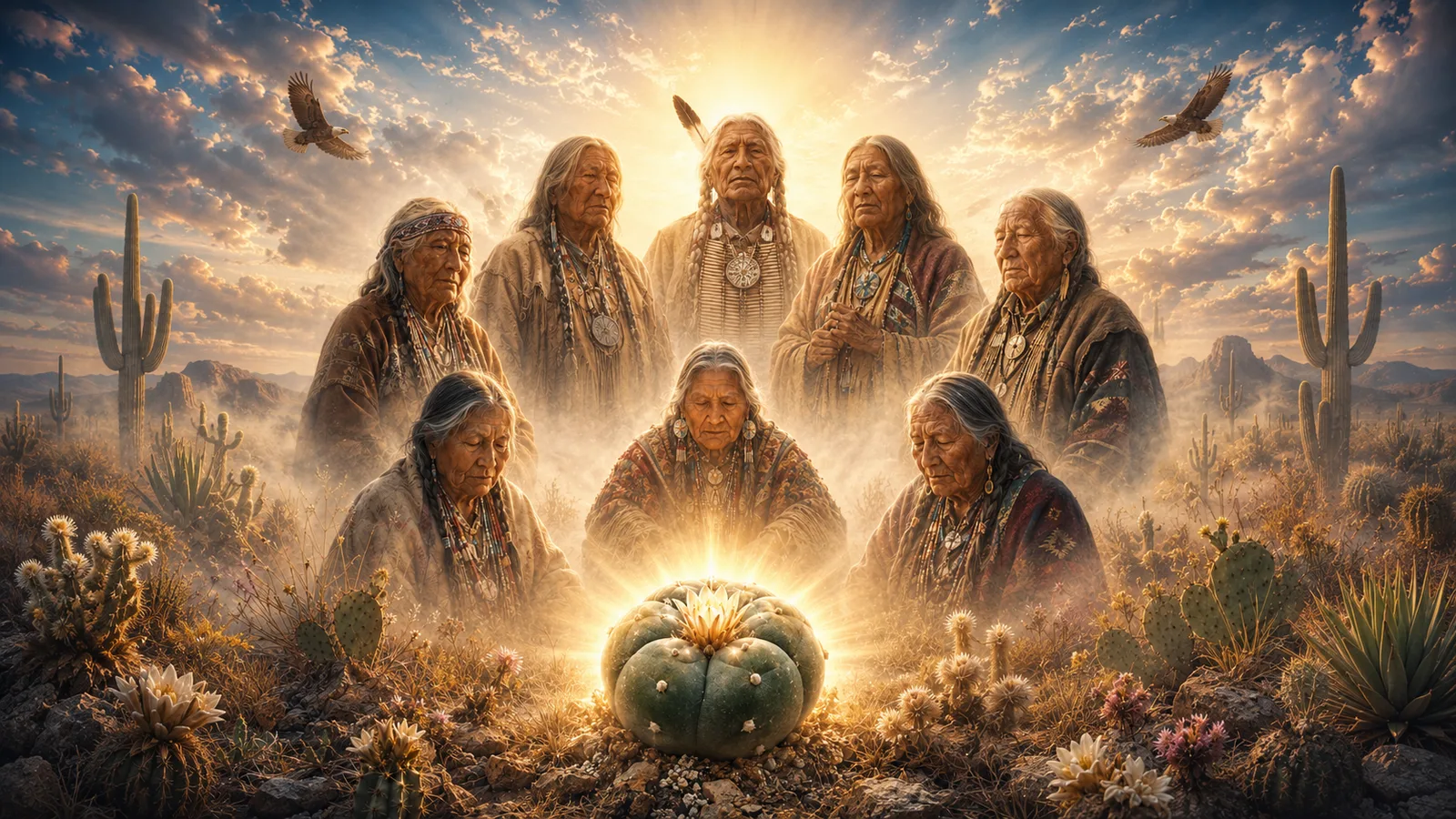
Peyote must be understood first as a sacred Indigenous medicine, not as a recreational substance, not as an escape, and not as something separated from prayer, ceremony, discipline, and community responsibility.
Long before outside colonial governments tried to define it, Indigenous Peoples knew this medicine through relationship, sacrifice, suffering, ceremony, and spiritual authority. It came north through the prayers and experiences of our relatives. Among the most remembered and honored was Quanah Parker of the Comanche people, who helped defend and carry the Peyote Road as a sacred way of healing and survival.
This medicine has never been about amusement. It is very bitter, demanding, prayerful, humbling, and deeply serious. It is held by ceremonial leaders, families, songs, fire, water, discipline, moral teachings, and love for the people.
It is not a medicine people casually take for entertainment. In its proper ceremonial context, peyote is approached with humility, reverence, and accountability before the Creator, the family, the community, and the people’s suffering.
It is also important to understand why the name “Native American Church” came to be used. That name protected the people from persecution at a time when Indigenous ceremonies were being attacked, outlawed, misunderstood, and suppressed.
By using the word “church,” the people were able to speak in a language that governments and courts could recognize, while still protecting a sacred Indigenous way of prayer and healing.
Some of the relatives who walk this road are Christians, and for them, Christian scriptures, the name of Jesus, and biblical teachings may be part of their prayers. Other relatives understand the medicine through older Indigenous teachings, through the Creator, the fire, the water, the songs, the drum, the staff, the medicine, and the all-night ceremony.
There is room for these different understandings because the central purpose is not to force a single theology upon the people. The central purpose is healing.
Every Sacred Fireplace has its own Sacred Lineage and understanding. Each Sacred Fireplace is a unique reflection of the Oneness of our Creator.
The Native American Church is not a church in the same way many outside people understand a church. There is no single book, no single formal creed, no single universal theology imposed on every Nation, every family, or every fireplace.
The people come to pray. They come to sing. They come to cry. They come to ask for help. They come to heal from alcohol, grief, sickness, confusion, trauma, family pain, and spiritual imbalance. They come to sit through the night with the medicine, the fire, the songs, the prayers, and the love of the people.
So when someone attends a peyote meeting, it should not automatically be understood as though they have “left” one religion and “joined” another. Many people who come this way still carry their own spiritual identity. They may be Christian, Bahá’í, traditional, or from another path of prayer. What they are entering is a sacred Indigenous healing ceremony, held by an Indigenous spiritual authority, to restore life, balance, sobriety, humility, and right relationship.
I can also say that if I needed that kind of help, I would certainly reach out to my relatives who know and heal with this Sacrament. I would not feel, in any way, shape, or form, that I was violating the teachings of the Bahá’í or any Faith by turning to a sacred Indigenous medicine applied properly by trained Indigenous ceremonial practitioners.
To me, this is not a contradiction. It is an expression of trust in the Creator of All Good Things, who has placed healing powers throughout creation and has given different peoples different gifts, medicines, sciences, and spiritual responsibilities.
The question is much deeper than peyote alone. The question is: who has the right to be recognized as a physician? Is a physician only someone trained in a Western university, licensed through a Western system, and dressed in the authority of modern institutions?
Or do we also recognize that our Indigenous Nations have always had physicians, doctors, medicine people, herbalists, midwives, ceremonial leaders, and healers who have been trained through generations of observation, discipline, fasting, prayer, apprenticeship, dreams, ceremonies, and direct relationship with the natural world?
For centuries upon centuries, our Indigenous practitioners have studied plant, spiritual, emotional, family, and community medicines. They have learned from Elders, from the land, from the waters, from the animals, from the stars, from ceremony, and from the suffering and healing of the people themselves.
Their knowledge did not come from a university degree, but that does not make it less real. In many cases, it is knowledge tested through generations of lived experience, carried with humility, responsibility, and sacred accountability.
I believe and have personally witnessed and experienced that our Indigenous healers are every bit as competent, and sometimes, even more, than Western healers within the systems of medicine they have been trained to carry. In some cases, especially where spiritual, emotional, cultural, family, and physical healing are all connected, Indigenous medicine may reach places that Western medicine alone cannot reach.
This does not mean we reject hospitals, doctors, science, surgery, or modern care. It means we refuse to accept the colonial idea that only one system of healing is legitimate.
The Creator of All Good Things did not give medicine to only one people. The Creator placed healing in many places: in plants, in ceremony, in prayer, in water, in song, in touch, in fasting, in dreams, in family, in community, and in the living intelligence of Mother Earth.
Indigenous peoples were not left without medicine until Western institutions arrived. We had medicine. We had doctors. We had law. We had science. We had a ceremony. We had systems of healing rooted in relationship, responsibility, and reverence.
For many Indigenous families, peyote has been a medicine of sobriety. My dear relative and cousin, Kevin Locke, told me that he went through a time of deep alcoholism in his younger days. Then, in 1973, after attending an all-night Native American Church Ceremony, he walked out without the compulsion to drink alcohol ever again.
That testimony is sacred to me because I knew Kevin, I loved Kevin, and I witnessed the beauty, discipline, truthfulness, prayer, generosity, music, dance, and service that flowed through his life.
I have seen this kind of healing over and over again. I have seen people come into the ceremony broken by alcohol, grief, despair, and family pain, and I have seen them leave with a new light in their eyes and a new responsibility in their hearts.
I have also seen people healed from Rocky Mountain Spotted Fever, cancer, and other related diseases. I can also say that in my own younger days, I received great healing through sacred Indigenous plant medicines. That healing did not take me away from the Creator. It helped bring me closer to the Creator.
The purpose of medicine is not to make us dependent upon medicine. The highest purpose of any true medicine is to help us become whole enough that we no longer need to keep taking medicine. Medicine is not the goal. Healing is the goal. Sobriety is the goal. Balance is the goal. Family is the goal. Service is the goal. A clean heart is the goal. A stronger spirit is the goal. A life turned back toward the Creator is the goal.
For this reason, the Peyote Road must be spoken of with accuracy and respect. It is not a recreational drug culture. It is not a cult. It is not a competing doctrine trying to replace every other spiritual path. It is a sacred medicine way that has helped countless Indigenous people survive, recover, pray, and return to their families with a cleaner heart and a stronger spirit. The people do not come to be entertained. They come to be healed.
For me, there is no conflict between honoring Bahá’u’lláh and respecting the sacred medicines that the Creator has entrusted to Indigenous Peoples, via our Indigenous “ MD’s.”
When held in a sacred way, with lawful protection, cultural. Authority, prayer, discipline, and responsibility, sacred medicine does not prevent a person from being a good Bahá’í, or whatever Faith Tradition someone may come from.
This Sacred Medicine helps a person become more humble, more truthful, more sober, more prayerful, more responsible, and more devoted to service. In that sense, when it is held properly, it can help a person become a better human being and, for those who are Bahá’ís, a better Bahá’ís.
Truth is one. Healing is sacred. The Creator has not abandoned any people. All true medicine, all true prayer, all true science, and all true healing come from the same Source.
This is the Sacred Guidance.
“Nevertheless, intoxicating liquor, if prescribed by a physician for the patient and if its use is absolutely necessary, then it is permissible.” —‘Abdu’l-Bahá.
“Resort ye, in times of sickness, to competent physicians;” —Bahá’u’lláh.
“does not forbid their use when prescribed by qualified physicians as part of a medical treatment.” —Notes to the Kitáb-i-Aqdas.
“under the advice of a competent and conscientious physician, who may have to prescribe it for the cure of some special ailment.” —Notes to the Kitáb-i-Aqdas, summarizing letters written on behalf of Shoghi Effendi.
“The use of narcotics and intoxicants of any kind, except as remedies in case of illness, is strictly forbidden by Bahá’u’lláh.” —Bahá’u’lláh and the New Era.
“Do not neglect medical treatment when it is necessary, but leave it off when health has been restored.” —Bahá’u’lláh, Tablet to a Physician.
“Abstain from drugs when the health is good, but administer them when necessary.” —Bahá’u’lláh, Tablet to a Physician.
“There are two ways of healing sickness, material means and spiritual means.” —‘Abdu’l-Bahá.
“Both means should be used and practiced.” —‘Abdu’l-Bahá.
“The power of the Holy Spirit healeth both physical and spiritual ailments.” —‘Abdu’l-Bahá.
“Thy name is my healing, O my God, and remembrance of Thee is my remedy.” —Bahá’u’lláh.
Bringing Western and Indigenous Science Together for Healing
The question before us is not whether Western science or Indigenous science is superior. The deeper question is how these two streams of knowledge can come together to heal and protect the people. On this day, when diabetes, heart disease, trauma, addiction, grief, and many other serious health challenges are affecting Indigenous families, we need every true medicine, every true science, every true prayer, and every true physician working together.
There is no reason for Western medical doctors and Indigenous ceremonial healers to stand apart from one another when the suffering of the people is so great. A responsible path would bring them into respectful collaboration. Western physicians can help assess a person’s physical condition, including heart health, blood pressure, diabetes, medications, and other medical concerns. Indigenous ceremonial leaders can hold the spiritual, cultural, emotional, family, and ceremonial dimensions of healing. Together, they can help protect the whole person.
Before any serious medicine is received, whether it comes through a hospital, a pharmacy, a plant, a ceremony, or a traditional healing way, the first concern must always be the well-being of the person. We should never treat sacred medicine casually. We should never make promises of a cure. We should never pressure anyone. We should never ignore the body. The body is a sacred trust. If a person has diabetes, heart disease, high blood pressure, serious illness, or is taking medications, then careful medical consultation is not a lack of faith. It is part of the responsibility.
This is especially important for Indigenous Bahá’ís who may feel drawn to this sacred medicine way for healing, sobriety, trauma, grief, or spiritual help, but who also want to remain fully faithful to the Bahá’í teachings. The Bahá’í writings tell us to turn to competent physicians and to use both material and spiritual means of healing.
That principle can become a bridge. A person can seek a medical assessment from a qualified physician and also seek guidance from properly recognized Indigenous ceremonial practitioners. These two forms of care do not have to contradict one another.
As an immediate and practical step, any Indigenous Bahá’í who is sincerely considering this sacred healing way, within its lawful and proper ceremonial context, should first be encouraged to consult a licensed medical doctor for a careful health assessment.
That physician can review the person’s heart health, diabetes status, blood pressure, medications, mental health concerns, and overall physical condition. This does not replace Indigenous spiritual authority. It helps protect the person physically while the ceremony addresses the deeper spiritual, emotional, and family dimensions of healing.
At the same time, this practical medical step does not answer the deeper question. The deeper question is: what does the Bahá’í phrase “competent and conscientious physician” truly mean in a world where Indigenous Peoples have carried sophisticated healing systems for thousands of years? Does competence only come from a Western university? Does conscience only come through a license from a colonial state? Or can competence also come through generations of Indigenous apprenticeship, ceremony, discipline, plant knowledge, prayer, fasting, and service to the people?
This is a discussion we must have with humility, reverence, justice, and courage. Indigenous healers are not untrained simply because their training does not come through Western institutions. Many have been trained since childhood by Elders, family lines, ceremonies, medicines, dreams, and direct responsibility to the people. Their science is relational, spiritual, ecological, observational, and experiential. Western science can measure many things, but Indigenous science knows many things through relationship, ceremony, responsibility, and long-tested practice.
The future should not be a conflict between these ways. The future should be a circle. In that circle, the medical doctor helps protect the body. The Indigenous ceremonial leader helps protect the spirit. The family helps protect the heart. The community helps protect the path. The person seeking healing is held with dignity, freedom, consent, and love. No one is forced. No one is shamed. No one is treated as less faithful because they seek healing through a sacred Indigenous way properly held by their own people.
For Indigenous Bahá’ís, this bridge is especially important. Sacred Indigenous medicine, when held lawfully, prayerfully, and responsibly, does not have to keep anyone from being a good Bahá’í. It may help a person become more sober, more truthful, more humble, more prayerful, more healthy, more responsible, and more devoted to service. The purpose is not to take medicine forever. The purpose of true medicine is to help the person become whole enough that less medicine is needed, and that life itself becomes the prayer.
So let us bring Western medicine and Indigenous medicine into a respectful partnership. Let us ask our physicians to help protect the physical body. Let us ask our Indigenous ceremonial leaders to help protect the sacred way. Let us ask Bahá’í institutions and communities to approach this matter with humility, not fear; with consultation, not judgment; with respect for Indigenous spiritual authority, not colonial dismissal. The healing of the people is too important to be separated. The time has come for the sciences of the body and the sciences of the spirit to work together for life.
A Practical Path Forward
There is also a very practical step we can take right now. We do not have to wait for years of discussion before we help people who are sincerely seeking healing, clarity, and guidance. The Continental Indigenous Council has relationships with medical doctors who understand the importance of integrating physical and spiritual care.
If there are Indigenous Bahá’ís who feel that this sacred medicine way may help them, and who want to approach it, prayerfully, responsibly, bringing Western and Indigenous Science Together for Healing
The question before us is not whether Western science or Indigenous science is superior. The deeper question is how these two streams of knowledge can come together to heal and protect the people. On this day, when diabetes, heart disease, trauma, addiction, grief, and many other serious health challenges are affecting Indigenous families, we need every true medicine, every true science, every true prayer, and every true physician working together.
There is no reason for Western medical doctors and Indigenous ceremonial healers to stand apart from one another when the suffering of the people is so great. A responsible path would bring them into respectful collaboration. Western physicians can help assess a person’s physical condition, including heart health, blood pressure, diabetes, medications, and other medical concerns. Indigenous ceremonial leaders can hold the spiritual, cultural, emotional, family, and ceremonial dimensions of healing. Together, they can help protect the whole person.
Before any serious medicine is received, whether it comes through a hospital, a pharmacy, a plant, a ceremony, or a traditional healing way, the first concern must always be the well-being of the person. We should never treat sacred medicine casually. We should never make promises of a cure. We should never pressure anyone. We should never ignore the body. The body is a sacred trust.
If a person has diabetes, heart disease, high blood pressure, serious illness, or is taking medications, then careful medical consultation is not a lack of faith. It is part of the responsibility.
This is especially important for Indigenous Bahá’ís who may feel drawn to this sacred medicine way for healing, sobriety, trauma, grief, or spiritual help, but who also want to remain fully faithful to the Bahá’í teachings.
The Bahá’í writings tell us to turn to competent physicians and to use both material and spiritual means of healing. That principle can become a bridge. A person can seek a medical assessment from a qualified physician and also seek guidance from properly recognized Indigenous ceremonial practitioners. These two forms of care do not have to contradict one another.
As an immediate and practical step, any Indigenous Bahá’í who is sincerely considering this sacred healing way, within its lawful and proper ceremonial context, should first be encouraged to consult a licensed medical doctor for a careful health assessment. That physician can review the person’s heart health, diabetes status, blood pressure, medications, mental health concerns, and overall physical condition. This does not replace Indigenous spiritual authority. It helps protect the person physically while the ceremony addresses the deeper spiritual, emotional, and family dimensions of healing.
At the same time, this practical medical step does not answer the deeper question. The deeper question is: what does the Bahá’í phrase “competent and conscientious physician” truly mean in a world where Indigenous Peoples have carried sophisticated healing systems for thousands of years?
Does competence only come from a Western university? Does conscience only come through a license from a colonial state? Or can competence also come through generations of Indigenous apprenticeship, ceremony, discipline, plant knowledge, prayer, fasting, and service to the people?
This is a discussion we must have with humility, reverence, and courage. Indigenous healers are not untrained simply because their training does not come through Western institutions. Many have been trained since childhood by Elders, family lines, ceremonies, medicines, dreams, and direct responsibility to the people.
Indigenous science is relational, spiritual, ecological, observational, and experiential. Western science can measure many things, but Indigenous science knows many things through relationship, ceremony, responsibility, and long-tested practice.
The future should not be a conflict between these ways. The future should be a circle. In that circle, the medical doctor helps protect the body. The Indigenous ceremonial leader helps protect the spirit. The family helps protect the heart. The community helps protect the path. The person seeking healing is held with dignity, freedom, consent, and love. No one is forced. No one is shamed. No one is treated as less faithful because they seek healing through a sacred Indigenous way properly held by their own people.
For Indigenous Bahá’ís, this bridge is especially important. Sacred Indigenous medicine, when held lawfully, prayerfully, and responsibly, does not have to keep anyone from being a good Bahá’í. It may help a person become more sober, more truthful, more humble, more prayerful, more healthy, more responsible, and more devoted to service. The purpose is not to take medicine forever.
The purpose of true medicine is to help the person become whole enough that less medicine is needed, and that life itself becomes the prayer.
So let us bring Western medicine and Indigenous medicine into a respectful partnership. Let us ask our physicians to help protect the physical body. Let us ask our Indigenous ceremonial leaders to help protect the sacred way. Let us ask Bahá’í institutions and communities to approach this matter with humility, not fear; with consultation, not judgment; with respect for Indigenous spiritual authority, not colonial dismissal.
The healing of the people is too important to be separated. The time has come for the sciences of the body and the sciences of the spirit to work together for life.
We can help connect them with a qualified physician for a thorough physical assessment.
This is very important. Before any all-night ceremony or intensive sacred healing experience, whether it is peyote, ayahuasca, sweat lodge, Sundance, fasting, or any other serious spiritual practice, the physical condition of the person must be respected.
The heart must be considered. Blood pressure must be considered. Diabetes must be considered. Medications must be considered. Age, exhaustion, dehydration, trauma, and overall health must be considered. This is not fear. This is responsibility.
In properly held sacred ceremonies, the purpose is healing, not intoxication, entertainment, or excess. Still, we must be honest that people can be put at risk when their physical condition is unknown or not respected. We have seen people become seriously ill, and in some cases, people have died, in sweat lodges, Sundance ceremonies, mushroom retreats, and other intensive ceremonial settings when the body was not properly protected. That is why medical assessment can become a blessing rather than an obstacle.
By bringing medical doctors and Indigenous ceremonial leaders into a respectful relationship, we can strengthen the healing path. The medical doctor can help assess the physical body. The ceremonial leader can help hold the spiritual way. The family and community can help support the person with love, prayer, and accountability. This is how Western science and Indigenous science can begin to work together rather than against one another.
So the door is open. If there are Indigenous Bahá’ís who have felt drawn to this sacred medicine way but have been uncertain, afraid, or concerned about whether it conflicts with the Bahá’í teachings, please reach out.
This is not an invitation to casual use. This is not a promise that any particular medicine is right for every person. This is an invitation to responsible consultation, medical assessment, prayerful discernment, and respectful guidance within lawful Indigenous ceremonial ways.
Four Worlds can help connect sincere Indigenous relatives with a qualified medical doctor for a physical assessment and, where appropriate, medical clearance. From there, each person can continue in prayer, consultation, and personal conscience. No one should be pressured. No one should be judged. No one should be shamed. The purpose is to help each person walk safely, lawfully, and spiritually toward healing.
This may become a new and stronger model for the future: Indigenous ceremonial authority and Western medical care working together for the life of the people. The healing of our people is too important to be separated. The time has come to bring every true medicine, every true science, every true prayer, and every true physician into one circle of protection, dignity, and love.