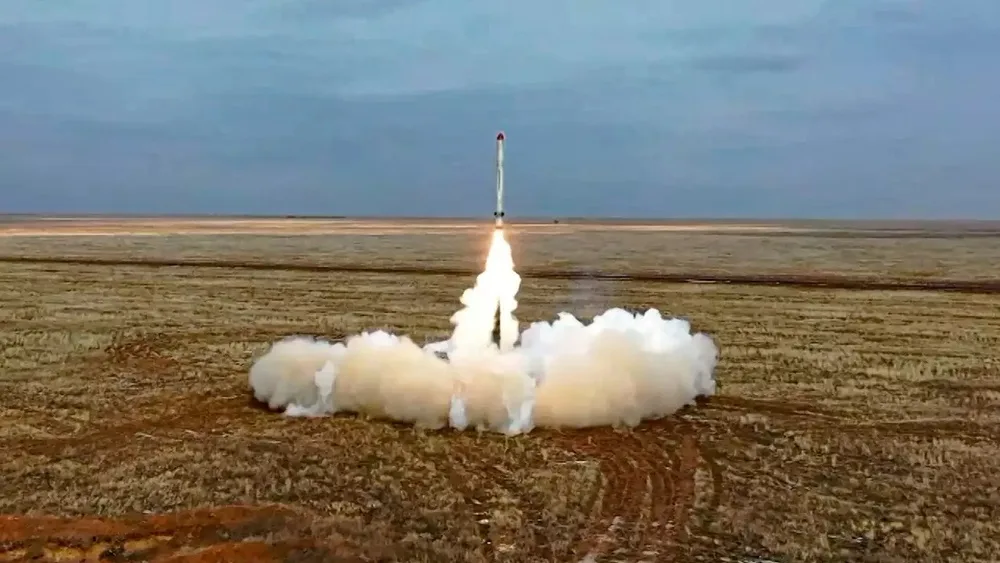
The reported use of Russia's new hypersonic missile, the "Oreshnik," as a direct response to Western-supported strikes in Russia signals a profound intensification of the conflict.
From an Indigenous perspective, such developments carry implications far beyond geopolitical boundaries. They remind us that Mother Earth, our sacred and shared home, bears the burden of these hostilities. The escalation reflects the urgency of addressing the more profound spiritual and relational imbalances perpetuating cycles of aggression, mistrust, and division among our human family.
Strategic Implications of the Oreshnik Missile
The deployment of the Oreshnik represents a significant shift in the balance of power, demonstrating capabilities that transcend conventional warfare and enter the realm of nuclear potential. This dual nature—a tool of immense destruction and a symbol of deterrence—parallels the duality in many teachings of life’s sacred forces. It underscores humanity’s responsibility to wield power with wisdom and restraint.
Russian President Vladimir Putin’s statement about mirroring Western actions highlights the principle of reciprocity, though it is expressed in a manner far removed from its sacred meaning. In Indigenous teachings, reciprocity involves mutual care and respect, maintaining harmony among all beings. Mirroring hostile actions deepens the cycle of discord, signaling that without a shift in consciousness, these escalation patterns may lead to outcomes no one intends or can control.
The Oreshnik’s reach, capable of targeting all of Europe, reminds us of the interconnectedness of all nations. Like the roots of a great tree, actions taken in one part of the world inevitably reverberate across Mother Earth. Such technological advancements, while demonstrating human ingenuity, also amplify the stakes of conflict, threatening the delicate balance of life that sustains us all.
Escalating Risks and Global Security Concerns
Former UN weapons inspector Scott Ritter’s assessment of the situation today emphasizes the fragility of global security. The rhetoric from world leaders and military officials described as reckless reveals the danger of walking a path guided by fear and dominance rather than understanding and unity.
Indigenous wisdom teaches us that every word and action carries a spiritual weight, influencing the harmony or disharmony of the world. The language of preemptive strikes and nuclear readiness escalates tensions and reflects a profound disconnection from the sacredness of life and Mother Earth’s intricate web of interdependence.
Humanity has carried the shadow of nuclear warfare for generations, a manifestation of what happens when material power eclipses spiritual responsibility. Ritter’s warning that we are approaching a “point of no return” calls to return to balance, healing, and reconciliation principles. When decisions are made without regard for their impact on future generations, they defy the teachings of stewardship and the sacred duty to protect life.
Political Dynamics and Future Prospects
The political maneuvering described by Ritter speaks to the broader challenges of leadership during times of crisis. The focus on outmaneuvering political opponents risks sidelining the greater moral responsibility to find pathways to peace.
From an Indigenous perspective, leadership is rooted in service to the people and a commitment to the well-being of the entire community, including the unborn. Any approach that prioritizes power over peace strays from this sacred duty.
Russia’s firm stance on achieving its stated objectives and the differing strategies of Western leaders reflect a profound division in worldview. Yet, the teachings of the medicine wheel remind us that unity arises when diverse perspectives come together in mutual respect and shared purpose.
To overcome such divisions, there must be a collective commitment to transcending the narratives of dominance and control and seeking instead the common ground of peace, justice, and harmony.
Path Forward
The unfolding conflict reflects humanity’s struggle to reconcile material power with spiritual responsibility. Introducing weapons like the Oreshnik amplifies the urgency for dialogue and de-escalation, not merely as a diplomatic strategy but as a spiritual imperative. Indigenous teachings remind us that the health of Mother Earth and all her children depends on the harmony of human relationships. War, in its many forms, disrupts this harmony, leaving scars on the land, the waters, and the spirits of all who dwell here.
As this situation evolves, the international community is called to embody the sacred principles of respect, reciprocity, and responsibility. Meaningful dialogue must replace the language of threats, and the pursuit of peace must rise above the pursuit of political advantage. To restore balance, we must act with the understanding that every decision made today shapes the world we leave for the seventh generation.
Failure to heed this call risks devastating consequences for the immediate parties involved and a deeper wound to the sacred unity of the human family and Mother Earth. Let this moment be where humanity chooses the path of healing and harmony, honoring the interconnectedness of all life and the shared responsibility to safeguard our collective future.
Shunkmanu He Me Yedo! Chanupa Sapa He Me Yedo!
Hinhan Wicasta/Deloria Tiospaye, Ihanktonwan, and Chickasaw Nations