
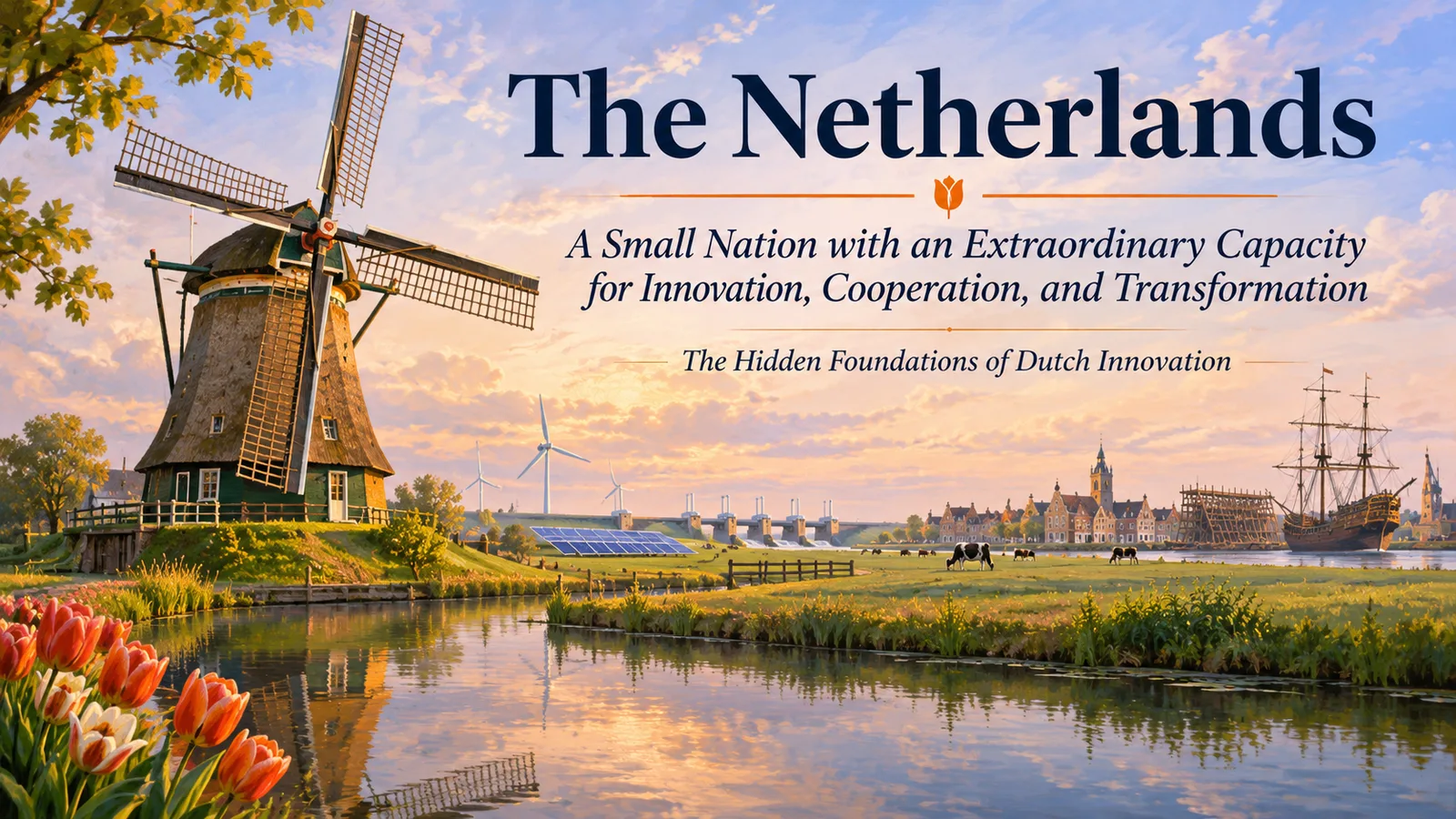
Executive Summary
My recent journey to the Netherlands, October 30-November 7, deepened my appreciation for the extraordinary achievements and human qualities of this relatively small nation. Through Community Gatherings, Ceremonies, Talking Circles, Consultation Circles, shared songs, and meaningful conversations with beloved relatives, focused on innovations in digital technology and other related developments, I experienced a remarkable spirit of cultural connectedness, warmth, generosity, and cooperation.
These experiences led me to reflect on a fundamental question: How has a nation of just over eighteen million people exercised such extraordinary influence on technological innovation, international commerce, agriculture, water management, and global development?
I believe part of the answer lies in something that conventional economic measurements seldom fully recognize: the invisible foundations of culture, social trust, shared understanding, and collective intelligence. When people possess strong relationships and the capacity to cooperate, their individual gifts can become a collective strength far greater than what they could accomplish separately. I experienced this beautifully when someone began singing a familiar Dutch song and others naturally joined in, expressing a shared cultural memory and sense of belonging that reminded me deeply of our own Indigenous traditions.
Throughout its history, the Netherlands has demonstrated an extraordinary ability to transform challenges into opportunities. Wind-powered sawmills helped revolutionize timber production and shipbuilding, while centuries of cooperation in water management created sophisticated institutions and engineering systems essential to national survival. Dutch innovation in agriculture, finance, maritime commerce, advanced technologies, and international trade further demonstrates how knowledge, creativity, practical necessity, and effective cooperation can multiply the capacities of a relatively small nation.
Yet the Netherlands now faces substantial challenges within a changing European and global economy. Growing industrial competition from China, changing trade and technological relationships with the United States, and increasing dependence upon imported energy place pressure upon Dutch industries, households, and economic independence. In 2025, the Netherlands depended upon foreign sources for approximately 77 percent of its energy needs, while its internationally connected economy remained vulnerable to trade restrictions, rising costs, and geopolitical instability. Housing shortages, electricity grid congestion, environmental pressures, and demographic change add further complexity to these challenges.
The Netherlands’ greatest historical achievements were also connected with colonial expansion, exploitation, and profound injustices against Indigenous peoples and other populations. I therefore find particular significance in King Willem-Alexander’s willingness to commission independent research into the colonial history of the House of Orange-Nassau, publicly acknowledge difficult historical findings, and reaffirm his commitment to unity, healing, and reconciliation. These initiatives create an important opportunity to move beyond acknowledgment and apology toward meaningful restoration, reciprocity, and the renewal of relationships historically shaped by unequal power.
From my perspective as an Indigenous Hereditary Chief, the purpose of reconciliation must be to renew the relationship itself. This means creating enduring partnerships grounded in justice, mutual respect, cultural dignity, shared ownership, educational opportunity, economic cooperation, and responsibility to future generations. The Netherlands possesses extraordinary capacities in water management, agricultural science, renewable energy, engineering, finance, and technological innovation that could contribute to a new era of mutually beneficial relationships with Indigenous nations and other historically marginalized peoples.
The Sixteen Guiding Principles of the Four Worlds approach provides an important framework for understanding these possibilities. They remind us that true and lasting transformation begins from within, that development must encompass the whole person and community, and that cultural vitality, social trust, meaningful participation, ecological responsibility, and economic prosperity are interconnected.
Sustainable development cannot be achieved simply by introducing new technologies or increasing financial investment. Sustainable development must strengthen the relationships and collective capacities through which people determine and sustain their own futures.
I believe the Netherlands has an extraordinary opportunity to help pioneer a more integrated understanding of innovation and development. Its historical strengths in consultation, experimentation, international cooperation, and technological creativity could now be directed toward strengthening economic resilience, healing colonial relationships, regenerating Mother Earth, and establishing more equitable partnerships throughout the world.
The next great Dutch innovation may not simply be a new machine, technology, or financial system, but a new way of bringing people together so that human creativity and resources serve life more completely.
What gives me the greatest hope is not simply what I learned about Dutch history or economic achievements, but what I personally experienced among our beloved Dutch relatives. Beneath the visible accomplishments of this nation, I sensed a living foundation of cultural belonging, shared memory, generosity, and cooperation that may be among its greatest and least fully recognized resources. These qualities, consciously strengthened and extended across cultural differences, can become powerful foundations for unity in diversity and sustainable transformation.
My central reflection is that the Netherlands may be small in territory, but its capacity for collective innovation, cultural connectedness, and international cooperation is extraordinary. By bringing its technological achievements together with moral courage, historical responsibility, Indigenous wisdom, and a renewed commitment to justice and reciprocity, it can help demonstrate a more complete model of sustainable development.
Ultimately, the greatest innovation humanity requires may not lie simply in what we can invent, manufacture, or produce. It may lie in what becomes possible when we learn to trust one another, honour our different gifts, heal our historical relationships, and work together for the well-being of the entire human family. This is the deeper promise I see in the Netherlands and one of the most inspiring understandings I carried home from my journey.
Seeking to Understand the Deeper Strengths of the Netherlands
One of the most meaningful experiences of my recent journey to Europe was spending time with beloved longtime friends, spiritual relatives, and many new relatives in the Netherlands. Our Gatherings, Ceremonies, Talking Circles, Consultation Circles, shared meals, songs, and conversations reminded me of the extraordinary possibilities that emerge when people come together in a spirit of openness, mutual respect, creativity, and shared purpose. I came away deeply grateful for the warmth and generosity I experienced, and with a renewed appreciation for the remarkable human capacities that already exist within this relatively small nation.
These experiences also caused me to reflect more deeply upon the extraordinary history of the Netherlands itself. Here is a country that, over several centuries, has exercised an influence upon international trade, technological development, finance, agriculture, water management, and social innovation far greater than its geographical size might suggest.
The Netherlands covers approximately 41,500 square kilometers and has a population of just over 18 million people, making it considerably smaller than Germany, France, Spain, or the United Kingdom, yet its achievements in commerce, engineering, scientific innovation, and international cooperation have been extraordinary.
This raises an important question that I believe deserves thoughtful consideration. How has such a small country repeatedly developed capacities that have allowed it to become a major participant in world affairs, often exercising an influence far beyond what its size or population might suggest? What is it about the Netherlands, its people, culture, history, institutions, and relationships, that has enabled it to accomplish so much?
I believe part of the answer lies in the ability of Dutch society to recognize practical challenges, experiment with new approaches, combine different forms of knowledge, and organize its human and material resources with remarkable effectiveness. But having now spent meaningful time with our Dutch relatives, I find myself wondering whether a deeper explanation may be found in something that is not as easily measured through economic statistics or technological achievements. It is the remarkable cultural connectedness, shared understanding, social trust, and capacity for collective cooperation that I felt so strongly among the people with whom we gathered.
The Netherlands demonstrates that a nation’s greatest strength may not be the size of its territory, the abundance of its natural resources, or even its technological achievements, but the quality of its relationships, its collective imagination, and its ability to bring people together around a common purpose. This understanding connects directly with the Sixteen Guiding Principles of the Four Worlds approach to human and community development. It also offers an important perspective on the economic challenges now confronting the Netherlands and the wider European community.
The Extraordinary Strength Hidden Within Dutch Cultural Connectedness
One of the things that touched me most deeply during our gatherings was the natural closeness I experienced among the Dutch relatives. There was a shared cultural understanding beneath the surface of ordinary conversations and relationships, something that allowed people to connect almost effortlessly. It was a quality that I could feel, even though it is not easy to describe in words.
I noticed this particularly when someone began singing a familiar song. Almost immediately, others would join in, often knowing the same words, melodies, and rhythms, without anyone needing to organize or direct them. There was something wonderfully natural about it, as though a shared cultural memory was already present within the gathering, simply waiting for an opportunity to express itself.
What impressed me was not merely that people knew the same songs. It was the ease with which they came together, the enjoyment of participating, and the sense of belonging that emerged through their shared voices. I felt that something much deeper than music was taking place, something that revealed the living connections among people who shared a cultural inheritance.
As an Indigenous Elder, I found this deeply meaningful because I recognize something similar within our own cultures. When a familiar song begins during a gathering or ceremony, people may join together through an understanding that reaches far beyond the individual words. The song carries memories, relationships, shared experiences, spiritual meaning, and a sense of belonging to something larger than ourselves.
In those moments, culture is not simply something we remember or discuss; it becomes a living experience through which people recognize and renew their relationships with one another. I began to wonder whether this same quality of cultural connectedness, expressed through many different forms of cooperation, might help explain how the Netherlands has accomplished so much throughout its history. Beneath the visible institutions of any society are countless shared memories, relationships, traditions, understandings, and habits of cooperation that may have developed over generations.
These foundations are often so deeply woven into everyday life that the people who possess them may scarcely recognize their significance. Yet they can represent some of the greatest strengths available to a community or nation, providing a foundation for trust, communication, cooperation, and collective action. I have come to believe that the extraordinary history of Dutch innovation may be connected, in important ways, to this remarkable capacity for cultural continuity, social trust, shared understanding, and collective cooperation.
Culture as a Living Network of Relationships
From an Indigenous perspective, culture is much more than language, clothing, music, ceremonies, or historical traditions considered separately. It is a living network of relationships through which people learn who they are, how they belong, what responsibilities they carry, and how they are connected to one another, their ancestors, their descendants, and the natural world. Culture provides a foundation through which people inherit not only knowledge, but also the values, responsibilities, and relationships that give knowledge its meaning.
Culture also provides a shared foundation for communication and cooperation. It allows knowledge to move between generations, enables people to understand familiar expressions and expectations, and creates opportunities for collective action without requiring every relationship to be established anew. In this way, culture becomes one of the essential foundations of a people’s collective life and capacity for development.
Consider again the simple experience of singing together. When people know the same song, they carry a shared understanding of its rhythm, melody, words, and meaning, even though each person may experience it somewhat differently. As soon as someone begins, others can contribute their voices, and what emerges is not simply a collection of separate individuals singing at the same time, but a shared experience created through their participation.
The song becomes greater than any single voice because the relationship among the voices creates something that none could produce in quite the same way alone. I believe this offers a powerful metaphor for understanding the hidden foundations of cultural and economic innovation. When people share sufficient trust, knowledge, understanding, and common purpose, their different capacities can be brought together with remarkable effectiveness.
The energy required to establish relationships may be reduced because many foundations of cooperation are already present. People may communicate more easily, recognize familiar expectations, and understand how their different contributions fit within a larger undertaking. From our Four Worlds understanding, this is one of the ways that unity in diversity becomes a practical force for transformation.
Gezelligheid: The Warmth and Spirit of Togetherness
The Dutch have a beautiful word that helps describe some of what I experienced: gezelligheid. Although it is often translated as warmth, friendliness, conviviality, or togetherness, its meaning reaches beyond any single English expression. It refers to the comfortable feeling of being among people with whom one shares a sense of belonging, whether around a family table, during a gathering of friends, at a community celebration, or in ordinary moments when people simply enjoy one another’s company.
What makes this quality so interesting is that it does not depend on elaborate ceremonies, formal institutions, or extraordinary occasions. It can be expressed through everyday relationships, shared humor, familiar conversations, hospitality, and the simple pleasure of being together. I believe this is an essential form of cultural wealth, one that deserves far greater recognition in our understanding of human and community development.
A society possesses tremendous strength when its people share understandings that allow them to connect naturally, cooperate readily, and see themselves as participants in a larger community. These qualities may be so familiar to those who have grown up within the culture that they are scarcely noticed, yet to someone coming from outside, their presence can be deeply impressive. This was certainly part of my experience in the Netherlands, where I sensed a warmth and familiarity among many of our relatives that helped create the conditions for open conversation, shared reflection, and meaningful relationships.
I also recognize that the Netherlands contains considerable regional, religious, linguistic, and cultural diversity, and that not every Dutch person experiences the same degree of connectedness. Like every nation, the Netherlands faces challenges involving social change, migration, economic inequalities, and differences in cultural experience. Nevertheless, I believe the qualities I witnessed deserve recognition as important foundations of social well-being, resilience, and collective capacity.
Shared Songs, Language, and Cultural Memory
Language plays an especially important role in creating cultural connectedness. A shared language carries much more than information; it carries humour, expressions of affection, stories, historical memories, and ways of understanding relationships that have developed over generations. Through language, people inherit not only words but also ways of interpreting their experiences and relating to one another.
Songs provide another powerful expression of these shared understandings. Their melodies and words can connect people across differences in age, occupation, education, and personal circumstances, creating an immediate experience of participation and belonging. Dutch traditions of communal singing offer particularly interesting examples, including popular songs sometimes described as levensliederen, or songs of life, which frequently express familiar human experiences of love, loss, friendship, hardship, and celebration.
What interests me is not simply the musical tradition itself, but the social relationships that become visible through it. When people sing together, they experience a sense of solidarity and connection that is difficult to create through ordinary discussion alone. When people can join together almost effortlessly through a familiar song, we are witnessing something much deeper than entertainment. We are witnessing the living power of shared cultural memory.
The language, melodies, and feelings have already created pathways of connection among them, and a single song can bring those relationships into immediate expression. From the perspective of the Four Worlds approach, these are among the invisible foundations upon which strong communities are built. Such experiences remind us that culture is not only preserved through formal institutions, but also through ordinary moments of shared participation.
In our Indigenous traditions, we know how important it is to protect the languages, songs, ceremonies, stories, and relationships through which a people maintain their identity and continuity. When these cultural foundations are weakened, communities may lose far more than visible cultural expressions; they may also lose important pathways through which knowledge, trust, responsibilities, and collective understanding are transmitted from generation to generation. Conversely, when these foundations remain healthy, they can support creativity, resilience, belonging, and innovation in ways that may not be immediately apparent.
From Cultural Connectedness to Collective Intelligence
We often speak of intelligence as though it were primarily an individual quality. We recognize gifted scientists, inventors, engineers, artists, entrepreneurs, and leaders, and we celebrate their extraordinary achievements. Yet the history of innovation also demonstrates that individual creativity becomes far more powerful when it can draw upon the knowledge, experience, and cooperation of others.
A person may have an inspired idea, but transforming that idea into something useful frequently requires many additional capacities. It may require skilled workers, financial support, specialized knowledge, community acceptance, institutional cooperation, and the ability to learn through experimentation. All these capacities depend upon relationships and upon the willingness of people to bring their different contributions together.
When people can share information, develop sufficient trust to cooperate, and recognize the value of different contributions, innovation can become a collective process rather than the achievement of isolated individuals. The deeper resource is not simply the intelligence contained within individual people, but the collective intelligence that becomes possible through healthy relationships among them. This understanding helps explain why the capacity to cooperate can be just as important as the capacity to invent.
I believe this is an important way of understanding the extraordinary achievements of the Netherlands. A small country cannot rely indefinitely upon the advantages of territory, population, or abundant natural resources, so it must often develop more effective ways of organizing knowledge, combining skills, and using its available resources. The Dutch have demonstrated remarkable capacities to do this across many generations.
Their history suggests that technological innovation and social cooperation can become mutually reinforcing. New technologies create opportunities for collaboration, while strong networks of cooperation make it easier to develop, adapt, and apply new technologies. This does not mean cultural connectedness alone explains Dutch economic success, since geography, international trade, capital, institutions, education, and historical circumstances have all played essential roles.
Nevertheless, I believe cultural and social connectedness deserve much greater recognition as foundations that can make these other strengths more effective. The visible achievements of innovation often depend upon invisible relationships that allow knowledge, resources, and human creativity to become collective action. This is one of the deeper lessons I believe the Netherlands offers to our wider human family.
The Windmills That Helped Transform the World
One of the most extraordinary examples of Dutch innovation comes from the period when the Netherlands emerged as a major maritime and commercial power during the sixteenth and seventeenth centuries. At that time, European nations were competing to develop the ships, trading networks, and maritime capabilities that would shape international commerce and colonial expansion. Larger countries possessed substantial populations, territories, and resources, yet Dutch innovators discovered ways to achieve remarkable productive advantages through technology and organization.
A particularly important breakthrough was the development of the wind-powered sawmill, associated with Cornelis Corneliszoon van Uitgeest in the 1590s. By applying wind power to timber cutting, Dutch entrepreneurs dramatically increased the speed and efficiency with which lumber could be prepared for construction and shipbuilding. Historical comparisons describe wind-powered sawmills processing approximately sixty timber beams in four or five days, compared with roughly 120 days using traditional hand-sawing methods, although such figures depend upon the particular equipment and circumstances involved.
Think about the significance of that innovation. A relatively simple adaptation of an existing energy source transformed an essential industrial process, enabling greater production while reducing the time and labor required for one of the age's most important materials. This was not merely a mechanical improvement, but an innovation with profound implications for industry, commerce, and the development of maritime capabilities.
In the Zaan region near Amsterdam, hundreds of windmills eventually powered an extraordinary industrial complex. They were used not only to cut timber, but also to produce paper, process oils, grind spices, and support numerous other activities. These developments helped make the region a major center of European shipbuilding, with Dutch shipyards capable of producing large numbers of vessels to support extensive trading networks and maritime commerce.
A small nation had discovered how to multiply its productive capacities by combining renewable energy, technological ingenuity, skilled labor, and effective organization. To me, this is a remarkable historical illustration of a principle that remains relevant today. Development does not always require greater quantities of resources; sometimes the greatest advances occur when we discover smarter, more cooperative ways to use what we already possess.
The Hidden Human Networks Behind Technological Innovation
Yet the wind-powered sawmill was not simply a machine operating independently of society. Its development required knowledge of mechanical engineering, woodworking, wind power, construction, financing, and commercial organization. Its wider success depended upon networks of skilled workers, shipbuilders, merchants, suppliers, and institutions capable of bringing these different capacities together.
The technology itself was important, but so was the larger system of relationships through which it could be developed and applied. This is where I see an important connection with the Sixteen Guiding Principles, because development becomes more powerful when its different elements reinforce one another. Knowledge strengthens technology, technology expands productive possibilities, cooperation enables larger undertakings, and the resulting achievements create opportunities for further learning and innovation.
What made these developments so remarkable was not simply that the Dutch learned to harness the wind, but that they learned to organize human knowledge, labor, technology, and resources into highly productive relationships. The same principle applies to contemporary development: the effectiveness of a new technology depends on how it is introduced, who participates in its development, and whether its benefits strengthen the wider community. Technologies become most transformative when they are supported by relationships through which people can learn, cooperate, and act together.
This is one reason I believe cultural connectedness and collective intelligence deserve greater attention in our understanding of economic innovation. The visible technology may be the most easily recognized achievement, but the relationships that make its development and successful application possible are equally important. Human cooperation is not simply something that follows innovation; it is frequently one of the essential conditions that makes innovation possible.
Maritime Innovation, Global Trade, and the Lessons of Colonial History
The extraordinary development of Dutch maritime capabilities contributed to the Netherlands becoming one of the world’s leading commercial powers during the seventeenth century. Dutch merchants, shipbuilders, financiers, and trading enterprises developed extensive international networks connecting Europe with Asia, Africa, the Americas, and other regions of the world. Innovations in shipping, finance, commercial organization, and international trade helped establish economic influence far beyond the country’s geographical boundaries.
The Dutch East India Company, established in 1602, became one of the most powerful trading enterprises of its time. Its development illustrates how financial innovation, maritime technology, and coordinated commercial organization could be brought together on an unprecedented scale. Yet we must also recognize that these achievements were deeply entangled with colonial expansion, exploitation, slavery, and violence against Indigenous peoples and other populations.
Technological ingenuity and commercial success do not, by themselves, establish moral wisdom. The same extraordinary capacities that enabled the Dutch to build ships, organize commerce, and extend their influence were also used within systems that caused profound suffering. As an Indigenous Elder, I believe it is essential to acknowledge both sides of this history, recognizing the remarkable achievements of Dutch innovation while honouring the peoples whose lands, labour, resources, and lives were exploited through colonial relationships.
The deepest lesson is not simply that the Netherlands became a powerful trading nation, but that extraordinary human capacities must ultimately be guided by equally extraordinary moral and spiritual responsibility. The opportunity before us today is to draw upon those capacities for entirely different purposes, including healing historical relationships, restoring justice, developing equitable partnerships, and creating forms of prosperity that benefit all participants. What an extraordinary contribution the Netherlands could make by helping transform relationships once shaped by colonial domination into relationships of reciprocity, restoration, cultural respect, and shared economic development.
The House of Orange-Nassau: Hereditary Leadership, Historical Responsibility, and the Opportunity for a New Beginning
As I reflect upon the extraordinary achievements of the Netherlands and the painful histories associated with its colonial expansion, I believe it is important to recognize a significant development now taking place within the Dutch Royal House itself. His Majesty King Willem-Alexander has demonstrated a willingness to examine publicly the historical responsibilities of his own ancestors and the institution he represents. From my perspective as an Indigenous Hereditary Chief, this is a meaningful expression of leadership, because it recognizes that inherited honour also carries responsibilities extending across generations.
In December 2022, King Willem-Alexander commissioned an independent investigation into the role of the House of Orange-Nassau in Dutch colonial history. The research was undertaken through Leiden University, supervised independently, and examined the family’s involvement from the beginnings of Dutch colonial expansion through the postcolonial period. The King specifically called for rigorous, critical, and independent research so that the history of his own family could be examined openly rather than protected from uncomfortable truths.
On July 1, 2023, during the national commemoration of the history of slavery in Amsterdam, King Willem-Alexander publicly apologized for the Netherlands’ involvement in slavery and for the failures of earlier leaders to act against this profound injustice. He acknowledged the painful contradiction between the freedoms celebrated within the Netherlands and the denial of those same freedoms to peoples subjected to slavery in Dutch colonies. His statement represented an important recognition that the moral responsibilities of leadership extend beyond what may have been legally permitted or socially accepted in earlier generations.
An especially important development occurred on October 3, 2026, when the King received the completed findings of the independent investigation at Leiden University. Approximately sixty researchers had contributed to five volumes examining more than four centuries of the House of Orange-Nassau’s relationships with colonial expansion, slavery, economic exploitation, and the exercise of political power.
The findings were deeply challenging. They established that earlier members of the royal house were not simply passive observers of colonialism, but that successive stakeholders and monarchs actively supported colonial enterprises, benefited from colonial systems, and, at various times, approved the suppression of resistance. The research also recognized that the monarchy’s relationship with former colonies changed considerably during the reigns of Queen Juliana and Queen Beatrix, reflecting the possibility of institutional learning and transformation.
What impressed me was the King’s willingness to receive these difficult findings publicly and acknowledge their implications. He recognized that the consequences of colonialism and slavery continue to affect people’s lives through discrimination, inequality, and historical suffering. Speaking at the presentation, he affirmed:
“I will keep working, together with the Queen, to promote unity, healing and reconciliation.”
These words are especially meaningful to me because they connect the responsibilities of hereditary leadership with the continuing work of healing relationships. We cannot change what previous generations have done, but we can accept responsibility for understanding those histories and for determining how we will act in the present. The highest expression of honor is not simply preserving the reputation of our ancestors, but having the courage to uphold the principles of justice, dignity, and truth even when history reveals painful failures.
I also appreciate the initiative undertaken through the Royal Collections to investigate objects acquired within colonial contexts. The independent provenance investigation, completed in 2026, examined questions of lawful ownership and ethical responsibility, and Queen Máxima expressed support for adopting its recommendations. Such initiatives can create practical pathways toward appropriate restitution, return, and more respectful relationships with the peoples from whom cultural belongings originated.
Of course, historical acknowledgment and apologies are beginnings rather than the completion of reconciliation. Peoples affected by colonialism continue to raise legitimate questions concerning reparatory justice, the restoration of cultural belongings, economic inequalities, and the long-term consequences of dispossession. These questions require sustained consultation with affected communities and a willingness to translate historical understanding into meaningful action.
The deeper purpose of reconciliation must extend beyond acknowledging historical injustice to renewing the relationship itself. Our goal should not simply be to establish formal equality where profound inequalities once existed, but to develop positive and enduring relationships of reciprocity, mutual respect, cultural understanding, shared responsibility, and social and economic cooperation. These relationships must recognize the dignity, rights, knowledge, and aspirations of all participating peoples.
Imagine what could become possible if the Netherlands brought its extraordinary capacities in water management, agricultural science, renewable energy, engineering, education, finance, and international cooperation into new partnerships with Indigenous nations and peoples historically affected by Dutch colonialism. Such partnerships could be developed through mutual consultation, respect for sovereignty, shared ownership, and equitable opportunities for economic, educational, cultural, and environmental development. They could help transform historical relationships associated with extraction and exploitation into relationships dedicated to healing, regeneration, and shared prosperity.
From the perspective of the Sixteen Guiding Principles of the Four Worlds approach, this is an essential dimension of true and lasting transformation. Healing requires truth, but it also requires a positive vision of the relationships we wish to create. Reconciliation becomes sustainable when people move beyond acknowledgment toward shared responsibility, meaningful participation, and united action.
As an Indigenous Hereditary Chief, I recognize that the responsibilities of leadership are not confined to the present generation. We inherit histories, relationships, obligations, and opportunities that extend from our ancestors to those who will come after us. What matters most is whether we use the authority and influence entrusted to us to strengthen justice, restore dignity, and improve the lives of those we are called to serve.
I believe King Willem-Alexander’s willingness to commission independent research into his own family’s colonial history, accept its difficult findings, and publicly commit himself to healing and reconciliation represents an encouraging step in this direction. It does not erase the injustices of the past, nor does it resolve every question concerning their continuing consequences. But it creates an important opportunity for truth to become the foundation of renewed relationships.
And perhaps this is one of the most significant possibilities before the Netherlands now. A nation that has repeatedly demonstrated extraordinary capacities for technological, commercial, and institutional innovation may now help demonstrate another kind of innovation: the conscious transformation of relationships historically shaped by colonial domination into partnerships founded upon justice, reciprocity, cooperation, and shared human dignity.
What an extraordinary new beginning it would be if relationships once founded upon conquest and unequal power could now be renewed upon the foundations of mutual respect, restoration, and the recognition that we are members of one human family. This would not simply honor the peoples who suffered, but also give new meaning to the highest principles of hereditary leadership and national responsibility. It would demonstrate that the true measure of a great tradition lies not only in what it has inherited, but in what it is willing to transform for the well-being of future generations.
Living With Water: Cooperation as a Foundation of Survival
Another remarkable dimension of Dutch history is the relationship between the people and the waters surrounding their homeland. Much of the Netherlands consists of low-lying coastal and river-delta landscapes, with significant areas situated below sea level. Throughout its history, the country has confronted the continuing challenge of protecting its communities, agricultural lands, and infrastructure from flooding.
Rather than accepting these conditions as insurmountable obstacles, generations of Dutch people developed increasingly sophisticated systems of dikes, canals, drainage works, pumping technologies, and water management. The windmills that became such recognizable symbols of the Netherlands were also central to this process, helping drain water from low-lying lands and contributing to the creation and maintenance of agricultural areas and settlements. These achievements required more than engineering ingenuity. These achievements also demanded sustained cooperation among communities, landowners, municipalities, and public institutions, often across generations.
Floods do not respect property boundaries or political disagreements. When a dike fails, the consequences may extend far beyond the immediate location, affecting neighbours and communities whose lives are interconnected. This creates a powerful practical incentive for cooperation, and over generations Dutch communities developed systems of water management requiring consultation, shared responsibilities, financial contributions, technical knowledge, and coordinated action.
Regional water boards have existed since the Middle Ages, and their history provides an extraordinary example of institutions developing around the recognition of shared dependence upon the natural environment. These institutions were not always equally inclusive or democratic, but their history demonstrates how Dutch communities repeatedly developed organized responses to challenges that individuals could not resolve alone. When people must cooperate to survive, the repeated experience of working together can gradually develop knowledge, institutions, and habits of collective responsibility that become part of a society’s enduring strengths.
I believe this is one of the most important lessons that can be drawn from Dutch history. The practical necessity of working together can gradually become a cultural capacity, passed from generation to generation until cooperation itself becomes a familiar way of approaching shared challenges. From an Indigenous perspective, there is something deeply meaningful about this possibility, because Mother Earth herself teaches us that our lives are interconnected and that the waters sustaining one community flow into the lives of others.
Our responsibilities cannot ultimately be confined to the boundaries of individual ownership or political authority. The health and security of each community are connected to the health and security of others, and recognizing these relationships is essential to sustainable development. The living systems of Mother Earth continually remind us that cooperation is not simply a social preference, but an essential condition of our collective well-being.
The Flood of 1953 and the Continuing Responsibility of Collective Protection
The devastating North Sea flood of 1953, which claimed more than 1,800 lives in the Netherlands, represents another profound chapter in this history. The disaster revealed the vulnerability of communities living within the country’s coastal and delta regions, but it also led to extraordinary advances in water management and long-term planning. The resulting Delta Works became internationally recognized examples of large-scale engineering and coordinated flood protection.
For me, these accomplishments demonstrate how necessity can become a powerful source of collective creativity when people develop the capacity to work together. The Netherlands did not become innovative simply because it possessed unusual natural advantages; in many respects, some of its most important innovations emerged because it faced enormous natural challenges and learned to respond through knowledge, organization, cooperation, and determination. The ability to transform adversity into learning, innovation, and united action is one of the greatest capacities any person can develop.
This understanding is particularly relevant today as sea levels rise and climate impacts intensify, placing growing pressure on coastal and river communities worldwide. Dutch expertise in water management has tremendous international relevance and may offer important opportunities for partnership with Indigenous nations with generations of ecological knowledge about watersheds, coastal ecosystems, rivers, wetlands, and the relationships between healthy lands and healthy waters. Such partnerships could bring together modern engineering, traditional ecological knowledge, and community-based approaches to protecting the living systems upon which our collective future depends.
The Polder Model: Transforming Differences Into Cooperation
Another expression of Dutch historical experience can be found in what has become known as the polder model. This approach emphasizes consultation, negotiation, compromise, and the search for practical agreements among groups with different interests. Its modern economic expression became particularly prominent through cooperation among government, employers, and labour organizations.
The Wassenaar Agreement of 1982 is often identified as an important turning point in this approach. During a period of serious economic difficulty, representatives of labour and business reached agreements intended to address unemployment, wage pressures, and economic recovery. What interests me is the underlying recognition that disagreement does not always have to result in permanent division or destructive competition.
People may have different interests and perspectives, yet they can still recognize that cooperation offers possibilities unavailable through confrontation alone. The purpose of consultation is not to eliminate differences, but to discover how different interests can be brought into relationships that serve a larger common good. This understanding is closely related to the Four Worlds approach, particularly our movement from Talking Circles to Consultation Circles and then to united action.
We have learned that people do not need to surrender their identities or convictions in order to cooperate. They need opportunities to listen respectfully, discover common interests, develop trust, and recognize their shared responsibilities. This is one of the reasons I find Dutch traditions of consultation so interesting, because they suggest that the capacity to transform disagreement into cooperation can become an important developmental resource.
Agriculture, Science, and the Power of Doing More With Less
The Netherlands offers another extraordinary example through its agricultural and horticultural development. Despite its relatively small land area, the country has become one of the world’s leading agricultural trading nations, combining scientific research, advanced greenhouse technologies, precision agriculture, logistics, food processing, and international distribution networks. These achievements again demonstrate how knowledge, technology, and effective cooperation can multiply the productive capacities of a relatively small country.
In 2025, Dutch agricultural exports were valued at approximately €137.5 billion. This includes products grown or processed in the Netherlands as well as goods imported and subsequently re-exported, reflecting both domestic productive capacity and the country’s role as an international trading and distribution center. The significance of this achievement is not simply the value of its exports, but the way scientific knowledge, engineering, agricultural expertise, transportation, and commercial organization have been integrated into highly productive systems.
Institutions such as Wageningen University & Research have contributed to the Netherlands’ international reputation for agricultural science and innovation. Dutch expertise in greenhouse cultivation, seed development, water efficiency, and food systems has attracted attention far beyond its borders. These achievements show what is possible when specialized knowledge, technological creativity, and effective cooperation come together.
Of course, intensive agricultural production also creates serious environmental challenges, including pressures related to nitrogen emissions, water quality, biodiversity, and energy consumption. These difficulties remind us that innovation must continue evolving toward ecological balance rather than being measured through productivity alone. A relatively small country has shown how the intelligent combination of science, technology, knowledge, and cooperation can generate remarkable productive capacity, but that capacity must increasingly be directed toward sustaining the natural systems on which all agriculture depends.
From the perspective of the Sixteen Guiding Principles, the next step is to ensure that such achievements contribute simultaneously to economic prosperity, ecological regeneration, food security, community well-being, and the health of Mother Earth. This requires recognizing that agricultural productivity and environmental responsibility are not separate concerns, but interconnected dimensions of sustainable development. The most valuable innovations are those that strengthen both the capacity to produce and the living systems upon which production ultimately depends.
The Willingness to Experiment and Learn
Another aspect of Dutch society that I find particularly interesting is its willingness, at various points in its history, to experiment with social policies and approaches that other nations have regarded as unconventional or controversial. The Netherlands has developed an international reputation for pragmatic approaches to certain social questions, including public health, personal freedoms, and regulating activities that other societies have often addressed primarily through criminal prohibition. This willingness to explore alternatives is an important dimension of its broader history of practical innovation.
Its approach to cannabis provides one example. Beginning in the 1970s, Dutch authorities developed policies under which the sale of small amounts of cannabis through designated coffee shops could be tolerated under specific conditions, rather than treated in precisely the same manner as more dangerous drugs. This did not mean that cannabis was fully legalized, nor has the approach been without controversy or difficulties involving production, illegal supply chains, public health, and organized crime.
The important point for my reflection is not whether one agrees with these policies. Rather, Dutch society has demonstrated a willingness to question established assumptions, consider alternatives, experiment with different approaches, and learn from the practical consequences. This capacity for experimentation is an important dimension of innovation because it requires acknowledging that existing methods may not always produce the best outcomes.
Not every innovation proves successful, but societies that retain the ability to learn, adapt, and correct their mistakes possess important capacities for responding to changing circumstances. From our Four Worlds understanding, development is fundamentally a learning process, and the ability to reflect upon experience, recognize what is working, acknowledge mistakes, and adapt accordingly is essential to sustainable transformation. The willingness to learn may ultimately be as important as the ability to innovate, because it allows innovation itself to become a continuing process of growth and improvement.
Social Trust: An Invisible Form of National Wealth
Contemporary evidence also supports the importance of social connectedness within Dutch society. In 2025, Statistics Netherlands reported that approximately 71 percent of residents had social contact with family, friends, or neighbors at least once a week. About 47 percent participated in organized voluntary work during the year, demonstrating the continuing importance of civic and community participation.
These figures do not suggest that Dutch society is without difficulties. Recent research indicates that some forms of social participation and trust have declined, making their preservation and renewal increasingly important. Nevertheless, the Netherlands has historically ranked relatively highly among European countries in measures of interpersonal trust and civic participation.
I believe these findings point toward an important form of wealth that is frequently overlooked in conventional economic analysis. Social trust can reduce the difficulties of cooperation, helping people share information, build partnerships, coordinate activities, and support one another during periods of uncertainty. When people trust that others will act responsibly, they may be more willing to take constructive risks, share ideas, and participate in collective initiatives.
Trust is not merely a pleasant social quality; it is one of the foundations through which a society becomes capable of learning, innovating, and acting together. The Dutch experience suggests that a nation’s productive capacities may depend partly upon social and cultural relationships that conventional economic measurements do not adequately capture. This is particularly important when considering sustainable investment, because we must ask not only how much financial capital a society possesses, but also how effectively its people can bring their knowledge, creativity, institutions, and relationships into cooperation.
Why Cultural Strength Can Become So Invisible
One of the most interesting aspects of my experience in the Netherlands was the feeling that some of these strengths were so natural to the people themselves that they might not always recognize how extraordinary they were. When people grow up sharing a language, songs, familiar expressions, humour, traditions, and social understandings, these experiences become part of everyday life. They may not seem particularly remarkable because they have always been present, yet to someone arriving from another culture, the ease of connection can be striking.
I have witnessed similar patterns among Indigenous peoples. A familiar song, ceremony, expression, or shared understanding can bring people together through relationships cultivated over generations. These experiences remind us that cultural continuity carries knowledge that cannot always be easily explained or measured.
A people may possess extraordinary collective capacities precisely because those capacities have become so deeply embedded in their culture that they no longer recognize them as separate achievements. This is one of the reasons cultural revitalization is so important, because culture carries practical, social, emotional, and spiritual capacities essential to the continuity of a people. When languages, songs, relationships, and traditions are weakened or lost, a community may lose far more than visible cultural expressions.
It may also lose important pathways through which knowledge, responsibilities, trust, and collective understanding are transmitted. Conversely, when these cultural foundations remain healthy, they can support creativity, resilience, belonging, and innovation in ways that may not be immediately apparent. This understanding has profound implications for how we approach education, community development, and the preservation of cultural heritage.
The Difference Between Cultural Closeness and Cultural Exclusiveness
At the same time, I believe we must recognize an important distinction. A closely connected culture can provide extraordinary strengths, but those strengths do not automatically guarantee that everyone experiences the same sense of belonging. The Netherlands, like other European nations, is becoming increasingly diverse through migration, international relationships, demographic changes, and the movement of peoples.
Some newcomers may not share the language, songs, historical memories, or cultural assumptions that make participation so natural for those who have grown up within Dutch society. This can create challenges for both longstanding communities and those arriving from elsewhere. The question is how to preserve the beautiful strengths of Dutch cultural identity while extending the experience of belonging to the full diversity of people who now share the country.
From the perspective of the Sixteen Guiding Principles, unity in diversity does not require the disappearance of cultural identity; it requires that strong cultural identities become foundations for respectful relationships rather than barriers that exclude others. This is an important opportunity for the Netherlands, whose traditions of cooperation, social participation, and consultation could help create new forms of belonging across cultural differences. The same capacities that have supported longstanding Dutch communities can be consciously extended toward relationships with people whose histories and traditions differ.
Such a development need not weaken Dutch cultural identity. At its best, it could deepen the country’s capacity to contribute to the larger human family while enriching its own cultural life. The greatest gift of a closely connected culture may ultimately be its ability to extend the experience of belonging beyond those who already share its traditions.
Small in Territory, Yet Extraordinary in Global Influence
When we bring these historical and contemporary achievements together, an important pattern begins to emerge. The Netherlands has repeatedly demonstrated an ability to accomplish things that seem disproportionate to its geographical size. Its wind-powered industries helped transform manufacturing and shipbuilding, its maritime and financial innovations contributed to global commerce, and its water management expertise has become internationally respected.
Its agricultural systems, research institutions, technological enterprises, ports, logistics networks, and international partnerships continue to exercise considerable influence. The Port of Rotterdam remains one of Europe’s most important gateways for international trade, while Dutch expertise in advanced technologies, including equipment essential to semiconductor manufacturing, demonstrates the country’s continuing importance within modern global supply chains. These achievements illustrate how the combination of specialized knowledge, international relationships, and effective organization can multiply the influence of a relatively small nation.
These achievements do not mean the Netherlands is without serious problems or that its policies have always been wise. Like every nation, it faces social divisions, ecological challenges, questions of migration and identity, and the continuing responsibility of addressing historical injustices. Yet I believe its experience provides a powerful reminder that smallness need not be a limitation when a people possess vision, creativity, flexibility, and the capacity for cooperation.
Indeed, smaller nations may sometimes possess advantages in their ability to develop relationships, test new approaches, connect institutions, and organize around shared purposes. What matters is whether those possibilities are recognized and wisely cultivated. This becomes especially important when we consider the economic pressures now confronting the Netherlands within the wider European and global economy.
The Netherlands at a Crossroads: The Strength and Vulnerability of an Extraordinary Trading Nation
As I reflect upon the remarkable achievements of the Netherlands, I believe it is equally important to consider the serious challenges confronting this relatively small nation within the larger economic circumstances facing Europe. The same international relationships that have contributed so greatly to Dutch prosperity are now being tested by changing trade patterns, energy insecurity, technological competition, and increasing tensions among major economic powers. The country’s extraordinary international connectedness is both one of its greatest strengths and an important source of vulnerability.
The Netherlands has built much of its prosperity upon its ability to connect people, markets, technologies, and resources across national boundaries. Its ports, transportation systems, financial institutions, research centres, agricultural industries, and advanced technology enterprises have allowed a nation of just over eighteen million people to play an important role in the global economy. Yet when trade relationships become strained, energy prices rise, or major powers impose new economic restrictions, the consequences can be felt throughout Dutch society.
The Netherlands faces a profound challenge: How can a small, highly interconnected nation preserve the advantages of international cooperation while strengthening its economic independence, resilience, and capacity to determine its own future? I believe this question becomes especially important when examined through the three major economic pressures confronting Europe: industrial competition from China, changing relationships with the United States, and continuing energy insecurity. These challenges are interconnected and must be understood within the larger economic, political, environmental, and social circumstances of Europe.
China: A Powerful Trading Partner and an Increasing Industrial Competitor
The Netherlands occupies a distinctive position in Europe’s economic relationship with China. Its highly developed ports, logistics systems, and international trading networks make it one of the most important gateways through which Chinese products enter the European market. According to Statistics Netherlands, Dutch goods imports from China were valued at approximately €48.5 billion in 2025, accounting for about 8.2 percent of Dutch goods imports.
The Netherlands handled more than one-fifth of the European Union’s total import value from China, reflecting its extraordinary importance as a centre of international distribution. Goods arriving through Rotterdam and other Dutch transportation networks often continue onward to Germany, Belgium, France, and other European countries. Nearly half of Dutch goods exports in 2025 consisted of re-exports, products imported into the Netherlands and subsequently exported with relatively little additional processing.
This demonstrates the enormous economic significance of the country’s role as a gateway to Europe. Yet as China continues developing increasingly sophisticated manufacturing industries, European producers face competition in sectors that were once important sources of European technological and industrial strength. The Port of Rotterdam Authority has identified growing imbalances between container imports and exports, along with pressures arising from Chinese industrial competition, high European energy costs, and changing global markets.
For the Netherlands, these developments create a particularly complicated situation. Chinese imports help sustain its ports, logistics enterprises, and commercial networks, while Chinese competition can simultaneously place pressure upon European industries that depend upon those same Dutch transportation systems. The Netherlands benefits enormously from international commerce, yet its long-term prosperity also depends upon the continued strength of European industries that produce, innovate, and trade through its networks.
This is a delicate relationship requiring considerable wisdom. The Netherlands cannot simply withdraw from international trade without threatening important foundations of its economy, yet neither can it assume that its traditional advantages will remain secure if Europe’s industrial capacities continue to weaken. I believe its challenge is to develop relationships with China that encourage mutual prosperity while strengthening European innovation, advanced manufacturing, and economic resilience.
Advanced Technology: Where the Netherlands Has Extraordinary Influence
One of the most remarkable examples of Dutch technological influence is ASML, the Netherlands-based company that produces some of the world’s most advanced equipment for manufacturing semiconductors. These machines are essential to the production of advanced computer chips used in artificial intelligence, communications, scientific research, and countless other technological applications. Here again, we see how an extraordinarily small nation can exercise influence far beyond its population or geographical size.
Yet ASML also illustrates the challenges created when technological innovation becomes closely connected with international geopolitical competition. The United States has introduced restrictions intended to limit China’s access to certain advanced semiconductor technologies, while the Netherlands has also established export controls affecting specified semiconductor manufacturing equipment. These policies reflect concerns regarding national security and technological competition, but they also create difficult commercial and diplomatic questions for Dutch enterprises.
In 2025, approximately 29 percent of ASML’s total net sales came from customers in China. This demonstrates the importance of the Chinese market to one of the Netherlands’ most internationally significant technology companies. The challenge is therefore not simply to choose between China and the United States, but to preserve the Netherlands’ capacity for scientific innovation, legitimate commercial exchange, technological independence, and responsible international cooperation.
Dutch technological leadership provides extraordinary opportunities, but it also places the Netherlands directly within some of the most consequential economic and security relationships of our time. The country’s experience reminds us that innovation creates responsibilities as well as opportunities. Technological achievements must be guided by thoughtful decisions about their applications, the relationships they create, and their consequences for the wider human family.
The United States: An Essential Partner and a Growing Source of Dependence
The second major challenge arises from the Netherlands’ changing economic relationship with the United States. The USA remains one of the country’s most important economic partners, contributing through investment, technological cooperation, energy exports, scientific relationships, and commercial exchange. In 2025, the Netherlands imported approximately €57.3 billion in goods from the United States, making America its second-largest supplier after Germany.
Yet the economic relationship is changing as tariffs, international trade disputes, and restrictions on advanced technologies increasingly influence commercial decisions. Because the Netherlands depends so heavily upon international trade, these changes can have consequences far beyond the companies directly involved. Dutch businesses are connected through complex supply chains to customers and suppliers across Europe, Asia, and North America, so trade barriers and investment uncertainty can spread across manufacturing, logistics, transportation, finance, and employment.
The European Commission has identified American tariffs as one factor expected to weaken Dutch export growth in 2026. This places the Netherlands in a challenging position because it must maintain productive relationships with the United States while protecting its ability to develop independent technologies, sustain domestic industries, and participate in European efforts to strengthen economic sovereignty. A healthy international partnership should increase the freedom, prosperity, and productive capacities of all participating nations rather than progressively limiting their choices.
I believe this understanding is especially relevant to the Netherlands, whose achievements have depended so profoundly upon international cooperation. The challenge is not to turn away from the United States, but to establish relationships that preserve mutual respect, economic balance, and the capacity for independent decision-making. These relationships must also be considered within the larger European context, because the economic choices of one member nation can affect the well-being of many others.
Energy: The Netherlands’ Particularly Serious Vulnerability
Perhaps the most striking challenge facing the Netherlands is energy dependence. For many years, natural gas production from the Groningen field contributed significantly to Dutch energy security and economic development, but concerns about earthquakes and their consequences for communities led to the progressive reduction and eventual closure of production. This decision reflected important responsibilities concerning public safety and the well-being of affected residents, yet it also contributed to a major change in the country’s energy circumstances.
In 2025, according to Statistics Netherlands, the country depended upon foreign suppliers for approximately 77 percent of its energy needs, compared with 70 percent a decade earlier. The United States became particularly important within this changing relationship, with American oil and natural gas accounting for approximately 24 percent of the Netherlands’ total energy supply. Dependence upon Russian energy had declined substantially, but new concentrations of dependence had developed elsewhere.
This is an extraordinary situation for a nation with such a remarkable history of harnessing natural energy sources, beginning with the windmills that once powered its industries and helped manage its waters. The Netherlands remains a major centre for energy imports, processing, transportation, and distribution within Europe, yet its domestic economy and industries remain vulnerable to international energy prices. When natural gas or oil prices rise, the consequences can be felt throughout manufacturing, chemical production, agriculture, transportation, and household budgets.
The challenge is particularly important for energy-intensive industries operating around Rotterdam and other major industrial centres. The Port of Rotterdam Authority reported that several chemical companies announced closures or suspended investments during 2025, while projects involving renewable fuels also encountered difficulties. These developments illustrate the difficult choices facing policymakers and investors as industries seek affordable and reliable energy while the country must also reduce emissions, protect public health, and move toward more sustainable systems.
Energy security, industrial competitiveness, and environmental sustainability can no longer be treated as separate questions; they are increasingly different dimensions of one challenge. This is precisely where a whole-to-parts understanding of development becomes essential. Solutions must address not only the immediate cost of energy, but also the long-term relationships among industrial productivity, environmental protection, community well-being, and national independence.
The Return of the Wind: An Extraordinary Opportunity
As I consider these challenges, I cannot help but reflect on the remarkable symbolism of the Dutch windmill. Centuries ago, the Netherlands learned to harness the power of the wind to transform its industries, expand productive capacities, and protect its communities from water. Now, in a new technological era, wind energy is once again becoming central to the country’s economic and environmental future.
Offshore wind development in the North Sea offers significant opportunities to strengthen energy security, reduce dependence on imported fossil fuels, and support industrial innovation. The Netherlands also possesses important capabilities in renewable energy engineering, electricity infrastructure, hydrogen technologies, energy storage, and the development of more efficient industrial processes. Yet the transition presents substantial practical challenges that must be addressed through coordinated planning and investment.
The country’s electricity networks are experiencing serious congestion, limiting the ability of new businesses, housing developments, renewable energy installations, and industrial projects to obtain connections. The European Commission has identified electricity grid congestion as one of the principal constraints upon Dutch investment and economic growth. This means that the Netherlands cannot simply generate more renewable electricity without also investing in the infrastructure required to distribute, store, and use that energy effectively.
The next great Dutch energy innovation may lie not simply in producing more electricity, but in developing integrated systems through which renewable energy, advanced technology, industrial production, and community needs can reinforce one another. This is where the country’s historical strengths in engineering, cooperation, organization, and long-term planning may become especially valuable. Just as earlier generations learned to organize wind-powered industry and collective water management, the present generation has an opportunity to develop new systems that unite energy security with ecological responsibility and sustainable prosperity.
The Challenges Within the Netherlands Itself
The Netherlands’ economic future is not determined solely by events in China, the United States, or international energy markets. The country also faces significant internal challenges that may constrain its capacity to respond, including housing shortages, labor and skills shortages, demographic changes, and growing demands upon public services. These challenges affect families, young people, industries, and communities in ways that cannot be understood solely through economic statistics.
Housing shortages strain affordability and opportunities for younger generations, while labor shortages limit the ability of businesses and public institutions to expand. An aging population creates growing demands for healthcare and other essential services, while environmental challenges involving nitrogen pollution, agricultural production, biodiversity, and ecological protection contribute to delays in permits, construction, and industrial investment. These pressures demonstrate how closely economic, social, and environmental questions are connected.
The European Commission’s May 2026 economic forecast projected approximately 1 percent growth in the Netherlands during 2026, compared with 1.8 percent in 2025. The International Monetary Fund has similarly identified weak investment, energy constraints, nitrogen-related restrictions, labour shortages, and housing pressures as important challenges to the country’s future productivity. These findings suggest that the Netherlands must address not only external vulnerabilities, but also the internal relationships among its economy, infrastructure, environment, and social well-being.
The Netherlands is not a nation without financial, technological, or institutional resources; its challenge is increasingly how to bring these resources into effective relationships while resolving competing demands upon its land, energy systems, environment, and population. From the perspective of the Sixteen Guiding Principles, this is where an integrated vision of development becomes essential. The country has an opportunity to address economic, ecological, and social challenges together rather than allowing them to become increasingly fragmented and competing priorities.
What Will Continue, and What Risks Being Left Behind?
As I examine these circumstances, I believe several areas of Dutch investment will remain especially important. Advanced semiconductor technology, water management, maritime logistics, renewable energy, electricity infrastructure, agricultural innovation, and other specialized industries are likely to remain central to the country’s economic future. These are areas in which the Netherlands already possesses important knowledge, institutional relationships, and internationally recognized capabilities.
Yet there is also a danger that some of the deeper foundations of national well-being may be neglected. Housing affordability, community development, education, ecological restoration, cultural participation, and the well-being of young people may face increasing pressure as financial resources are directed toward immediate economic and security demands. International development cooperation and the opportunity to establish more equitable relationships with Indigenous nations and historically marginalized peoples may likewise become vulnerable when national budgets are constrained.
As the Netherlands responds to its own economic uncertainties, there may be growing pressure to concentrate resources within its national boundaries. I understand the practical reasons for such decisions, but I believe it would be unfortunate if short-term economic pressures caused the country to overlook the extraordinary possibilities created through international partnership. The Netherlands’ greatest historical achievements have often emerged through its capacity to connect people, knowledge, resources, and opportunities across boundaries.
The challenge now is to use that same capacity to strengthen both the Netherlands and the wider human family. Economic security must be understood in relation to social well-being, ecological health, education, cultural continuity, and international cooperation. Sustainable investment should therefore strengthen the foundations on which prosperity depends, rather than focusing exclusively on activities that promise immediate financial returns.
The Netherlands Within Europe: Small Enough to Innovate, Connected Enough to Influence
The Netherlands cannot resolve the challenges posed by China, the United States, or global energy instability entirely through its own actions. Its economy is too closely connected with those of its European neighbours and the wider international community. Yet this does not mean it lacks influence, because the country’s distinctive capabilities provide important opportunities to contribute to broader European solutions.
The country’s position as a major European trading gateway, its advanced technological industries, its experience in water and energy management, and its traditions of consultation offer significant strengths. In 2025, approximately 77 percent of Dutch goods exports were destined for European markets, demonstrating how deeply the Netherlands’ economic future is connected with the prosperity of its neighbours. The strength of Germany’s industries, the stability of European energy markets, and the effectiveness of European cooperation are therefore directly relevant to Dutch prosperity.
At the same time, the Netherlands possesses specialized capacities that can help other European countries respond to their own challenges. Its expertise in semiconductor equipment, water management, agriculture, logistics, engineering, and international coordination provides valuable opportunities for shared innovation. This is where I believe its extraordinary history of cooperation may become especially important.
The Netherlands does not need to become a larger country to exercise greater influence; it can strengthen its contribution by helping Europe become more innovative, more cooperative, more resilient, and more united in its diversity. The challenge is to bring its distinctive capacities into partnerships that strengthen the whole while preserving its own cultural identity and economic independence. In this way, the Netherlands can continue demonstrating that the influence of a small nation may be multiplied through relationships rather than territorial expansion.
Cultural Synergy: The Hidden Foundation of Dutch Innovation
As I reflect upon the extraordinary achievements of the Netherlands, I am increasingly convinced that its technological and economic innovations cannot be fully understood apart from its cultural capacities. The wind-powered sawmills, shipbuilding industries, water management systems, agricultural innovations, and international trading networks that helped establish Dutch influence did not emerge through technology alone. They also required people who could organize, cooperate, exchange knowledge, establish relationships, and bring different skills together in pursuit of common objectives.
These capacities are not always visible in economic measurements, yet they can make an enormous difference in what a relatively small nation is able to accomplish. I would describe this as a form of cultural synergy, through which the relationships among people become a source of strength that extends beyond their individual abilities. When people possess a strong sense of connection, shared understanding, and mutual responsibility, their collective capacities can become far greater than the sum of their individual abilities.
This does not mean everyone agrees, nor that cultural closeness automatically produces wise decisions. Rather, it suggests that strong relationships can provide a foundation through which differences are addressed, knowledge is shared, and collective action becomes possible. In the Four Worlds approach, we recognize that sustainable development must emerge from the strengths already present within a people.
The challenge is not simply to introduce new technologies, institutions, or economic programs, but to recognize the cultural, spiritual, social, and human capacities that already exist and bring them into a larger process of positive transformation. From this perspective, Dutch cultural connectedness may be among the nation’s most valuable and least fully recognized resources. The same capacities that helped the Dutch innovate through earlier centuries may now become essential to navigating the economic uncertainties of the present.
The Next Great Dutch Innovation May Be Social and Spiritual
As I consider the extraordinary history of Dutch innovation, I wonder whether the country’s next great contribution to humanity may emerge not simply through new machines, agricultural technologies, shipping systems, or financial institutions. Perhaps it will emerge through new ways of organizing relationships among people, institutions, cultures, and nations. The challenges confronting humanity today require not only technological solutions, but also transformations in how we understand and organize our responsibilities to one another.
Climate change, economic inequality, war, social division, historical injustice, and the deterioration of natural systems cannot be resolved through technological innovation alone. The Netherlands possesses valuable experience in consultation, cooperation, water management, international relationships, scientific research, and practical experimentation that could contribute significantly to these challenges. What if these capacities were brought together with Indigenous wisdom, community-based development, ecological knowledge, and the spiritual foundations of human well-being?
What if the Netherlands became an important centre for developing new forms of regenerative partnership, through which technological innovation and cultural wisdom reinforce one another? What if it helped demonstrate how economic development could be guided by relationships of trust, reciprocity, cultural respect, and responsibility to future generations? The next great innovation may not be a new way of producing more, but a new way of bringing people together so that what we produce serves life more completely.
This is where I see an especially meaningful opportunity for partnerships between Dutch institutions, Indigenous nations, and other peoples whose communities are seeking sustainable development. Such partnerships could explore not simply the exchange of technology and capital, but the development of new relationships grounded in reciprocity, shared ownership, cultural respect, ecological responsibility, and genuine participation. They could also demonstrate how the wisdom accumulated within different cultures can be brought together without diminishing the integrity of any participating people.
From Historic Global Commerce to Regenerative Global Partnerships
As I reflect upon my recent experiences with beloved relatives in the Netherlands, I see an extraordinary opportunity emerging. For centuries, Dutch ingenuity helped connect distant regions of the world through shipping, finance, trade, and technological development. Yet many of these historical relationships were organized within systems of unequal power and colonial exploitation, and their consequences remain important responsibilities for our present generation.
What if the Netherlands now helped demonstrate how those same capacities for innovation, organization, and international connection could be directed toward creating a fundamentally different kind of global partnership? Imagine bringing Dutch expertise in water management, agricultural technology, renewable energy, engineering, finance, logistics, and scientific research into respectful partnership with Indigenous nations and other historically marginalized peoples. Such partnerships could combine technological innovation with Indigenous ecological knowledge, community-based development, cultural wisdom, and the responsibilities associated with caring for Mother Earth.
These relationships could create opportunities for shared ownership, education, enterprise development, environmental restoration, and the strengthening of local economic capacities. Most importantly, they could be developed through reciprocity rather than dependency, with all participating peoples recognized as equal partners whose knowledge, dignity, rights, and aspirations must be respected. The Netherlands could help demonstrate that the next great era of international development need not be based upon competition for control over resources, but upon cooperation in regenerating the foundations of life.
To me, this would represent an extraordinary continuation and transformation of the Dutch tradition of innovation. The very capacities that once helped establish global commercial influence could now contribute to new relationships founded upon justice, mutual respect, healing, and shared prosperity. Such a transformation would honour the positive achievements of the past while helping address the injustices that were also part of that history.
The Netherlands and the Sixteen Guiding Principles
As I consider these possibilities through the Sixteen Guiding Principles of the Four Worlds approach, I see several important connections. One is the recognition that development must emerge from the strengths, capacities, and circumstances of the people themselves. The Dutch experience demonstrates how communities can draw upon their particular geographical conditions, cultural traditions, practical knowledge, and collective ingenuity to create new possibilities.
Another is that true and lasting development requires learning. The capacity to experiment, evaluate results, acknowledge mistakes, and adapt is essential for any society seeking sustainable transformation. A third is the understanding that the different dimensions of development must be integrated, so that technological achievements strengthen human dignity, community well-being, ecological health, cultural vitality, and opportunities for future generations.
Perhaps most importantly, the Dutch experience illustrates how much can become possible when individuals and institutions organize their efforts around a common purpose. When knowledge, creativity, cooperation, and shared vision are brought together, the resulting capacities can become far greater than the sum of their individual parts. This is one of the deepest understandings that has emerged from our decades of Four Worlds work.
We have often observed that well-financed projects fail because they are introduced without sufficient understanding of the communities they are intended to serve. By contrast, relatively modest resources can sometimes produce extraordinary results when communities possess a clear vision, strong relationships, shared responsibility, and the capacity to organize their own efforts. The Dutch experience offers a compelling illustration of this possibility, showing how knowledge, technology, organization, and cooperation can accomplish things far beyond what a country’s size might suggest.
Yet I believe the deeper lesson is that the visible achievements of innovation are often sustained by invisible foundations of culture, trust, shared understanding, and collective purpose. These foundations are not merely inherited from the past; they must be continually nurtured, renewed, and adapted to changing circumstances. They require investment in families, education, community relationships, cultural vitality, social participation, and institutions capable of fostering trust.
In this sense, cultural development and economic development are not separate undertakings. They are interconnected dimensions of the same process through which people develop their collective capacities and improve their circumstances. This is why the moral, spiritual, social, and cultural foundations of development must remain central to our understanding of sustainable prosperity.
What I Carried Home From Our Dutch Relatives
When I think back upon our gatherings in the Netherlands, I remember not only the conversations, ceremonies, Talking Circles, and Consultation Circles, but also the warmth and natural connectedness I experienced among the people. There were moments when it seemed that a common cultural understanding was already present before anyone spoke. Through music, shared humour, familiar expressions, and the simple pleasure of being together, people could find their way into relationships with remarkable ease.
I found myself wondering whether our Dutch relatives fully appreciate what a tremendous gift this is. Those who have grown up within a culture may take its familiar qualities for granted because they have always been part of everyday life, yet when viewed from the outside, these same qualities can reveal extraordinary strengths. As Indigenous peoples, we know how important it is to protect the languages, songs, traditions, relationships, and cultural memories through which a people maintain their identity and continuity.
We also know that culture is not simply a collection of practices inherited from the past. Culture is a living source of strength that can continually renew itself while remaining connected to its deepest roots. This understanding reminds us that cultural continuity and innovation are not opposing forces, but can become mutually reinforcing expressions of a people’s development.
Perhaps this is one of the most encouraging insights I carried home from my journey. The Netherlands has already demonstrated remarkable capacities for innovation, adaptability, and international cooperation, but beneath these visible achievements, I sensed something even more fundamental: a cultural foundation of shared belonging and connectedness that can help sustain those achievements into the future. I believe this foundation offers extraordinary possibilities for building new relationships with Indigenous nations, other historically marginalized peoples, and the wider human family.
The opportunity is to combine the strengths of Dutch cultural identity with a growing capacity to recognize and celebrate the strengths of others, creating relationships through which everyone can contribute to a common future. The greatest gift of a closely connected culture is not simply that its members know how to belong to one another; it is that they can use this understanding of belonging to help create a world in which everyone has a place. For me, that is the deeper promise of the warmth, generosity, shared songs, and cultural closeness I experienced among our beloved Dutch relatives.
It reminds me once again that some of the greatest foundations of sustainable development are not things we can purchase, manufacture, or measure in monetary terms. They are the relationships of trust, love, memory, responsibility, and shared purpose through which human communities become whole. These are the foundations that can sustain innovation, strengthen resilience, and help transform even the most difficult circumstances into opportunities for positive change.
A Closing Reflection: The Greatest Innovation Is in Our Relationships
As I bring these reflections together, I find myself returning to the remarkable contrast between the small geographical size of the Netherlands and the extraordinary influence it has exercised throughout history. This small nation learned to harness the wind, organize water, build ships, develop international trade, advance agricultural science, and create institutions capable of supporting complex forms of cooperation. Yet I believe its greatest possibilities may still lie ahead.
The Netherlands now faces serious economic pressures arising from changing international trade relationships, growing industrial competition, dependence upon foreign energy, technological restrictions, environmental constraints, and the demands of its own society. These challenges are substantial, and their solutions will require thoughtful decisions, practical innovation, and sustained cooperation within the Netherlands and across Europe. Yet the country’s history demonstrates that difficult circumstances can become powerful opportunities when people bring their knowledge, creativity, and collective capacities together.
What gives me particular hope is that beneath the Netherlands’ visible achievements, I encountered something that touched me more deeply than any technological accomplishment. I experienced extraordinary human capacities for warmth, cultural connectedness, shared understanding, and collective cooperation. I heard these capacities expressed in familiar songs and felt them in the generosity of our relatives, the sincerity of our conversations, and the spirit of consultation that characterized our gatherings.
Perhaps the greatest source of innovation is not simply what individual human beings know, but what becomes possible when they learn to trust, understand, and work together. This understanding has profound implications for our present global challenges, particularly when we consider the extraordinary scientific knowledge, technological capacities, financial resources, and communications systems humanity already possesses. Despite these achievements, we continue to experience war, economic inequality, environmental destruction, social division, and the suffering of millions of our relatives.
The deeper question is whether we can develop the collective wisdom and moral courage to bring these extraordinary capacities into relationships that serve the well-being of all. The Netherlands has demonstrated remarkable abilities to organize knowledge, resources, and human effort, and it possesses valuable experience in cooperation across institutions and national boundaries. What an extraordinary contribution it could now make by helping demonstrate how those same capacities can be directed toward healing historical relationships, regenerating Mother Earth, and establishing more just and reciprocal partnerships throughout the world.
For me, this is the deeper promise of the Netherlands and one of the most inspiring possibilities I carried home from my time with our beloved Dutch relatives. The Netherlands may be small in territory, but the possibilities contained within its cultural relationships, creativity, collective intelligence, and capacity for cooperation are extraordinary. Its future contribution may depend not simply upon developing new technologies, but upon bringing its historical strengths into an integrated vision of human and ecological well-being.
Perhaps its greatest contribution in the generations ahead will be to demonstrate that when the human heart, cultural wisdom, scientific knowledge, and the spirit of cooperation are brought together, even a small nation can help transform the future of our entire human family. The same people who learned to harness the wind for industrial development may now help humanity learn to harness the power of cooperation for peace, healing, and the regeneration of life. This would be an extraordinary continuation of the Dutch tradition of innovation, guided by a deeper understanding of our shared responsibilities.
Ultimately, the greatest innovations humanity now requires may not be found only in new machines, technologies, or financial systems. They may be found in our growing capacity to renew the relationships through which we recognize our shared humanity and our sacred responsibility to Mother Earth. True and lasting transformation begins from within, and its fullest expression emerges when we bring our different gifts together in unity, dignity, love, and service to one another.
This is the deeper foundation of sustainable development, the promise of the Sixteen Guiding Principles, and the extraordinary possibility I see in the Netherlands. It is also the understanding that I believe can help guide the country’s response to the challenges of our time, while contributing to a more peaceful, just, and sustainable future for the whole human family. May we continue to learn from one another, strengthen our relationships, and put our collective gifts to work for the generations yet to come.
Mitákuye Oyás’iŋ — We Are All Related.
These reflections are offered in the spirit of consultation, appreciation, and shared learning. They draw upon personal experiences in the Netherlands, beginning in 1953, historical and economic research, Indigenous wisdom, and the Sixteen Guiding Principles of the Four Worlds approach to human and community development. Economic figures reflect information available as of November 10. 2026 and may be revised.