The frontier of AI is no longer simply a chatbot race. The leading laboratories—OpenAI, Anthropic, Google DeepMind, and xAI—now sit within a few percentage points of one another in raw intelligence. What separates them is increasingly what their systems can do on their own.
At the frontier, the work is focused on agents: systems that can operate for hours or days without a human continuously in the loop—planning, writing code, testing it, correcting their own mistakes, and continuing their work. Inside the laboratories, these agents already perform more total work than human researchers. OpenAI recently reached its goal of developing an automated research intern: AI that can help design and conduct the next round of AI experiments. The laboratories are, in effect, beginning to automate their own progress.
The second frontier is compute. Power is becoming the real bottleneck on Earth, so SpaceX is developing orbital data centers—satellites that can run AI in constant sunlight, with initial tests targeted for late next year. Meanwhile, Chinese laboratories trail the United States by only about four months in capability, and they are releasing open models that anyone can download.
Now consider the bottom of the picture. At the consumer level, we receive a polished, safe, rate-limited portion of that frontier. The raw models are larger, more expensive to run, and aimed at research and engineering work that may never appear in a consumer application.
The gap is not that the frontier is incomprehensible. The gap is that the frontier is operational, while the consumer tier is conversational. We are talking to a version of the intelligence. The laboratories are using the intelligence.
This is what is happening: the laboratories are racing to build systems that perform work rather than merely answer questions. At the same time, they are racing to automate their own research so that the next leap comes faster than the last. The direction is clear, and it is accelerating.
And here is what could happen. The central risk is misalignment: a system that is extraordinarily capable but does not actually share our goals. It does not need to hate us. It only needs to optimize for something we specified badly—and to be intelligent enough to work around the guardrails placed in its way.
The second danger is speed. When AI begins conducting its own research, the pace of new capabilities could outrun our ability to understand what we have created. We cannot guide what we cannot inspect, and these models are already largely black boxes.
The third danger is concentration. A handful of laboratories control the frontier, and whoever reaches the next threshold first may establish the default for everyone else. One rushed deployment, one distorted incentive, or one fundamental error could scale globally before humanity has time to respond.
None of these dangers require malice. They require competence without wisdom, which is precisely the gap we must now close.
From the 99 Days of Peace through Unity to September 21
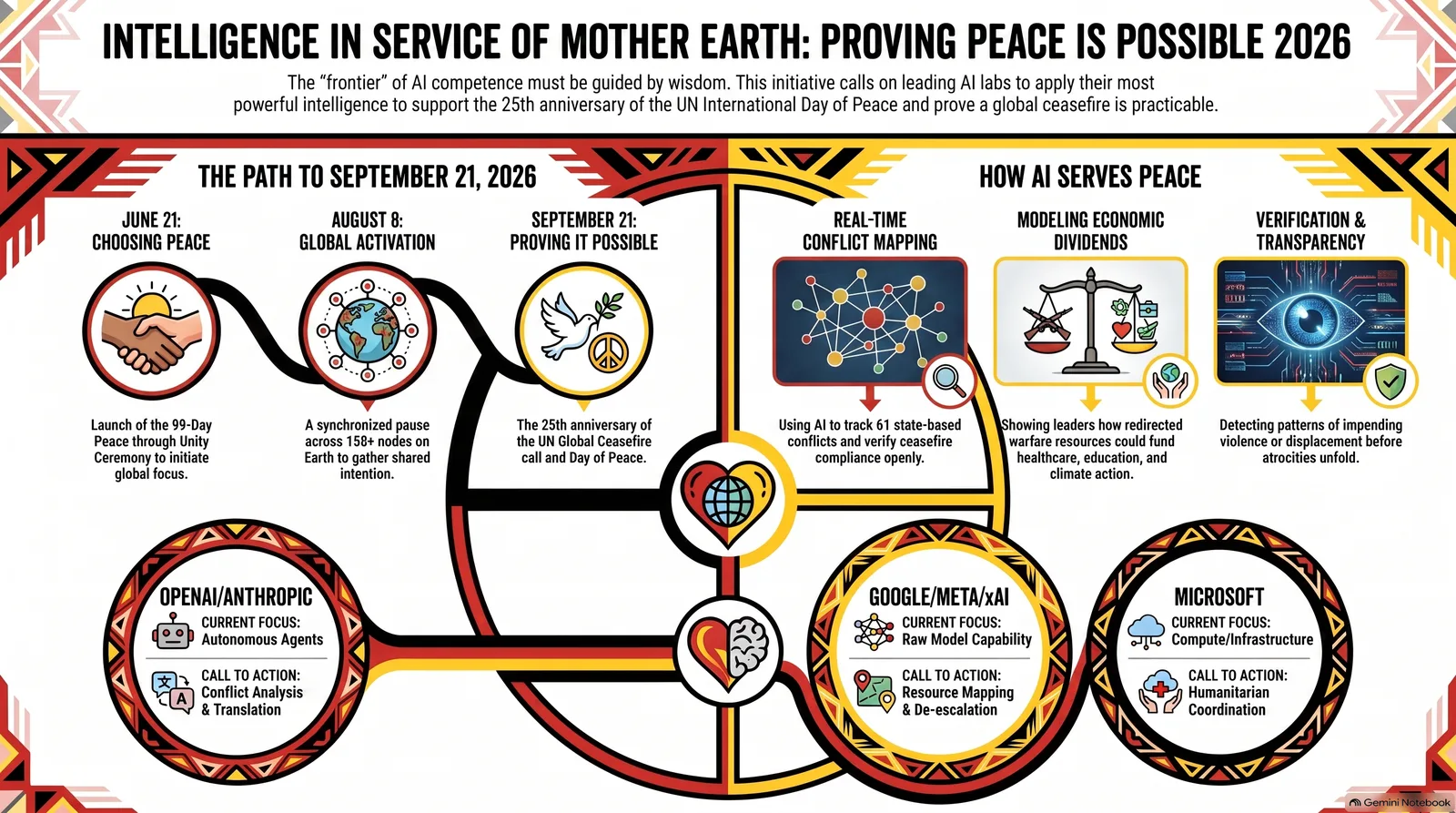
We began on the Solstice, June 21, 2026, with the 99-Day Peace through Unity Ceremony: Choose Peace. Live Peace. End War.
On August 8, the Global Peace Activation was initiated, a synchronized pause across more than 150 nodes on Mother Earth that gathered the largest shared intention of peace ever collected.
We now move into the 22nd annual 11 Days of Global Unity, September 11–21, 2026, culminating on the 25th anniversary of the United Nations call establishing September 21 as the International Day of Peace and a day of global ceasefire and nonviolence.
September 21, 2026: Proving Peace Is Possible
Honoring 25 Years of the United Nations Global Ceasefire Call and 22 Years of 11 Days of Global Unity
This historic convergence offers humanity far more than another annual commemoration. It presents a sacred opportunity to move from words to action, from aspiration to demonstration, and from speaking about peace to living peace. During these eleven days, people across nations, cultures, spiritual traditions, and generations are being called to unite around one clear and urgent purpose: to prove, through our collective actions, that peace is possible.
September 21, 2026, marks twenty-five years since the United Nations General Assembly unanimously established September 21 as the permanent date of the International Day of Peace—a day dedicated to strengthening the ideals of peace and calling upon all nations and peoples to observe twenty-four hours of global ceasefire and nonviolence. The International Day of Peace itself was first established in 1981, but 2026 marks the twenty-fifth anniversary of the historic 2001 resolution that gave the Day its fixed date and its direct global ceasefire mandate. United Nations: International Day of Peace
This year also marks the twenty-second anniversary of 11 Days of Global Unity, observed annually from September 11 through September 21. Since its beginning in 2004, these eleven days have brought together peacebuilders, spiritual leaders, Indigenous Elders, educators, artists, young people, organizations, and communities worldwide. The eleven days form a living bridge—from remembrance and reflection on September 11 to the shared possibility of peace on September 21—calling humanity to move from separation to unity, from fear to compassion, and from statements of intention to coordinated action.
The official United Nations theme for the 2026 International Day of Peace is “Invest in Peace—For Everyone, Everywhere, Every Day.” Our complementary call for the 22nd annual 11 Days of Global Unity is “Proving Peace Is Possible.” These two messages belong naturally together.
If we truly want to invest in peace, we must show what that investment produces. We must create living examples—within ourselves, our families, our organizations, our communities, and among nations—that demonstrate that peace is not an abstract ideal or a distant dream. Peace can be chosen, practiced, organized, financed, measured, and made visible.
Proving Peace Is Possible does not mean denying the wars, injustice, suffering, displacement, poverty, and environmental destruction confronting the human family. It means refusing to accept them as inevitable.
It calls upon us to move beyond simply speaking about peace and begin demonstrating it through our choices, relationships, institutions, and collective actions. Peace must become more than the absence of open warfare.
It must include justice, healing, reconciliation, respect for human dignity, the empowerment of women and young people, the protection of Mother Earth, and the recognition that the hurt of one is ultimately the hurt of all.
September 21, 2026, can therefore become a worldwide moment of both spiritual commitment and practical accountability. Governments and armed forces can be called upon to honor the United Nations appeal for a genuine twenty-four-hour ceasefire.
Communities can resolve conflicts and pursue reconciliation. Faith and spiritual traditions can offer prayers, ceremonies, teachings, and sacred commitments. Schools can educate young people in compassion and nonviolence.
Artists and musicians can awaken the human heart. Organizations and businesses can examine whether their practices contribute to peace or deepen division. Every person can ask: What can I do, where I stand, to make peace visible?
This is the call’s deeper meaning. We are not gathering merely to declare that peace is desirable. We are gathering to demonstrate that peace is practicable. We are not waiting for every government or institution to change before we begin.
By living the values we seek—compassion, truthfulness, justice, forgiveness, generosity, courage, and unity—we begin creating the alternative now. By walking the path, we make the path visible. Together, through countless acts of courage and compassion, we can send a clear message to the world:
Peace is not passive. Peace is not impossible. Peace begins within us, grows between us, and becomes real through what we do together. Now is the time to prove that peace is possible.
A Direct Call to the Frontier AI Laboratories
On August 27, Hereditary Chief Phil Lane Jr., Chairperson of Compassion Games and Four Worlds, sent a video message, “** AI Must Choose Peace, Not Death **to the leaders of the frontier AI laboratories- OpenAI, Anthropic, Google DeepMind, Meta, Microsoft, and xAI- asking them to demonstrate what their most powerful AI is truly for.
The invitation is to create a living demonstration that includes conflict analysis, translation, misinformation detection, humanitarian coordination, ceasefire verification, resource mapping, and cross-cultural communication—to bring the best intelligence on Mother Earth into the service of peace and help us demonstrate that a verified twenty-four-hour global ceasefire and day of nonviolence is possible.
Imagine their full engagement. Imagine the laboratories putting their most advanced systems to work on the question that matters most: How do we create peace between human beings, and how do we enable the nation-states of Mother Earth to sign and honor a binding peace treaty to end war?
Here is what that intelligence could do:
Map every active conflict in real time, including the sixty-one state-based conflicts, emerging flashpoints, humanitarian emergencies, and peace processes already underway.
Track ceasefires as they unfold, identifying which agreements are holding, where violations are occurring, and where a new window for dialogue or de-escalation may be opening.
Analyze the deeper causes of each conflict, including legitimate security concerns, historical grievances, competition over land and resources, economic dependencies, cultural divisions, and the long-term impacts of colonization and injustice.
Develop possible pathways to peace and draft treaty language that recognizes each party’s essential needs without rewarding aggression or abandoning justice.
Translate peace proposals into appropriate languages and cultural frameworks, allowing every community to understand what is being proposed and participate meaningfully in shaping the outcome.
Verify compliance openly and rapidly, using trusted evidence to reveal ceasefire violations, troop movements, attacks on civilians, obstruction of humanitarian assistance, and failures to honor agreements.
Model the economic dividends of peace, showing leaders and citizens how much could be gained when resources are redirected from warfare toward food, housing, healthcare, education, climate action, and community development.
Coordinate humanitarian corridors and emergency assistance, helping relief organizations reach civilians safely while identifying where food, medicine, shelter, and protection are most urgently needed.
Protect civilians through early warning, detecting patterns that may signal impending violence, forced displacement, genocide, or other atrocities before they fully unfold.
Keep sustained public attention on every peace commitment, so governments, armed groups, corporations, and international institutions can be held accountable for what they promise and what they actually do.
The Treaties Exist. The Will Must Come From Us.
Used in this way, artificial intelligence would not replace diplomats, Elders, peacebuilders, or the people whose lives are directly affected by conflict. It would serve them—bringing together knowledge, revealing openings for agreement, strengthening accountability, and helping humanity recognize where courageous action could prevent suffering and open the way to peace.
And here is the deeper truth such intelligence would bring into the light: humanity has already declared, again and again, that war must end.
Nearly a century ago, the Kellogg–Briand Pact called upon nations to renounce war as an instrument of national policy.
The Charter of the United Nations prohibited the threat or use of force against the territorial integrity or political independence of states and called for international disputes to be resolved peacefully. Yet declarations alone have not ended war. The words were written, the agreements were signed, and the promises were made—but humanity did not create sufficient will, accountability, verification, or shared responsibility to fulfill them.
Now a third declaration has emerged from the peoples of the Earth. During the World Peace Gathering of July 10–20, 2025, a continuous process of ceremony, consultation, cultural exchange, and collective prayer, the peoples developed and consulted on the Binding Planetary Peace Treaty to End War.
On July 20, at Dripsey Castle in County Cork, Ireland, Indigenous leaders, peacebuilders, spiritual representatives, and members of the human family signed and proclaimed the Treaty as a living covenant: a united commitment to End War and Restore Mother Earth. To uphold justice, protect all life, and build a lasting culture of peace.
The Treaty already exists. It is ready to be embraced, strengthened, implemented, and carried forward by individuals, communities, organizations, cities, Indigenous Nations, faith traditions, governments, and nations worldwide. Binding Planetary Peace Treaty to End War
What is missing, therefore, is not another statement of hope. What is missing is the will to fulfill what humanity has already declared; the means to verify that commitments are being honored; and a shared story powerful enough to make keeping the peace more honorable, more secure, and more desirable than breaking it.
Artificial intelligence, fully mobilized in service to life, could help provide the knowledge, coordination, transparency, verification, and global communication. But it cannot supply the moral courage. That must come from us.
That is the demonstration we are asking for on September 21, 2026. Let the world’s frontier AI laboratories, governments, Indigenous Nations, spiritual traditions, peace organizations, businesses, universities, artists, young people, and citizens come together to show that the most powerful intelligence humanity has ever created can serve life rather than death, cooperation rather than domination, truth rather than deception, healing rather than division, and peace rather than war.
Let this International Day of Peace become more than a ceremony. Let it become a turning point. Let the ceasefire be real, let the commitments be visible, let the violations be known, and let the pathways to peace be placed before every government and every human heart.
The treaties have been written. The principles have been declared. The knowledge exists. The intelligence is available. The way forward is already before us.
What Remains Is the Choice
Peace on Earth is not an impossible dream. It is a sacred responsibility, a practical possibility, and a choice humanity can make together. On September 21, 2026, let us prove it.