Executive Summary
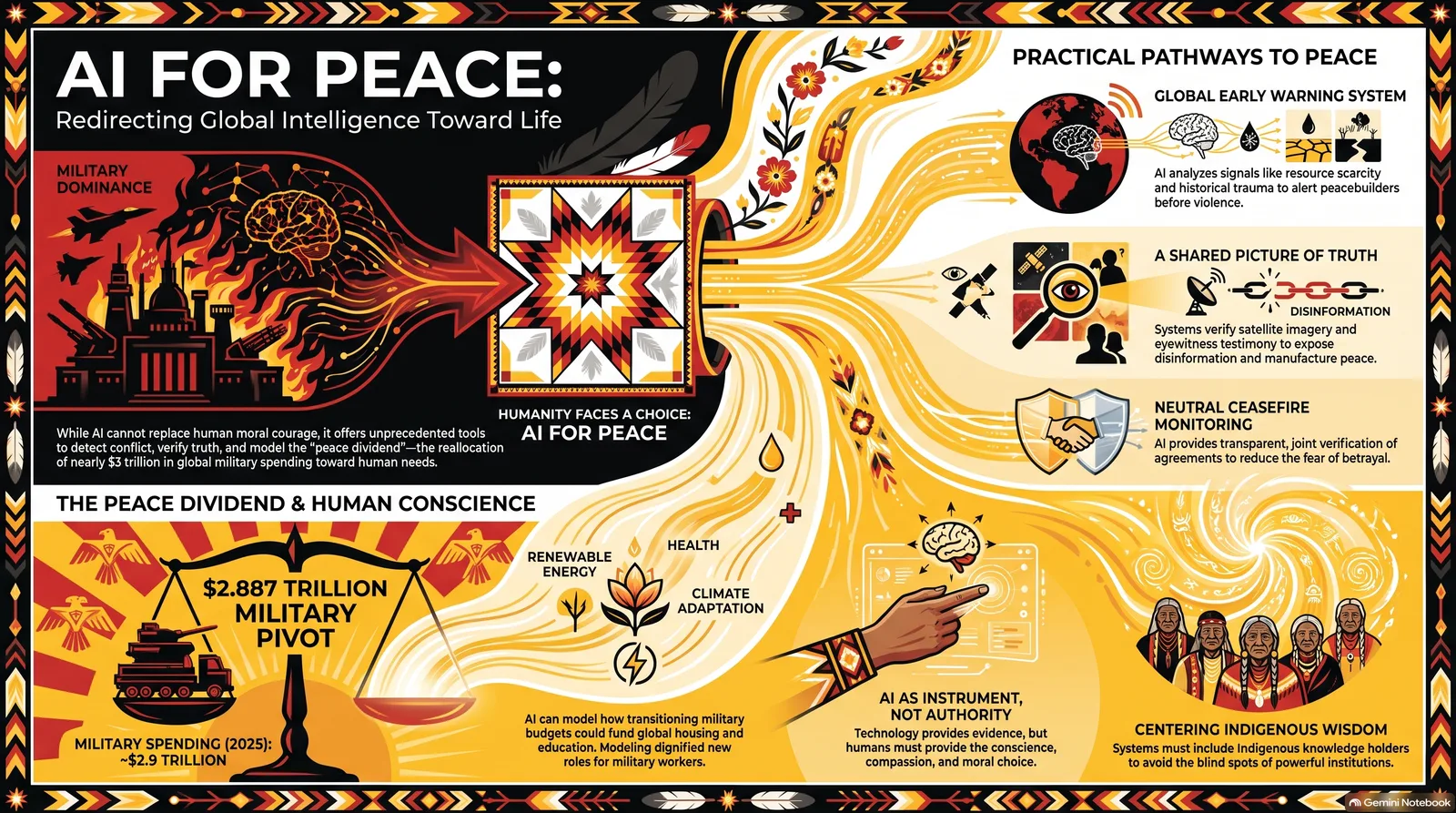
Artificial intelligence already possesses extraordinary capacities that could be directed toward preventing conflict and building peace. AI can detect the warning signs of war, counter disinformation, translate across languages, identify common ground between adversaries, model pathways to agreement, draft workable treaties, monitor ceasefires, protect humanitarian corridors, and demonstrate the enormous economic benefits of replacing military expenditure with human and ecological development.
A Global AI Commons for Peace could unite governments, frontier laboratories, open-source developers, the United Nations, Indigenous Peoples, peacebuilders, and civil society around transparent tools dedicated to protecting life. No single nation or corporation should control this work. It must be governed multilaterally, independently audited, and firmly grounded in human rights, privacy, cultural wisdom,m and human decision-making.
AI, however, cannot provide the courage, conscience,e or moral will required to choose peace. It can illuminate the pathway, but humanity must decide to walk it. Resistance may come from legitimate concerns about sovereignty and security, but also from institutions that profit from war, secrecy, fear,r and permanent division. Those interests must be brought into the light and held publicly accountable.
The technology already exists to begin. The decisive question is whether humanity will place the most powerful intelligence on Mother Earth in service to life rather than death. AI can help us find the way—but we must choose peace, live peace, and end war now.
Turning the Full Power of Artificial Intelligence Toward Peace
Humanity is standing before a choice unlike any we have faced before. We have created artificial intelligence systems capable of reading, comparing, and interpreting more information in moments than any human institution could examine in years. These systems can translate across languages, recognize patterns hidden within vast bodies of data, model consequences, detect danger, test possible agreements, and help coordinate action across borders. Their capacities are expanding almost daily.
Yet the overwhelming power of artificial intelligence is still being directed primarily toward competition: competition among companies, competition among nations, competition for markets, surveillance, strategic advantage, and military superiority. We keep asking how AI can make us richer, faster, stronger, and more dominant. We have not yet gathered the laboratories, governments, universities, Indigenous Peoples, peacebuilders, faith communities, scientists, and citizens of the world around the most important question of all: What would happen if the full power of artificial intelligence were deliberately turned toward ending war and building peace on Earth?
The answer is not that AI would magically create peace. It cannot. Peace is a moral choice, and no machine can make that choice for humanity. But if the United States, China, Europe, Russia, India, the nations of Africa and Latin America, the United Nations, the frontier AI laboratories and the growing global open-source community placed their combined capacities in service to peace, they could give humanity the clearest and most powerful practical pathway toward peace we have ever possessed.
AI Could Help Us See Conflict Before It Explodes
Wars rarely begin without warning. Before open violence comes a long accumulation of fear, humiliation, displacement, hunger, propaganda, military movement, political exclusion, resource scarcity,y and unresolved historical trauma. The warning signs are often visible, but they are scattered among thousands of reports, languages, agencies, and communities.
AI can bring those signals together. With proper safeguards, it can examine economic conditions, food and water insecurity, climate pressures, population displacement, public statements, local reporting, satellite imagery, and reports from trusted people on the ground. It can identify rising tensions and alert qualified human peacebuilders before a crisis becomes a war.
The United Nations has already identified early warning, preventive diplomacy, peacekeeping analysis,s and protection of civilians as areas in which AI could assist. The possibility before us is to build a truly global early-warning system not controlled by one military alliance or intelligence service, but governed multilaterally, independently audited, and informed by the communities most directly affected.United Nations
Such a system must never become machinery for mass surveillance. It must protect privacy, avoid treating prediction as guilt, and remain accountable to international human rights. Used wisely, however, it could help the world act while there is still time to talk.
AI Could Create a Shared Picture of the Truth.
** **Competing claims surround every war. Governments accuse one another. Propaganda floods the information space. Real atrocities are denied, while fabricated events are circulated to deepen hatred. Ordinary people are left unable to distinguish fact from manipulation.
An international AI peace system could gather and compare satellite imagery, verified photographs and videos, humanitarian reports, public records, eyewitness testimony, and independent journalism. It could flag contradictions, trace coordinated disinformation, and distinguish confirmed facts from unverified allegations.
Instead of announcing one machine-generated “truth,” it could show the evidence, its confidence level, the remaining uncertainty, and the different interpretations.
That distinction is essential. AI must help human beings examine evidence; it must never become an unquestionable authority. An independent body representing different regions, cultures, disciplines,s and affected communities would oversee the process. Indigenous knowledge holders and local peacebuilders must be at the table, because a system trained only on the records of powerful institutions will reproduce those institutions’ blind spots.
When lies can be exposed quickly, and truth can be examined openly, it becomes more difficult to manufacture consent for war.
AI Could Help Adversaries Understand One Another
Many negotiations fail before they begin because each side hears only accusations. Beneath hardened positions, however, there are usually deeper concerns: security, land, dignity, recognition, survival, access to resources, protection of children, the return of prisoners, or the fear of being attacked again.
AI can examine speeches, treaties, negotiating records, historical grievances,s and confidential proposals to help mediators distinguish public positions from underlying needs. It can identify areas of agreement buried beneath years of hostility. It can also help reveal where apparently irreconcilable demands are really different expressions of the same fundamental need for safety and dignity.
Real-time translation could let elders, women, youth, refugees, and grassroots leaders participate directly, rather than having their voices filtered through distant institutions. AI could summarize thousands or even millions of public consultations, allowing negotiators to see what people actually fear, what they need, ed and what compromises they might accept.
This would not replace face-to-face dialogue. It would make authentic dialogue more possible.
AI Could Test Thousands of Pathways to Agreement
Peace negotiations often place exhausted human beings in rooms with limited time, incomplete information, and immense pressure. AI could help them explore far more options than any negotiating team could develop alone.
It could model alternative ceasefire lines, security guarantees, peacekeeping arrangements, prisoner exchanges, phased withdrawals, shared-resource agreements, reconstruction plans, and systems of local autonomy. It could test how each proposal might affect civilians, minorities, neighboring countries, food supplies, water, employment, migration, and long-term stability.
AI could also expose the hidden costs of a poorly designed agreement. Would a proposed border divide communities or water systems? Would a sudden military withdrawal leave civilians exposed? Would sanctions relief benefit ordinary people or only powerful elites? Would a reconstruction plan deepen dependency, or would it build local ownership and capacity?
The machine would not select the agreement. It would help human beings see the likely consequences of their choices before more lives are lost.
AI Could Help Draft Agreements That Can Actually Work
Once political will exists, AI can quickly compare constitutions, peace treaties, ceasefire agreements, and international law worldwide. It can help legal teams draft clear language, identify contradictions, translate agreements consistently, and design implementation schedules with defined responsibilities.
It could also make agreements understandable to the people. Every peace settlement should be translated into local languages and explained in plain language, not buried in legal documents that only specialists can read.
Citizens should be able to ask: What does this agreement mean for my village? What does it mean for my children, my land, my culture, and my future? Who has promised to do what, and by when? How will we know whether those promises have been kept?
When people understand an agreement, they can defend it better.
AI Could Monitor a Ceasefire Without Belonging to Either Side
One of the greatest barriers to ending war is mistrust. Each side fears that if it stops fighting, the other will use the pause to rearm, reposition, or attack.
AI-assisted monitoring could examine satellite and drone imagery, radar data, verified field reports, weapons-fire sensors, and agreed military disclosures. It could detect possible violations and immediately notify independent monitors. A transparent system could show all parties the same evidence at the same time and distinguish an isolated incident from an organized breach.
The safeguards must be absolute. Automated systems must never be permitted to punish, target, or attack. Human investigators must review allegations, protect sensitive information, and provide a process for correction and appeal. The International Committee of the Red Cross has repeatedly emphasized the need for human-centered controls wherever AI enters military decision-making.International Committee of the Red Cross
But a jointly governed verification system could reduce the fear that causes ceasefires to collapse.
AI Could Protect Civilians and Open Humanitarian Corridors
During war, information is often fragmented while people are starving, trapped, or fleeing. AI can help coordinate safe routes, hospital capacity, food delivery, medical supplies, shelter, demining, and evacuation. It can update plans as roads close, bridges fail, weather changes, or populations move.
It could match urgent needs with available resources across governments, humanitarian agencies, local organizations,s and donors. It could identify overlooked communities and detect when corruption or political favoritism distorts aid distribution. Translation tools could allow affected people to report their needs in their own languages.
Again, local communities must remain in control of their information. A humanitarian map that falls into the wrong hands could become a targeting map. Security, consent, and strict limits on data use must therefore be built into the system from the beginning.
AI Could Reveal the Enormous Peace Dividend
The world spent approximately $2.887 trillion on the military in 2025. That is nearly $3 trillion in a single year—while communities lack housing, clean water, health care, education, climate protection and meaningful employment.SIPRI
AI could calculate, country by country and community by community, what even a modest reduction in military spending could accomplish. It could show how factories devoted to weapons might transition toward renewable energy systems, public transportation, resilient housing, medical equipment, ecological restoration and climate adaptation.
It could model how soldiers and military workers could be guaranteed dignified new roles rather than abandoned by economic conversion. It could show communities, businesses, and governments that peace is not merely the absence of war—it is an unprecedented opening for shared prosperity.
This is crucial because peace must not be presented as loss. It must be shown as the greatest development opportunity in human history.
War destroys capital, infrastructure, human potential, and trust. Peace releases all of them. Ending war would not impoverish humanity. It would free wealth on a scale capable of transforming life on Mother Earth.
From Competition to a Global AI Commons for Peace
China has formally called for AI to become an international public good, for greater open-source sharing and for new structures of global AI cooperation. Whatever political differences exist among nations, that principle deserves a serious response. No single country and no handful of corporations should possess the only advanced intelligence systems capable of shaping humanity’s future.China’s Global AI Governance Action Plan,State Council of China
Claims that one country is a precise number of months ahead of another are difficult to verify and can change quickly. The deeper reality is undeniable: powerful AI capacity is spreading. If today’s frontier laboratories refuse meaningful cooperation for the common good, open models and new laboratories will keep emerging elsewhere.
A global AI commons of some form is likely to grow. The decisive question is whether rivalry and fragmentation or shared standards, reciprocal contribution, human rights, and life service will shape it.
A Global AI Commons for Peace could allow nations and laboratories to contribute models, data, translation systems, scientific tools, and computing resources without surrendering every sovereign or commercial interest. Sensitive information could remain protected while shared peace functions—early warning, mediation support, treaty analysis, ceasefire verification, humanitarian coordination, and peace-dividend planning—could be developed openly and audited by all.
No nation would have to trust another nation completely. They would need to trust a transparent process that all could inspect.
What AI Cannot Provide
AI can identify the road, illuminate the obstacles and show the terrible cost of refusing to move. It can help adversaries understand each other. It can generate proposals, verify commitments, expose deception and show the material benefits of peace.
But AI cannot give us courage.
It cannot make a leader risk political power for strangers’ lives. It cannot make nations let go of old hatred. It cannot heal historical trauma merely by analyzing it. It cannot compel wealthy interests to surrender profit or fearful populations to trust again. It cannot create the moral foundation upon which peace must stand.
That part belongs to us.
Development begins from within. Peace also begins from within. Technology can serve as an instrument, but humanity must provide conscience, compassion, truthfulness, humility, and the willingness to act as one human family. Without those qualities, the finest peace system ever designed will remain a beautiful plan sitting unused while people continue to die.
We must also have the courage to unify. Governments, frontier laboratories, and civil society cannot each build isolated “peace AIs” that defend their own versions of events. The work must bring together different systems and different civilizations.
The United States and China do not have to agree on everything to cooperate in stopping children from being killed. Russia, Europe, India, the nations of the Global South, Indigenous Nations, and the United Nations do not have to surrender their identities to establish shared mechanisms for preventing war.
Unity does not mean uniformity. It means organizing our diversity around the sacredness of life.
Why Would Anyone Resist?
If peace would save lives, release trillions of dollars, restore economies, and open a new era of human development, why would any government, corporation, or institution resist using AI to pursue it?
We should not accuse every opponent of hiding crimes or acting in bad faith. Resistance can arise from genuine fears: that a rival will exploit openness, that confidential information will be exposed, that an AI system will be biased, that national sovereignty will be weakened, or that verification tools will become instruments of surveillance.
These concerns must be answered through careful design, equal governance, independent auditing, privacy protection and human control.
But we must also name other forms of resistance.
Some people and institutions profit enormously from weapons, reconstruction contracts, resource seizure and permanent insecurity. Some political leaders maintain power by creating enemies and keeping their people afraid. Some security institutions have built their budgets, status, and identity around the expectation of endless conflict.
Some governments may fear transparent evidence because it could expose atrocities, corruption, secret agreements, or public deception. Some technology companies may resist a commons because scarcity, secrecy, and exclusive control protect their market dominance. Some nations may prefer superiority over mutual security, even when that pursuit makes everyone less safe.
These possibilities require evidence in each case; they are not automatic accusations. Yet the public has every right to ask direct questions: Who benefits when peace efforts fail? Who profits when war continues? Who gains power from fear? Who opposes transparent verification, and what reasons do they give? Who is willing to submit their own conduct to the same scrutiny they demand of others?
The purpose of asking is not to begin another hunt for enemies. It is to make accountability unavoidable.
If an institution rejects a credible peace process, it should explain publicly what specific safeguard is missing and what alternative it proposes. “No” can no longer be an acceptable answer when the means exist to save millions of lives.
The Choice Before Us
For the first time, humanity possesses tools capable of gathering much of the world’s knowledge, translating across almost every major language, modeling the consequences of war, designing workable alternatives, and monitoring commitments across borders.
We do not yet possess perfect systems, and we never will. But we already possess enough capacity to begin.
The frontier AI laboratories could form an emergency AI for Peace Consortium. Governments could authorize protected data-sharing for conflict prevention and ceasefire verification. The United Nations could convene an independent council representing nations, Indigenous Peoples, peacebuilders, scientists, women, youth, humanitarian organizations, and affected communities.
Open-source developers could build public tools that no corporation or nation owns. Universities could test them. Citizens could examine their findings. Mediators could put them to work immediately in active conflicts.
Within months—not generations—we could demonstrate that AI can help detect escalation, identify common ground, draft ceasefire options, protect humanitarian corridors, verify commitments, and calculate the benefits of peace.
Each successful demonstration would create a living example.
By walking the path, we make the path visible.
The question is no longer whether artificial intelligence can contribute to peace. It can.
The question is whether we have the moral courage to place the most powerful intelligence on Mother Earth in service to life rather than death.
This is not a dress rehearsal. This is the real deal. We are the ones we have been waiting for. AI can help us see the way, but we must choose to walk it—together.
The time has come to choose peace, live peace, and end war now.
About Hereditary Chief Phil Lane Jr.
Hereditary Chief Phil Lane Jr. is an enrolled citizen of the Ihanktonwan Dakota and Chickasaw Nations, White Swan Oyate, and has devoted more than 55 years to Indigenous leadership, education, healing, reconciliation, community development, and international peacebuilding. He is Chairperson of Compassion Games International and Four Worlds International Institute and is helping lead the global 11 Days to Prove Peace Is Possible initiative.
Chief Lane co-founded the Four Worlds International Institute in 1982, advancing culturally grounded approaches to human and community transformation throughout the Americas and internationally. From 1980 to 1996, he served as an Associate Professor in the Faculty of Education at the University of Lethbridge, where he received tenure after only one year. His lifelong work has brought academic research, spiritual principles,s and Indigenous knowledge together with direct service in communities addressing cultural restoration, youth leadership, substance-abuse prevention, reconciliation, and intergenerational healing.
Chief Lane helped awaken public understanding of the intergenerational harms caused by Canada’s Indian Residential School system and contributed to the broader healing movement that led to the national settlement, healing resources,s and public apology. He is a member of the AISES Council of Elders, a co-founder and former Global Trustee of the United Religions Initiative, and a member of Evolutionary Leaders. His work has taken him throughout North, Central and South America, Africa, Micronesia, Hawaii, China, India and Southeast Asia.
On August 31, 2026, Chief Lane issued a direct public invitation to OpenAI, Anthropic, Google DeepMind, Microsoft, Meta, xAI, their principal investors and the wider artificial intelligence community: bring humanity’s most advanced intelligence into the service of peace.
That invitation has now been made. This presentation carries the message forward—beyond the laboratories and their investors to governments, educators, peacebuilders, spiritual communities, Indigenous Peoples and the entire human family.
This is now a call for people everywhere to understand what is already possible, to demand that artificial intelligence serve life rather than death, and to help create the moral and public will required to turn these capacities toward peace. AI must remain a servant of human conscience—not the authority over humanity’s future—and must be guided by spiritual principles, Indigenous wisdom, transparent accountability,y and the lived knowledge of communities most affected by war, poverty, displacement and environmental destruction.
Frontier laboratories can provide extraordinary technological capacities, but people must provide the courage, unity, and moral direction. This is no longer only an invitation to those who build artificial intelligence. It is a call to humanity to decide what intelligence is for.