
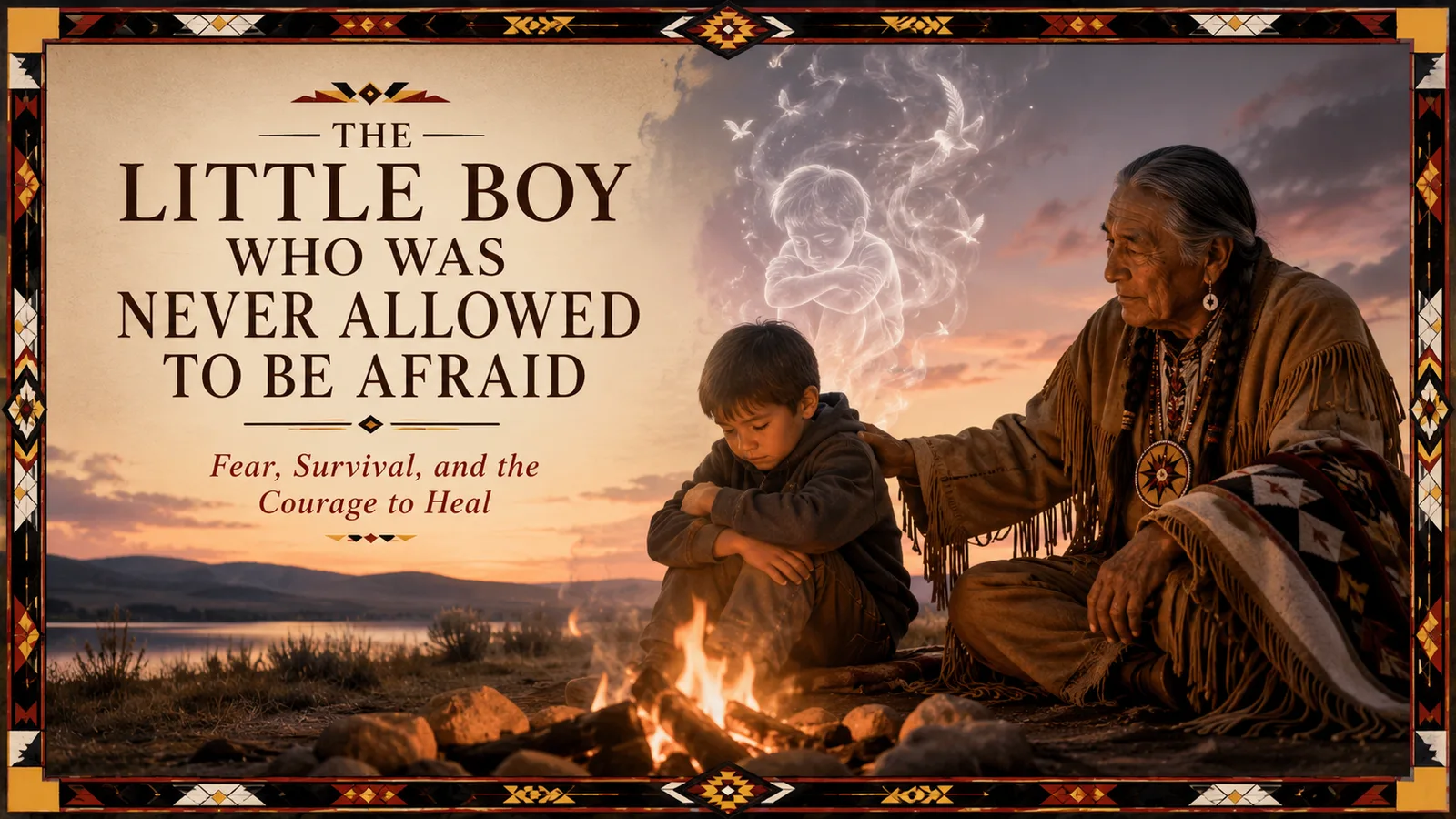
Some children are raised to believe that fear must never be shown. Not sometimes, and not only in front of strangers. They are taught to show absolutely no fear whatsoever.
Fear may be treated as something shameful, something that must be conquered, hidden, swallowed, and driven from your face before anyone can see it. A child may be expected to stand straight, remain silent, endure whatever comes, and never allow a fearful heart to become visible.
And so the child learns. The child learns how to control their face, hold back their tears, steady their voice, and remain standing when everything inside wants to run or seek protection. The child learns to say, “I am all right,” even when that is not true. The lesson becomes deeply rooted: fear must never be seen.
Perhaps this teaching is intended to prepare a child for a difficult world. Perhaps those who pass it on believe they are giving courage, discipline, toughness, and the strength to survive.
In many ways, they may be. The ability to endure fear without immediately displaying it can help a person survive dangerous circumstances. It can produce determination, perseverance, leadership, discipline, and an extraordinary capacity to remain standing through hardship.
But there is an important difference between learning to act courageously in the presence of fear and being taught that fear itself is forbidden. Fear is not a moral failure. It is not cowardice. It is not proof that something is wrong with a person’s character.
Fear is one of the ancient protectors within the human being. It warns us of danger. It tells us when something feels uncertain, unsafe, unfamiliar, or beyond our control. It prepares the body and mind to confront danger, escape it, become still, or seek protection. Fear has a purpose.
When a child is not permitted to acknowledge fear, however, the fear does not necessarily disappear. It may simply be driven underground. The child learns not to express it, but the body may continue carrying it.
The mind may continue watching for danger. The heart may continue waiting for permission to speak. The child grows older, but somewhere deep within, the frightened little one may remain watchful, silent, and alone.
Fear that cannot be expressed often changes its clothing. It may appear as anger. A person may strike out, become impatient, or react aggressively because anger feels stronger and safer than fear. The anger says, “Do not come any closer. Do not discover how vulnerable I feel.”
Fear may become control. A person may feel that everything must be organized, managed, and kept within strict boundaries. Unexpected changes may feel threatening, not because the changes themselves are terrible, but because uncertainty awakens the old feeling of being unsafe.
Fear may become perfectionism. A child who was never permitted to be frightened may grow into an adult who believes that mistakes are dangerous. The person may come to believe that if everything is done perfectly, nobody can criticize, shame, reject, or overpower them. Perfectionism then becomes more than a desire to do well. It becomes a protective shield.
Fear may become constant activity. A person may remain busy every hour of the day, serving, leading, organizing, helping, traveling, speaking, and solving problems. Activity may become a way of keeping deeper feelings from rising to the surface. As long as the person remains in motion, there is little time to sit quietly with what has been carried within.
Fear may become emotional distance. A person may decide, often without consciously choosing it, that it is safer not to depend too deeply upon anyone. Love, tenderness, closeness, and vulnerability may feel dangerous because they require a person to lower long-established defenses. The person may care deeply for others while remaining unable to reveal what is happening in the deepest places of the heart.
Fear may also become excessive responsibility. A person may believe that they must carry everyone, protect everyone, solve every crisis, and remain strong for the whole family or community.
They may become a shelter for others while never allowing themselves to seek shelter. They may give comfort freely yet feel uncomfortable receiving it.
When people are full of fear, they do not always look frightened. Sometimes they look powerful. They may appear forceful, stubborn, impatient, controlling, suspicious, restless, or completely unemotional.
They may make decisions too quickly because uncertainty feels unbearable. They may react to an imagined danger as though it has already arrived.
A fearful person may become defensive when nobody is attacking. Disagreement may be interpreted as betrayal. A request may feel like a demand. A delay may feel like rejection.
A change in another person’s voice may be heard as a warning. The nervous system may remain prepared for danger even during moments that are meant to be peaceful.
Some people strike first because they fear being hurt. Some withdraw before they can be abandoned. Some dominate conversations because listening makes them feel exposed. Some refuse help because needing another person feels unsafe.
Others may become reckless, impulsive, argumentative, or deeply isolated. They may push away the very people who could comfort and support them.
They may feel compelled to win every disagreement because losing feels like becoming powerless. They may try to control every detail because uncertainty awakens helplessness. They may remain constantly alert, watching for danger even in places where no immediate danger exists.
From the outside, these actions may look unreasonable or self-destructive. But deep within the person, they are often attempts to create safety. The fearful part of the person is not necessarily trying to destroy their life. It is trying to protect them, although it may be using methods learned long ago that are no longer helpful.
A person may become admired for being fearless, dependable, and strong. Others may come to rely upon that strength. Over time, strength may become more than a quality; it may become an identity. The person becomes the one who knows what to do, the one who remains steady, the one who carries the burden, the one who protects the family, and the one who never falls apart.
Yet such an identity can become a prison. When a person is never allowed to be frightened, that person will also feel unable to ask for comfort. When weakness is forbidden, receiving care may become difficult. When tears have been treated as failure, grief may remain unexpressed. When dependence has been associated with danger, trust may become painful.
The person may become deeply compassionate toward others while remaining harsh toward the self. They may tell others that it is all right to be afraid while secretly believing they have no right to feel the same way. They may forgive vulnerability in everyone except themselves.
This can produce loneliness even when family, friends, colleagues, and community surround the person. Others may know the person’s strength, achievements, service, and public responsibilities without ever fully knowing the frightened and tender human being beneath them.
Fear that has been held down for many years may begin to surface later in life. This may happen because illness, loss, pain, surgery, physical weakness, sleeplessness, retirement, grief, or the realities of aging weaken the old walls that once held everything in place. The body may no longer have the same energy to suppress what has been carried for decades. The mind may become more aware of vulnerability. The old strategies of toughness, constant activity, silence, and control may no longer work as they once did.
Then the fear begins to speak. It may say, “I have been here all along.” It may ask, “You have carried everyone else, but who will carry you?” It may ask, “You have protected others, but who will protect you?” It may ask, “You have been strong for so long; is there now a place where you may rest?”
This does not necessarily mean that the person has become weaker in spirit. It may mean that the long-silenced parts of the self are finally seeking recognition and healing. What feels like a breakdown may, in part, be an opening. The child who was never allowed to say, “I am frightened,” may finally be asking the Elder within to listen.
That child does not need to be scolded again. The child does not need to be told to stop feeling fear. The child does not need another command to remain silent. The child needs compassion. The child needs to hear that fear does not make anyone weak, dishonorable, or unworthy. The child needs to know that there were understandable reasons for feeling afraid. The child needs reassurance that the danger has passed, that support is available, and that constant watchfulness is no longer necessary.
Perhaps the healing words are these: Little one, I see you now. You were frightened, and you had every right to be frightened. You learned to hide your fear because you believed it was the only way to survive. You have protected this life faithfully for many years. You do not have to carry everything alone anymore. Fear does not make you weak, and it does not make you less worthy. Come and sit beside the sacred fire. You are safe enough now to speak.
There is more than one kind of courage. The first kind of courage enables a person to stand firm, endure pain, face danger, protect others, and continue through hardship. This courage deserves honor. It may have saved lives, held families together, sustained communities, and carried people through experiences that seemed impossible to survive.
But there is another kind of courage. It is the courage to speak honestly about what is happening within. It is the courage to say, “I am afraid,” without believing that dignity has been lost. It is the courage to receive comfort after a lifetime of comforting others. It is the courage to allow trusted people to walk beside us. It is the courage to grieve what was never grieved, feel what was never permitted to be felt, and speak what was never safe to say.
This deeper courage does not require a person to surrender strength. It teaches us that strength and vulnerability are not enemies. A tree is strong not because it refuses to move, but because it can bend with the wind while remaining rooted in Mother Earth. Water is powerful not because it is hard, but because it yields, moves, adapts, and continues its journey. The sacred circle is strong because every part belongs and every voice has a place.
So it is within the human being. Our strength does not come from banishing every vulnerable feeling. It comes from bringing the spiritual, mental, emotional, physical, and volitional dimensions of our being into right relationship. Fear must not govern the whole person, but neither should it be exiled from the circle.
Fear can be invited to sit down and speak. We can ask what it is protecting, what danger it is expecting, what it needs to feel safer, whether the danger belongs to the present moment or comes from something that happened long ago, and what compassion might look like in this situation.
Listening to fear does not mean surrendering to it. Fear may have a voice, but it does not have to hold the final authority. This is where volition becomes essential. Volition is our sacred capacity to choose our direction, set worthy goals, persevere, and bring our intentions to completion even when powerful emotions are moving through us.
We may feel fear without becoming fear. We may acknowledge fear without allowing it to govern every decision. We may listen to its warning, seek wisdom, receive support, and then choose the next good step.
The path forward is not to wage another war against fear. Fear has already been fought, denied, buried, and silenced for too long. The path forward is to understand it, bring it into the light, and surround it with patience, truth, loving support, prayer, and wise action.
The child within did not fail. That child found a way to survive. The defenses that now cause difficulty may once have been necessary. Anger may once have provided protection. Silence may once have prevented punishment. Control may once have reduced chaos. Emotional distance may once have protected the heart.
Healing does not require condemning these survival responses. It requires honoring what they once accomplished while gently recognizing that they may no longer be needed.
The Elder within can now teach the child something new. The Elder can teach the child that it is no longer necessary to hide. The Elder can say, “You have done your duty. You have guarded this life faithfully. You may now rest. You are not alone. You are allowed to feel. You are always worthy of love.”
As we grow older, we may discover that unresolved fear does not simply disappear with time. It may remain within us, shaping our relationships, decisions, health, and peace of mind until we are willing to meet it with honesty and compassion.
If we want to be happy in our later years, and if we want to feel that our lives have been meaningful and fulfilled, we may need to deal with the fear we were never allowed to express. This does not diminish the courage of our lives. It completes it.
Fulfillment does not come only from what we accomplished, how many people we helped, how bravely we endured, or how faithfully we fulfilled our responsibilities. It also comes from becoming whole. It comes from making peace with the frightened child, the wounded heart, the tired protector, and the human being who longed to be held but was taught only to remain strong.
Perhaps the final work of a fulfilled life is not to prove that we were never afraid. Perhaps it is to look back with compassion and acknowledge that there was fear, there was pain, and there were burdens that should never have been carried alone. And still, we survived. Still, we loved. Still, we served. Still, we continued.
Now the fear can be welcomed into the circle, not as a ruler, but as a wounded relative returning home. Courage is not the absence of fear. Courage is the sacred capacity to recognize fear, listen to what it is trying to protect, and still choose to walk in a good way.
Perhaps the fear that rises in the later years of life is not asking to become our master. Perhaps it is asking, at last, to be healed.