
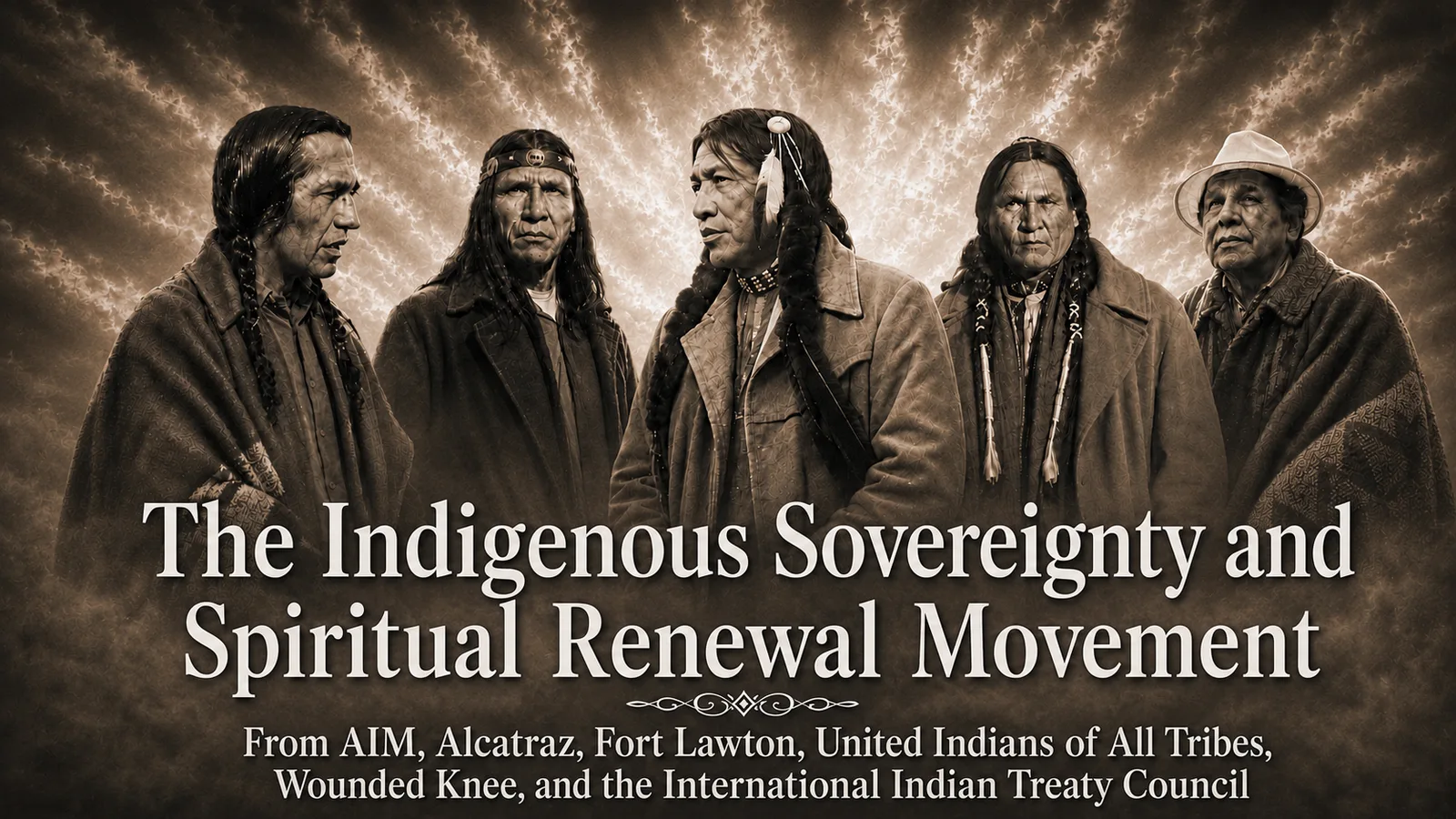
What has often been called the Red Power era was, from the Four Worlds perspective, far more than a political protest movement. It was the Indigenous Sovereignty and Spiritual Renewal Movement. This name reaches deeper into what was truly happening. Indigenous peoples were not simply demanding civil rights or seeking inclusion within the American system. They were rising from within their own nations, ceremonies, treaty memories, spiritual laws, ancestral responsibilities, and sacred relationships with the land.
They declared that Indigenous peoples were not defeated, not vanished, and not mere minorities awaiting recognition. They were original nations with living rights, living treaties, living ceremonies, and living responsibilities to future generations.
The movement emerged because silence was no longer possible. Across the United States and the Americas, Indigenous communities bore the heavy consequences of centuries of colonization: land theft, broken treaties, military violence, boarding schools, forced assimilation, poverty, termination and relocation policies, police brutality, cultural suppression, and spiritual attack.
Yet beneath the suffering, the sacred fire of the people had never been extinguished. Elders still carried the teachings. Languages still held the memory of the land. Ceremonies still opened pathways to healing. Treaties still spoke. Ancestors remained present. Children still needed a future.
The Rise of AIM
The American Indian Movement (AIM) began in Minneapolis, Minnesota, in July 1968. Its founding circle included Dennis Banks, Clyde Bellecourt, Eddie Benton-Banai, Pat Bellanger, George Mitchell, and many other Indigenous organizers, families, veterans, mothers, fathers, youth, and community members responding to urgent urban conditions.
AIM did not begin as an abstract political theory. It arose in the streets, homes, jails, and community gatherings of Indigenous people pushed into cities through federal relocation policies that promised opportunity but often delivered poverty, racism, unemployment, discrimination, police harassment, poor housing, and separation from land, language, ceremony, and kinship. Indigenous people were told—directly and indirectly—that survival meant becoming less Indigenous. AIM rose against that lie.
One of AIM’s first expressions was community protection. Indigenous residents in Minneapolis faced police harassment and abuse, so AIM organized patrols to monitor conduct and protect relatives. This was kinship in motion—the ancient responsibility to defend the people taking new form in an urban landscape.
AIM understood that urban suffering was inseparable from the broader colonial history: poverty linked to land theft, police violence to military conquest, unemployment to destroyed economies, and family disruption to boarding schools and relocation. The urban wound and the treaty wound were part of the same story.
This is why AIM became a thunderbolt of the Indigenous Sovereignty and Spiritual Renewal Movement. It broke the silence. It forced the United States to see Indigenous people not as vanished relics but as living nations, families, cultures, and movements. It carried anger and dignity, confrontation and ceremony, resistance and love. It awakened a generation told to assimilate and disappear, answering with a clear voice: “We are still here.”
Eddie Benton-Banai’s role deserves special recognition. A founder of AIM, he also carried profound cultural and spiritual responsibility. His later teachings, including The Mishomis Book, reflected what was present from the beginning: Indigenous liberation had to be cultural and spiritual as well as political. It required restoring memory, returning children to their stories, ceremonies, languages, prophecies, and spiritual laws, and rebuilding the inner foundation without which political freedom would be hollow.
This cultural foundation was already forming before AIM’s public emergence. In 1962, Clyde Bellecourt and Eddie Benton-Banai met in Stillwater State Prison, where they helped create the Indian Folklore Club. Even behind prison walls, Indigenous men reached back to identity, stories, songs, and teachings—refusing spiritual imprisonment. That spirit of remembrance became part of AIM’s bedrock.
AIM also focused on the future through the children. Recognizing that colonial systems targeted Indigenous youth to sever them from language, culture, and identity, AIM created survival schools such as the Heart of the Earth Survival School in Minneapolis. These were places of cultural rescue, teaching children they were sacred beings carrying the inheritance of nations—not problems to be fixed. They transformed education into an act of self-determination.
Alcatraz, Fort Lawton, and Institution Building
In November 1969, the occupation of Alcatraz Island began (lasting until June 1971). Though not an AIM action in the narrow sense, it belonged to the same fire. Indigenous students, urban Natives, and traditional people occupied the island and asserted a treaty-based claim to unused federal land. They turned a symbol of imprisonment into a beacon of Indigenous freedom, awakening imagination across the continent and showing that bold moral action could shift consciousness.
That same energy reached Seattle. On March 8, 1970, Indigenous activists led by Bernie Whitebear occupied Fort Lawton, a surplus military installation. More than one hundred people participated, singing, praying, and drumming while asserting Indigenous priority over the land. The peaceful action resulted in arrests, but the images of military force used against Indigenous people highlighted the deep contradiction. Out of this struggle emerged the United Indians of All Tribes Foundation and, ultimately, the Daybreak Star Indian Cultural Center in Discovery Park, a permanent home for urban Indigenous people from many nations.
Daybreak Star became a living victory: a place for art, education, family services, ceremonies, and intertribal gathering. It turned the pain of relocation into a sense of belonging and demonstrated that direct action could create lasting institutions.
Wounded Knee and the International Stage
In 1972, the Trail of Broken Treaties brought Indigenous people in a caravan to Washington, D.C., demanding sovereignty and treaty rights. It made the treaty issue impossible to ignore and exposed the contradiction at the heart of American democracy.
Then, in 1973, came the 71-day occupation at Wounded Knee on the Pine Ridge Reservation. AIM joined traditional Oglala Lakota people in returning to this sacred wound—the site of the 1890 massacre. The occupation brought treaty rights, traditional governance, federal betrayal, and ongoing colonization into global view. It revealed both continuing violence in new forms and the enduring strength of the people.
Leonard Crow Dog, Sicangu Lakota medicine man and spiritual leader, provided a vital ceremonial foundation. At Wounded Knee and beyond, he helped root the movement in prayer, purification, and sacred responsibility. He reminded everyone that liberation and the return of ceremony, language, land, and spiritual law were inseparable.
This deepened treaty consciousness gave birth to the International Indian Treaty Council (IITC), founded at Standing Rock in June 1974. Thousands of Indigenous representatives gathered, carrying forward the energy of Alcatraz, AIM, Fort Lawton, the Trail of Broken Treaties, and Wounded Knee into the international arena.
The IITC affirmed that treaties were living, sacred nation-to-nation agreements—not dead documents subject only to domestic control. In 1977, it became the first Indigenous organization to gain consultative status with the United Nations Economic and Social Council. Its work helped pave the way for the 2007 United Nations Declaration on the Rights of Indigenous Peoples and continues today, defending treaty rights, sovereignty, sacred sites, traditional knowledge, and self-determination.
A Living Legacy
In just six years (1968–1974), the movement accelerated from urban community defense in Minneapolis to land reclamations, national confrontation, the stand at Wounded Knee, and international treaty advocacy. These events—AIM, Alcatraz, Fort Lawton, United Indians of All Tribes, Wounded Knee, and the International Indian Treaty Council, were branches of the same living tree.
Together they embodied Development from Within. The people remembered, organized, protected one another, reclaimed land, built schools and institutions, and carried treaty memory onto the world stage. They turned pain into purpose. They showed that true development begins when a people recover their own vision.
They also demonstrated that resistance and healing must walk together. Survival schools healed identity. Daybreak Star healed belonging. Treaty work healed historical erasure. Ceremony grounded resistance in prayer and responsibility.
The Indigenous Sovereignty and Spiritual Renewal Movement restored treaty consciousness, strengthened cultural pride, created enduring institutions, influenced policy, and opened international doors. It reminded the world that Indigenous peoples are nations with inherent rights rooted in their relationship with the land, the Creator, ancestors, and continuing existence.
These events were not isolated moments that ended. They became roots that continue to nourish present struggles for sovereignty, justice, healing, and right relationship with Mother Earth. The sacred fire still burns. The treaties still live. The children will know who they are. And from memory, vision, courage, and responsibility, Indigenous peoples continue to rise—not only to resist harm, but to help guide humanity toward justice, balance, and renewal.