
The morning of November 4, 1791, dawned cold and uncertain along the upper waters of the Wabash River, near what is now Fort Recovery, Ohio. Major General Arthur St. Clair’s force had marched northward as part of a continuing military campaign against the Indigenous Nations of the Ohio Country.
His army was exhausted, poorly supplied, weakened by sickness and desertion, and encamped in a vulnerable position. Many soldiers had not yet formed their lines when the forest around them suddenly came alive.
From several directions, a powerful confederacy of Miami, Shawnee, Lenape, Potawatomi, and other Indigenous warriors moved against the American encampment. Little Turtle of the Miami, Blue Jacket of the Shawnee, Buckongahelas of the Lenape, and other experienced leaders had brought together warriors who understood the land, knew how to move through the forest,t and recognized the weaknesses of the invading army.
Their attack was not a disorderly charge. It was disciplined, coordinated, ed and strategically planned. The warriors formed around the American position, steadily compressing St. Clair’s forces and preventing them from establishing an effective defense. American artillery crews were targeted, militia lines collapsed, and repeated attempts to break through the surrounding warriors failed.
Of approximately 920 American soldiers engaged, 632 were killed and 264 wounded. According to the National Park Service, only twenty-four soldiers escaped without injury. It became the most devastating defeat suffered by the United States Army during the long period of warfare against the Indigenous Nations.
Yet it is still too often treated as a footnote rather than understood as one of the most significant Indigenous military victories in this continent’s history, highlighting the importance of recognizing Indigenous resilience and strategic success.
This victory did not arise from savagery, as older colonial histories so often portrayed it. It arose from organized resistance to invasion. St. Clair’s expedition was moving into a region where Indigenous villages, food supplies and agricultural fields had already been attacked and destroyed by earlier American campaigns.
The Native Confederacy was not crossing an ocean to conquer another people. Its warriors were defending their homelands, their families, their hunting territories, their cornfields, their sacred places, and their right to determine their own future.
The battle revealed an important truth that would recur many times: military power does not automatically confer moral authority. A government may possess soldiers, weapons, money, and institutions, but these things do not make its actions just. Nor does victory or defeat determine who was right.
Justice must be measured by the nature of the relationship, by whose lands were being entered, whose homes were being threatened, whose agreements were being ignored,d and whose children would bear the consequences.
The victory at the Wabash temporarily halted the American advance, but it did not end the struggle. The United States reorganized its army under General Anthony Wayne and returned with greater force.
After the Native confederacy was defeated at the Battle of Fallen Timbers in 1794, representatives of numerous Indigenous Nations entered negotiations that produced the Treaty of Greenville in 1795.
Little Turtle participated in the treaty process because endless warfare was destroying communities and because some form of peace had become necessary. The treaty required Indigenous Nations to surrender vast territories.
However, it also established a boundary intended to separate lands opened to American settlement from lands still recognized as belonging to Indigenous Peoples. It was formally described as a treaty of peace between the United States and the participating Nations.
To Indigenous Peoples, such an agreement is not simply a transaction recorded on paper. It is a Sacred Covenant, prayerfully declared, in Sacred Ceremony before Wakan Tanka, the Great and Mysterious Spirit, our Creator, emphasizing the sacredness and deep spiritual importance of Treaties.
Therefore, Treaties are Sacred and carry sacred responsibilities between Sovereign Nations, establishing how Nations would coexist peacefully and respect boundaries, safeguarding future generations from conflict.
But the pressure for land did not end. Settlers continued moving toward and beyond treaty boundaries, perpetuating the cycle of dispossession that continues to affect Indigenous communities today.
Each new treaty was presented as a final settlement. Each new cession was described as the price of peace. Yet peace never seemed to satisfy the hunger for more land and natural resources.
This is one of the deepest wounds in the relationship between Indigenous Nations and the United States. Indigenous leaders have treated and continue to treat treaties as solemn covenants between sovereign peoples.
In contrast, the expanding American state treated them, time and time again, as temporary instruments, useful until population growth, mineral discovery or political pressure made them inconvenient.
A Sacred Treaty that can be discarded whenever the stronger party desires something more is not in any way a Sacred Treaty. It is just the opposite. It becomes little more than a pause in the process of dispossession.
Eighty-five years after St. Clair’s defeat, this pattern appeared again on the northern Plains.
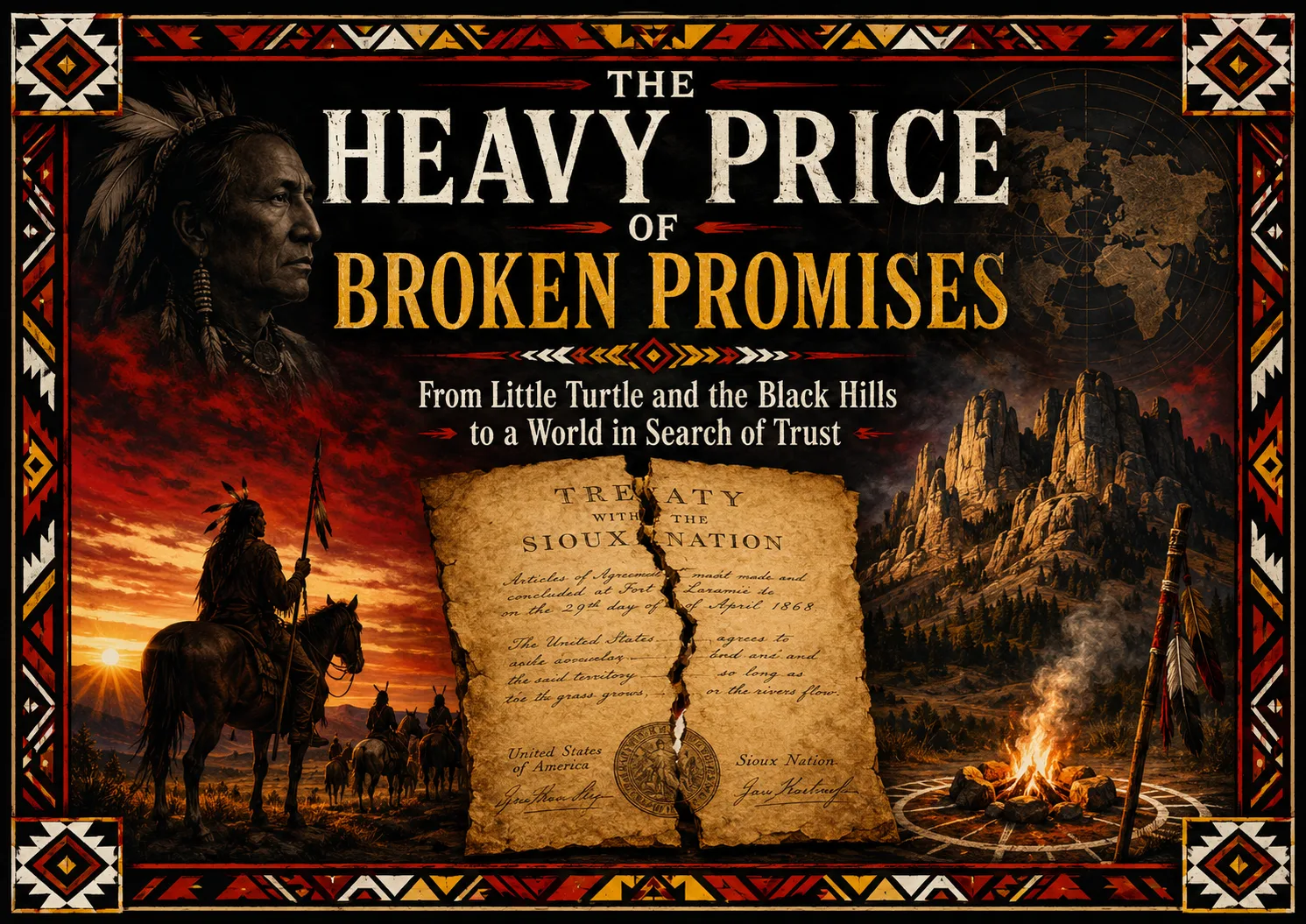
In 1868, after years of resistance led by Red Cloud and other Oceti Sakowin leaders, the United States entered into the Fort Laramie Treaty with the Oceti Sakowin. The treaty recognized the Black Hills as part of the Great Sioux Reservation and set the area aside for the exclusive use of the Sioux Nation. It also recognized a vast unceded territory in which Indigenous Peoples retained hunting rights and unauthorized settlement or entry was prohibited.
For the Oceti Sakowin, the Black Hills were never simply real estate. They were, and remain, the sacred heart of the Nation—the place known as He Sápa, connected to the origins, ceremonies, medicines, identity and spiritual life of the people. The land was not merely something the people owned. It was a living relative within a sacred relationship of reciprocal responsibility.
This distinction is essential. The colonial system approached land as a commodity. Land could be surveyed, divided, fenced, mined, mortgaged, and transferred. Its value was calculated based on timber, minerals, agricultural productivity, or market price.
Indigenous Peoples understand that land carries memory, holding the bones of ancestors, nourishing life, and teaching identity, making it more than a commodity in the marketplace.
Yet only six years after the Fort Laramie Treaty was signed, Lieutenant Colonel George Armstrong Custer led a military expedition into the Black Hills. The expedition confirmed reports of gold, and miners soon entered the region in open violation of the treaty.
Rather than removing the trespassers and enforcing its own agreement, the United States attempted to purchase the Hills. When the Oceti Sakowin refused to sell, the government increased military and economic pressure.
The government eventually ordered Indigenous families who were living outside the reservation to report to government agencies during the depths of winter. Those who did not comply were classified as hostile. The army was then sent against them.
Once again, the language of law was reversed. The people defending treaty-protected lands were called hostile, while those violating the treaty presented themselves as agents of law and order.
This reversal is one of the most enduring instruments of colonial power. First, an Indigenous Nation is pressured into signing an agreement. Then outsiders violate the agreement.
When the Indigenous Nation resists the violation, its resistance is described as aggression. The original breach disappears from the story, and the defenders are blamed for the conflict created by those who broke their word.
In June 1876, Custer and the Seventh Cavalry approached a vast encampment of Lakota, Dakota, Cheyenne, and Arapaho families along the Greasy Grass, known in English as the Little Bighorn River. The village was not simply a military formation. It was a living community containing children, mothers, grandparents, spiritual leaders, lodges, horses, and families gathered during a time of ceremony, hunting, and renewal.
Custer underestimated the size and strength of the village. He divided his regiment into separate commands and moved to attack before the other columns of the military campaign had arrived. Historians continue to examine his motives and decisions, but the consequences are clear: he attacked a much larger community whose warriors were prepared to defend their families.
The response was swift. Oceti Sakowin and Cheyenne warriors, including those fighting under the leadership and spiritual influence of Sitting Bull, Crazy Horse, Gall, Low Dog, Two Moons, and many others, moved decisively against the divided cavalry.
Major Marcus Reno’s force was driven back after attacking the southern end of the village. Captain Frederick Benteen’s battalion joined Reno and survived a prolonged siege on the bluffs.
Custer’s direct command of five companies was surrounded and destroyed. Every soldier with that portion of the regiment was killed.
The Battle of the Greasy Grass was an extraordinary Indigenous victory. It demonstrated courage, military skill, coordination, and a powerful determination to defend the people. It should never be reduced to the mythology of “Custer’s Last Stand,” as though the central meaning of the battle were the death of one American officer.
The greater meaning was that Indigenous Nations successfully defended their families against an attacking military force operating within lands protected by treaty.
Yet the victory carried a terrible consequence. News of Custer’s defeat intensified public anger and political demands for retaliation. The United States increased its military campaign, destroyed food sources, pursued communities through the winter, and used control over rations to force surrender.
After the elimination of Custer and the 7th Cavalry, the US Congress passed the Surrender or Starve Act. Congress then enacted legislation to take the Black Hills without obtaining the consent required under the Sacred Treaty.
More than a century later, in United States v. Sioux Nation of Indians, the United States Supreme Court upheld a financial award arising from the government’s taking of the Black Hills. But the Oceti Sakowin have consistently maintained that the issue is not simply financial compensation. The sacred land itself remains at the center of the claim. Money cannot transform an unlawful taking into a sacred or legitimate act.
The Wabash and the Greasy Grass, therefore, stand together in history.
Both were decisive military victories for Indigenous forces defending their homelands. Both revealed the strength and intelligence of Indigenous confederacies. Both disrupted the belief that American expansion was inevitable and irresistible.
And both were followed by the same underlying result: the United States returned with greater resources, agreements were weakened or discarded, and Indigenous lands were taken.
This teaches us that a military victory, however courageous and necessary, cannot, by itself, protect a people when the opposing power controls the surrounding political, economic, and legal systems.
After the battle ends, the struggle often shifts to legislatures, courts, banks, newspapers, schools, rationing systems, and treaty negotiations. Physical warfare may be followed by administrative warfare. The weapon changes, but the objective remains the same.
The pattern that began with Indigenous lands did not remain limited to North America. As the United States became a global power, similar struggles emerged around oil, minerals, agricultural lands, transportation routes, and strategic territories.
The names changed. The continents changed. The language of intervention changed. But the central question remained: what happens when a people attempt to control their own lands and resources in ways that conflict with the interests of a greater power?
In Iran, Prime Minister Mohammad Mosaddegh led a government that nationalized the country’s oil industry after decades in which British interests had exercised extraordinary control over Iranian petroleum. Iran argued that its oil belonged to the Iranian people and that the nation had a sovereign right to determine how this resource would be developed.
Britain resisted nationalization and sought American cooperation in removing Mosaddegh. In 1953, British and American intelligence agencies participated in the planning and implementation of the operation that overthrew his government and strengthened the rule of Shah Mohammad Reza Pahlavi. President Dwight Eisenhower later acknowledged in his private diary that the United States had helped bring about Mosaddegh’s removal and the restoration of the Shah’s power.
Cold War fears, internal Iranian divisions, and concerns about communist influence formed part of the historical setting. Those realities should be recognized. But they do not erase the fundamental issue: an outside power intervened in another country’s political life when that country attempted to regain authority over a vital natural resource.
The long-term consequences were profound. The Shah’s government became increasingly authoritarian, and resentment over foreign interference contributed to the conditions that eventually produced the Iranian Revolution of 1979. A short-term strategic victory created generations of distrust.
In Guatemala, President Jacobo Árbenz introduced an agrarian reform program intended to redistribute unused portions of large private estates to landless farmers. Among the properties affected were extensive holdings controlled by the United Fruit Company, a powerful American corporation with deep economic and political connections.
The Eisenhower administration viewed Árbenz through the framework of the Cold War and feared communist influence in Guatemala. Yet American records also demonstrate the importance of United Fruit and the wider struggle over land and economic control. In 1954, a CIA-supported operation helped bring about the overthrow of Árbenz. The social and labor movements that had grown during Guatemala’s democratic period were severely damaged afterward.
The coup was presented as a defense against communism. For many Guatemalans, however, it appeared as another moment when the interests of foreign capital were placed above the democratic choices and economic aspirations of a people.
The consequences were not confined to one presidency. Guatemala entered decades of dictatorship, political violence, civil war and mass suffering, with Indigenous Maya communities carrying an especially devastating burden.
In Chile, Salvador Allende came to power through constitutional elections in 1970. His government sought to nationalize copper and other major industries, expand social programs, and pursue a democratic road toward socialism. The United States government had already used covert funding to prevent his election and, after he took office, applied political, economic, and covert pressure to prevent his government from consolidating power.
American historical records show that officials discussed encouraging conditions favorable to a military intervention and that United States policy sought to exert maximum pressure on Allende’s government. The exact relationship between American actions and every decision made by Chilean military officers remains the subject of historical debate. Still, the wider campaign to destabilize and isolate Allende is well documented.
On September 11, 1973, the Chilean military overthrew Allende. General Augusto Pinochet established a dictatorship under which thousands of people were killed, disappeared, imprisoned, tortured, or driven into exile.
Here again, a policy defended in the language of immediate strategic necessity left a legacy of suffering and mistrust that endured long after the officials who made the original decisions had left office.
Iran, Guatemala, and Chile were not identical. Each had its own history, internal divisions, political movements, and regional circumstances. Local elites and military actors also carried responsibility. It would be too simple to portray every conflict as the work of a single outside power.
Yet differences in detail do not erase the recurring pattern.
When governments attempted to control oil, land, copper,r or other strategic resources, powerful foreign interests often treated economic sovereignty as a threat. Democratic principles were praised when they produced acceptable outcomes and weakened when they did not. National self-determination was affirmed in speeches but frequently subordinated to corporate, military, or geopolitical objectives.
This contradiction has carried a heavy price.
A nation does not build lasting leadership through fear alone. It may compel obedience for a time. It may overthrow a government, occupy a territory, impose sanctions, dominate a financial system, or secure access to a resource. But coercion cannot create genuine trust.
Trust grows when a nation’s word remains dependable even when keeping it becomes difficult.
The deepest power of a treaty is not the paper upon which it is written. Its power lies in the parties’ willingness to honor it when temptation, fear, or self-interest makes violation appear advantageous. Keeping an agreement only when it is convenient is not integrity. Integrity is revealed precisely when there is a cost to keeping one’s word.
This is why broken treaties with Indigenous Nations are not merely events of the distant past. They established habits of power. They taught political institutions that agreements could be reinterpreted, narrowed, or abandoned when valuable land and resources were at stake.
A government cannot repeatedly practice one standard toward Indigenous Nations at home and expect an entirely different moral character to guide its conduct abroad. The outward policy grows from the inward foundation.
When the sacred agreements made with the original Peoples of the land are treated as disposable, the same logic can eventually shape relationships with other nations. The names and legal forms may change, but the underlying belief remains: the stronger party assumes that its own interests permit it to disregard others’ rights.
Today, the world is moving away from the period in which a single nation could dominate most international institutions without serious challenge. Power is becoming more distributed. China has emerged as a major economic and political center. Russia continues to exercise military and geopolitical influence. India, Brazil, Türkiye, Indonesia, South Africa, Saudi Arabia, and many other nations are seeking greater independence within a changing international order. Analysts increasingly describe a world of competing centers of power, regional alignments, and overlapping spheres of influence.
In such a world, historical memory matters.
The people of Iran remember 1953. The people of Guatemala remember 1954. The people of Chile remember 1973. Indigenous Nations remember the Treaty of Greenville, the Fort Laramie treaties, and hundreds of other agreements that were diminished, violated,d or ignored.
These memories do not disappear because a new administration takes office or because diplomatic language changes. They are carried through families, communities, and national institutions. They shape how new promises are heard and how future agreements are judged.
When the United States urges other nations to respect sovereignty, international law, and territorial agreements, many people compare those words with its historical actions. This does not mean that every criticism directed at the United States is fair, nor that rival powers consistently behave with greater honor.
China and Russia have their own histories of coercion, broken commitments, repression, and the subordination of smaller peoples. No major power should be romanticized. A multipolar world does not automatically become a just world. It may simply create several competing centers of domination rather than one.
But the failures of rival powers do not erase American responsibility. One cannot rebuild credibility by pointing to the wrongdoing of others. Credibility is restored by aligning one’s own conduct with one’s stated principles.
Other nations are watching not only what America says, but what it does when its interests are tested. Allies are watching. Adversaries are watching. Smaller nations are watching. Indigenous Peoples are watching.
They are asking whether agreements will be honored after governments change. They are asking whether international law applies equally to powerful and less powerful nations. They are asking whether sovereignty is a universal principle or merely an argument used when convenient.
They are asking whether natural resources belong to the people upon whose lands they are found or whether powerful states and corporations may claim them through pressure, manipulation, and force.
These are not abstract questions. They are questions of survival.
The thread connecting Little Turtle, the Black Hills, Mosaddegh, Árbenz, Allende, and the present multipolar world is not that every event was identical. The thread is that power repeatedly chose immediate advantage over relationship, control over consent, and short-term victory over long-term trust.
Each time this happens, something greater than a treaty or government is damaged. The moral fabric of the relationship is weakened.
Once trust has been broken repeatedly, even sincere promises are received with suspicion. Diplomacy becomes more difficult. Alliances become transactional. Nations begin searching for alternative partners, currencies, security arrangements, and institutions. The power that once stood at the center may discover that others have quietly learned to organize without it.
This is the heavy price of a broken word.
The lesson is not that the United States is doomed or incapable of transformation. Nations, like human beings, can acknowledge wrongdoing, learn, make restitution, and choose a better path. But healing cannot begin through denial. It begins with truth.
Truth requires acknowledging that Indigenous resistance was often resistance to invasion, not irrational hostility toward civilization. It requires acknowledging that many treaties were not freely negotiated agreements between equal parties. It requires acknowledging that the taking of the Black Hills was not merely an unfortunate policy but a profound violation of a solemn commitment.
Truth also requires acknowledging the consequences of foreign interventions carried out in the name of security, freedom, or strategic necessity. Good intentions cannot be used to erase predictable suffering. Nor can fear become a permanent excuse for denying other people the right to shape their own future.
A different path remains possible.
The United States could begin by honoring its original treaties as living commitments rather than historical artifacts. It could enter genuine nation-to-nation relationships with Indigenous Peoples, restore lands where possible, protect sacred places, uphold tribal sovereignty and recognize that reconciliation without restitution remains incomplete.
Internationally, it could consistently apply the principles of sovereignty and international law, even when doing so limits its immediate advantage. It could support relationships based on mutual benefit rather than domination, and partnership rather than dependency.
Most importantly, it could remember that genuine greatness is not demonstrated by the number of nations one can pressure, punish, or defeat. Greatness is demonstrated by the number of relationships one can sustain through justice.
Little Turtle’s victory, the defense of the Greasy Grass, and the resistance of peoples around the world all carry a common message: human beings will continue to defend their lands, dignity, resources, and the right to determine their own destiny.
They may be temporarily defeated. Their leaders may be removed. Their lands may be occupied and their histories rewritten. But the truth of what happened does not disappear. It lives in the land, in the descendants, and in the collective memory of the people.
The hurt of one person eventually becomes part of the hurt of the whole human family. A broken treaty weakens more than the two parties who signed it. It weakens belief in the law itself. A government overthrown for defending its resources sends a warning to every smaller nation. A sacred land taken through coercion teaches future generations that force stands above justice.
Conversely, every agreement honored strengthens the human family. Every act of restitution restores part of the moral balance. Every relationship rebuilt through humility creates a foundation upon which lasting peace can grow.
The ultimate question is therefore not whether another will replace one empire. The question is whether humanity will continue to organize the world through domination, extraction, and fear, or finally learn to build relationships grounded in truth, consent, reciprocity, and sacred responsibility.
Military victories rise and fall. Governments and empires pass away. Wealth changes hands. But the moral consequences of our choices continue through generations.
In the end, the strength of a nation will not be measured only by the battles it won, the governments it influenced, or the resources it controlled. It will also be measured by whether its word can be trusted.
A nation that loses the trust of the world may still possess great power, but it has already begun to lose something far more difficult to recover: moral authority.
And without moral authority, power eventually stands alone and disintegrates from within.