The Four Worlds Model begins with a simple but profound understanding: the human being is not merely a physical organism, an intellect, an emotional personality, or a spiritual essence. We are all of these together. We are spiritual, mental, emotional, and physical beings whose capacities are woven into one living and indivisible whole. Each dimension influences the others, each carries sacred gifts and responsibilities, and none can reach its fullest development in isolation.
The great crisis of the modern world is not only that humanity has lost balance with our Mother Earth. We have also lost balance within ourselves. We have developed tremendous intellectual, scientific, technological, and material power, but we have not developed an equal measure of spiritual understanding, emotional maturity, moral responsibility, compassion, and wisdom. We know how to transform landscapes, split atoms, cross oceans, communicate across our Mother Earth, and reach into the heavens. Yet, we continue to struggle with hatred, fear, greed, prejudice, violence, loneliness, and division.
This imbalance reveals that human development cannot be measured solely by what we possess, produce, invent, or control. The quality of our relationships must also measure true development, the clarity of our purpose, the depth of our compassion, the health of our communities, the integrity of our actions, and the contribution we make to the well-being of the whole.
A civilization may be technologically advanced and spiritually impoverished. It may be economically powerful and emotionally wounded. It may be intellectually sophisticated and morally confused. It may possess enormous material wealth while its children, families, communities, waters, lands, and living systems are suffering.
From the perspective of the Four Worlds Model, authentic development is therefore the progressive awakening, cultivation, integration, and expression of the spiritual, mental, emotional, and physical potentialities of the individual and the community. It is a lifelong process of becoming more conscious, more capable, more compassionate, more responsible, and more fully human. It is not simply the acquisition of information or material resources. It is the movement toward wholeness.
The Spiritual World: Remembering Who We Are
The spiritual dimension is the foundation from which all other dimensions receive meaning and direction. It concerns our relationship with the Great Mystery, Wakan Tanka, our Creator, the sacred Source of life, and the living Universe to which we belong. It asks the deepest questions of human existence: Who are we? Why have we been given life? What is the purpose of our journey? What responsibilities do we carry toward one another, our Mother Earth, our ancestors, and our generations yet to come?
The spiritual world awakens within us the understanding that life is sacred. It reminds us that we did not create ourselves, that we are not separate from Creation, and that our lives are part of a far greater story. We have received our bodies from Mother Earth, our breath from the living atmosphere, our nourishment from the plants and animals, our language and culture from those who walked before us, and our opportunity to live from the mysterious generosity of the Creator. Life is therefore not merely a possession. It is a sacred trust.
Spiritual development begins when we recognize that every human being carries inherent dignity and sacred potential. Beneath the wounds, fears, mistakes, and limitations of the personality lives a deeper spiritual reality capable of love, truthfulness, courage, generosity, sacrifice, forgiveness, and service. The purpose of spiritual growth is not to escape the world, but to awaken these sacred qualities and express them within the world.
Prayer, ceremony, meditation, contemplation, fasting, sacred songs, service, time in nature, and the study of spiritual teachings can open the human heart to this deeper reality. Yet spiritual development cannot be measured solely by religious language, ceremonial knowledge, mystical experience, or public declarations of faith. Its fruits must become visible in character. A spiritually developed person becomes more humble, trustworthy, patient, courageous, loving, just, and willing to serve.
The spiritual world teaches us that power is not given merely so that we may elevate ourselves. Power is given so that we may protect, heal, unite, and serve. Knowledge is not given so that we may dominate others. Knowledge is given so that we may act wisely. Leadership is not the privilege of standing above the people. It is the sacred responsibility of helping the people discover their own gifts, strength, dignity, and capacity.
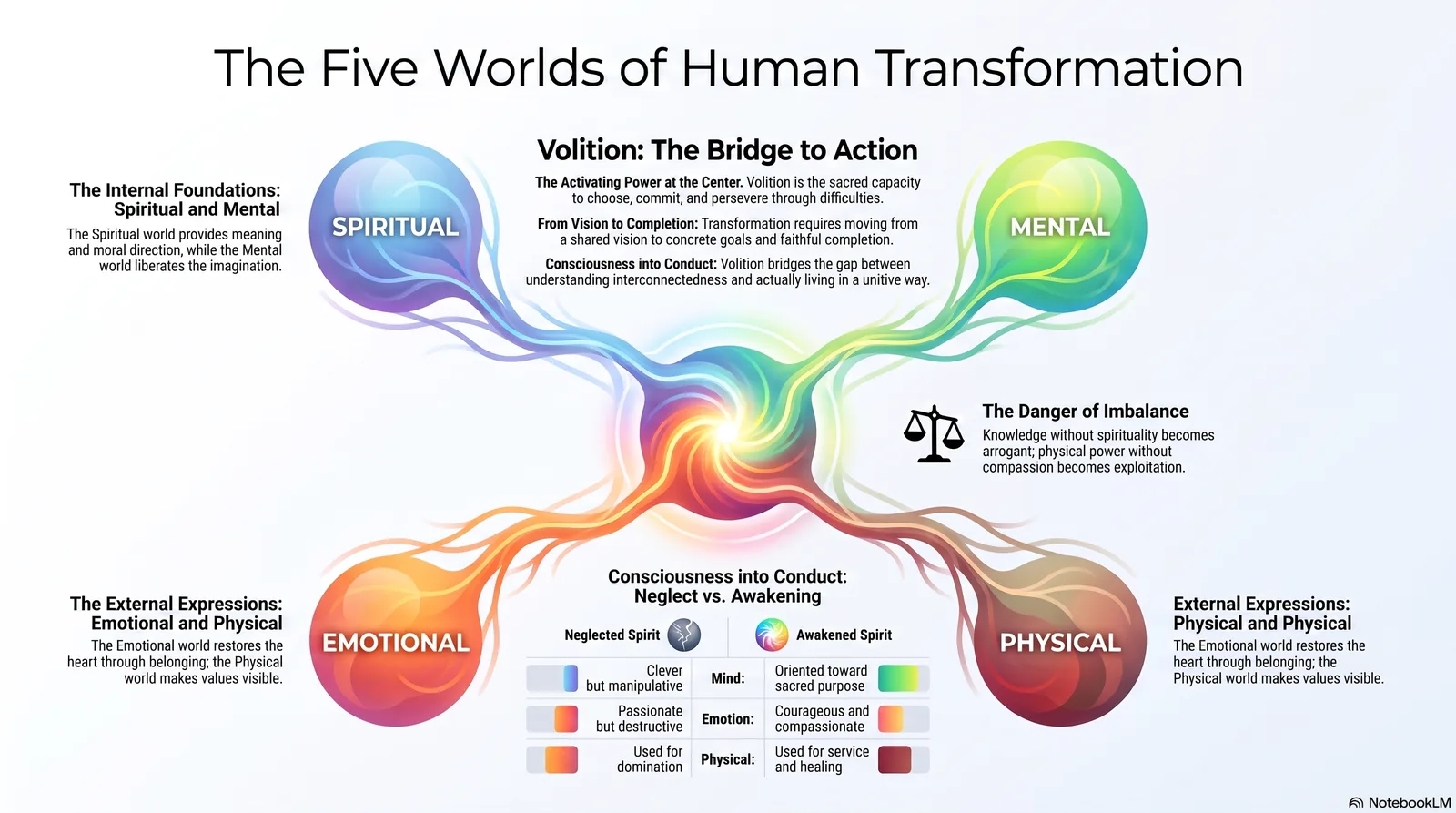
When the spiritual dimension is neglected, the other dimensions lose their moral direction. The mind becomes clever but manipulative. Emotion may become passionate but destructive. Physical power becomes domination. Technology is used without wisdom. Wealth is pursued without justice. Development becomes an instrument for exploitation rather than liberation.
When the spiritual dimension is awakened, however, the whole person begins to orient toward sacred purpose. The individual no longer asks only, “What can I gain?” but also, “What have I been given, and how may I use it for the good of the whole?” This shift from possession to stewardship, from self-centeredness to service, is one of the clearest signs of spiritual maturity.
The Mental World: Learning to See the Whole
The mental dimension includes perception, memory, imagination, knowledge, reasoning, critical thought, discernment, creativity, and the capacity to understand relationships. It is through the mind that we interpret our experiences, create meaning, envision possibilities, identify patterns, solve problems, and pass knowledge from one generation to another.
The mind is a sacred gift. It allows us to learn from the past, understand the present, and imagine futures that do not yet exist. Every great act of human transformation begins, in part, with an idea, an insight, a question, or a vision carried within the mind. Before a new community can be built, it must first be imagined. Before an injustice can be corrected, it must first be recognized. Before a new pathway can be followed, someone must believe that another way is possible.
Yet the mind can also become imprisoned by the stories it repeatedly receives. When people are continually told that they are powerless, inferior, deficient, unworthy, or incapable, these messages can become internalized.
Colonialism and oppression do not operate only through laws, institutions, violence, and economic control. They also seek to colonize the imagination. They attempt to convince people that the existing order is permanent, that their ancestral knowledge has no value, and that they have no power to create a different future.
Mental development therefore requires the liberation of the imagination. Individuals and communities must learn to examine the beliefs they have inherited, distinguish truth from falsehood, recover suppressed knowledge, and envision themselves as active participants in their own development.
Education must not merely train people to fit into existing systems. It must strengthen their capacity to understand those systems, transform them, and create alternatives rooted in justice, culture, sustainability, and human dignity.
The Four Worlds Model calls for an education that teaches relationship. It is not enough to know the names of the rivers, plants, animals, peoples, institutions, and technologies around us. We must understand how they are connected. We must understand how water relates to health, how land relates to culture, how culture relates to identity, how identity relates to belonging, how belonging relates to emotional well-being, and how all of these influence the capacity of a community to flourish.
The educated mind must learn to see consequences. It must be able to ask not only whether something can be done, but whether it should be done, whom it will affect, what it may cost, and what consequences it may carry for future generations. Intelligence without moral discernment produces powerful tools without understanding the purposes those tools should serve.
Mental maturity also requires humility. A wise person does not confuse information with wisdom or certainty with truth. The more deeply we learn, the more clearly we recognize the vastness of what remains unknown. Genuine knowledge should deepen wonder rather than arrogance. It should strengthen our ability to listen to different perspectives, revise our assumptions, and recognize the limitations of our own understanding.
Within a healthy Four Worlds process, the mind does not dominate the spirit, heart, or body. It enters into relationship with them. Spiritual values guide the purposes of thought. Emotional awareness helps us understand the human consequences of our ideas. Physical experience grounds knowledge in reality. The mind contributes analysis, imagination, clarity, and discernment, but it does so as part of the whole.
The Emotional World: Restoring the Human Heart
The emotional dimension concerns belonging, identity, trust, empathy, grief, courage, hope, compassion, love, and the quality of our relationships. It is the world through which we feel our connection with ourselves, our families, our communities, the human family, Mother Earth, and the sacred circle of life.
Human beings cannot live by intellect alone. We may understand something mentally without yet possessing the emotional capacity to live according to that understanding. A person may intellectually accept the oneness of humanity while still carrying fear, resentment, prejudice, or mistrust. A society may proclaim equality while its institutions and relationships continue to express exclusion and humiliation. Ideas can point toward unity, but the heart must learn to experience unity as a living reality.
Many of humanity’s most destructive behaviors arise from unhealed fear. Fear of scarcity leads to hoarding and exploitation. Fear of difference leads to prejudice and exclusion. Fear of vulnerability leads to control and aggression. Fear of powerlessness leads people to dominate others. Fear that has never been acknowledged or healed may become anger, violence, withdrawal, addiction, despair, or hatred.
The emotional wounds carried by individuals and communities are not signs of weakness. They are the understandable consequences of experiences that overwhelmed the capacity to respond. Colonialism, residential schools, war, forced displacement, racism, abuse, poverty, cultural suppression, and the destruction of lands and languages have created profound emotional and intergenerational injuries. These wounds can be transmitted through silence, fear, shame, mistrust, disrupted relationships, and patterns of behavior that continue long after the original events.
Healing begins when pain is brought into the light with truth, safety, compassion, and respect. People need places where they can speak and be heard without judgment. Communities need processes through which they can remember, grieve, reconcile, restore dignity, and rebuild trust. Ceremony, talking circles, storytelling, art, music, prayer, laughter, shared work, and service can all become pathways of emotional healing.
The emotional world also carries the power of belonging. A person who knows that they are loved, needed, valued, and connected possesses a foundation from which courage and resilience can grow. Belonging does not require sameness. It means knowing that one’s distinctive identity and gifts have a meaningful place within the circle.
A mature emotional life does not deny anger, grief, fear, or sorrow. It learns how to listen to these emotions without allowing them to become destructive masters. Anger may reveal that a boundary has been violated. Grief may reveal the depth of our love. Fear may alert us to danger. Sorrow may open the heart to compassion. Emotional development allows us to receive the message of an emotion, respond wisely, and transform its energy into healing, protection, creativity, and constructive action.
Compassion is one of the highest expressions of emotional intelligence. Compassion does not mean passivity, sentimentality, or the avoidance of difficult truths. It is the capacity to recognize suffering, understand relationship, and respond in ways that restore dignity and well-being. Compassion can be gentle, but it can also be courageous. It may comfort the wounded, confront injustice, protect the vulnerable, and call those who have caused harm back into right relationship.
The emotional world teaches us that unity must be felt as well as understood. When the heart awakens, the suffering of another is no longer seen as entirely separate from our own. The flourishing of another person or people is no longer experienced as a threat. We begin to recognize that another person’s dignity strengthens our shared humanity and that the healing of one part of the circle contributes to the healing of the whole.
The Physical World: Making Our Values Visible
The physical dimension includes the human body and the material conditions through which life is sustained: food, water, land, shelter, health, safety, work, transportation, technology, institutions, economic systems, and the natural environment. It is the world of embodiment, where spiritual values, mental understanding, and emotional commitments become visible through action.
The physical world continually reveals what we truly value. Our words may proclaim equality, but our budgets reveal whether we are willing to support it. We may speak of the sacredness of Mother Earth, but our treatment of the waters, forests, soils, animals, and atmosphere reveals the depth of that commitment. We may speak of compassion, but the conditions in which children, Elders, workers, refugees, and marginalized peoples live reveal whether compassion has taken material form.
Love must become visible. It must become food for the hungry, clean water for communities, shelter for those without homes, care for the sick, protection for children, dignity for Elders, education for the young, justice for the oppressed, and the restoration of damaged lands. Without embodiment, even the most beautiful spiritual teachings and visions remain incomplete.
The physical world also includes our relationship with our bodies. The body is not separate from the spirit. It is the sacred vessel through which we experience, learn, serve, create, and relate. Caring for the body through nourishment, movement, rest, healing, and balance is not merely a personal concern. It strengthens our capacity to fulfill our responsibilities.
At the community level, physical development means creating the conditions through which people can live with dignity and participate meaningfully in shaping their future. It includes adequate housing, health care, education, meaningful work, cultural spaces, safe communities, ecological protection, and access to the resources required for collective well-being.
Yet material development must remain rooted in relationship. Economic growth that destroys the land, weakens families, concentrates wealth, or leaves future generations with poisoned waters cannot be called true development. Technological progress that isolates people, deepens inequality, or places human survival at risk cannot be accepted merely because it is innovative.
The physical world teaches consequence. Whatever we place into the water eventually returns to us. Whatever we remove from the soil affects the generations that follow. Whatever violence we normalize enters our families and communities. Whatever systems we build shape the choices available to those who live within them.
To wound Mother Earth is ultimately to wound ourselves. To contaminate the water is to contaminate the source of our own life. To degrade the soil is to weaken the foundation of future generations. To drive species into extinction is to diminish the living community of which humanity is only one part. To wage war against another people is to wound the larger body of the human family.
The physical dimension therefore calls humanity to embodiment, accountability, and action. It asks us to make our highest values visible in the structures of daily life.
The Sacred Relationship Among the Four Worlds
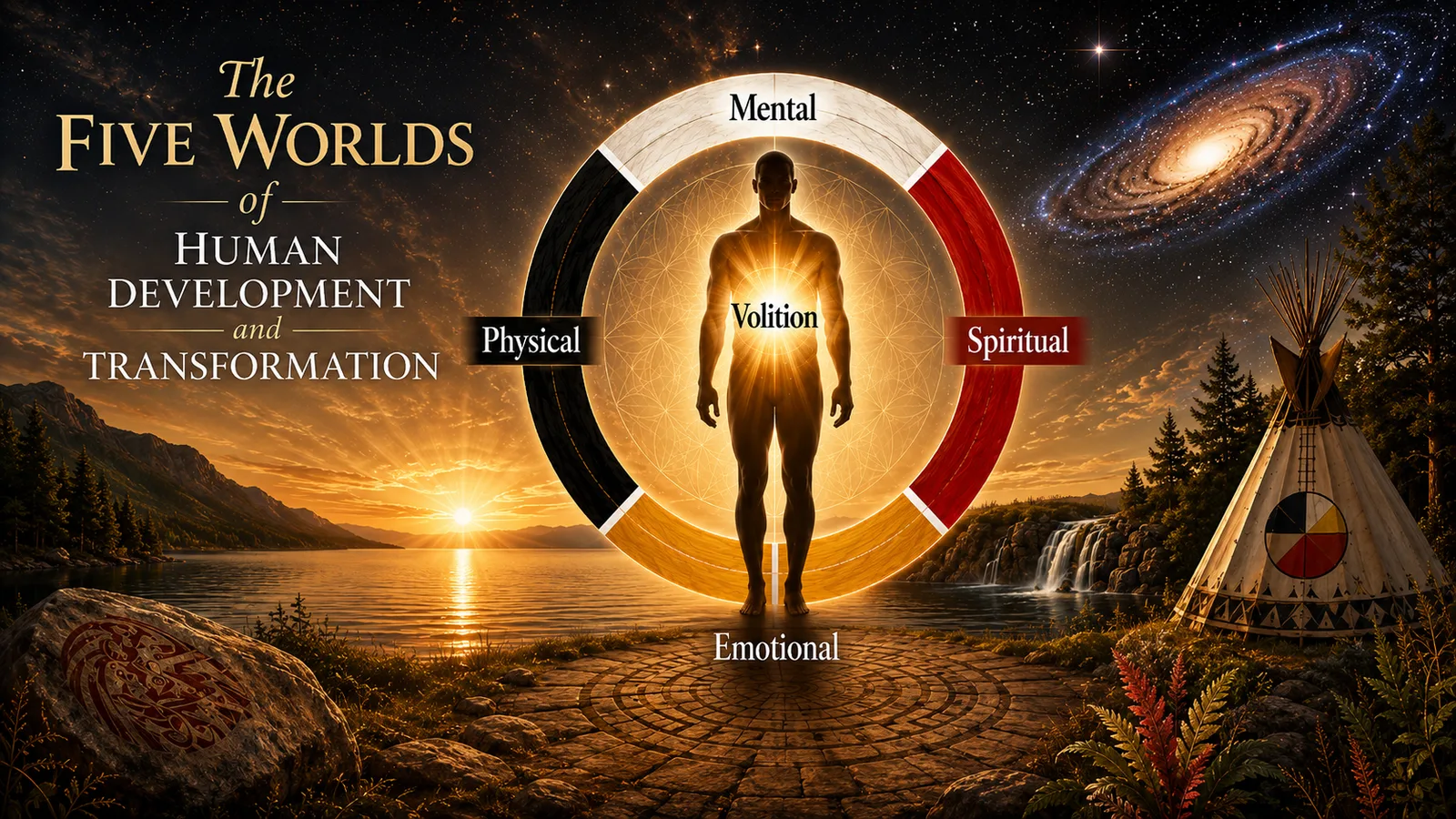
Although we may speak of the spiritual, mental, emotional, and physical worlds separately, they are never truly separate. They are like four directions within one sacred circle. Each has its own qualities, gifts, and responsibilities, but each receives meaning through relationship with the others.
A spiritual vision must be understood by the mind, embraced by the heart, and embodied through physical action. Mental knowledge must be guided by spiritual values, humanized through compassion, and tested in the realities of life. Emotional energy must be illuminated by understanding, anchored in sacred purpose, and expressed through constructive behavior. Physical action must arise from clear thought, compassionate relationship, and moral direction.
When the Four Worlds become disconnected, imbalance follows. Spirituality without knowledge may become superstition or dogmatism. Knowledge without spirituality may become cold, arrogant, or destructive. Emotion without discernment may become reactive or divisive. Physical power without compassion may become exploitation and violence.
When the Four Worlds are brought into harmony, however, human potential begins to unfold in a balanced way. The spirit gives meaning. The mind gives understanding. The heart gives relationship. The body gives expression. Together they create the conditions for wisdom in action.
This integration is essential not only for individuals but also for families, communities, institutions, nations, and the entire human family. A healthy community must possess spiritual purpose, mental clarity, emotional cohesion, and physical capacity. A healthy institution must be guided by values, informed by knowledge, sustained through respectful relationships, and organized to produce just and practical outcomes.
True development therefore does not occur in only one world. It is the progressive harmonization of all four. It is the process through which what we believe, understand, feel, and do increasingly come into alignment.
Becoming Whole
The purpose of the Four Worlds Model is not the achievement of perfection. It is conscious growth. It asks each of us to examine where we are strong, where we are wounded, where we are unbalanced, and where further development is required.
We may possess spiritual aspiration but lack practical discipline. We may possess knowledge but struggle to express compassion. We may care deeply but lack the skills required to translate that care into effective action. We may work tirelessly in the physical world while neglecting our spiritual renewal, emotional healing, or mental development.
Wholeness is not a final destination at which all struggle disappears. It is an ongoing practice of listening, learning, healing, choosing, acting, reflecting, and beginning again. Each stage of life brings new responsibilities and new possibilities for integration.
As individuals become more whole, they strengthen their families. As families become healthier, they strengthen communities. As communities become more conscious and capable, they can transform institutions. As institutions embody justice and responsibility, nations can move toward unity. As nations learn to cooperate, the human family can begin to create a peaceful and sustainable planetary civilization.
The Four Worlds Model therefore calls us to become the change we seek. Spiritual teachings must become character. Knowledge must become wisdom. Compassion must become relationship. Vision must become action. Love must become service. Justice must become the lived structure of our communities and institutions.
The Doorway to Volition
Yet there remains a vital question. A person may possess spiritual values, mental knowledge, emotional sensitivity, and physical ability, and still not act. A community may understand what must be done, care deeply about the consequences, and possess many of the necessary resources, yet remain unable to move consistently from intention to sustained action.
What is the power that gathers the spiritual, mental, emotional, and physical dimensions together and directs them toward a chosen purpose? What enables a human being to form a vision, set a goal, make a decision, persevere through difficulty, overcome discouragement, and continue until a meaningful process is brought to completion?
This is the domain of volition. Volition is not merely another compartment standing beside the Four Worlds. It is the activating power through which our spiritual, mental, emotional, and physical potentialities are consciously developed and directed. It is the sacred capacity to choose, to commit, to persevere, and to bring potentiality into actuality.
Without volition, spiritual insight remains an aspiration. Knowledge remains unused. Compassion remains a feeling. Physical capacity remains dormant. Volition is the power through which vision begins its journey toward embodiment.
The next stage of our exploration must therefore turn toward this sacred human capacity: the power of purposeful will, not the will to dominate, control, or impose, but the will to align ourselves with a worthy vision, persevere through the tests that arise, and carry our responsibilities faithfully toward completion.
For it is not enough to know the path. It is not enough to feel called toward the path. It is not even enough to possess the capacity to walk the path. At some point, we must choose to take the first step, continue walking when the road becomes difficult, and carry the journey through to its rightful conclusion.
Volition: The Sacred Power to Choose, Persevere, and Bring Vision into Form
The spiritual, mental, emotional, and physical dimensions reveal the full range of human potential. Still, potential alone does not transform a life, heal a community, or change the direction of civilization. We may possess spiritual insight, intellectual knowledge, emotional compassion, and physical ability. Yet, these gifts can remain dormant, scattered, or unfulfilled unless there is an inner power capable of gathering them together and directing them toward a consciously chosen purpose.
That power is volition. Volition is our sacred capacity to choose, to form intention, to envision a desired future, to establish meaningful goals, to organize our abilities, to persevere through difficulty, and to bring a chosen course of action toward completion. It is the activating power through which human potential becomes purposeful action.
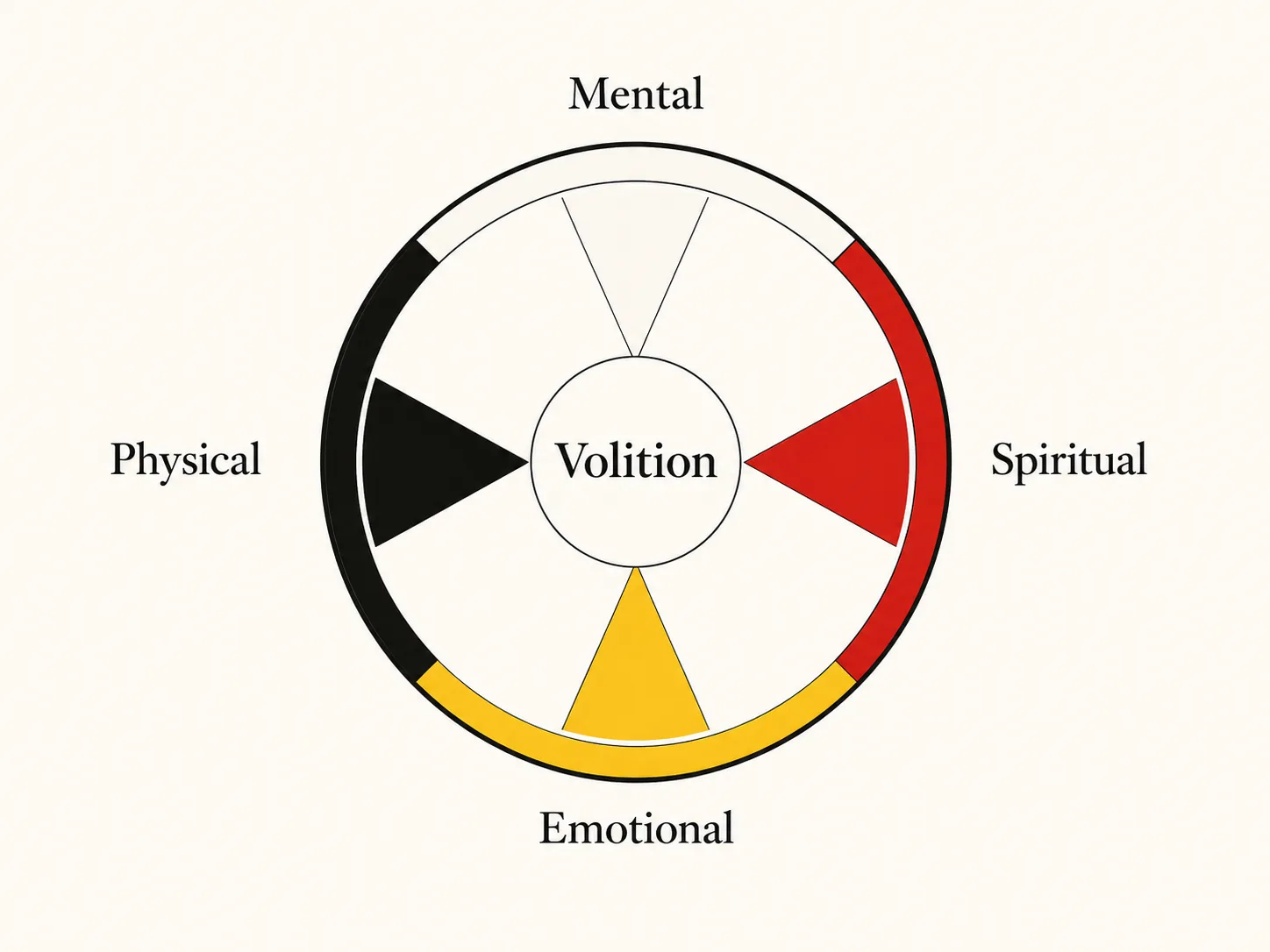
Volition is not a fifth world standing apart from the spiritual, mental, emotional, and physical dimensions. Rather, it is the integrating and directing power that enables the Four Worlds to work together. It is at the center of the Medicine Wheel.
The spiritual dimension helps us discern what is sacred, truthful, life-giving, and worthy of our commitment. The mental dimension enables us to understand our circumstances, imagine possibilities, establish priorities, develop plans, and learn from experience. The emotional dimension provides courage, hope, empathy, passion, trust, and the sense of belonging that gives energy to our commitments. The physical dimension allows us to embody our intentions through disciplined action, service, work, practice, and the material transformation of our conditions.
Volition gathers these dimensions together and says: This is the direction in which I will walk. This is the vision I will serve. These are the responsibilities I will accept. These are the steps I will take. I will learn from the difficulties before me, renew my commitment when I become discouraged, and continue until the work has reached its proper completion.
From Vision to Commitment
Every meaningful process of transformation begins with vision. Vision allows us to see beyond the limitations of the present and imagine conditions that do not yet exist. It may reveal a healed person, a reunited family, a restored community, a protected watershed, a just institution, a peaceful nation, or a spiritually mature planetary civilization.
Vision opens the door of possibility, but volition enables us to walk through that door. Without volition, vision remains a beautiful idea, a prayer, a hope, or an inspiring conversation. Volition transforms vision from something we admire into something we consciously choose to serve. It asks us to move beyond wishing that conditions were different and to accept our part in making them different.
This movement from vision to commitment is one of the most important moments in human development. It is the moment when a person or community says: We recognize the future that is calling us. We understand that its realization will require sacrifice, discipline, learning, cooperation, and courage. We freely choose to dedicate ourselves to bringing it into being.
A community may possess great cultural knowledge, spiritual strength, creativity, intelligence, and experience. Yet unless these gifts are gathered around a shared vision and sustained through collective volition, they may remain scattered. People may care deeply but work in different directions. They may hold many meetings, express many concerns, and generate many ideas without developing the unity of purpose required for lasting transformation.
This is why authentic vision-building must always be participatory. People must be able to recognize themselves within the vision. They must see that their knowledge, gifts, responsibilities, and lived experience are essential to its fulfillment. Most importantly, they must be free to examine the vision, contribute to it, shape it, and claim it as their own.
Development imposed from outside seldom awakens genuine volition. People may comply temporarily with authority, pressure, funding conditions, institutional expectations, or the directions of outside experts, but compliance is not the same as commitment. Sustainable transformation begins when people inwardly embrace the vision, recognize their own responsibility, and choose to become its authors, participants, and guardians.
Giving Vision a Pathway
A vision gives direction, but goals give the vision a pathway into the world. A goal takes a broad aspiration and translates it into a clear, purposeful commitment. It helps us move from saying, “We desire healing,” toward identifying what healing requires. It moves us from declaring, “We seek peace,” toward establishing the practices, relationships, and institutions through which peace may become visible. It carries us from saying, “We must protect Mother Earth,” toward concrete responsibilities for the land, water, climate, animals, plants, and future generations.
Meaningful goals help us identify what is to be accomplished, why it matters, who will participate, what gifts and resources are available, what obstacles may arise, and how we will recognize progress. They give sequence, focus, and form to the work before us.
From the Four Worlds perspective, however, a worthy goal cannot be merely material or technical. It must contribute to the development of the whole person and the whole community.
A community health initiative, for example, should not concern itself only with the treatment of physical illness. It should also strengthen spiritual identity, increase knowledge, restore supportive relationships, address emotional wounds, build community participation, and awaken the collective will required to sustain healthy ways of living.
An educational goal should not be limited to transferring information or preparing young people for employment. Education should develop character, imagination, cultural identity, critical thought, emotional maturity, practical competence, moral responsibility, and the ability to establish and pursue worthy purposes.
An ecological initiative should not focus only on technical restoration. It should renew the human relationship with the land, restore responsibility to future generations, draw upon Indigenous and local knowledge, strengthen community participation, and awaken reverence for the living systems upon which all life depends.
Goals are not intended to reduce life to rigid measurements. They are vessels through which vision takes form. They must remain responsive to new learning, changing circumstances, community wisdom, spiritual guidance, and the realities encountered along the journey.
Volition is therefore not stubbornness. It is not blind determination or the refusal to change direction. Mature volition combines commitment with humility. It allows us to adjust our methods without abandoning our deepest purpose. It teaches us to remain faithful to the vision while continually learning how that vision may best be served.
Persevering Through the Tests
The pathway from vision to realization is rarely straight or easy. Every serious undertaking encounters obstacles. Resources may be limited. Plans may fail. People may become tired or discouraged. Conflicts may arise. Institutions may resist change. Old wounds may return to the surface. Progress may unfold more slowly than expected.
Volition gives us the capacity to persevere. Perseverance does not mean simply enduring hardship or forcing ourselves forward regardless of the consequences. It is the capacity to remain faithfully connected to a worthy purpose while learning, adapting, healing, and growing through experience.
A person or community with developed volition does not interpret every difficulty as a command to surrender. Instead, difficulty becomes an invitation to deeper reflection. We learn to ask: What is this experience teaching us? What must be changed? What strength must be developed? What relationship requires healing? What knowledge or resource is missing? What is the next faithful step?
Setbacks do not always mean that the vision was mistaken. They may reveal weaknesses in our preparation, gaps in our understanding, unresolved conflicts, unrealistic expectations, or capacities that still need to be developed. When received with humility, even failure can become a teacher.
Perseverance requires the support of all Four Worlds. Spiritually, we need meaning, faith, moral courage, and connection to a purpose greater than ourselves. Mentally, we need reflection, discernment, planning, problem-solving, and the capacity to learn from mistakes. Emotionally, we need hope, encouragement, patience, trust, forgiveness, and relationships that sustain us during difficult times. Physically, we need disciplined action, healthy practices, practical skills, material resources, and the willingness to continue showing up for the work.
Volition keeps these capacities connected to the vision. It reminds us why we began. It helps us recover when we stumble, reorganize when circumstances change, and renew our commitment when the first enthusiasm has passed.
The sacred path is not proven by how strongly we begin. It is revealed by how faithfully we continue.
The Capacity to Bring Things to Completion
One of the most overlooked dimensions of human development is the capacity to bring a process to an appropriate completion. Individuals, organizations, and communities may begin many undertakings with great enthusiasm. Inspiring meetings are held. Committees are formed. Public promises are made. Projects are announced. Yet when the excitement fades, responsibilities may become unclear, attention may shift elsewhere, and the work may remain unfinished.
Incomplete processes consume spiritual, mental, emotional, and physical energy. Unfulfilled promises weaken trust. Repeated beginnings without completion can create discouragement, cynicism, confusion, and a loss of collective confidence. People begin to doubt whether commitments are meaningful or whether anything will truly change.
Volition enables us not only to begin, but also to continue and complete. Bringing a process to completion means carrying it through its necessary stages, fulfilling responsibilities, evaluating outcomes, acknowledging contributions, integrating lessons, addressing what remains unresolved, and clearly marking the transition from one stage to another.
Completion does not always mean that every original goal has been achieved exactly as first imagined. Circumstances may change. New knowledge may emerge. A project may need to be revised, transferred, redirected, or consciously concluded. Responsible completion may sometimes mean acknowledging that a particular pathway has served its purpose or can no longer be sustained.
The essential matter is that the process is not simply abandoned through avoidance, fatigue, discouragement, confusion, or loss of interest. Conscious completion releases energy. It allows lessons to be gathered, relationships to be honored, responsibilities to be clarified, and people to move into the next stage without continually carrying the unresolved obligations of the past.
Within healing, completion may involve truth-telling, acknowledgment, restitution, forgiveness, reconciliation, acceptance, or the establishment of new boundaries. Within community development, it may include evaluating results, documenting learning, celebrating accomplishments, addressing unfinished responsibilities, and renewing the vision for the next cycle. Within personal development, it may mean fulfilling a promise, releasing a destructive pattern, accepting the consequences of a choice, or consciously moving from one stage of life into another.
The capacity to complete strengthens integrity because it aligns our actions with our words. It teaches people that our commitments can be trusted and that our visions are not merely spoken; they are carried faithfully through the full circle of development.
Freedom Joined With Responsibility
True volition depends upon freedom. People must possess the genuine capacity to examine choices, understand consequences, establish priorities, and make decisions without coercion, manipulation, or domination.
Development that removes human agency cannot create mature, responsible, or self-determining people. Systems that continually make decisions for people—even when claiming to help them—may weaken the very capacities required for sustainable development.
At the same time, freedom does not mean acting without responsibility. No choice exists in isolation. Every decision enters a living web of relationships and produces consequences for ourselves, our families, our communities, Mother Earth, and the generations yet unborn.
Mature volition therefore joins freedom with responsibility. It does not ask only, “What do I want?” It also asks: Is this purpose worthy? Will this choice contribute to healing or deepen harm? Does it respect the dignity, freedom, and well-being of others? Does it strengthen the whole community? What consequences will it carry for Mother Earth and future generations? Does it reflect my highest spiritual and moral understanding?
Volition becomes spiritually mature when personal will is brought into alignment with sacred purpose. It is no longer merely the power to obtain what we desire. It becomes the power to choose what is right, sustain what is life-giving, relinquish what is destructive, and remain faithful to responsibilities that extend beyond personal self-interest. The highest expression of volition is not domination. It is self-mastery in service to the whole.
Restoring the Power to Choose
Historical oppression attacks the volitional capacity of a people. Colonial systems did not merely seize lands and resources. They attempted to weaken the ability of Indigenous Peoples to name themselves, educate their children, practice their spiritual traditions, speak their languages, govern their communities, maintain their relationships with the land, and determine the direction of their own future.
Repeated experiences of imposed authority, broken promises, institutional violence, forced dependency, and powerlessness injure individual and collective volition. People may begin to believe that their choices do not matter, that their efforts will not bring change, or that someone else will always control the conditions of their lives.
Healing therefore includes the restoration of volition. It involves recovering the ability to dream, envision, choose, decide, organize, act, persevere, evaluate, and complete what has been undertaken. It means restoring confidence in the power of individuals and communities to become active participants in shaping their own lives.
This restoration cannot occur through programs that continue controlling people in the name of helping them. Nor can it occur when outside institutions define community needs, prescribe solutions, control resources, and determine success without meaningful participation by the people themselves.
The role of a genuine outside supporter is not to replace community volition but to strengthen it. They may contribute knowledge, resources, technical assistance, relationships, or opportunities, but these contributions must increase the community’s capacity to envision, decide, act, evaluate, learn, and continue its own development.
Authentic assistance says: We will walk with you, but we will not take the journey from you. We will share what we have, but we will not replace what you carry. We will support your strength, not build our authority upon your dependency. Development becomes sustainable when people themselves become the authors, actors, and guardians of the transformative process.
From Individual Will to Collective Volition
Volition exists not only within the individual. Families, communities, organizations, peoples, nations, and our entire Human Family can also develop collective volition.
Collective volition emerges when people come to a shared understanding of their circumstances, create a common vision, establish agreed-upon goals, clarify responsibilities, and commit themselves to coordinated action.
A community may contain many talented, caring, and spiritually devoted people yet remain unable to transform its conditions if those people are isolated, divided, mistrustful, or working toward conflicting purposes. Collective volition gathers scattered capacities into organized, purposeful power.
This does not require everyone to think, believe, or act identically. Unity is not uniformity. Collective volition honors diversity by enabling people with different gifts, experiences, perspectives, and responsibilities to contribute toward a shared purpose.
One person may carry spiritual guidance. Another may hold historical knowledge. Another may possess organizational ability. Others may teach, heal, prepare food, care for children, protect the water, manage resources, build structures, communicate, advocate, create art, resolve conflict, or strengthen relationships.
No one person carries everything required by the whole. Yet when diverse gifts are recognized, honored, and coordinated through a shared vision, the community becomes capable of accomplishing what no isolated individual could achieve alone.
Collective volition is strengthened through participation. People are far more likely to protect and sustain what they have helped create. Authentic consultation, Talking Circles, community dialogue, ceremony, shared learning, and inclusive decision-making are therefore not secondary activities. They are essential processes through which collective purpose and responsibility are awakened.
Participation awakens ownership. Ownership awakens responsibility. Responsibility strengthens perseverance. Perseverance enables transformation to continue through difficulty.
The Bridge Between Consciousness and Conduct
The Unitive Narrative calls humanity to awaken to the truth of our profound interconnectedness. Yet awareness of unity, by itself, will not transform the world.
We may understand intellectually that all life is interconnected while continuing to live in ways that damage Mother Earth. We may experience spiritual oneness yet avoid the difficult work of transforming unjust institutions. We may feel compassion for suffering peoples while failing to organize sustained action on their behalf. We may proclaim peace while continuing to humiliate, exclude, and attack those with whom we disagree.
Volition is the bridge between consciousness and conduct. Through volition, spiritual insight becomes moral choice. Mental understanding becomes planning and problem-solving. Emotional compassion becomes courage, service, and reconciliation. Physical capacity becomes disciplined and constructive action.
Volition converts awareness into commitment, commitment into practice, practice into learning, and learning into increased capacity. Sustained through perseverance, this capacity brings transformation into being.
Without volition, potential remains possibility. With volition, possibility becomes purpose. Purpose becomes action. Action becomes experience. Experience becomes learning. Learning strengthens capacity. Capacity, guided by sacred vision and sustained through perseverance, becomes transformation.
Becoming the Vision
The future will not be created merely by the narratives we proclaim. It will be created by human beings and communities who develop the spiritual depth, mental clarity, emotional maturity, physical capacity, discipline, unity, and volition required to embody those narratives.
If we envision peace, we must develop the volition to practice peace in the midst of conflict. We must learn to disagree without dehumanizing, to speak truth without humiliation, to establish justice without revenge, and to protect the innocent without becoming what we oppose.
If we envision justice, we must develop the volition to confront injustice even when doing so is difficult, unpopular, or personally costly. We must be willing to examine the systems from which we benefit and change those systems when they diminish the dignity of others.
If we envision ecological balance, we must develop the volition to transform our patterns of production, consumption, transportation, land use, economics, and governance. Reverence for Mother Earth must become visible in our daily choices and collective institutions.
If we envision healthy communities, we must develop the volition to heal relationships, strengthen families, educate young people, protect children, honor elders, restore cultures, care for the vulnerable, and create systems that support the spiritual, mental, emotional, and physical well-being of all.
If we envision the unity of our Human Family, we must develop the volition to overcome prejudice, relinquish domination, listen across differences, repair historical harm, and build institutions that reflect the equal dignity of every people.
The Four Worlds Model therefore calls us not only to awaken our spiritual, mental, emotional, and physical potentialities, but also to cultivate the volitional power that brings these potentialities into unified and purposeful action.
We must learn to envision clearly, choose consciously, establish worthy goals, organize our capacities, persevere through adversity, learn continuously, fulfill our commitments, and bring our undertakings to responsible completion.
This is how human beings become active participants in their own development. This is how families break destructive cycles and create healthier patterns for their children. This is how communities move from dependency toward self-determination. This is how people recover their dignity, identity, and collective power. This is how the spiritual becomes physical. This is how knowledge becomes wisdom. This is how compassion becomes justice. This is how vision becomes reality. This is how we become the change we seek.
Volition is the sacred power within the human being and the human community to say: We can envision a better world. We can freely choose to serve that vision. We can gather our spiritual, mental, emotional, and physical capacities around it. We can take the necessary steps. We can learn from our mistakes. We can rise after disappointment. We can persevere through the tests before us. We can fulfill the responsibilities we have accepted. We can complete what we have begun.
The future is not something merely waiting to happen to us. It is being shaped through the choices we make, the relationships we strengthen, the wounds we heal, the responsibilities we accept, and the purposes to which we dedicate our lives.
The Unitive Narrative reminds us that we belong to one another. The Four Worlds Model calls us to embody that belonging through the balanced development of the whole human being and the whole community. Volition gives us the power to choose that pathway, to walk it faithfully, and to carry the vision from the unseen world of possibility into the living world of form.
Together, guided by spiritual purpose, strengthened by knowledge, sustained by love, grounded in action, and united in service to the whole, we can bring a new world into being. Not someday. Not through words alone. But through the sacred choices we make, the faithful steps we take, and the lives we begin transforming here and now