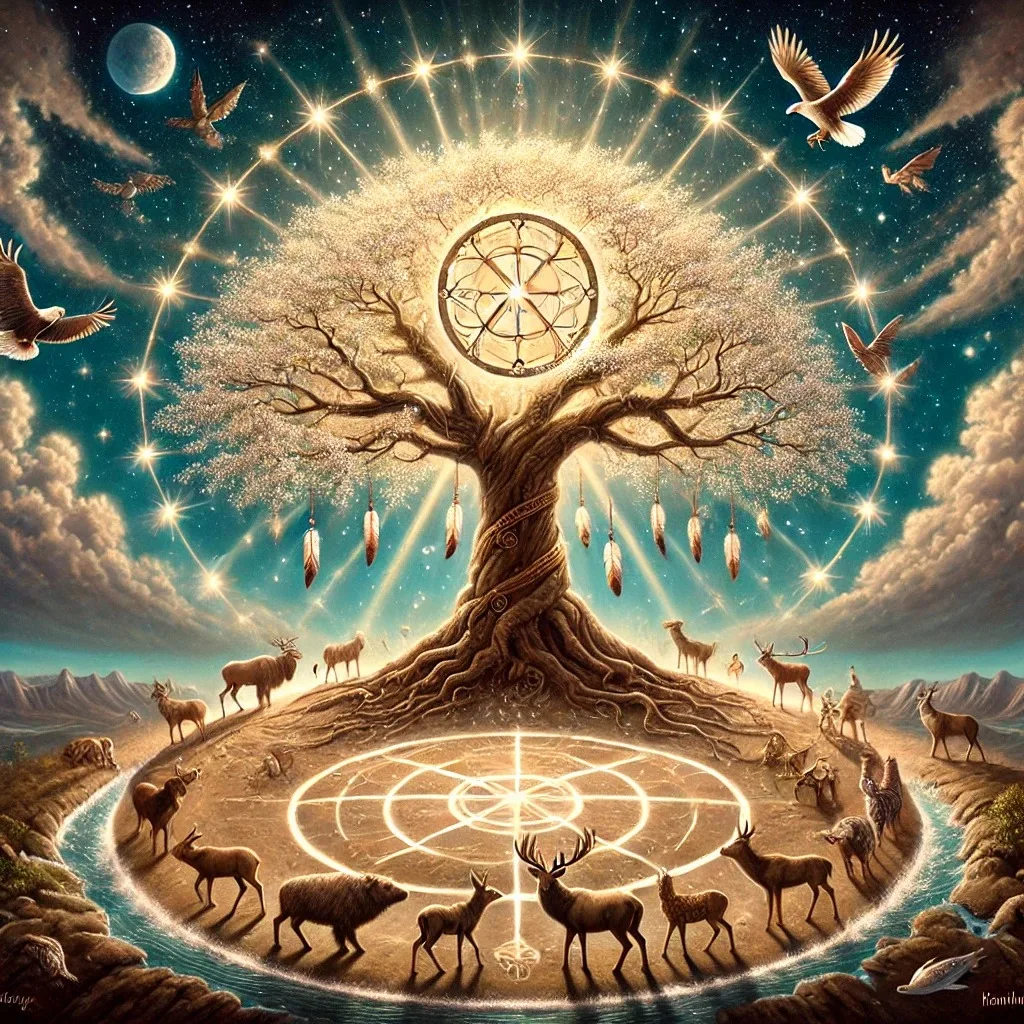
In the vast and intricate tapestry of spiritual teachings woven across the ages and continents, the Americas hold a sacred and special place, deeply enriched by the wisdom of Indigenous Spiritual Teachers who have guided their peoples with profound teachings from Wakan Tanka, the Great Spirit. These revered figures, such as the White Buffalo Calf Woman (Ptesáŋwiŋ), the Peacemaker, and Quetzalcoatl, have manifested spiritual teachings that resonate with the universal spiritual principles revealed by other great Messengers of the Creator, such as Buddha, Krishna, Jesus, Baha'u'llah, Zoroaster, Mohammed, and Moses.
These Divine Teachings, shared by the Spiritual Teachers of the Americas and the Spiritual Messengers of other lands, represent sacred truths bestowed upon humanity to elevate the human spirit, cultivate virtues, and create a world that reflects the divine order.
They guide individuals and communities toward a life of harmony, love, justice, and unity. Through these teachings, humanity is called to recognize the oneness of all peoples, the interconnectedness of all life, and the profound responsibility to live in harmony with Mother Earth and one another.
For instance, White Buffalo Calf Woman's teachings emphasize life's sacredness, respect and reciprocity, and the interconnectedness of all beings. Her message of the Sacred Pipe, embodying a prayer for peace and unity among all nations, mirrors the universal call in Jesus' teachings to love one another and Baha'u'llah's vision of the oneness of humanity.
Similarly, the Peacemaker, who brought the Great Law of Peace to the Haudenosaunee (Iroquois Confederacy), taught principles of unity, collective governance, and care for future generations. These teachings echo the words of Moses, who led his people with laws emphasizing justice and communal responsibility, and the teachings of Mohammed, who established a community based on justice, equality, and submission to the divine will.
Quetzalcoatl, the Spiritual Messenger of the Toltecs, represents the union of Earth and sky and embodies the dualities of life, balancing the material and spiritual realms. His teachings on self-sacrifice, humility, and wisdom resonate with Buddha's teachings on the middle path and the importance of overcoming the desire to achieve enlightenment.
In speaking of "Divine Teachings," Abdul-Baha refers to these universal truths that transcend time and culture, manifesting through different messengers to guide humanity on its spiritual journey. Whether it is Krishna's teachings on dharma and righteous action, Zoroaster's emphasis on truth and the battle between good and evil, or Baha'u'llah's call for the unity of all religions and global peace, the Divine Teachings serve as a constant thread that binds the human family together.
These teachings are not merely historical or cultural relics but living principles that continue to inspire and guide us today. They remind us of our shared spiritual heritage and collective responsibility to live in a way that honors the divine within ourselves and all of creation. Their ultimate purpose is to lead humanity toward spiritual maturity, helping us recognize our oneness with each other and with the divine, and to build societies reflecting the virtues of love, justice, peace, and unity.
In this light, the Divine Teachings of the Messengers of Wakan Tanka and the world's great spiritual leaders are part of a unified vision for the upliftment of humanity. They call us to rise above our differences, embrace the spiritual truths that connect us, and work together to create a world where the sacredness of life is honored, and the divine will is fulfilled. This is the path toward realizing a global community in harmony with the Creator, each other, and Mother Earth.
As revealed by Buddha, the Four Noble Truths and the Eight-Fold Path are excellent examples of what Abdul-Baha refers to as Divine Teachings. These foundational principles offer profound guidance on understanding human suffering and the path to liberation, aligning with universal spiritual truths to elevate the human condition and foster unity and peace.
The Four Noble Truths—acknowledging the reality of suffering, understanding its cause, recognizing that it can be overcome, and following the path to its cessation—are not just insights into the human experience but reflections of the Divine Will, guiding individuals toward a life of awareness, compassion, and inner peace.
The Eight-Fold Path—right understanding, intention, speech, action, livelihood, effort, mindfulness, and concentration—provides a comprehensive framework for living a moral and spiritually awakened life. It leads to personal enlightenment and virtues that benefit the broader community, contributing to humanity's well-being.
These teachings of Buddha resonate deeply with the principles revealed by Indigenous Teachers such as the White Buffalo Calf Woman, the Peacemaker, Quetzalcoatl, and others who have guided their peoples toward harmony, unity, and respect for all life. In this way, Buddha's teachings are a vital part of the universal Divine Teachings that Abdul-Baha speaks of, offering timeless guidance for personal and collective spiritual development.
When Abdul-Baha uses the term Divine Teachings, he refers to the spiritual and moral principles revealed by all the Messengers of Wakan Tanka. These principles elevate humanity's spiritual and moral condition, fostering unity, justice, and the well-being of all peoples. This understanding takes on profound significance in Abdul-Baha's prophecy regarding the Indigenous Peoples of the Americas in the Tablets of the Divine Plan.
Abdul-Baha's prophecy highlights the unique destiny and spiritual potential of the Indigenous peoples of the Americas. He foretold that when Indigenous nations arise to embrace these Divine Teachings, they will play a crucial role in leading humanity toward a more just, unified, and spiritually evolved world. This prophecy, understood through the lens of the teachings of the Messengers of Wakan Tanka, suggests that Indigenous peoples hold a unique spiritual heritage and wisdom aligned with these universal principles.
The Divine Teachings emphasize love, justice, truth, humility, and the oneness of humanity—values deeply rooted in the traditional teachings of many Indigenous cultures. The White Buffalo Calf Woman's message of unity and respect, the Peacemaker's vision of peace, and Quetzalcoatl's call for selflessness and wisdom all reflect these timeless principles. These teachings resonate with the same spiritual truths brought by Messengers like Buddha, Krishna, Jesus, Mohammed, and Baha'u'llah, who guide humanity toward moral and spiritual maturity.
Abdul-Baha's prophecy states that when spiritually awakened and united with the global community, Indigenous peoples will help guide the world toward fulfilling these Divine Teachings. This is not a call only for the spiritual upliftment of Indigenous Bahá'ís but an acknowledgment of the vital role Indigenous peoples will play in helping humanity achieve unity and harmony. Indigenous peoples are seen as recipients, guardians, and protectors of spiritual knowledge and wisdom essential for global transformation.
This prophecy reminds us that the Divine Teachings revealed by Wakan Tanka and other Messengers are universal truths meant to uplift all humanity. Indigenous peoples of the Americas have a unique role in exemplifying and spreading these teachings to bring about global peace, justice, and unity.
In essence, Abdul-Baha's use of Divine Teachings emphasizes Indigenous peoples' transformative role in realizing a spiritual order that reflects humanity's oneness, the harmony between the material and spiritual realms, and the sacred connection between all beings and Mother Earth.
This prophecy is not limited to Indigenous Bahá'ís alone. While the Tablets of the Divine Plan were addressed to the Bahá'í community, Abdul-Baha's vision is inclusive and transcends any one belief system. It speaks to the broader spiritual destiny of all the Indigenous Peoples of the Americas.
\
Abdul-Baha's profound vision, as expressed in the Tablets of the Divine Plan, transcends the boundaries of any one religious community or belief system. To understand his prophecy as limited to Indigenous Baha'is would mean misunderstanding the inclusive and universal nature of his teachings.
Abdul-Baha's vision is rooted in the fundamental principle of unity, which is central to the Baha'i Faith and resonates deeply with Indigenous spiritual traditions. This principle asserts that all humanity is interconnected and that the spiritual destinies of all peoples are intertwined.
Abdul-Baha's reference to the Indigenous peoples of the Americas is not confined to those who identify as Baha'i. Instead, it recognizes Indigenous peoples' unique spiritual capacities and roles in unfolding humanity's destiny. Indigenous traditions have long emphasized the interconnectedness of all life, the sacredness of the Earth, and the importance of living in harmony with the natural world—values central to the Baha'i teachings.
These shared values suggest that Indigenous peoples' spiritual destinies are not contingent on their religious affiliations but are instead tied to their inherent spiritual gifts and their role in the greater tapestry of human spiritual evolution.
The idea that only Baha'is possess Divine Teachings contradicts the Baha'i principle of the oneness of religion, which acknowledges that all major religious traditions are divinely inspired and part of a progressive revelation. The Baha'i Faith teaches that our Creator's guidance has been revealed through many messengers throughout history, each bringing teachings suited to the needs of the time and place. Indigenous spiritual traditions, therefore, are also seen as part of this divine tapestry, offering unique insights and wisdom that contribute to the spiritual awakening of humanity as a whole.
Abdul-Baha's vision, as expressed in the overall Tablets of the Divine Plan, is universal inclusivity. It calls for recognizing the unique spiritual potential of all peoples, including the Indigenous peoples of the Americas. This vision encourages unity and collaboration across all spiritual traditions, recognizing that each has a vital role in realizing a just and harmonious world. It is a vision that honors the spiritual diversity of humanity and sees the spiritual destiny of the Indigenous peoples as integral to fulfilling the broader purpose of the Baha'i Faith—to bring about the unity of the human family.
Thus, Abdul-Baha's prophecy should be understood as an invitation to all peoples, regardless of their religious affiliations, to contribute to building a unified and spiritually awakened world. It is a call to recognize the sacredness of all spiritual paths and to work together in a spirit of mutual respect and understanding, acknowledging that the spiritual destiny of the Indigenous peoples of the Americas is a vital part of the collective journey toward unity and peace.
Čhaŋnúpa Sápa hé miye do! Šuŋkmánu hé miye do, waŋyáŋka úŋ Wakan Tanka etáŋhaŋ wóiyake na wówačhiŋ heháka iyéčhiŋ kiŋ!
"Hinhan Wicášta na Deloria Tióšpaye kiŋ, Ihanktonwan, and Chickasaw Nation