
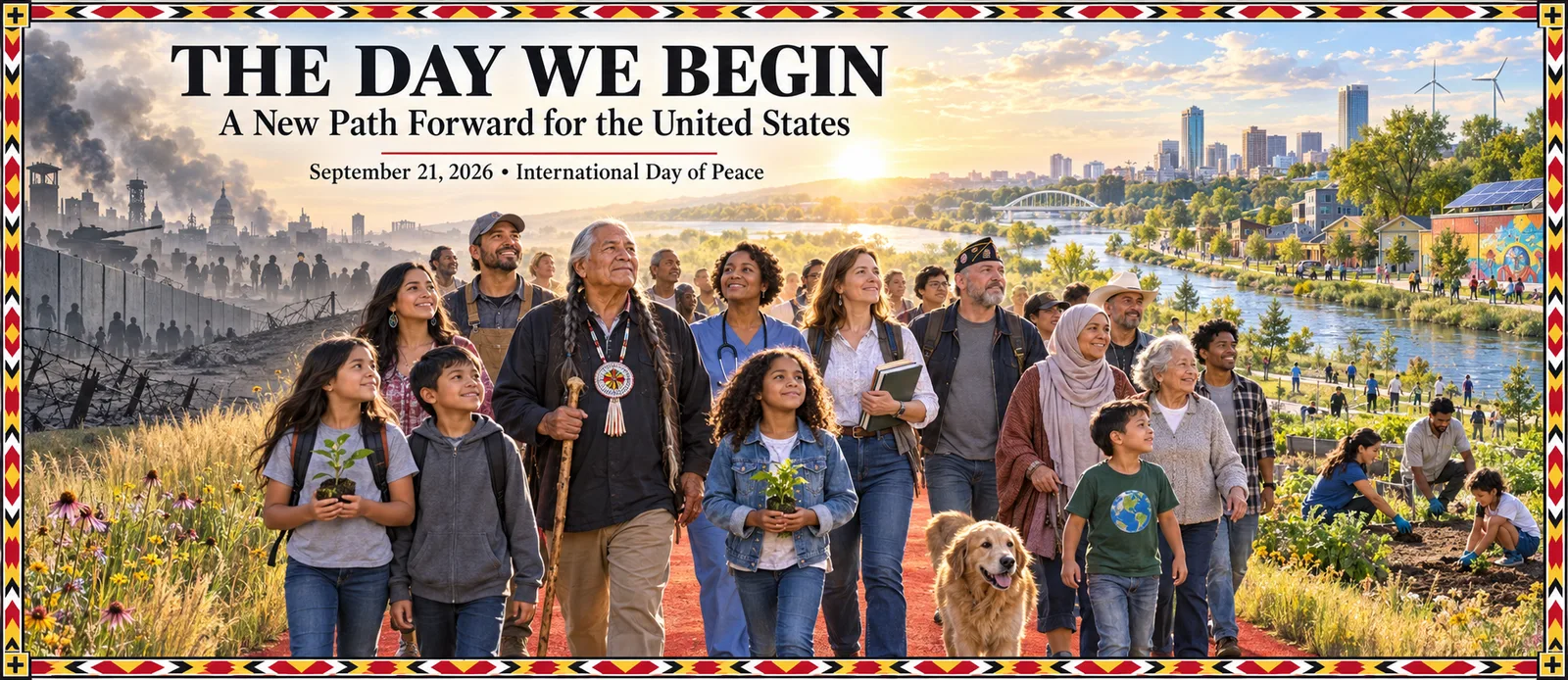
Let us begin on September 21, 2026, the International Day of Peace. Let us remember that date as more than another observance, proclamation, conference, or ceremony. Let us name it as the day we begin: the day the people of the United States consciously begin moving away from war, violence, hatred, humiliation, and division; the day we begin changing and transforming ourselves; and the day we begin building peace within our own hearts, families, communities, institutions, and nation.
The United Nations established September 21 as an annual day of nonviolence and ceasefire. (United Nations Digital Library) But one day without violence is not enough. September 21 must become a doorway, not a destination. The silence of the guns for twenty-four hours must become the beginning of a new direction for the other 364 days. Peace Day should not be the one day when we speak beautifully about peace before returning to the same systems of fear and destruction. It should be the day we make a covenant to live differently.
On that day, let every person who is willing pause and ask: Where does violence live within me? What wound am I carrying? Whom have I stopped seeing as a human relative? What must I forgive, repair, or transform? What gift can I offer? What is one act of peace I will carry into my family and community? Let families sit together. Let schools, Tribal Nations, places of worship, veterans’ organizations, workplaces, unions, public institutions, and neighborhoods gather in circles. Let bells ring, sacred fires burn, prayers rise, children speak, elders be heard, and communities choose their first shared acts of healing and service.
This must not be a demand that everyone else change first. It must begin with each of us. The first declaration is not, “They must become peaceful.” It is, “I will choose peace. I will live peace. I will refuse to feed hatred. I will help heal what is within my reach.” From millions of personal commitments, joined through communities and supported by institutions, a national transformation can grow.
The United States is standing at a threshold. Looking within is the necessary beginning, but it cannot be the end. Once we see the wounds clearly, we must decide what kind of people and what kind of nation we will become.
The path forward is not a return to an imagined past. It is a movement toward a more mature future—one in which the United States no longer attempts to lead through domination, fear, wealth, or military power, but earns respect through the quality of life it creates, the promises it keeps, the wounds it heals, and the peace it practices.
This is not a partisan path. It does not belong to the political left or the political right. It belongs to every person who understands that our children must inherit something better than division, debt, violence, poisoned lands and waters, and endless preparation for war. It belongs to everyone who still believes that the extraordinary gifts of the people of the United States can be placed in the service of life.
The United States does not need to declare itself the greatest nation on Mother Earth. A truly great nation does not have to announce its greatness. People recognize it by how that nation lives. If we want moral authority in the world, we cannot demand it, purchase it, threaten others into acknowledging it, or manufacture it through public relations. Moral authority is earned slowly through truthfulness, humility, justice, sacrifice, consistency, and service. It is earned when our conduct at home matches the values we proclaim abroad.
The Sixteen Guiding Principles taught through Four Worlds offer a foundation for this turning. They are not another ideology to impose upon the country. They are living principles drawn from generations of human experience: development begins from within; a great dream and a clear vision are needed; healing is essential; unity is the foundation; participation must include all the people; justice and morality must guide action; culture and spiritual life must be respected; the material and spiritual dimensions of life must remain in balance; learning must continue throughout the journey; development must be sustainable; and those who seek change must embody it.
These principles tell us that the renewal of the United States cannot be accomplished by one election, one president, one Congress, one movement, or one heroic leader. It must become a shared national covenant, carried simultaneously from the heart outward and from the grassroots upward. At the same time, governments and institutions place their authority, knowledge, and resources into the service of the people.
The First Step Is Healing
The first work is personal. This does not mean that injustice is merely a matter of individual attitude, or that changing ourselves excuses institutions from changing unjust laws and practices. It means that wounded people can unconsciously reproduce wounds, and fearful institutions can reproduce fear. A nation cannot build peace while anger, humiliation, loneliness, addiction, grief, and unresolved trauma are moving silently through millions of homes.
We must therefore stop treating healing as a private luxury available only to those who can afford it. Healing must become part of the nation’s public foundation. Mental healthcare, addiction recovery, trauma-informed schools, family support, suicide prevention, community-based wellness, cultural healing, healthy food, safe housing, recreation, and opportunities to belong are not secondary expenses. They are the conditions from which responsible citizenship, safe communities, and a healthy economy grow.
The evidence confirms what Indigenous Peoples have always known: human beings live through relationship. The United States Department of Health and Human Services now recognizes social connection as a major influence on individual, community, and societal health, and calls for stronger social infrastructure, healthier digital environments, and a culture of connection. (U.S. Department of Health and Human Services) We cannot medicate our way out of a crisis of belonging. We must rebuild the human circle.
Every community should have welcoming places where children, youth, parents, veterans, elders, people recovering from addiction, and those carrying grief can gather without shame. Some will be community centers, schools, libraries, cultural centers, healing lodges, places of worship, parks, union halls, Tribal facilities, or neighborhood homes. Their form will differ, because culture and local conditions differ. Their purpose will be the same: to restore connection, dignity, responsibility, hope, and the understanding that no human being is disposable.
Tell the Truth Without Turning Truth Into a Weapon
Healing requires truth. The United States needs a sustained national process of truth-telling and listening—not a tribunal of partisan accusation, and not an exercise in assigning inherited guilt to children for what their ancestors did. It must be a process of mature responsibility through which we learn the whole story of the country: the wisdom and achievements, the courage and generosity, and also the slavery, land theft, broken treaties, forced removals, massacres, boarding schools, segregation, exploitation of workers, exclusion of immigrants, violence against women, and damage inflicted upon Mother Earth.
Truth must not be used to humiliate people. Truth must free people. When it is carried with love, truth allows a family or a nation to stop defending falsehoods, recognize what remains unrepaired, and decide together what justice now requires. Every school should teach history honestly, while also teaching students how different peoples resisted injustice, formed alliances, protected one another, transformed institutions, and enlarged the meaning of freedom.
This national process should be lived locally. Tribal Nations, states, counties, cities, schools, universities, religious communities, veterans’ organizations, labor organizations, businesses, and neighborhood groups can convene listening circles in which people speak from experience and listen without interruption or contempt. The purpose is not to force agreement on every political question. The purpose is to recover the ability to recognize one another as relatives and to discover the responsibilities we share.
Fulfill the Treaties and Establish a New Relationship With the First Peoples
No national renewal will be morally complete while the United States continues to neglect its original promises to the First Peoples of Turtle Island. The federal trust responsibility is not ceremonial language. Indian Affairs describes it as a legally enforceable fiduciary obligation to protect Tribal treaty rights, lands, assets, and resources and to carry out federal responsibilities toward Tribal Nations. (U.S. Indian Affairs)
The treaties must become living commitments reflected in budgets, laws, and conduct. Tribal Nations must be treated as sovereign governments and full partners from the beginning of decisions—not invited after the important choices have already been made. Healthcare, housing, education, public safety, clean water, language renewal, land restoration, sacred-site protection, and economic development must be adequately supported in accordance with treaty and trust obligations. Whenever policy affects Tribal lands, resources, cultures, or futures, the principle must remain clear: Nothing about us without us.
The country should also recognize that Indigenous Peoples bring more than claims arising from past injustice. We bring living knowledge needed by the future: knowledge of relationship, kinship, fire, water, soil, medicines, community responsibility, restorative justice, and the inseparability of human well-being from the well-being of Mother Earth. This knowledge should not be extracted or appropriated. It should be respectfully braided with science and other forms of knowledge through partnerships in which Indigenous Peoples retain authority over their knowledge and share in the decisions and benefits.
Create a National Covenant of Basic Human Dignity
A society cannot promise that every life will be free from difficulty. Still, a wealthy society can decide that no child will go hungry, a treatable illness will destroy no family, no veteran will be abandoned to the street, no elder will be left without care, and no community will be denied safe drinking water. The path forward requires a national floor beneath which no human being may fall.
That floor must include safe, affordable housing; nutritious food; accessible healthcare and medicine; excellent public education; clean water; reliable infrastructure; fair opportunity to work; and dignified care for elders and people with disabilities. These are not rewards for political loyalty or acts of pity. They are investments in the nation’s human capacity.
Yet the way these commitments are fulfilled matters. Programs designed far away and imposed uniformly can weaken the very people they intend to assist. Development begins from within. Communities must identify their own strengths and wounds, create their own vision, help govern the resources placed in their hands, and be accountable for results. Federal and state institutions should provide reliable funding, technical support, legal authority, and transparent standards while local people bring lived knowledge, culture, relationships, leadership, and responsibility.
This union of top-down and bottom-up action is necessary. Peace cannot be imposed from the top, but grassroots people cannot be expected to repair generations of neglect with volunteer labor and small donations. Those who hold resources must learn to serve. Those closest to the conditions must have real authority. Neither can succeed without the other.
Move From Punishment to Restoration and Prevention
Public safety is a sacred responsibility. Violent people must be stopped, victims must be protected, and accountability must be real. But punishment alone does not heal the conditions that produce violence. The United States must shift resources toward preventing harm before it occurs: early childhood support, stable families, mentoring, good schools, mental healthcare, recovery from addiction, safe public spaces, meaningful work, community peacekeepers, and credible local leaders.
Restorative approaches should be expanded wherever they can safely bring victims, families, communities, and responsible offenders into a process of truth, accountability, restitution, healing, and reintegration. Police officers, emergency responders, corrections staff, teachers, social workers, and healthcare workers also need healing and sustained support. We cannot ask wounded systems, staffed by exhausted people, to produce healthy communities. We must heal the healers.
Rebuild Democracy Through Participation, Not Spectatorship
Democracy cannot survive as a contest that awakens people every few years, frightens them into choosing sides, and then sends them home angry. Citizenship must become a daily practice of relationship, service, learning, deliberation, and shared responsibility.
Every county, municipality, Tribal community, and urban neighborhood should be encouraged to form nonpartisan community renewal councils. These councils should include youth, elders, women, veterans, educators, workers, business owners, people of different faiths, people with disabilities, immigrant communities, people who have experienced homelessness or incarceration, and others who live closest to the problems being addressed. Their task would be to identify local priorities, map existing strengths, choose measurable goals, coordinate action, and report publicly on progress.
Participatory budgeting can give residents a direct voice in how part of their public money is spent. Citizens’ assemblies can bring a representative cross-section of people together to study difficult issues, hear evidence, deliberate respectfully, and recommend action. Public meetings can be redesigned as circles of inquiry and responsibility rather than arenas of insult. Local news, libraries, schools, and universities can provide trustworthy information and spaces for civil dialogue.
Election systems must be transparent, secure, professionally administered, and open to meaningful public observation. The United States Election Assistance Commission explains that trained officials, bipartisan or multiperson procedures, testing, paper records, observation, and post-election audits are among the safeguards used to verify results. (U.S. Election Assistance Commission) People from every community should consider serving as trained poll workers and nonpartisan observers. Trust grows when people can see how public decisions are made and when they have a real place within the process.
Transform the Economy From Extraction to Stewardship
The economy must serve life. Life must not be sacrificed to serve the economy. This does not require rejecting enterprise, innovation, investment, or prosperity. It requires asking a deeper question: Prosperity for whom, at what cost, and for how many generations?
Businesses should be judged not only by the wealth they extract or the returns they deliver to shareholders, but by whether they provide dignified work, strengthen families and communities, pay their fair share, protect land and water, and create genuine value without transferring hidden costs to the public or the generations yet unborn. Public investment should favor enterprises that restore ecosystems, build affordable homes, strengthen local food systems, expand preventive healthcare, modernize infrastructure, and create lasting community ownership.
National budgets must also reflect moral priorities. Waste, fraud, corruption, and uncontrolled debt do not serve future generations. In June 2026, the Government Accountability Office again warned that the federal government remains on an unsustainable long-term fiscal path. (U.S. Government Accountability Office) Fiscal responsibility, however, must not become a phrase used only to remove food, medicine, housing, and opportunity from vulnerable people while leaving wasteful contracts, excessive militarization, and privileged interests untouched. True fiscal responsibility means directing the nation’s finite wealth toward what prevents suffering, builds capacity, protects the future, and produces the greatest enduring good.
Establish Peace as a Measure of National Security
The United States must remain capable of defending its people, but it must stop defining security almost entirely through weapons, force, surveillance, and domination. A secure nation has healthy children, resilient communities, clean water, trustworthy institutions, stable infrastructure, cared-for veterans, protected ecosystems, reliable allies, and peaceful relationships. Security is not merely the ability to destroy an enemy. It is the capacity to prevent enemies from being created and to resolve conflict before destruction begins.
The country should establish a peacebuilding capacity equal in seriousness to its capacity for war: greatly strengthened diplomacy, professional mediation teams, civilian protection, atrocity prevention, humanitarian relief, trauma healing, cultural exchange, and sustained support for locally led peace processes. Every major military commitment should be accompanied by a publicly understandable diplomacy strategy and an achievable path toward peace. War must become the absolute last resort, not the first instrument reached for when imagination and patience fail.
Over time, a meaningful peace dividend should be redirected from unnecessary and wasteful military expenditures into housing, health, education, Tribal treaty obligations, infrastructure, climate resilience, and community renewal. This transition must also support workers and communities currently dependent on military contracts by converting skills and facilities toward renewable energy, transportation, emergency preparedness, ecological restoration, and other forms of production that protect life.
When the United States engages with the world, it should come first with open hands: listening, learning, trading fairly, supporting locally defined development, relieving suffering, protecting human rights consistently, and helping adversaries find a path away from war. The United States must seek partnership rather than obedience and cooperation rather than control. Its strength should help create a world in which other peoples are also strong, secure, respected, and free.
Protect Mother Earth as a Sacred Trust
No healthy nation can exist on a dying Earth. Clean air, living soil, forests, oceans, rivers, pollinators, and a stable climate are not special interests. They are the life-support system of every family, every community, and every economy. Mother Earth is not a warehouse of resources. Mother Earth is a living relative and a sacred trust.
Every major public and private decision should be evaluated for its impact upon the seventh generation. The country must accelerate clean energy, reduce pollution, conserve water, regenerate soil, protect biodiversity, restore damaged lands, and prepare communities for fires, floods, storms, heat, and displacement. Indigenous Nations, rural communities, farmers, scientists, young people, and workers must help design this transition so that it is practical, just, and locally grounded.
Ecological restoration can become one of the country’s great unifying works. People who disagree politically can still restore a watershed, plant trees, reduce wildfire danger, rebuild soil, clean a river, create a community garden, and protect the land their grandchildren will inherit. Shared work can rebuild trust where argument alone has failed.
Place Technology and Artificial Intelligence in the Service of Life
Technology is not morally self-directing. It magnifies the purpose of those who design, own, deploy, and govern it. Artificial intelligence can deepen surveillance, manipulation, unemployment, inequality, and war, or it can help extend healthcare, translate languages, strengthen education, identify waste, support people with disabilities, protect ecosystems, coordinate disaster relief, and connect communities working for the common good.
The United States should establish clear, enforceable safeguards for privacy, human rights, children, workers, democratic processes, and the use of lethal force. No machine should be permitted to make an unaccountable decision to take human life. Communities affected by automated systems must have the right to know when and how those systems are being used, to challenge harmful decisions, and to obtain human review.
At the same time, public-interest technology should be treated as shared infrastructure. AI and digital communication can help communities map needs and gifts, braid knowledge across cultures, translate public deliberations, find successful solutions, and measure whether resources are actually improving life. Humanity must provide the moral direction. Technology must remain the servant of conscience, cooperation, and life.
What the People Can Do Now
The people do not have to wait for Washington. In September 2026, every one of us can begin where we stand. We can gather a small circle of people who do not all think alike but who share love for their children and community. We can begin with prayer or quiet reflection according to our own traditions. We can listen to one another’s lived experience. We can identify one wound that needs healing and one strength already present. Then we can choose one achievable act of service and carry it through together.
A neighborhood might accompany lonely elders, mentor young people, support a family in crisis, welcome veterans home, help people obtain identification and employment, restore a stream, assist those recovering from addiction, provide meals, create a safe gathering place, or train volunteers for emergency response. The particular action matters, but the way it is undertaken matters just as much: with the people affected, not for them; with humility, not self-congratulation; with consistency, not a moment of publicity; and with accountability for whether life actually improves.
People can move some of their money toward local businesses, cooperatives, credit unions, regenerative agriculture, and enterprises that treat workers and Mother Earth responsibly. Workers can ask whether their institutions embody the values written in their mission statements. Shareholders, donors, consumers, educators, public employees, and voters can insist upon transparent budgets and measurable human outcomes. Parents and teachers can help young people learn media literacy, conflict resolution, service, history, ecological responsibility, and the skills of democratic participation.
We can also refuse the commerce of contempt. Before sharing a claim, we can verify it. Before condemning a whole group, we can meet a human being from that group. Before reacting in anger, we can ask whether our words will increase understanding or merely spread the wound. Freedom of speech carries a sacred companion: responsibility for what our speech creates.
The federal government already measures volunteering and civic engagement through work by AmeriCorps and the Census Bureau, recognizing them as indicators of the nation’s civic health. (AmeriCorps Civic Engagement and Volunteering Dashboard) The next step is to treat service not as an occasional charitable activity but as part of the nation’s shared identity. Every young person and every adult should have access to paid or supported service opportunities in community health, elder care, tutoring, ecological restoration, emergency response, peacebuilding, and infrastructure renewal.
From Peace Day 2026 to Peace Day 2027
Beginning on September 21, 2026, communities across the United States could enter a National Covenant of Healing and Renewal without waiting for unanimous political agreement. This would not be a new organization claiming ownership over the work. It would be a shared commitment that many peoples, communities, and institutions could carry in their own culturally grounded ways. Each participating community would bring together a representative circle, honestly assess both wounds and strengths, and choose a small number of measurable priorities. Funding from government, philanthropy, business, and local institutions could then be braided around plans created and governed with the people themselves.
The year from Peace Day 2026 to Peace Day 2027 could become the first cycle of transformation. During the opening days, people would make personal commitments and form local circles. Over the first several months, those circles would listen, map community gifts and needs, create a shared vision, and choose practical work. Throughout the year, communities would serve, learn, measure results, exchange knowledge, repair mistakes, and deepen relationships. On September 21, 2027, they would gather again—not merely to make more speeches, but to account honestly for what changed, honor those who served, share what was learned, and renew the covenant for the year ahead.
The first measure would not be how many meetings were held, how much money was announced, or how many promises were made. The measures would be human and visible: Are fewer children hungry? Are more people safely housed? Are overdose deaths falling? Are elders less isolated? Are veterans receiving care? Are young people hopeful and engaged? Is drinking water safer? Are Tribal commitments being fulfilled? Are families stronger? Are lands and waters being restored? Do people have a greater voice in the decisions affecting their lives?
These local efforts should remain connected through a transparent national learning network so communities can share what works, what fails, and what must be adapted. This is not a rigid program delivered from one center. It is a living process of learning, cooperation, and continuous improvement. What works in Wakpala may not work in Detroit, Appalachia, Los Angeles, the Rio Grande Valley, or rural Maine. But every community can learn from the principles beneath another community’s success.
National leaders should then listen to these communities and remove the barriers that prevent them from succeeding. Laws, budgets, and agencies must be aligned around long-term well-being rather than short political cycles. Public dashboards should allow people to see where money goes, who benefits, what outcomes are achieved, and where commitments remain unfulfilled. The people must be able to follow the relationship between promise, investment, action, and result.
Moral Authority Must Be Lived
The United States can regain respect, but not by insisting that the world forget its contradictions. It will regain respect when it faces those contradictions openly and works steadily to transform them. It will regain respect when democracy means that people are heard; when prosperity reaches the communities whose labor created it; when treaties are honored; when no child is discarded; when veterans are cared for; when justice repairs as well as punishes; when technology serves humanity; when Mother Earth is protected; and when peace receives at least the imagination, discipline, and investment now devoted to war.
This does not mean becoming better than other nations. It means taking responsibility for our place in the human family. Every nation carries gifts and wounds. Every people has something to teach and something to learn. The United States should stand among the Nations of Mother Earth not as a master, but as a relative—strong enough to be humble, honest enough to repair harm, generous enough to share, and wise enough to listen.
The Sixteen Guiding Principles bring us back to the decisive truth: Be the change you want to see. We cannot convince the world to choose peace while preparing endlessly for war. We cannot ask other nations to honor human rights while tolerating preventable suffering at home. We cannot preach democracy while silencing one another. We cannot call for unity while profiting from division. We cannot ask our children to protect the future while consuming it for our comfort today.
But the opposite is also true. Every act of healing makes healing more believable. Every fulfilled promise restores trust. Every circle that crosses division weakens the machinery of hatred. Every child protected, veteran housed, river restored, treaty honored, and conflict resolved without violence becomes evidence that another way is possible.
Let September 21, 2026, be remembered as the day we began—not the day we completed the work, but the day we stopped waiting for someone else to begin it. Let it be the day the United States started moving away from war by learning to remove war from its relationships, its institutions, its economy, and its own heart.
By walking the path, we make the path visible.
That is how the United States can help lead again—not from above, not by force, not by claiming perfection, and not by asking anyone to follow unthinkingly. It can help lead by becoming a living example of a people courageous enough to look within, humble enough to change, united enough to serve, and faithful enough to protect life for the generations yet unborn.
The work begins within each person, but it must not remain there. It moves from the person to the family, from the family to the community, from the community to the institutions, and from the institutions into the country’s relationships with the whole human family and Mother Earth. This is how personal healing becomes national transformation. This is how national transformation becomes peace.
Unify Humanity. End War. Restore Mother Earth.