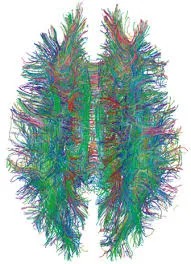
A connectome is a comprehensive map of the neural connections within a brain or nervous system. It represents the detailed wiring diagram of how neurons and their connections, or synapses, are organized and interact to facilitate the brain's functions. The term is derived from "connection" and "genome," reflecting its role as a blueprint for understanding the brain's architecture.
Key Aspects of a Connectome:'
Neuronal Connections include the pathways formed by axons (nerve fibers) and dendrites (branches of neurons) that link neurons.
Scale: Connectomes can be studied at different levels:
Macro-scale: Large-scale connections between different brain regions.
Mesoscale: Connections within regions or circuits.
Micro-scale: Individual neuron-level connections, including synaptic details.
Mapping Tools: Creating a connectome requires advanced techniques such as:
MRI-based methods: Like diffusion tensor imaging (DTI) for large-scale mapping.
Electron microscopy: For detailed neuron-level mapping.'
Human Connectome Project (HCP): A significant effort to map the human brain's connectome to understand its structure and functional relationships.
Applications:
Neuroscience Research: Helps in understanding brain functions, disorders, and development.
Clinical Use: Provides insights into conditions like Alzheimer's, autism, and schizophrenia by revealing structural and functional abnormalities.
Artificial Intelligence: Inspires brain-like computing architectures.
The study of connectomes is a frontier in neuroscience, offering profound insights into how the brain's physical wiring influences thoughts, behaviors, and emotions.
A connectome is deeply related to past experiences because the brain's wiring is not static—it evolves and changes in response to what we experience, learn and feel throughout life. This phenomenon is called neuroplasticity, which refers to the brain's ability to reorganize itself by forming new connections or altering existing ones.
How Connectomes Reflect Past Experiences:
Experience-Driven Changes:
Specific neural pathways are strengthened when we learn a new skill, engage in a habit, or recall a memory. This is often described as the brain's "wiring and firing" together to reinforce patterns of thought and behavior.
These changes leave traces in the connectome, which evolves to reflect accumulated experiences.
Memory Encoding and Retrieval:
Past experiences are stored as patterns of neural activity across the brain. The connections in the connectome represent how these patterns are formed and how they are accessed later.
Emotional or significant experiences often create more robust and lasting changes in the connectome.
Trauma and Healing:
Traumatic experiences can alter the connectome, creating connections associated with heightened fear or stress responses. Healing and therapy can help rewire these pathways, demonstrating the brain's adaptability.
Developmental Milestones:
The connectome changes during childhood, adolescence, and adulthood to reflect developmental needs and experiences, like acquiring language, forming social relationships, or learning complex skills.
Aging and Experience:
Over time, the brain’s connectome can reflect cumulative life experiences, showing use and even wear patterns. Positive activities like learning, meditation, or exercise can help maintain the health of the connectome as we age.
Significance:
The connectome is the neural "footprint" of our life story, constantly reshaped by the events, emotions, and choices that define our existence. Understanding an individual's connectome could one day offer insights into their cognitive and emotional history, helping in personalized therapies and interventions.