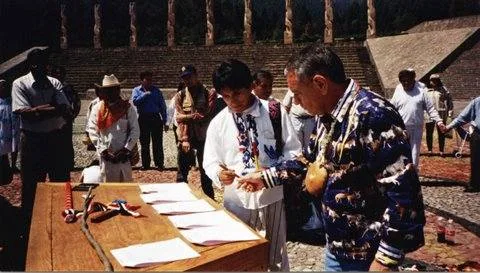
For untold generations, our Indigenous nations—stretching from the cold northern plains of Turtle Island to the warm, forested valleys and mountains of Abya Yala—have held close a prophecy whispered through time. It was not written in books, nor confined to the walls of temples; it lived in the breath of the storytellers, in the prayers of grandmothers, and in the heartbeat of the ceremonies that never ceased despite every storm of history. This prophecy foretold a moment when the Condor, symbol of the great spiritual peoples of the South, and the Eagle, guardian of the North, would rise together once again.
This reunion was not merely symbolic. It represented the healing of an ancient wound—the separation of peoples who had once been united by trade routes, shared ceremonies, and a worldview rooted in harmony with Mother Earth. According to this ancient vision, when the Condor and the Eagle reunited in mutual strength and respect, a new era would open for the human family, an era of peace, well-being, prosperity, and spiritual illumination.
Not the prosperity of material dominance, but the prosperity born from balanced relationships, regenerative lifeways, and a renewed understanding that all creation is interconnected.
A Prophecy Made Stone: The Otomí Ceremonial Amphitheater (1982)
So profound was the devotion to this prophecy among the Otomí peoples of the State of Mexico that in 1982—during a time when Indigenous people were still struggling under centuries of marginalization—they mobilized thousands of volunteers, entire families, whole communities. With no government funding, and with little more than their own hands, hearts, and sacred determination, they constructed one of the most extraordinary ceremonial structures of the modern era.
This vast amphitheater—rivaling in size, grace, and architectural grandeur the great pyramids of the Maya, Mexica, and Zapotec—was raised stone by stone through community effort. It was an act of collective faith, a living testimony to ancestral guidance, and a declaration to future generations that the Prophecy of the Condor and Eagle was not merely to be remembered—it was to be lived.
At the heart of this remarkable structure stands the monumental stone carving of a Condor and an Eagle locked in a loving embrace. This image, sculpted by the hands of materially poor but spiritually wealthy Indigenous people, reflects the deepest truth of the prophecy: unity is not an idea, but a lived relationship. The embrace symbolizes not just the North and South, but the sacred union of spiritual vision and practical action, the integration of ancient wisdom and future possibility, and the return of balance to Mother Earth.
May 5, 1999 — The First International Condor–Eagle Trade and Social Development Unity Pact
It was upon this sacred ground—prepared by decades of prayer, sacrifice, and communal labor—that history shifted again on May 5, 1999.
On that day, the first-ever Reunion of the Condor and the Eagle International Indigenous Trade and Social Development Agreement and Unity Pact was signed. Representatives from First Nations across Canada and the U.S. joined Indigenous leaders representing more than 100,000 Otomí and other Native peoples of Mexico.
This gathering was far more than a ceremony. It was a rebirth of Indigenous diplomacy, a reactivation of ancient trade routes, and a spiritual covenant to work together for:
the revitalization of Indigenous economies
the protection of Mother Earth
the healing of historical trauma
the empowerment of youth and future generations
the building of a just and harmonious world for all peoples