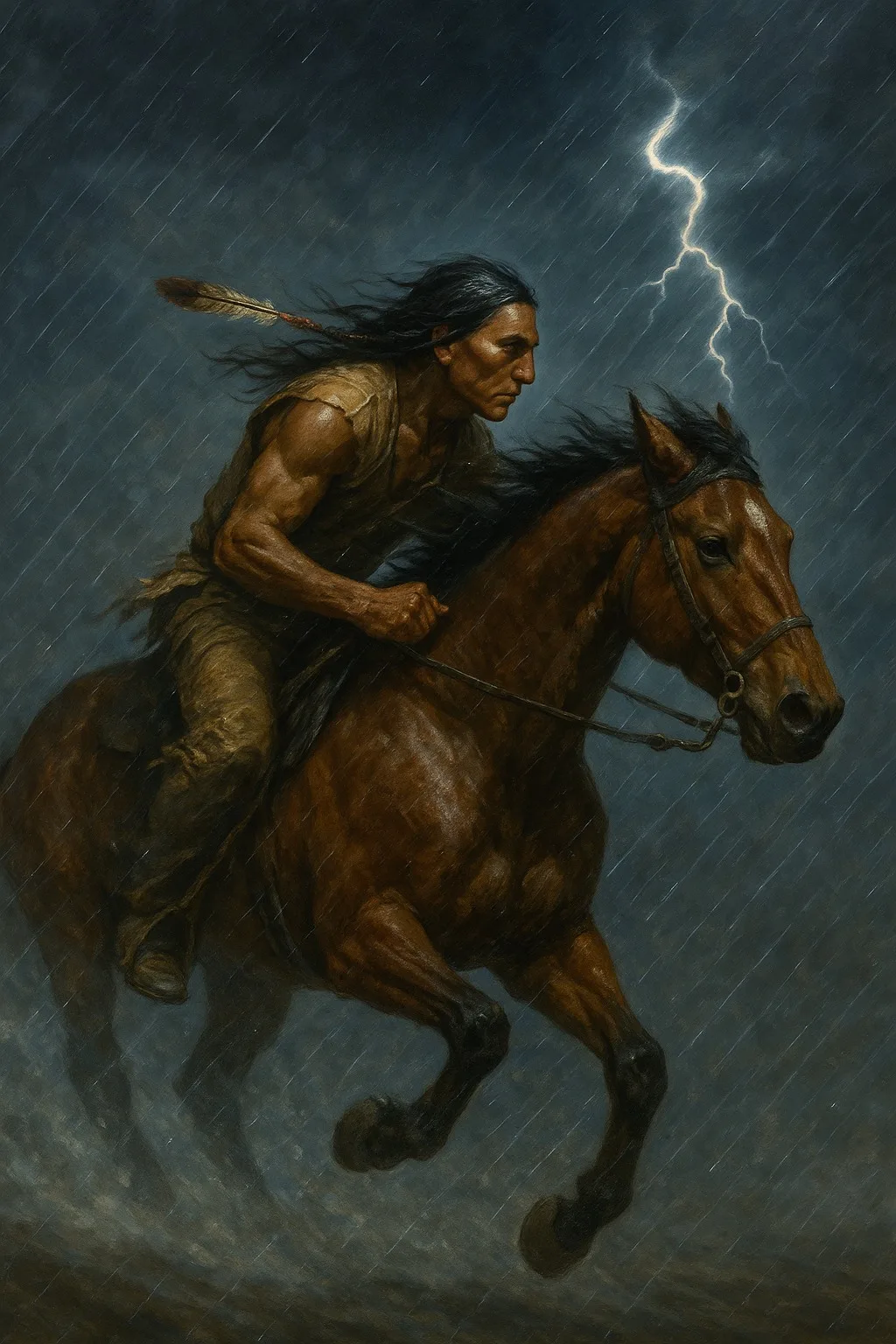
The Compassionate Strength of Crazy Horse: A Teaching in Being a Good Relative
As told by my Hunka Ate, Lionel Kinunua, Minneconjou Lakota from the Cheyenne River Reservation, the sacred story of Crazy Horse's early life reveals the profound depth of leadership rooted not in domination or glory, but in humility, vision, and the sacred principle of Wólakota—living in harmony.
By the age of sixteen, Crazy Horse was already walking the path of a Wičháša Wakȟáŋ—a sacred man, a holy warrior whose very presence carried the weight of spiritual gravity. He was not just a skilled warrior of the Oceti Sakowin Oyate, the Seven Council Fires; he was becoming a living embodiment of the teachings of Wakȟáŋ Tȟáŋka, the Great Mystery.
His humble nature, spiritual discipline, and uncanny ability to foresee danger and guide others toward safety had drawn admiration from many, except for one. Among his own family, a jealous uncle watched as the young warrior’s star rose, his heart becoming heavy with resentment.
The more Crazy Horse shone, the deeper his uncle sank into kíčhizapi, the tearing down of others through gossip and slander. Yet Crazy Horse, taught from childhood to honor his elders and uphold oyáte kin wóuŋspe, the wisdom of the people, remained silent.
But silence does not mean blindness.
Crazy Horse saw clearly how his uncle’s actions created disunity in the camp circle. Whispers became walls. Suspicion replaced trust. The once-harmonious drumbeat of the people began to fall out of rhythm.
He knew in his heart that this division was more dangerous than any enemy on the plains. For the survival of the Tiyóšpaye—the extended family—depended not on numbers or weapons, but on čhaŋtémaza, the iron heart rooted in love and unity.
Crazy Horse did something that only a true spiritual warrior could do.
He prayed.
With a spirit bowed in humility, he turned to Wakȟáŋ Tȟáŋka and sought vision, not for victory over his uncle, but for the healing of the people. That night, without fanfare or farewell, Crazy Horse and his family packed their thípi and quietly left camp, traveling downstream under the moon’s silent gaze. They left not in anger, but in ceremony—every step a prayer to restore balance.
At dawn, when the people saw his absence, his uncle seized the moment to deepen his accusations. But the people, especially the elders and the wise women, sensed something deeper. The camp became uneasy, the sacred circle incomplete.
All the relatives visited during the following days. Then, one night, they all quietly left to join Crazy Horse. Only the uncle's tipi remained in the old circle. The uncle awoke to silence and emptiness, realizing the entire community had moved to be with Crazy Horse. But this was no exile, no punishment. It was a teaching.
Crazy Horse was saddened, not victorious. He did not rejoice in his uncle’s isolation. He loved his uncle. He felt wóuŋšila—compassion—and knew that even those who hurt us carry their pain.
At sunrise, Crazy Horse entered the Inípi, the sacred Sweat Lodge. With the steam rising from glowing stones, he poured out his heart in the womb of Mother Earth.
He asked Wakȟáŋ Tȟáŋka for guidance, not to defeat his uncle but to understand him. He sought nažiŋ, to stand upright in spirit and act in a way that honored the ancestors' teachings.
When he emerged, cleansed in spirit, Crazy Horse mounted his horse and rode back alone to his uncle’s tipi. There, in the quiet shadows of the firelight, he sat beside him—not with accusation, but with empathy. The young man, who had faced countless battles, now faced the hardest one: opening his heart to someone who had tried to wound him with words.
“Uncle,” he said softly, “we are one oyáte, one family. If one finger wounds another, does the hand not suffer? I do not want to lose you. I want to understand you. Let us walk again as relatives.”
And in that sacred moment, a great healing began.
The uncle, touched by this unexpected grace, wept. He saw the reflection of his own wounded spirit in his nephew's clear eyes. He felt the burden of jealousy lift, replaced by a deep yearning to be made whole again.
In the following months, uncle and nephew stood together to rebuild what had been broken. They organized feasts, shared stories, and reminded the people of what made them strong: Mitákuye Owas’iŋ—that we are all related. Together, they reminded the Oyate that our greatest strength is not found in our arrows or horses but in our love, respect, and shared purpose.
This story of Crazy Horse became more than a memory. It became medicine.
He taught that a true leader does not seek dominance but harmony. He taught that čhaŋtéwašte—a good heart—must guide our actions, even toward those who hurt us. He taught that unity must be protected like the sacred fire tended daily, never allowed to go out.
Years later, when Crazy Horse faced betrayal and the cold steel of a bayonet, his spirit remained untarnished. He had already transcended this world of shadow and sorrow. He had seen the greater reality in his visions—worlds lit by thunder, lightning, and rain. Before he passed, he told the People, “I will return through the thunder, lightning, and rain.”
And we believe him.
Because Crazy Horse never truly left.
He lives in every camp where people seek peace over pride.
He lives in every heart that chooses compassion over conflict.
He lives in every circle and heart where we remember that being a good relative is the highest path of all.