
A relative recently asked me to share my perspective: “What does it mean to be a Hereditary Chief?”
What I offer is my best understanding, drawn from what I learned from my beloved father, mother, aunts and uncles, cousins, brothers, grandparents, and from the lives, teachings, sacrifices, and examples of many extraordinary Elders I have been honored to meet and spend time with.
I do not present myself as someone who has fulfilled this path perfectly. I am still striving to walk it, still learning what it requires, and still discovering how much further I must go.
Anyone can be called a Chief, or call themselves a Chief, in the outer world of titles, names, recognition, and position. But becoming a true Chief is an inward spiritual journey.While we honor outer symbols of leadership and recognition, we understand that within us is something far greater than this physical world of time and space: our soul, a sovereignty, ancient, imperishable, and everlasting.
We understand that just as the purpose within the womb world is to grow our physical body, our purpose in this “womb world” is to grow our spiritual body of spiritual values.
The real work is to reach a place within where we become free from attachment to everything except our beloved Creator—free from the demands of the ego, the desire for recognition, the fear of criticism, the hunger for control, and the influence of wealth, power, status, family loyalty, or personal advantage.
Only through this inner freedom can we begin to see with the eyes of justice.
The sacred teaching tells us that the Creator’s most beloved thing is justice. Justice enables us to see with our own eyes and know through our own understanding. It allows us to recognize the truth of a situation without being blinded by prejudice, self-interest, favoritism, fear, anger, or attachment.
Truthfulness is equally foundational. Without truthfulness, no other human virtue can be fully developed. Courage without truthfulness can become aggression. Loyalty without truthfulness can protect wrongdoing. Authority without truthfulness can become domination. Even love, when separated from truth and justice, can become attachment, avoidance, or favoritism.
A Chief must therefore strive to become inwardly free enough to tell the truth, uphold justice, and protect the people—even when doing so is difficult, unpopular, or personally costly.
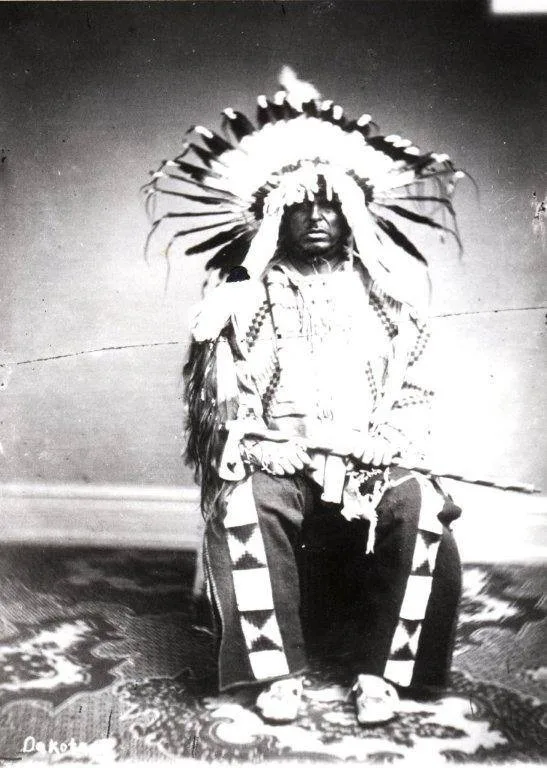
To be an Itȟáŋčhaŋ—to be a Chief—is not primarily to hold a title or exercise authority. It is to accept a sacred responsibility for the well-being of the whole circle.
A Chief is the last to eat and the last to sleep. A Chief is the first to step forward when danger, hardship, conflict, or uncertainty enters the camp. The responsibility is not to stand above the people, but to stand with them—and, when necessary, to stand between the people and whatever may bring them harm.
A Chief listens carefully and ensures that every voice has an opportunity to be heard. No one person should make decisions affecting the people alone. Elders, women, men, youth, children, and all members of the circle carry knowledge and gifts essential to the community’s life. True leadership draws those gifts forward and helps the people come into the greatest possible unity.
In our Dakota culture, the mistreatment or abuse of women was deeply censured. If a woman was being harmed, leadership was responsible for intervening and confronting the person causing that harm—even if the offender was her husband or one of the most prominent and influential men in the camp.
No position, relationship, wealth, reputation, or personal connection placed anyone beyond accountability. Women are sacred. Children are sacred. Every person within the circle must be protected.
This is where justice becomes more than an idea. Justice means that we do not excuse wrongdoing because the person responsible is powerful, wealthy, respected, related to us, or useful to us. Truth must remain truth, no matter who is involved. Harm must be addressed, whoever has caused it.
The Chief’s responsibility is always to guard the circle, preserve the peace of the camp, care for those who are vulnerable, and ensure that no one is abandoned, silenced, excluded, or left behind.
A Chief must walk a spiritual path grounded in humility, thanksgiving, generosity, compassion, courage, justice, truthfulness, and kinship. Leadership means continually feeding the life of the people—not only materially, but emotionally, mentally, culturally, and spiritually.
Whatever knowledge, resources, relationships, or opportunities come to a Chief are not personal possessions to accumulate or withhold. They are sacred trusts—gifts to be shared in every direction for the well-being of the whole.
This is why there is no retirement from such a responsibility. There is only an ever-deepening journey: gathering and synthesizing knowledge, healing one’s own heart, refining one’s character, strengthening communication, and faithfully transcribing and transmitting what has been learned to the generations coming behind us.
We are never finished. Never.
We continue striving to follow this path and improve ourselves until we leave this life. With every sincere step, something more is revealed: something within ourselves that requires healing, something we need to understand, something new we must learn, or another way we are being called to serve.
As long as we keep our minds and hearts open, every day can become a sacred day of revelation—a day when we may see, hear, understand, or feel something we have never encountered before.
Sometimes we can clearly see where the journey is leading. At other times, we simply know that we are participating in a sacred process that is still unfolding. We may not yet understand where it is taking us, but we continue walking faithfully.
As long as we remain upon the Red Road, live as well as we can according to the sacred guiding principles of life, and honor the great spiritual teachings that call humanity toward love, compassion, kindness, justice, truthfulness, forgiveness, generosity, and peace, what is meant to emerge will reveal itself in its proper time.
In the Four Worlds understanding, authentic development comes from within. We cannot ask others to become what we ourselves are unwilling to embody. A Chief must therefore strive each day to live the values being called forth in the community—to become the peace, justice, generosity, discipline, healing, and unity we wish to see flourishing among the people.
This does not mean that a Chief is perfect. It means remaining teachable. It means having the humility to acknowledge mistakes, accept correction, seek forgiveness, make amends, and begin again. The moment we believe there is nothing more for us to learn, we close ourselves to the wisdom our beloved Creator continually reveals.
A Chief does not own the vision. The vision belongs to the people, to the generations yet unborn, to Mother Earth, and ultimately to the Great Mystery. The Chief’s task is to help prepare the vessel, welcome everyone aboard, and ensure that the journey of collective transformation remains guided by love, truth, justice, participation, and service.
This is the understanding my father and the many great Elders whose lives demonstrated these sacred responsibilities passed to me. I continue striving to follow their example—not claiming that I have arrived, but praying each day to become more truthful, more just, more compassionate, more humble, and more worthy of serving the whole circle.
None of us completes this journey alone. We move through the strength of our relationships, through the gifts we share, and through our remembrance that we are all relatives.