
One of the clearest signs of the breakdown of society in all parts of the world is the erosion of trust, respect, and genuine collaboration between the people and the institutions that claim to govern on their behalf. Governance is not merely the management of power, law, elections, money, and policy.
True governance is a sacred responsibility. It is the careful tending of relationships among the people, the leaders, the ancestors, the children yet unborn, Mother Earth, and the spiritual laws that hold life together.
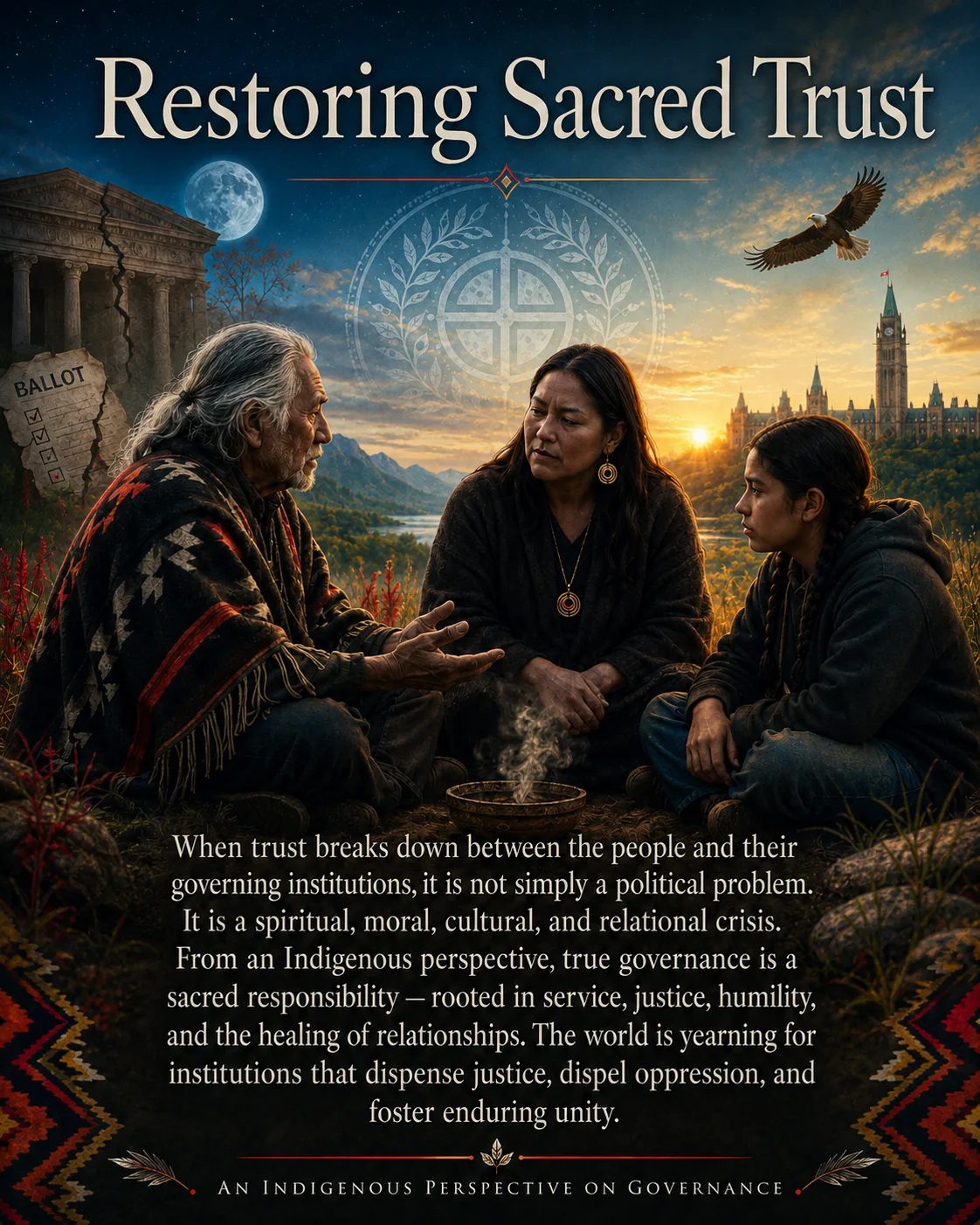
When trust breaks down between the people and their governing institutions, it is not simply a political problem. It is a spiritual, moral, cultural, and relational crisis. It means that the circle has been broken. It means that those who were entrusted to serve the people have too often forgotten that authority is never meant to be domination.
Leadership is meant to be service. Power is meant to protect life. Decision-making is meant to uphold justice, restore balance, and strengthen unity.
In a growing number of nations, the electoral process has become discredited because corruption has entered the doorway of governance. Wealthy interests, hidden agreements, party loyalties, media manipulation, and the pursuit of power for its own sake have too often replaced truth, humility, wisdom, and service.
When money speaks louder than the people, when political parties demand loyalty over conscience, when public perception is shaped by distortion rather than honest consultation, then the people naturally become discouraged.
They begin to feel that their voices do not matter, that the most capable and pure-hearted citizens will not be allowed to emerge, and that the whole system is designed to protect itself rather than heal the suffering of the people.
This is why apathy, alienation, anger, and despair are spreading in many places. The people are not simply tired of politics. They are tired of being divided. They are tired of being manipulated. They are tired of promises that do not become reality. They are tired of systems that speak of justice while permitting oppression, that speak of freedom while deepening dependency, that speak of unity while feeding conflict.
Deep in the hearts of the people, there is a yearning for something more truthful, more honorable, more spiritual, and more deeply rooted in the well-being of all.
The healing of governance cannot come from changing leaders alone. It must come from transforming the spirit, purpose, and method of governance itself. We cannot heal a broken circle by repeating the same adversarial patterns that broke it. We cannot restore trust through competition, accusation, manipulation, and victory over others.
We restore trust by returning to sacred principles: truthfulness, humility, respect, consultation, accountability, compassion, courage, and responsibility to the generations coming behind us.
In the old ways, a true leader did not rise by self-promotion. A true leader was recognized by service, sacrifice, wisdom, generosity, courage, and the ability to listen. The leader’s first duty was not to win power, but to protect the people.
The leader was expected to listen to the Elders, honor the women, encourage the youth, care for the vulnerable, defend the sacred, and keep the future in mind. No decision was considered whole if it harmed the children yet unborn, violated Mother Earth, or weakened the unity of the people.
This is the kind of governance the world is now yearning for: institutions that dispense justice, dispel oppression, and foster enduring unity among the diverse peoples of the human family. But such institutions cannot be built on the foundation of domination, selfish interest, racial superiority, greed, or spiritual emptiness.
They must be built on a higher understanding of humanity. They must recognize that the human family is one, that every person carries a sacred trust, and that the wisdom of Indigenous Nations is not a relic of the past but a necessary medicine for the future.
The Indigenous way teaches that consultation is not debate. It is not the art of defeating another person’s argument. It is the sacred practice of bringing many perspectives into the circle so that a greater truth may emerge. In true consultation, we do not seek to humiliate, overpower, or silence one another. We seek to understand.
We listen for the pain beneath the words, the wisdom beneath the differences, and the path forward that can serve the whole. This kind of consultation heals because it restores dignity. It makes room for the quiet voice, the wounded voice, the young voice, the Elder’s voice, and the voice of Mother Earth.
The crisis of governance in the world is, therefore,e a call to return to the circle. It is a call to move beyond systems that divide people into permanent camps of winners and losers. It is a call to create institutions that are transparent, trustworthy, spiritually grounded, culturally respectful, and truly accountable to the people.
It is a call to remember that justice is not an abstract legal concept. Justice is restored in a relationship. Justice is the lifting of oppression. Justice is the protection of the sacred. Justice is the assurance that every child can grow in dignity, safety, identity, and hope.
What is breaking down in the world is not only political confidence. What is breaking down is the old belief that material power alone can guide humanity.
The people are yearning for governance with a soul. They are yearning for leadership that carries prayer, humility, courage, and vision. They are yearning for institutions that do not simply administer society, but help heal it.
The way forward will not be found in hatred, revenge, or deeper division. It will be found in a renewal of sacred trust. It will be found when we remember that leadership is a covenant with the people, not a possession of the powerful. It will be found when governance becomes once again a circle of service, where every decision is measured by its impact on people experiencing poverty, the children, the Elders, the land, the waters, the animals, the spirit of the people, and the generations yet to come.
The world is calling for institutions that can carry justice with compassion, authority with humility, and unity without oppression. This is not only a political need. It is a sacred necessity. The healing of governance begins when we return to the truth that we belong to one another, that the Earth is not separate from us, and that the highest purpose of leadership is to help the people live in balance, dignity, peace, and unity.