
In the spring of 1962, I was seventeen years old and preparing to graduate from Walla Walla High School—Wa-Hi—in southeastern Washington State. None of us who began the Joe Gomez campaign could have fully understood it at the time, but looking back across more than six decades, I can see it was much more than a high-school prank.
It was one of my earliest experiences in community organizing. It was a youthful challenge to prejudice and authority. It affirmed our right to participate and to choose. It was also a lesson in how humor can expose an injustice without hatred—and how the wise action of one elder can transform a confrontation before anyone is harmed.
The campaign began in my old pickup truck on the way to track practice. A small group of us decided to launch an election campaign for a student named Joe Gomez for Student Body President of Walla Walla High School. The fun—and the problem—was that Joe Gomez did not exist.
Walla Walla in 1962
To understand why we chose the name Joe Gomez, it is important to understand something about Walla Walla in 1962. Walla Walla was a beautiful agricultural community surrounded by wheat fields, pea fields, onion fields, orchards, and vegetable crops. The agricultural abundance of the valley shaped nearly every part of our lives. Even young people who lived in town understood the rhythm of planting and harvest. Summer did not simply mean vacation. For many of us, summer meant work.
Agriculture was—and remains—one of the foundations of the county’s economy. But the public image of prosperity did not always acknowledge all the hands that made that prosperity possible. Indigenous people, Mexican people, Mexican Americans, and migrant agricultural workers performed much of the hardest work in the fields, packing plants, and canneries. Their labor was necessary, but their dignity was not always respected.
The national context is important. In 1962, the United States was still operating the Mexican Farm Labor Program, commonly known as the Bracero Program. It had begun during the Second World War and continued until 1964. Mexican laborers were recruited because American agriculture needed their strength and skill. Yet across the United States, many of these workers faced low wages, poor living conditions, discrimination, and language intended to make them appear less worthy than the people who depended upon their work.
Walla Walla was not separate from those contradictions. At that time, as I remember it, there were no Latino students at Wa-Hi. Yet Latino and Indigenous workers from the South were essential to the agricultural economy surrounding us. Some people in Walla Walla were openly unfriendly toward these workers. They used degrading words such as “wetbacks” and “spics” behind their backs and, when they felt safely outnumbered, sometimes to their faces. That did not sit well with me because these were not strangers to me. I had worked beside our Indigenous relatives from the South. I knew them through shared labor, dust, sweat, long hours, aching muscles, laughter, meals, and the responsibility of bringing in a crop before the weather changed. Without exception, I knew them as hardworking and dedicated human beings.
So when we created Joe Gomez, we did not choose his name accidentally. Joe came to represent someone whose labor the valley needed but whose full humanity the dominant society did not always see. He represented those who were present in Walla Walla’s economy but absent from the halls of our high school and from many positions of recognition and leadership.
Growing Up Through Work
I began working in the harvest when I was twelve years old. I picked strawberries. I cut, baled, and put up hay. I planted, suckered, and picked sweet corn. I drove wheat and pea trucks. I ran the flumes at the Birds Eye Frozen Food Plant, stacked cans at the Walla Walla Cannery, and cut Walla Walla Sweet Onions.
For many young people in Walla Walla, working all summer was not unusual. No one had to force us. It was simply what we did. Work was part of growing up. It taught us responsibility, endurance, cooperation, and respect for the land and for the people whose hands brought food from the earth.
We worked long hours. By the time I was fourteen, twelve-hour shifts were normal for me. During the onion, pea, and wheat harvests, we might work for three weeks without a day off. In the fields, the wheat harvest ran from sunrise to sunset. The pea harvest could continue around the clock. When I turned sixteen, I was old enough to work at Birds Eye and the Walla Walla Cannery, where we worked twelve-hour shifts, six days a week. If we were lucky, we could get overtime. Compared with sweating from sunrise to sundown under the hot Walla Walla sun, the cannery and frozen-food plant seemed almost like cushy jobs.
During the pea harvest, I worked for Art Danielson, a friend of my father who lived across Mill Creek Road from our family home. We earned one dollar an hour and received wonderful meals.
My father had taught me to drive our old 1939 Ford pickup when I was twelve. By the time I was fourteen, I was driving a spreader truck for the Danielsons during the pea harvest. This was permitted as long as I stayed on private property and did not drive on the public highway.
Agriculture was changing then. Farmers were moving from stationary vineries to pea combines. My job was to drive alongside a moving combine while it unloaded processed pea vines into my truck. Sometimes we worked on fairly steep hillsides. I enjoyed the challenge of keeping my truck correctly positioned beside the combine as both machines moved across the slope. I never saw a truck turn over, but I heard stories of it happening.
When my truck was full, I drove to a field that had already been harvested. I pulled a lever in the floor and stepped on the gas. If I accelerated quickly enough, the truck bed lifted and the pea vines spread evenly behind me to dry.
Once the vines had dried, they were baled and stored in a barn. The bales weighed about one hundred pounds each. After twelve hours of lifting and stacking them, a person was tired and ready to sleep before returning the next day to lift and stack more. That pattern continued day after day for two or three weeks.
One time, when I was fourteen, we were harvesting peas about thirty miles east of Walla Walla, near Dayton, Washington. I began on the night shift, from six in the evening until six in the morning. At sunrise I still felt strong, so I continued through the day shift, from six in the morning until six that evening. When that shift ended, my energy still felt good, and I challenged myself to work one more night shift. After thirty-six hours of work, I finally headed home.
It was about seven in the morning when I walked across the road from the Danielsons’ place and up our driveway. My father was outside feeding our horses. He looked at me and said, “Good morning, son. How was work?” I said, “I worked three shifts.” My father replied, “That’s good, son.” That was all that was said. I went upstairs to sleep because I had to report for another night shift at six that evening.
That simple exchange tells something about the world in which I was raised. My father did not flatter me, and he did not make a great production of what I had done. Work, discipline, and doing one’s part were expected. His quiet acknowledgment was enough.
Those summers also taught me something that no classroom could have taught in the same way. When people work shoulder to shoulder, false barriers begin to fall. You learn who a person is by whether they show up, whether they carry their part of the load, whether they help when another person is tired, and whether they remain steady when the work becomes difficult. The men I worked beside from the South earned my respect through their actions. That is why I thought Joe Gomez would make an excellent Student Body President of Wa-Hi.
A Sovereign Right to Choose
I also carried a strong but not yet fully articulated conviction that we possessed a God-given, sovereign right to vote for whomever we chose. To me, that right included voting for Joe Gomez, even though he did not exist.
Today, I can see the paradox clearly. Joe was imaginary, but the exclusion he exposed was real. The campaign asked a simple question: Who is considered worthy to belong, to be seen, and to lead? If a name alone could disturb the social order of our school, what did that reveal about the order itself?
My old friend Mike Friedman was one of the key co-conspirators in the Joe Gomez campaign. Around that same time, I learned that Mike intended to hitchhike through Europe, and he welcomed me to join him.
We left Walla Walla in late August 1962. At the edge of town, we began our journey with one suitcase bearing a sign my father had made. On it, he drew a large thumb and wrote the words: “New York or Bust!”
After forty-four rides and fewer than five days, we reached the Staten Island Ferry at sunrise. Some of those rides were memorable. One was with a Bible salesman who drove us through Nebraska while raising swearing, foul language, and dirty jokes to a level neither of us had previously imagined.
That journey became another chapter in a Native American and Jewish coming-of-age story. But before Mike and I left Walla Walla for Europe, we had unfinished business at Wa-Hi.
“Have You Met Joe Gomez Yet?”
Our campaign began with stories about a remarkable new student who had supposedly just moved to Walla Walla. His name was Joe Gomez. Joe could run the one-hundred-yard dash in ten seconds flat. He could broad-jump more than twenty feet and run two hundred yards in under twenty-three seconds. He was exceptionally intelligent, warm, friendly, and very handsome. In other words, Joe possessed nearly every quality a high-school electorate might admire.
The stories spread quickly. Our growing network of co-conspirators helped them, along with innocent questions such as, “Have you met Joe Gomez yet?”
For three weeks, we put up Joe Gomez election posters. At first, we did it openly. Soon, however, the school administration—especially Vice Principal Mr. Kramer—and our Student Body President, John “Speedy” Folsom, became unhappy with us. So the campaign went underground.
During class, co-conspirators asked permission to go to the bathroom. Along the way, they posted Joe Gomez campaign signs. The posters could not be too large because they had to be smuggled out of classrooms. Sometimes we hid them in the bathrooms, picked them up later, and put them back into circulation. Administrators and the Student Body President tore the posters down during breaks and at lunchtime. The Joe Gomez campaign quietly replaced them. The more the authorities attempted to erase Joe Gomez, the more present he became.
Mr. Kramer eventually summoned me to his office because he believed I was one of the ringleaders. I have no idea why he would think that. LOL.
After all, I only helped make the posters, hid them in the bathrooms, and recruited new co-conspirators. I made sure I didn't personally put them on the walls. Therefore, I could look Mr. Kramer in the eye and truthfully tell him that I had never put up a Joe Gomez poster.
A deeper cultural logic also worked in my mind. When I was twelve, my grandfather, Strong Heart, had given me the name Shúŋkmanú—Horse Thief. Within that youthful understanding of my name, I felt entirely comfortable making a “raid” on the bureaucracy of Wa-Hi. We were not stealing horses. We were stealing past the boundaries of an unjust assumption and carrying an excluded name into the center of the school.
Mr. Kramer warned me that if the Joe Gomez campaign continued, he would not permit me to use school time to visit colleges or universities I might wish to attend. I smiled and left his office.
The Joe Gomez Manifesto
Finally, the day approached for the schoolwide assembly at which the candidates would deliver their campaign speeches. The night before the assembly, we held a secret meeting at our old family home on Mill Creek Road. Mike Friedman, two other co-conspirators, my father, and I gathered to decide what to do. My father served as our elder adviser.
Together, we composed a one-page Joe Gomez Manifesto. We are still searching for a copy today. As I remember it, the manifesto announced beautifully that Joe had decided to withdraw humbly from the election because he did not want to participate in a system governed by personalities and social status rather than full participation. It also declared that if anyone attacked Joe Gomez during the assembly, we would defend him.
It was signed The Joe Gomez Election Campaign. Through our campaign network—and thanks, indirectly, to the kindness and resources of Walla Walla High School—we arranged for approximately 1,200 copies to be printed. Who had access to those old Wa-Hi copying machines? Only the Shadow knows.
The Final Assembly in the Old Wa-Hi Auditorium
The physical setting matters. Wa-Hi had been founded in 1889 and had occupied several buildings during its history. Our Class of 1962 was the last graduating class to complete its education at the old high-school campus. In 1963, the school moved to its new location at Fern and Abbott.
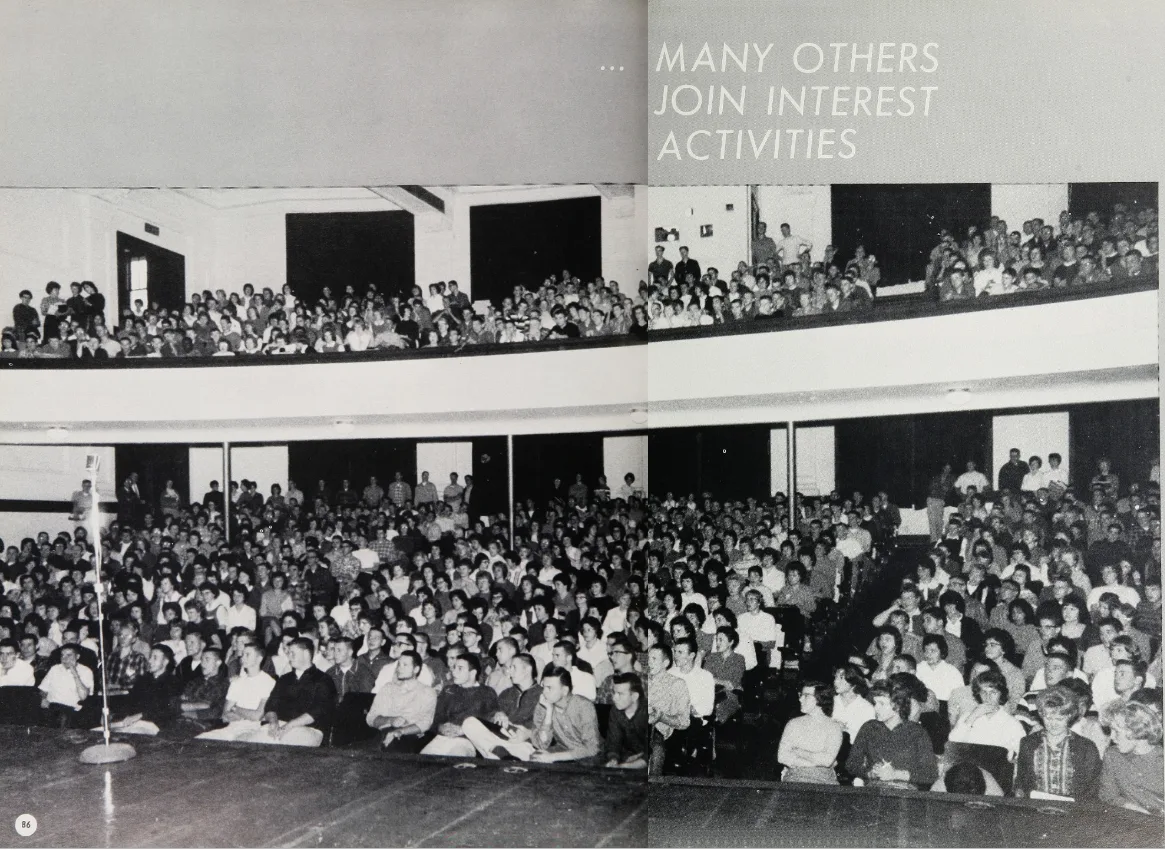
So the auditorium in which the Joe Gomez campaign reached its climax belonged to the closing chapter of an era. Generations of students had sat in that room. Its stage, curtains, aisles, and rows of seats carried the established order of the school. For one morning, however, the unseen Joe Gomez filled that entire space.
Before classes began, we enlisted juniors and sophomores to stand at every entrance and give a manifesto to every student entering Wa-Hi. I also made a special effort to slip one copy into the mail slot of the administration office and place another under Mr. Kramer’s door. We knew Mr. Kramer was angry because we had not responded to his threats or followed his rules concerning the campaign, so we devised a plan. If he attacked Joe Gomez from the stage, we intended to rush forward, physically restrain him, and allow me to deliver a speech defending Joe and what we believed to be our sovereign rights.
Looking back, I recognize how foolish and dangerous that plan was. We had thought through the confrontation but not its consequences. Our plan went only as far as rushing the stage. It is a blessing that events unfolded differently.
In those days of largely unexamined sexism, the athletes and their friends occupied the center section of the auditorium in four or five rows. Seniors sat in front, with juniors behind them, then sophomores, and so forth.
That morning, I sat between two very large friends: Ed Weitz, six feet five and about 220 pounds, and Ron Bradstreet, six feet four and about 245 pounds. We were positioned close to the middle of the front row, ready to move if necessary.
In the attached photograph, I am seated in approximately that same area, toward the right-hand side of the middle front row, near Ed Weitz and my old friend Mike Dunham. Mike passed to the Other Side Camp not long after I saw him last at our Class of 1962 fiftieth reunion.
As the auditorium filled, it became noticeably quieter than usual. Nearly every student held a copy of the Joe Gomez Manifesto. They read it, looked around, and waited. The room gradually fell silent with anticipation. What was going to happen? When the auditorium had become completely still, the stage curtains parted. But Vice Principal Kramer didn't step through them. It was our principal, Mr. Tedrick. Hanging from his neck was a sign that read:
“I’M FOR JOE GOMEZ.”
He surprised every one of us. In that instant, Principal Tedrick transformed the entire situation. He did not humiliate us. He did not denounce Joe. He did not answer youthful defiance with institutional force. Instead, he entered the story we had created and, with one simple act of humor and wisdom, brought the conflict to a peaceful conclusion.
At seventeen, I was foolishly disappointed. We had prepared ourselves to rush the stage, restrain Mr. Kramer, and make a dramatic defense of our rights. Part of me wanted the confrontation. Today, I thank the Great Spirit that Principal Tedrick saved the day.
His response taught a lesson I didn't fully understand until later: true authority doesn't always have to crush resistance. Sometimes it can listen beneath the resistance, recognize the truth hidden inside it, and make room for everyone to step back with dignity. Mr. Tedrick did not defeat the Joe Gomez campaign. In a sense, he joined it—and by joining it, he completed it.
Reconciliation and the Road Ahead
The story did not end with enemies. In time, Mr. Kramer and I became friends. He wrote a wonderful letter recommending me to the University of Washington, where I was accepted and later attended after our European adventure. “Speedy” Folsom and I also made peace. Later, we lived in the same place while attending the University of Washington.
These reconciliations matter. They remind me that a conflict need not define a relationship forever. People can disagree strongly, challenge one another, and still come to respect one another. A person we initially experience as an adversary may later become a friend and supporter.
The Joe Gomez campaign also contained the early seeds of lessons that would guide my life’s work:
I learned that organization begins in relationships: a few friends in an old pickup truck can begin something that reaches an entire community.
I learned that stories carry power: within days, an imaginary student became one of the most widely known names in our school.
I learned that humor can open doors that anger alone may close.
I learned that participation cannot be genuine if social status determines whose voice counts.
I learned that prejudice becomes harder to sustain when we have worked beside the people whom society tells us to dismiss.
I learned that courage without wisdom can easily become recklessness.
Most importantly, I learned that an elder’s timely action can turn confrontation toward reconciliation.
Joe Gomez never walked the halls of Walla Walla High School. He never ran the hundred-yard dash, made a broad jump, or delivered a campaign speech. Yet for several weeks in 1962, he became real in the minds of hundreds of students. His unseen presence compelled our school to confront questions of belonging, participation, authority, and freedom of choice.
Joe did not win the election. He withdrew because he would not participate in a system based upon personality and social standing without full participation. But in another sense, Joe Gomez won:
He won when 1,200 students entered school carrying his manifesto.
He won when an auditorium fell silent in anticipation.
He won when a principal walked through the curtain wearing the words, “I’m for Joe Gomez.”
He won when former adversaries later became friends.
And Joe continues to win whenever people remember that no community is whole while the people whose labor sustains it remain unseen, demeaned, or excluded. More than sixty years later, I understand that we were not merely campaigning for an imaginary student. In our youthful, mischievous, imperfect way, we were campaigning for the right of every human being to be seen, respected, included, and heard. That is why Joe Gomez's story still matters. It was not based on a true story. It is a true story.
Historical Note
The historical setting included here is supported by records of Walla Walla’s agricultural history, the Mexican Farm Labor or Bracero Program of 1942–1964, and the Walla Walla High School archival record confirming the school’s move to the Fern and Abbott campus in 1963. The personal events, dialogue, working experiences, and meaning of the Joe Gomez campaign are the firsthand recollections of Hereditary Chief Phil Lane Jr., Wa-Hi Class of 1962.
Selected Sources
Walla Walla County—Thumbnail History, HistoryLink
The Bracero Program, U.S. National Archives
Walla Walla High School Collection, 1898–1987, Archives West
Walla Walla Public Schools Graduates of Distinction
JOE GOMEZ
Short Film Treatment — First Development Stage
Based on the true story of Hereditary Chief Phil Lane Jr.
Proposed format: Narrative short film, approximately 22–28 minutes Genre: Coming-of-age historical drama with humor Setting: Walla Walla, Washington, primarily spring 1962, with memories of the harvest years from 1956–1961 and a brief epilogue in late summer 1962 Status: First-stage treatment, prior to scene outline and screenplay
Working Title
JOE GOMEZ
Alternative Title
I’M FOR JOE GOMEZ
Tagline
He never existed. The truth he revealed was real.
Logline
In 1962, a seventeen-year-old Indigenous athlete and his close Jewish friend invent an extraordinary Latino student and campaign to elect him president of their largely white high school, transforming a mischievous prank into a confrontation over prejudice, belonging, and the sovereign right to choose—until an elder’s unexpected act of wisdom changes everything.
The Heart of the Film
JOE GOMEZ is a true coming-of-age story about the awakening of a young organizer. It begins with humor: a handful of high-school friends invent a candidate who does not exist. Beneath the fun, however, lies something serious. The agricultural prosperity of Walla Walla depends upon Indigenous, Mexican, Mexican American, and migrant labor, while the people doing much of that labor remain unseen, demeaned, and absent from the halls of the high school.
Young Phil Lane does not yet possess the language he will later use as a lifelong Indigenous leader and community developer, but he already carries the instinct. He knows from working beside the men in the fields that character is not determined by race, social standing, or popularity. He knows that authority should not decide beforehand who is worthy to be seen or chosen. The imaginary Joe Gomez becomes a vessel for that unarticulated conviction.
The film moves toward what appears likely to become a physical confrontation in a packed school auditorium. Instead, Principal Tedrick steps through the curtain wearing a handmade sign around his neck: “I’M FOR JOE GOMEZ.” His gesture does not crush the students, surrender his responsibility, or publicly humiliate anyone. With humor and emotional intelligence, he enters their story and turns a dangerous moment toward peace. The seventeen-year-old Phil is disappointed that he does not get to deliver his defiant speech. The elder Phil, looking back more than sixty years later, understands that Tedrick’s response was the greater act of leadership.
Point of View and Storytelling Approach
The story is seen primarily through seventeen-year-old Phil’s experience. An older Phil may provide a light voice-over at the beginning, at two or three important transitions, and at the end. The voice-over should not explain what the images already show. It should bring the perspective of an elder to experiences the young man could not yet fully interpret.
The film should feel lived rather than narrated. Walla Walla is not presented as a place of simple villains and heroes. It is a beautiful, hardworking community carrying the ordinary prejudices and exclusions of its time. Vice Principal Kramer is an institutional antagonist, but he is not portrayed as a monster. The later reconciliation between him and Phil is essential because it demonstrates that opposition does not have to become permanent enmity.
Joe Gomez is never physically depicted. The audience may briefly believe that he is real, just as many Wa-Hi students did. His presence grows entirely through words, questions, posters, rumors, and the reactions of others. The more the administration tries to remove him, the more powerfully he fills the school.
Principal Characters
PHIL LANE JR., 17: An Ihanktonwan Dakota and Chickasaw senior, athlete, farm laborer, natural organizer, loyal friend, and gifted troublemaker with a strong internal sense of justice. Phil is physically courageous and accustomed to hard work. His greatest strength is his willingness to act; his youthful limitation is that he can mistake confrontation for victory.
PHIL’S FATHER: Quiet, grounded, hardworking, and observant. He speaks sparingly, but his words carry weight. He teaches Phil through example and serves as elder adviser to the Joe Gomez campaign. He recognizes the deeper purpose beneath the boys’ mischief without romanticizing it.
MIKE FRIEDMAN, 17: Phil’s Jewish friend and principal co-conspirator. Quick-minded, funny, adventurous, and prepared to challenge convention. His friendship with Phil gives the story its Native American and Jewish coming-of-age dimension. Their shared courage will soon take them hitchhiking across the United States and onward to Europe.
PRINCIPAL TEDRICK: A mature educator who understands the difference between maintaining authority and defending his ego. His climactic action reveals humor, courage, restraint, and the ability to recognize truth inside youthful rebellion.
VICE PRINCIPAL KRAMER: Responsible for discipline and increasingly angered by the campaign. He believes Phil is a ringleader and attempts to stop the movement through warnings and institutional pressure. His eventual recommendation of Phil to the University of Washington reveals a more complex man capable of changing his relationship with a former adversary.
JOHN “SPEEDY” FOLSOM: The actual Student Body President. Initially threatened and frustrated by the campaign for an imaginary challenger, he tears down posters and helps defend the official process. He and Phil later reconcile and live in the same place while attending the University of Washington.
ED WEITZ AND RON BRADSTREET: Phil’s exceptionally large athletic friends, seated with him at the assembly. Their physical presence makes the plan to rush the stage feel both possible and dangerous.
THE CAMPAIGN NETWORK: Juniors, sophomores, athletes, friends, and curious students who turn a private joke into a schoolwide movement. Collectively, they show how quickly an idea can travel when people feel that it belongs to them.
Visual World
Walla Walla in 1962 is rendered with warmth and specificity: golden wheat rolling toward the horizon, green pea vines crossing mechanical harvesters, dark soil beneath sweet onions, white cannery steam, metal flumes filled with rushing vegetables, dust on young workers’ faces, horses being fed at dawn, and an aging brick high school nearing the end of its life. The beauty of the valley exists alongside the hard labor beneath its abundance.
The color and energy shift between three worlds. The harvest sequences are sunlit, physical, noisy, and expansive. The school corridors are enclosed, orderly, and increasingly overtaken by handmade Joe Gomez posters. The final auditorium sequence begins crowded and restless, then becomes nearly still, with the old stage curtains holding the audience’s attention like a closed door.
The posters should look handmade and plausible for 1962. They become the film’s central visual motif. At first there are only one or two. Then they appear on hallway walls, bulletin boards, bathroom mirrors, and inside lockers. Administrators tear them down, leaving tape marks and pale rectangles. New posters appear in their place. By the final morning, the campaign has moved from the walls into the hands of approximately 1,200 students through the manifesto.
Script Treatment
Opening Image: A Name Appears
Before the audience sees any person, a hand presses a poster against an old high-school wall. Thick black letters read: JOE GOMEZ FOR PRESIDENT. A bell rings. Shoes pound through a corridor, and the poster is almost swallowed by passing students. One student stops, reads the name, and asks a friend, “Who’s Joe Gomez?” The friend answers with complete confidence, “You haven’t met him yet?”
Over this, the older Phil begins quietly: “In the spring of 1962, we started a campaign to elect Joe Gomez Student Body President of Walla Walla High School. There was only one small problem. Joe Gomez did not exist.” The title appears: JOE GOMEZ.
The Valley Beneath the Story
The film moves back several years. Twelve-year-old Phil works in a strawberry field under the Walla Walla sun. His hands are small but quick. Around him are working families and Indigenous and Latino laborers from the South. Seasons pass through a series of grounded images rather than a rapid, glossy montage. Phil cuts hay, suckers corn, lifts onions, stacks cans at the cannery, and guides produce through the flumes at Birds Eye. Each new task reveals him growing older and stronger.
The labor is demanding but not portrayed as punishment. Young people in Walla Walla expect to work during the summer. The fields are places of responsibility and fellowship, but they also reveal an inequality Phil cannot ignore. Men who are mocked or dismissed in town are dependable and highly skilled in the fields. They share food, help one another, and work until the crop is safely in.
At fourteen, Phil drives a spreader truck alongside a moving pea combine on a steep hillside. The machines sway dangerously as processed vines pour into the truck bed. Phil concentrates, exhilarated by the challenge. When the truck is full, he drives onto a harvested field, pulls the floor lever, and accelerates. The bed rises, spreading vines evenly across the earth behind him.
Later, hundred-pound pea-vine bales are lifted and stacked in a barn. The work continues hour after hour. Phil begins a night shift near Dayton, remains for the day shift, and then chooses to work another night. After thirty-six hours, he walks home at seven in the morning. His father is outside feeding the horses. He asks, “Good morning, son. How was work?” Phil answers, “I worked three shifts.” His father gives a small nod and says, “That’s good, son.” Phil goes upstairs to sleep because he must return for the six o’clock night shift.
The older Phil explains that such work taught him to judge people by whether they showed up, carried their part, helped someone who was tired, and remained steady when conditions became difficult. The men from the South earned his respect through their actions. The film then cuts from their faces in the fields to a busy corridor at Wa-Hi where no Latino faces are visible.
The Candidate Is Born
In spring 1962, seventeen-year-old Phil drives his old pickup toward track practice. Mike Friedman and two friends crowd into the cab or ride in the back. They talk about the student-body election and the familiar machinery of high-school popularity. Someone suggests inventing a candidate. Names are proposed and rejected until “Joe Gomez” lands with unexpected force.
The boys begin creating Joe’s life. Joe has just moved to Walla Walla. He runs the hundred-yard dash in ten seconds flat, broad-jumps more than twenty feet, and runs two hundred yards in under twenty-three seconds. He is highly intelligent, warm, friendly, and, Mike adds, extremely handsome. Each claim becomes grander, but not quite impossible. By the time the pickup reaches the track, Joe feels almost real.
Their first method is rumor. Phil asks someone, “Have you met Joe Gomez yet?” Campaign members repeat the question throughout the school. Students offer conflicting sightings. Someone thinks Joe is in a math class. Someone else heard he will join the track team. A girl says her friend met him. The campaigners do not need to manufacture every detail; the school begins creating Joe for itself.
Then the posters appear: JOE GOMEZ FOR PRESIDENT. The humor is infectious, but there is an unmistakable edge beneath it. The name of a Latino student—one who does not exist—is suddenly more visible inside Wa-Hi than the Latino and Indigenous workers whose labor sustains the valley outside it.
The Campaign Goes Underground
At first, Phil and his friends post their signs openly. Student Body President John “Speedy” Folsom tears one down. Vice Principal Kramer orders that the unofficial campaign material be removed. The campaign continues, and the struggle becomes a rhythm. A poster goes up. An administrator pulls it down. Another appears somewhere else.
When open posting becomes too risky, the campaign develops a network. During class, a student raises a hand and asks to use the bathroom. Hidden beneath a notebook is a small folded poster. In the bathroom, posters are stored behind a fixture or passed to another student. A campaigner emerges, walks the corridor, and puts one on the wall. During lunch, Speedy tears it down. Before the next bell, two more appear.
The campaign grows through participation. No single person controls it completely. Students who were not in the pickup begin contributing ideas and recruiting others. Joe becomes a shared creation, and the administration’s effort to erase him only makes students more curious.
Kramer summons Phil to his office. The vice principal sits behind a desk and states that he believes Phil is one of the ringleaders. Phil maintains an expression of injured innocence. He truthfully says he has never put up a Joe Gomez poster. What he does not say is that he makes posters, hides them in bathrooms, and recruits the people who put them up.
In a brief flash of memory, twelve-year-old Phil stands beside his grandfather, Strong Heart, and receives the name Shúŋkmanú—Horse Thief. Back in Kramer’s office, a faint smile crosses Phil’s face. In his youthful mind, the campaign has become a raid on the Wa-Hi bureaucracy. Kramer warns that if the campaign continues, Phil will not be given school time to visit colleges or universities. Phil smiles, rises, and leaves.
The Manifesto
The schoolwide candidate assembly approaches, and rumors spread that Kramer is furious. At the Lane family home on Mill Creek Road, Phil, Mike, and two co-conspirators meet with Phil’s father. The mood is half war council and half writing session. Phil’s father listens as the young men talk over one another. He helps them slow down and express what the campaign is actually about.
Together, they write the one-page Joe Gomez Manifesto. Joe will humbly withdraw because he does not want to participate in a system based on personality and social status without full participation. If Joe is attacked at the assembly, however, the campaign will defend him. It is signed The Joe Gomez Election Campaign.
The next problem is printing approximately 1,200 copies. A school copying machine begins operating after hours or beyond authorized use. The film does not reveal who has access. We see only paper feeding through the machine and stacks of manifestos growing. The older Phil asks, with a smile in his voice, “Who had access to those old Wa-Hi copying machines?” After a pause he answers, “Only the Shadow knows.”
A Plan That Goes Too Far
The campaigners believe Kramer may attack Joe from the stage. Their response is no longer merely playful. If he denounces Joe, they plan to rush the stage, physically restrain the vice principal, and allow Phil to speak in defense of Joe and their sovereign right to choose.
Ed Weitz, six feet five and about 220 pounds, and Ron Bradstreet, six feet four and about 245 pounds, will sit with Phil near the center front. The boys imagine the plan working but do not discuss what will happen afterward. Their silence about consequences shows the edge between youthful courage and recklessness.
Phil’s father is not shown approving a physical assault. The distinction must remain clear. He helped the students articulate their manifesto; the plan to rush the stage belongs to the young men and their incomplete understanding of power.
The Last Assembly at the Old Wa-Hi
The morning of the assembly arrives. This is the Class of 1962, the last graduating class to complete its education in the old Wa-Hi before the school moves to Fern and Abbott in 1963. The aging building carries decades of memory, authority, and tradition.
Juniors and sophomores stand at every entrance, handing a manifesto to each arriving student. Phil quietly places one through the administration office mail slot and slides another under Kramer’s door. Students enter the auditorium reading. The usual noise begins to fade.
Athletes and their friends occupy the center rows according to the informal hierarchy of that time. Phil positions himself between Ed and Ron, literally seated partly on one leg of each of them. Mike and other campaigners watch the entrances and stage. Kramer is nowhere in sight.
Approximately 1,200 pieces of paper rustle and then become still. Students glance toward the stage, toward Phil, and toward one another. The atmosphere is no longer that of a prank. The room feels ready to break in one direction or another.
The curtains part.
Principal Tedrick steps onto the stage.
Around his neck hangs a simple sign: I’M FOR JOE GOMEZ.
For a moment, no one responds because no one expected this. Then surprise rolls through the auditorium. Laughter and applause release the tension. Campaigners look at one another. Phil remains ready to move, slowly realizing there is no attack to answer and no enemy on the stage.
Tedrick does not deliver a sermon. He does not expose the ringleaders or demand a public apology. His sign is enough. He has acknowledged the campaign, accepted its humor, and made space for the truth beneath it without surrendering the school to disorder.
Seventeen-year-old Phil feels cheated. He had prepared himself to rush the stage, restrain Kramer, and defend their rights before the entire school. He wanted the confrontation and the speech. Instead, Tedrick has ended the conflict with dignity before Phil can become the hero of his own imagined battle.
The older Phil’s voice enters: “At seventeen, I was foolishly disappointed. Today, I thank the Great Spirit that Principal Tedrick saved the day.”
Epilogue: What Victory Looked Like
The school year ends. Posters are stripped from the walls. Seniors carry boxes and yearbooks out of the old building. Joe Gomez never appears because there was never anyone to appear. Yet his name has become part of the memory of Wa-Hi.
The epilogue does not pretend that one campaign ended prejudice in Walla Walla. Its victory is more intimate. Kramer eventually writes Phil a strong recommendation to the University of Washington. Speedy Folsom later makes peace with Phil, and the two live in the same place while attending the university. Former adversaries are not frozen forever in the roles they played during one high-school conflict.
In late August 1962, Phil and Mike stand at the edge of Walla Walla with one suitcase. Phil’s father has attached a sign featuring a large hand-drawn thumb and the words NEW YORK OR BUST! A vehicle approaches, slows, and stops. The two friends climb in, beginning the forty-four rides that will carry them to the Staten Island Ferry in fewer than five days and eventually onward to Europe.
As the car disappears down the road, the older Phil reflects that Joe Gomez was imaginary, but the exclusion he exposed was real. The campaign taught him that organization begins in relationships, stories carry power, humor can open doors, courage without wisdom can become recklessness, and an elder’s timely action can turn confrontation toward reconciliation.
The final image returns to the old school corridor. The wall is bare except for pale marks where tape once held a poster. A custodian passes. From somewhere off-screen, a student asks, “Whatever happened to Joe Gomez?” Another voice replies, “You mean you never met him?”
Cut to black.
On-screen text: “Joe Gomez never existed. The 1962 campaign did.”
Themes
Belonging and visibility: A community cannot be whole when the people whose labor sustains it remain unseen or demeaned.
Sovereign choice and participation: The campaign expresses a young Indigenous man’s instinct that ordinary people possess an inherent right to participate and choose, even before he has the mature language to explain that conviction.
Work as a source of knowledge: Phil’s respect for the workers comes from shared labor rather than abstract argument. Relationship corrects prejudice.
Humor as nonviolent power: Joe becomes influential because laughter makes participation possible and exposes contradictions that a lecture might leave untouched.
Courage and recklessness: The students are brave, but their plan to rush the stage shows how easily righteous energy can cross into harmful action.
Elder leadership: Phil’s father helps transform mischief into a statement of principle, while Principal Tedrick transforms confrontation into peace.
Reconciliation: Kramer and Speedy do not remain villains. The story allows people to grow beyond conflict.
Tone
The film should be warm, intelligent, energetic, and funny without trivializing the prejudice beneath the campaign. It should avoid nostalgia that makes 1962 appear innocent. It should also avoid imposing contemporary speeches upon teenagers of that era. The young people act from instinct, relationship, loyalty, humor, and an emerging sense of justice. The elder perspective gives those actions their fuller meaning.
The humor should arise from character and circumstance: the increasingly impossible perfection of Joe Gomez, Phil’s technically truthful denial in Kramer’s office, clandestine bathroom poster operations, the mysterious copying machine, and Phil’s sincere disappointment when wisdom prevents his moment of heroic confrontation.
Historical and Cultural Integrity
The film is based on Phil Lane Jr.’s firsthand recollections. Before screenplay dialogue is finalized, names, school roles, dates, athletics details, photographs, the old campus layout, and any surviving yearbooks or newspaper references should be checked. The original Joe Gomez Manifesto should be incorporated if a copy is found. Where exact dialogue is not remembered, the screenplay should preserve the truth and intent of the exchange without falsely presenting invented words as verbatim history.
The terms used against Latino and migrant workers belong to the historical reality and should appear only where necessary to establish what Phil and the workers confronted. They should never be used casually or for entertainment. Indigenous identity should be grounded in Phil’s actual Ihanktonwan Dakota and Chickasaw life, his relationship with his father and grandfather Strong Heart, and his name Shúŋkmanú, without adding invented ceremony or generalized “Native” imagery.
Joe Gomez must not become a stereotype. He is deliberately unseen. The actual Latino and Indigenous farmworkers, however, should be portrayed as distinct human beings rather than as a silent background. During screenplay development, any remembered names, personalities, meals, jokes, gestures of kindness, or specific working relationships should be added wherever Phil can recall them.
Why This Story Matters Now
The story asks a contemporary question without leaving 1962: Who is allowed to be visible, to belong, and to lead? It demonstrates how quickly a shared story can expose a social contradiction, but it also warns that moral certainty does not make every tactic wise. At a time when public life often treats humiliation and domination as victory, Principal Tedrick offers another model. He listens beneath resistance, recognizes the truth within it, and creates a way for everyone to step back with dignity.
The final meaning is neither that the students defeated the school nor that the school defeated the students. The deeper victory is that an imaginary young man revealed something real, a dangerous confrontation was transformed, and relationships survived strongly enough for former opponents to become friends.
Recommended Next Development Stage
The next stage should be a beat sheet and scene outline, identifying approximately 20–28 scenes, the purpose and emotional turn of each scene, which moments require older Phil’s narration, and where historically accurate dialogue must be reconstructed. Only after that structure is approved should the story move into a properly formatted screenplay.