
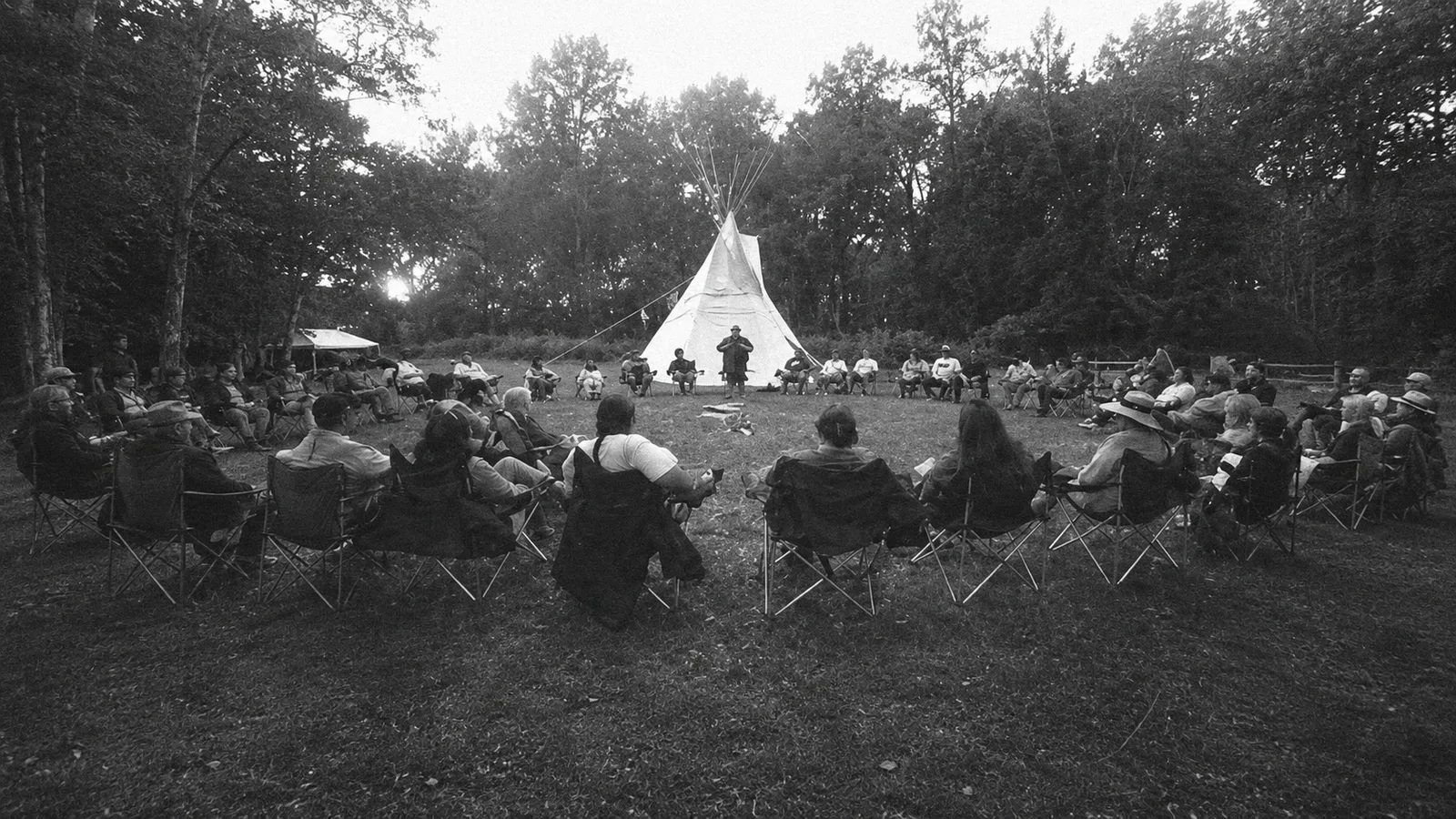
The Talking Circle Teachings were prayerfully passed on by beloved Elders Abe Burnstick, Dakota/Cree, and Eddie Belrose, Cree, at the Sweat House Lodge in Corvallis, Oregon, in 1975. The Sweat House Lodge was the first alcohol and drug treatment center to use the Sweat Lodge as a recognized treatment modality. It was a sacred place of healing, learning, discipline, and spiritual renewal.
At the same time that these beloved Elders shared the Teachings of Talking Circles, they also shared prophecies that are now being fulfilled. One of these prophecies foretold, in remarkable detail, the coming of what we now know as the internet and digital communication. At that time, we could not fully understand what they were speaking about.
The Elders told us that when the “Everywhere Spirit was made physically manifest on Mother Earth,” we should use this sacred gift in a good way. They said that when this time came, we would be able to speak with and see someone on the other side of Mother Earth. They shared other details about digital technology and the internet that we could not comprehend at the time. When I became a Professor at the University of Lethbridge in 1980 and first encountered a mainframe computer, I knew exactly what they had been speaking about.
These Talking Circle Guidelines have been shared for more than 50 years by those who learned at Sweat House Lodge, as well as by other spiritual relatives taught by Uncle Abe and Uncle Eddie. Uncle Abe and Uncle Eddie were themselves taught by Elder Raymond Harris, Eastern Shoshone and Northern Arapaho, from the Wind River Reservation in Wyoming, in the late 1960s.
These Talking Circle Teachings have been shared across Turtle Island and beyond. They are now widely used far beyond Indigenous communities, extending into many sectors of the wider world, including education, healing, justice, organizational development, leadership, and the business community. Time and history will tell this story in greater detail as the Indigenous Healing Movement continues to expand and deepen across Turtle Island, Abya Yala, and beyond.
Written Talking Circle Guidelines
In 1986, these Talking Circle Teachings and Guidelines were shared in writing for the first time through the Four Worlds’ Sacred Tree Curriculum Guide. They are shared below in that spirit of respect, healing, and service.
Talking Circles are important because they create a safe and sacred space where everyone can share their feelings, perspectives, experiences, and wisdom with others. This process helps people build trust, deepen emotional understanding, and strengthen empathy. It also teaches us how to listen from the heart, without judgment, interruption, debate, or the need to correct one another.
The following guidelines help ensure that Talking Circles remain safe places for sharing, listening, reflection, and the exploration of different points of view without criticism or judgment. The process strengthens understanding, appreciation, and respect for perspectives other than our own. Moral and ethical issues can also be raised in a Talking Circle and addressed in ways that prioritize healing over harm.
Whatever is shared in the Circle stays in the Circle. Complete confidentiality is fundamental to the Talking Circle process. Without trust, the Circle cannot fulfill its healing purpose.
People are free to respond however they wish, as long as they follow these guidelines. All comments should be addressed directly to the question or issue being explored, not to comments made by another participant. Both negative and positive comments about what another person has said should be avoided. Each person simply speaks what they need to say in a good way, from the heart.
Only one person speaks at a time. Everyone else listens nonjudgmentally to what the speaker is sharing. Some groups find it useful to have a clear way of indicating who has the floor. Going around the Circle systematically is one way to do this. Another way is to use a sacred or meaningful object, such as a stone, feather, or talking stick, which the speaker holds and then passes to the next person in the Circle.
Silence is an acceptable response. No one should ever be pressured to contribute if they do not wish to share. There must be no negative consequences, however subtle, for saying, “I pass.” Silence can also be a form of prayer, listening, respect, and inner reflection.
At the same time, everyone must feel genuinely invited to participate. Processes should be built in to ensure that a few vocal people do not dominate the discussion. For example, no one speaks twice until everyone in the Circle has had an opportunity to speak once. An atmosphere of patient, nonjudgmental listening usually helps quieter people feel safe enough to speak and helps more vocal participants moderate their sharing.
Going around the Circle systematically, inviting each person to participate simply by mentioning each name in turn, can be an effective way to balance participation. This practice honors every person’s presence and reminds the group that every voice has dignity, whether that voice speaks many words, a few words, or remains silent.
It is often better to hold Talking Circles in groups of five to nine people rather than in one large circle. In smaller groups, everyone has time to say what they need to say without feeling rushed, pressured, or lost in the size of the gathering.
The group leader or facilitator supports the Circle by acknowledging contributions respectfully and nonjudgmentally. This means avoiding comments such as “good comment” or “great,” which may unintentionally create comparison between contributions. When necessary, the facilitator may clarify what has been shared by saying something like, “If I understand what you’re saying, you’re…” This helps deepen understanding without judging the speaker.
No comments that put down others or ourselves are allowed. The group should establish an agreed-upon way of gently signaling the speaker when this occurs. Self-put-downs include comments such as, “I don’t think anyone will agree with me, but…” or “I’m not very good at…” The Circle teaches us to speak with humility, but also with dignity.
Speakers should feel free to express themselves in whatever respectful way feels natural to them. They may share a personal story, use an example or metaphor, offer an analytical reflection, speak from lived experience, or express themselves in any other way that honors the Circle and the people within it.
Some groups have found it helpful to encourage participants to send loving and compassionate feelings toward the speaker consciously. In this way, listeners support the speaker and avoid tuning out or focusing only on what they will say when it’s their turn. This transforms listening into an act of love, prayer, and service.
Source: Excerpted and adapted from The Sacred Tree Curriculum Guide, produced and copyrighted by The Four Worlds International Institute, 1987.
Today, what have often been called “Talking and Healing Circles” continue to evolve into “Circles Around the Fire for Daily Sharing.” These Circles are a key component of the Indigenous Healing Movement across Turtle Island and beyond. They help restore the ancient understanding that healing begins in relationship, in truthfulness, in listening, and in the sacred responsibility we carry for one another.
Among Indigenous peoples globally, two of the most universal archetypes are the Sacred Circle and the Sacred Tree. Both are key symbols and noetic integrators of the Indigenous Healing Movement. The Sacred Circle teaches us wholeness, balance, equality, and relationship. The Sacred Tree teaches us rootedness, growth, the connection between worlds, and the living unity of all life.
Other related Indigenous healing, inter-spiritual, and inter-cultural unity movements, inspired by dedicated, principle-centered, culturally respectful Indigenous spiritual and community leaders, have also been dynamically unfolding with increasing unity across Abya Yala and beyond. I have personally participated in, witnessed, and experienced these Indigenous Healing Movements very closely during the past 58 Winters.
The Talking Circle remains one of the great gifts of Indigenous spiritual and community life. It is not simply a method of communication. It is a sacred discipline of listening, truthfulness, humility, compassion, and collective healing. When practiced well, it helps human beings remember who we are, why we are here, and how we are meant to walk together upon Mother Earth.