
Executive Summary
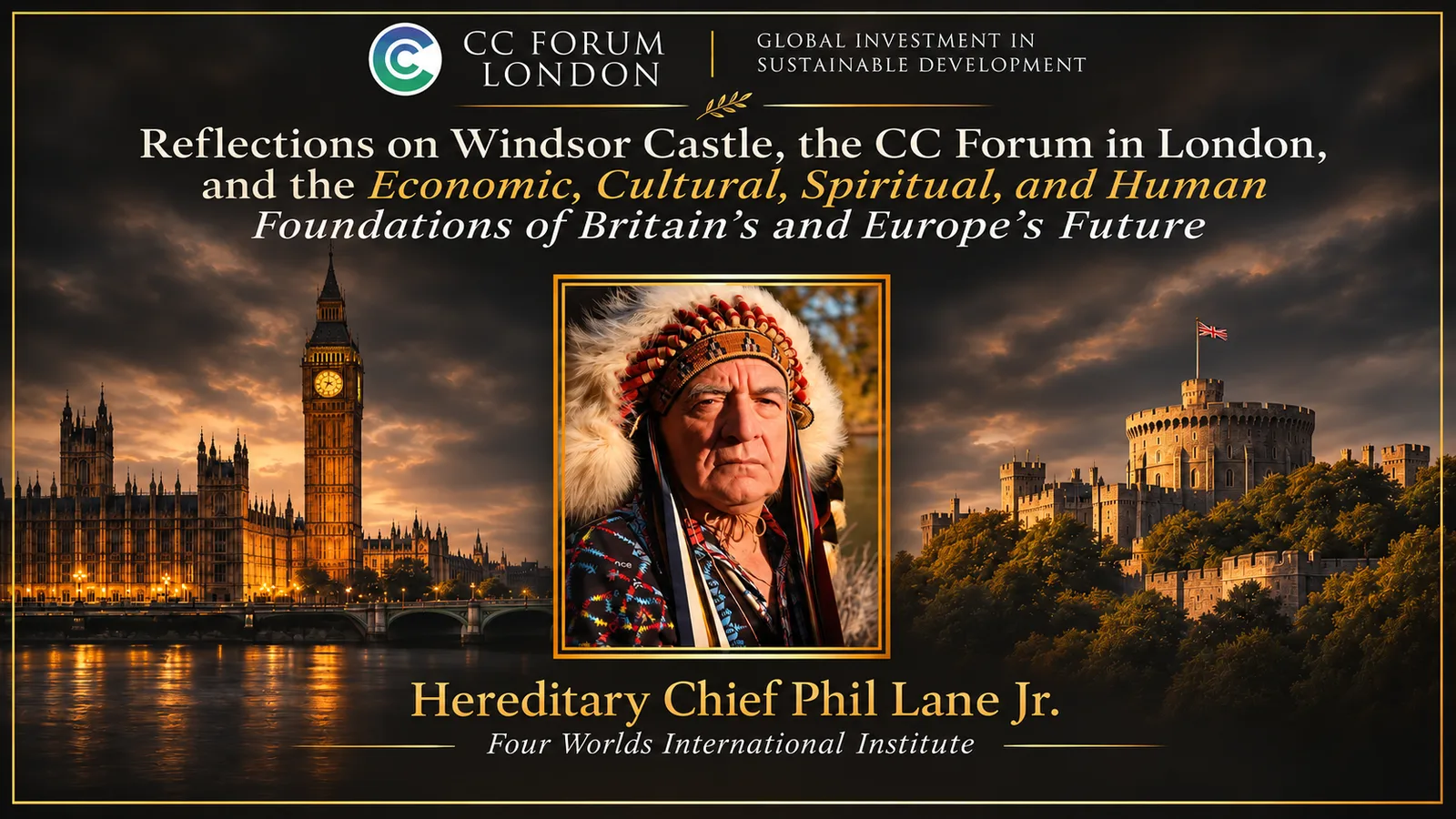
My recent journey to Britain and Europe deepened my appreciation for its extraordinary historical, spiritual, cultural, and human inheritance. At Windsor Castle, particularly St George’s Chapel, and sharing a keynote with world leaders at Georges House, I encountered centuries of traditions honoring dignity, courage, nobility, and sacred responsibility.
‘At the CC Forum in London, where I had the privilege of speaking on the Panel focused on the Challenges of Artificial Intelligence and delivering the keynote on Sustainable Development at the Gala Banquet and Awards Ceremony, I experienced that same spirit of nobility expressed through people sincerely striving to place their knowledge, resources, and influence in service to humanity.
My time with beloved relatives and longtime friends in the Netherlands, in Ceremony and Talking and Consultation Circles regarding the 4th Way Digital Network, the Good Machine, Planetir, and other related developments, further strengthened my gratitude and hope for Europe’s future.
My reflections draw upon more than five decades of experience in human, community, and community-based economic development guided by the Sixteen Guiding Principles of the Four Worlds approach, emphasizing interconnectedness, healing, unity in diversity, meaningful participation, and transformation from within. It also includes a personal history with Europe that began when the Netherlands faced the Great Flood of 1953, when I was 8.
Although I am not a trained economist, I have sought to understand Europe’s economic circumstances through these principles and my lifelong work experience with communities and institutions.
From my perspective, Europe faces three converging economic pressures threatening its long-term independence and prosperity.
First, growing industrial competition and economic dependence on China, reflected in an EU goods trade deficit of nearly €360 billion in 2025, equivalent to approximately €986 million daily.
Second, changing economic relationships with the United States, including tariffs, major energy commitments, and dependence on American digital infrastructure.
Third, continuing energy insecurity and volatile fuel costs that place additional burdens upon industries, households, and governments.
These challenges are compounded by slow economic growth, rising defense expenditures, public debt, demographic changes, and climate-related costs. Energy independence, critical materials, resilient infrastructure, and circular production are likely to remain investment priorities, while industrial communities, education, long-term innovation, ecological restoration, and international development cooperation risk being left behind.
Britain and the European Union possess complementary strengths that can contribute to a more resilient future. Britain’s financial expertise, research capabilities, and policy flexibility, combined with Europe’s industrial capacity and market scale, offer significant opportunities for cooperation in renewable energy, advanced technologies, critical materials, and sustainable development.
The deeper question is whether economic recovery will strengthen the living systems upon which prosperity ultimately depends. Our economy is not the foundation of Mother Earth. Mother Earth is the foundation of our economy. Sustainable investment must therefore be measured not only through financial returns, but through stronger communities, healthier ecosystems, cultural vitality, human dignity, and opportunities for future generations.
Europe is not facing inevitable collapse, but a profound choice about the direction of its future. Its greatest opportunity is to demonstrate that economic strength, environmental regeneration, social justice, cultural diversity, and international cooperation can reinforce one another.
Ultimately, sustainable investment is not simply about where we place our capital. It is about the kind of future we choose to create, the kind of relationships we are willing to build, and the kind of ancestors we will become.
Seeking First to Understand Before Seeking to Be Understood
Throughout my life, I have learned that sustainable transformation begins with listening, establishing relationships of trust, and recognizing the strengths already present within individuals, communities, and nations. We must seek first to understand before seeking to be understood, particularly when engaging with peoples whose histories, cultures, and circumstances differ from our own.
In this spirit, I prepared for my European journey. Before traveling, I devoted considerable time to studying the economic, political, environmental, and social challenges facing the people I would meet. I wanted to understand the circumstances surrounding the conversations on sustainable development, investment, and the future of Europe.
Having now experienced these gatherings, I find myself reflecting not only upon the economic difficulties confronting Europe, but also upon the remarkable human qualities I encountered. What inspired me most was the dignity, generosity, sincerity, and sense of responsibility expressed by so many people who were seeking constructive ways to contribute to humanity’s future.
These experiences reaffirmed something I have learned through decades of work with Indigenous communities and peoples worldwide. The greatest possibilities for positive transformation already exist within people themselves, and our responsibility is to help create the conditions through which those capacities can be brought into united action.
From this perspective, Europe’s present circumstances must be understood as more than an economic challenge. They represent an opportunity to strengthen relationships, renew a shared vision, and put the extraordinary capacities of its peoples to work for a more peaceful, just, and sustainable world.
Three Converging Economic Pressures: Britain’s Distinctive Challenges and Europe’s Shared Future
Britain and the European Union are confronting three powerful economic pressures that are reshaping their prospects for sustainable development: China’s expanding industrial strength, changing economic relationships with the United States, and continuing energy insecurity. Although these pressures affect both Britain and continental Europe, their consequences are not identical. Britain’s economic structure, international financial relationships, energy resources, and independent trade policies create distinctive opportunities as well as particular vulnerabilities.
Understanding these differences is essential. Britain is not simply a smaller version of the European Union, nor can the economies of continental Europe be treated as though they share identical circumstances. Their industrial strengths, investment relationships, energy systems, and institutional arrangements differ considerably. Yet their futures remain interconnected, and these differences offer important opportunities for cooperation when approached through a shared commitment to sustainable development.
China: Industrial Competition, Investment, and the Future of Economic Independence
China’s extraordinary advances in manufacturing, infrastructure, scientific research, and technological innovation have transformed the international economy. These achievements deserve recognition, yet they also present substantial competitive pressures for European industries, particularly in manufacturing sectors that have historically provided employment, economic stability, and technological leadership.
According to Eurostat, in 2025 the European Union imported approximately €559.4 billion in goods from China while exporting €199.6 billion, producing a trade deficit approaching €360 billion. This represents an average imbalance of approximately €986 million every day, or nearly one billion euros daily. These figures do not mean that the money is simply disappearing from Europe, since imports provide valuable goods, technologies, and equipment. Nevertheless, the magnitude of the imbalance raises serious questions about industrial competitiveness, productive independence, and the long-term future of European manufacturing.
These pressures are particularly visible in Germany, whose automotive, engineering, machinery, and advanced manufacturing industries have long been among the foundations of European prosperity. Germany’s Federal Employment Agency reported that manufacturing employment declined by approximately 177,000 jobs during 2025. Behind these figures are workers, families, communities, and generations of accumulated industrial knowledge that cannot easily be replaced once lost.
Britain faces a related but distinctly different challenge. While Germany and other continental European economies depend heavily upon industrial manufacturing, Britain possesses particular strengths in international finance, higher education, professional services, scientific research, and investment. These capacities provide important opportunities for cooperation with China, even as British manufacturing industries face increasingly sophisticated international competition.
In the twelve months ending June 2026, total trade between Britain and China reached approximately £108.9 billion. Britain imported £74.3 billion in goods and services while exporting £34.6 billion, producing a trade deficit of approximately £39.8 billion. Significantly, Britain recorded a substantial deficit in manufactured goods but maintained a services surplus of approximately £10.5 billion, illustrating the competitiveness of its educational, financial, and professional sectors.
The investment relationship is also important. At the end of 2024, officially recorded British direct investment in China stood at approximately £16.5 billion, compared with £2.5 billion in Chinese direct investment in Britain. Although these figures do not necessarily capture investment routed through intermediary jurisdictions, they demonstrate that the relationship involves British enterprises investing in China as well as Chinese investment entering Britain.
Britain has also sought to strengthen these economic connections. During Prime Minister Keir Starmer’s visit to China in January 2026, new export agreements, prospective market-access improvements, and investment commitments were announced. These developments illustrate an effort to expand economic opportunities while managing concerns about sensitive technologies, strategic infrastructure, national security, and growing economic dependence.
The central challenge for both Britain and the European Union is therefore not whether to cooperate with China, but how to ensure that cooperation strengthens their own productive capacities while contributing to mutual prosperity. China’s industrial and technological achievements are considerable, while Britain and Europe possess complementary strengths in finance, scientific research, education, advanced technology, and industrial innovation.
International trade and investment should strengthen the independence, productive capacities, and long-term well-being of participating societies rather than creating relationships of increasing vulnerability or dependence. From my perspective, genuine economic cooperation must be grounded in reciprocity, transparency, fairness, and an understanding that prosperity is most sustainable when its benefits are shared.
The United States: Britain’s Special Economic Relationship and Europe’s Changing Transatlantic Partnership
Britain’s relationship with the United States presents a different set of opportunities and challenges. The transatlantic relationship has long been central to Britain’s economic development, international investment, scientific collaboration, and security. However, Britain’s circumstances differ significantly from those of the European Union, particularly following its departure from the EU and the establishment of independent trade arrangements.
The economic relationship between Britain and the United States is exceptionally important. During the twelve months ending June 2026, total trade between the two countries reached approximately £338.5 billion, with Britain recording a trade surplus of £72.4 billion. This surplus was overwhelmingly generated through services, reflecting Britain’s considerable strengths in international finance, professional expertise, technology, and other high-value activities.
American investment is also deeply embedded within the British economy, supporting businesses, employment, scientific research, and technological development. These relationships provide substantial opportunities, particularly for Britain’s financial institutions, universities, and innovative enterprises. At the same time, they expose Britain to changes in American trade policy, investment priorities, technological regulation, and the concentration of digital infrastructure within major international corporations.
Britain has negotiated its own trade arrangements with the United States, including preferential treatment in certain sectors. These arrangements have provided some advantages relative to the European Union, where many exports face a general tariff framework of approximately 15 percent. Nevertheless, British exporters remain exposed to tariffs, changing regulations, and uncertainty concerning future American economic policies.
The European Union confronts these challenges from a different position. Its much larger integrated market provides considerable negotiating capacity, but its industrial economies are deeply affected by tariffs, changing supply chains, and investment decisions. The transatlantic trade framework announced in 2025 also envisaged substantial European purchases of American energy products and additional European corporate investment in the United States. The announced intentions included approximately $750 billion in energy purchases through 2028 and expectations of $600 billion in additional European investment, although these figures represented prospective commitments rather than completed transactions.
Both Britain and the European Union also depend heavily upon American companies for cloud computing, digital platforms, artificial intelligence infrastructure, and important technological services. These relationships offer enormous benefits, but they raise legitimate questions about data sovereignty, cybersecurity, technological independence, and the concentration of economic influence.
The United States remains an essential partner for Britain and Europe, and continued cooperation offers substantial opportunities for scientific advancement, investment, technological innovation, and economic prosperity. Yet a healthy partnership requires balance, mutual respect, and the capacity of each participant to make decisions in accordance with its legitimate interests.
Britain’s challenge is to preserve the advantages of its close relationship with the United States without allowing excessive dependence to constrain its own economic choices. Europe’s challenge is similar, but is shaped by its larger industrial economy, collective trade arrangements, and the diverse interests of its member nations.
From an Indigenous perspective, the underlying principle remains the same: sustainable relationships must be founded upon reciprocity rather than domination or dependency. International investment should strengthen the communities, industries, scientific capacities, and future opportunities of all participating peoples.
Energy Security: Britain’s Particular Vulnerabilities and Europe’s Shared Opportunity
Energy represents the third major economic pressure, connecting international relationships directly to industrial competitiveness, household well-being, environmental sustainability, and national resilience. Although Britain and the European Union share exposure to global energy markets, their resources, infrastructure, and vulnerabilities differ in important ways.
Following the war in Ukraine in 2022, European nations undertook substantial efforts to reduce dependence on Russian natural gas. These adjustments demonstrated considerable capacity for cooperation and adaptation, but they also increased reliance on alternative international suppliers, including Norway and the United States. In 2025, American suppliers provided approximately 58 percent of the European Union’s liquefied natural gas imports, illustrating both the achievement of diversification away from Russia and the emergence of new concentrations of dependence.
Britain’s energy circumstances are distinctive. Its domestic North Sea oil and gas resources, extensive pipeline connections with Norway, and established energy infrastructure provide advantages not shared equally by continental European countries. Yet declining domestic production, continuing dependence on imported natural gas, and exposure to international energy prices create substantial vulnerabilities.
Britain also faces a particularly serious challenge concerning industrial electricity costs. Electricity prices for major industrial users have been considerably higher than those in many comparable European economies, affecting manufacturing competitiveness, business investment, employment, and opportunities for industrial expansion. Even where Britain possesses exceptional scientific and technological capacities, expensive energy can undermine the practical development of these strengths.
At the same time, Britain has made remarkable progress in renewable electricity generation, particularly through wind power. Renewable sources accounted for approximately 52.5 percent of British electricity generation in 2025. These advances, together with Britain’s North Sea infrastructure and electricity connections with continental Europe, create important opportunities for energy storage, offshore renewable development, grid modernization, and international cooperation.
The European Union possesses complementary strengths, including substantial nuclear power capacity, hydroelectric resources, solar generation, industrial infrastructure, and an extensive interconnected electricity market. Its member nations have different energy systems, but coordinated investment and cross-border cooperation can help reduce vulnerabilities while strengthening economic resilience.
The continuing instability of international energy markets, including disruptions associated with conflicts affecting major transportation routes such as the Strait of Hormuz, demonstrates how quickly geopolitical events can influence production costs, household expenses, and public budgets. Higher energy prices can weaken industrial competitiveness precisely when governments are already confronting slow growth, increasing defense expenditures, and substantial demands for public services.
The fundamental challenge is therefore not simply to secure alternative supplies of oil and natural gas. It is to develop energy systems that are increasingly secure, affordable, diversified, environmentally responsible, and capable of supporting the long-term well-being of communities and industries.
Britain and Europe have significant opportunities to cooperate in achieving these objectives. Their complementary scientific capabilities, investment resources, industrial capacities, and renewable-energy potential can contribute to a more resilient future, provided the benefits of development extend beyond immediate financial returns.
Bringing These Three Challenges into a Shared Vision of Sustainable Development
Although the economic pressures arising from China, the United States, and energy insecurity are distinct, their consequences are deeply interconnected. Industrial competition influences employment, productive independence, and technological innovation. Changing international trade and investment relationships affect economic security and freedom of decision-making. Energy costs shape the competitiveness of industries, the financial stability of households, and the resources available for education, healthcare, infrastructure, and environmental protection.
These challenges cannot be addressed effectively through isolated policies or by treating Britain and the European Union as though their circumstances were identical. Britain’s strengths in international finance, scientific research, education, and professional services differ from the industrial scale and manufacturing capabilities of continental Europe. Their energy systems and trade arrangements also present different opportunities and constraints.
Yet these differences need not become barriers to cooperation. Britain’s financial expertise and international networks, combined with Europe’s industrial capacity, research institutions, and extensive markets, could provide powerful foundations for shared sustainable development.
My experiences at the CC Forum in London strengthened my conviction that many of the human and institutional capacities necessary for such transformation already exist. I encountered extraordinary individuals bringing together financial resources, scientific knowledge, entrepreneurial initiative, technological creativity, and a sincere commitment to addressing some of humanity’s most urgent challenges.
What impressed me most was not simply the sophistication of their innovations or the scale of the resources available to them. It was the dignity, generosity, sense of responsibility, and willingness to cooperate that I experienced in my relationships with so many of those present. These qualities provide the human foundations through which economic and technological capacities can become instruments of positive transformation.
From the perspective of the Sixteen Guiding Principles of the Four Worlds approach, sustainable development must be understood as an integrated process involving economic prosperity, social well-being, cultural vitality, environmental stewardship, and spiritual responsibility. These dimensions cannot be separated without weakening the living systems upon which enduring prosperity depends.
Our economy is not the foundation of Mother Earth. Mother Earth is the foundation of our economy.
The ultimate purpose of economic development must therefore extend beyond increasing trade volumes, attracting investment, or strengthening industrial competitiveness. These are important means, but they are not ends in themselves. Their deeper value lies in whether they strengthen communities, develop human capacities, protect the natural world, and create meaningful opportunities for future generations.
Britain and Europe possess different but complementary strengths, and their economic challenges offer opportunities to bring those capacities into constructive relationships. Through reciprocity, responsible investment, scientific innovation, meaningful participation, and a clear shared vision, they can help advance a model of sustainable development that strengthens economic independence while contributing to the well-being of the whole human family.
The challenge before Britain and Europe is not simply how to compete more effectively in a changing world. It is how to use their extraordinary resources, knowledge, and human capacities to help create a world in which prosperity, justice, dignity, and the health of Mother Earth strengthen one another.
The Fiscal Squeeze: When Everything Becomes a Competition for Resources
Taken together, these three pressures create a difficult economic environment. Europe faces growing industrial competition from China, changing economic arrangements with the United States, and energy costs increasingly influenced by geopolitical instability.
At the same time, governments must respond to demands for defense, pensions, healthcare, education, infrastructure, and climate adaptation. When economic growth slows, and public revenues are constrained, these priorities increasingly compete for limited resources.
The consequences are felt most directly by ordinary people. Workers worry about their jobs, families face higher living costs, young people question their opportunities, and communities become increasingly concerned about their future.
These conditions can contribute to growing political polarization and declining confidence in established institutions. When people feel that economic transformation is occurring beyond their control, frustration and distrust can become powerful forces.
From the perspective of the Four Worlds approach, we cannot understand these economic challenges in isolation from their human consequences. An economy is not simply a collection of financial transactions; it is part of the living relationships through which people, communities, and nations sustain themselves.
This is why sustainable development must remain central rather than becoming something governments consider only when resources are plentiful.
Migration, Cultural Diversity, and the Spiritual Challenge of Europe’s Changing Human Family
Beyond its economic challenges, Britain and Europe are experiencing a profound transformation in the composition of their societies. Migration, demographic change, international conflict, economic inequality, and the consequences of environmental disruption are bringing together peoples, cultures, languages, and spiritual traditions in ways that are reshaping the character of European communities.
These developments present substantial challenges, but they also carry extraordinary possibilities for the evolution of human relationships.
This transformation has a remarkable historical dimension. For centuries, European powers extended their influence throughout Africa, Asia, the Americas, the Pacific, and other regions of the world, establishing political, economic, and cultural relationships that profoundly affected Indigenous peoples and colonized nations. Today, many descendants of those historically connected populations live in Britain and other European countries. In a certain sense, the human relationships established through centuries of colonial expansion have come home to Europe, bringing with them both the unfinished responsibilities of history and new possibilities for mutual understanding.
Of course, contemporary migration arises from many circumstances, and not all migration can be understood through colonial history. People move to seek employment, education, family reunification, safety, and opportunities for a better life.
Others are displaced by armed conflict, political persecution, economic hardship, and environmental disasters. Climate change increasingly affects livelihoods and contributes to displacement, although most climate-related movement still occurs within countries or neighboring regions.
These changing populations bring valuable knowledge, cultural traditions, skills, entrepreneurial capacities, and human relationships. At the same time, rapid demographic change can place real pressure on housing, employment, education, healthcare, public infrastructure, and communities’ ability to accommodate newcomers successfully. Differences in language, religious traditions, historical experiences, and social expectations can also create misunderstandings, particularly when economic insecurity and political polarization are already present.
These challenges cannot be resolved through financial calculations, immigration regulations, or administrative policies alone. Such measures are necessary, and governments have legitimate responsibilities to maintain fair and effective immigration systems, provide essential services, and uphold the rights and responsibilities of everyone within their societies. Yet sustainable solutions also require a deeper transformation in how human beings understand their relationships with one another.
Climate change makes this responsibility even more urgent. As droughts, floods, rising seas, extreme heat, and declining agricultural productivity affect vulnerable communities, more people may face difficult decisions about whether they can remain in their ancestral homelands.
The consequences will not be distributed equally, and the poorest communities often possess the fewest resources to adapt or relocate. Europe, together with the wider international community, must therefore consider not only how to respond to displacement, but also how to strengthen the conditions that allow people to live safely and with dignity in their own homelands.
From an Indigenous perspective, the deeper challenge is spiritual as well as economic and political. We must learn to recognize our unity as members of one human family while respecting the extraordinary diversity of cultures, languages, histories, and spiritual traditions through which humanity expresses itself. Unity does not require people to abandon their identities, nor does cultural diversity eliminate the need for shared responsibilities, mutual respect, and common principles of community life.
This is where I believe the Sixteen Guiding Principles of the Four Worlds approach offer important insights. Lasting transformation requires healing historical relationships, building trust, creating opportunities for meaningful participation, and strengthening communities’ capacity to work together. These processes must include both established populations and newcomers, recognizing that genuine integration is a shared responsibility requiring mutual understanding, respect, and a commitment to the common good.
Britain and Europe are therefore confronting something much greater than a challenge of population management. They are being invited to develop new expressions of human community that embrace cultural diversity without losing social cohesion, maintain legitimate national responsibilities without abandoning compassion, and recognize historical injustices without becoming imprisoned by them.
The greatest opportunity lies in moving beyond the question of how different peoples can simply live alongside one another to discovering how they can learn from one another, strengthen one another, and build a shared future.
I believe this will require a profound evolution in human consciousness, grounded in dignity, reciprocity, justice, and the recognition of our fundamental interconnectedness. The scientific, financial, and technological resources available to Europe can help address the material dimensions of these challenges. Still, their lasting resolution will depend upon the qualities of character, relationships, and collective responsibility that guide their use.
Our Indigenous ancestors have long reminded us that the human family is part of a much larger circle of relationships, connecting all peoples, with Mother Earth, and with generations past and future. As Britain and Europe navigate these extraordinary changes, this understanding may become one of the most important foundations for building societies that are not only economically resilient, but also culturally vibrant, spiritually mature, peaceful, and genuinely inclusive.
What Will Continue: Investment in Security and Resilience
Despite these pressures, several areas of sustainable investment are likely to maintain strong political and financial support.
Energy security will remain a major priority. Renewable power, electricity grids, energy storage, efficiency improvements, and other reliable energy technologies can reduce dependence on imported fuels while strengthening European economic resilience.
Critical minerals, refining, recycling, and material recovery will also attract attention as Europe seeks to secure the resources modern industries require. Investment in the circular economy, which reduces waste and keeps valuable materials in productive use, offers important opportunities to strengthen both industrial competitiveness and environmental sustainability.
Resilient infrastructure, secure communications, transportation systems, and supply chains will likewise remain essential. Investments that contribute simultaneously to economic stability, environmental protection, and legitimate security needs are likely to receive particular attention.
What is changing is the way these investments are understood. Sustainability is increasingly becoming an essential part of economic security rather than a separate environmental consideration.
This is an important opportunity. When sustainable investment reduces costs, strengthens communities, creates meaningful employment, and protects natural systems, it can contribute directly to Europe’s economic recovery.
What Risks Being Left Behind: The Human and Ecological Foundations of Prosperity
A primary concern is not simply which industries will receive investment, but which people, communities, and essential dimensions of development may be neglected as financial pressures intensify.
Industrial workers and manufacturing communities are particularly vulnerable. When factories close, or employment opportunities disappear, the damage extends far beyond lost income, including weakened families, declining community confidence, and the erosion of skills developed over generations.
Long-term scientific research, education, technological innovation, and digital independence may also be threatened because their full benefits often require patient investment. Yet these are precisely the capacities that will determine where future prosperity is created.
Ecological restoration, biodiversity protection, watershed management, and climate adaptation may likewise be postponed when governments face competing demands. Unfortunately, the natural systems on which our economies depend do not operate on political or financial cycles.
I am also concerned about the consequences for developing nations and historically marginalized peoples. As Britain and Europe face increasing pressures to direct investment inward, international development cooperation and climate finance may become more vulnerable, even where modest investments could create extraordinary long-term benefits.
When resources become scarce, the danger is that we protect what is immediately profitable while neglecting what is fundamentally necessary for life.
This is where I believe an Indigenous understanding of development becomes especially relevant. Healthy communities, functioning ecosystems, meaningful relationships, and opportunities for future generations are not optional benefits to be considered after economic growth has been secured. They are among the foundations that make enduring prosperity possible.
Britain and the European Union: Different Strengths, a Shared Opportunity
Britain and the European Union face many of these same challenges, although they approach them from different economic and political positions.
Britain possesses considerable strengths in finance, scientific research, higher education, technology, and international investment. London remains an important global center for mobilizing capital, while Britain has greater flexibility to develop certain national policies outside the European Union’s institutional structures.
The European Union possesses the scale of a common market of approximately 450 million people, substantial industrial capabilities, and opportunities for coordinated investment across many nations. Its collective strength can provide advantages that individual European countries would find difficult to achieve alone.
Yet both Britain and the European Union remain exposed to energy price shocks, international competition, technological dependence, and growing public expenditure demands. Their future prosperity will increasingly depend upon how effectively they use their complementary strengths.
There are important opportunities for cooperation in North Sea renewable energy, electricity systems, critical materials, research, advanced technology, and environmental protection. These areas offer practical ways to strengthen resilience while creating new opportunities for innovation and sustainable growth.
Britain’s flexibility and financial expertise, combined with Europe’s industrial capacity and market scale, could become a powerful foundation for shared sustainable development.
From the perspective of the Sixteen Guiding Principles, unity does not require uniformity. Distinct nations can maintain their identities and legitimate independence while developing relationships through which their different strengths become mutually reinforcing.
The Deeper Question: What Are We Really Investing In?
Throughout my time in Europe, one understanding remained central to my reflections:
Our economy is not the foundation of Mother Earth. Mother Earth is the foundation of our economy.
Every economy ultimately depends upon the living systems of our planet. Our food, water, energy, materials, industries, and technologies arise from resources and relationships that exist within the natural world.
Yet economic development is too often measured primarily through financial growth, without equal consideration of ecological health, human dignity, cultural vitality, and the well-being of future generations.
The Sixteen Guiding Principles of the Four Worlds approach remind us that sustainable development must encompass the whole person, the whole community, and the larger systems of life. Economic prosperity, social well-being, cultural integrity, spiritual development, and environmental protection must be understood as interconnected dimensions of one process.
This requires investors and governments to ask questions extending beyond immediate financial returns. Does an investment strengthen local communities, develop human capacities, protect ecological systems, create meaningful employment, and leave future generations with greater opportunities?
It also requires recognizing that a sustainable transition cannot be accomplished for people without being accomplished with people. Meaningful participation, consultation, and shared ownership are essential if communities are to support and sustain the changes affecting their lives.
The greatest opportunities may therefore lie not simply in financing individual technologies or projects, but in strengthening the living systems that make lasting prosperity possible.
My Reflections for Investors and Leaders
As I bring these observations together, I believe Europe’s circumstances call for a more integrated approach to sustainable investment.
Investors should recognize the growing importance of energy independence, industrial resilience, critical materials, technological innovation, and circular production. These areas respond to immediate economic realities and offer important opportunities for long-term development.
But they must not abandon the human and ecological foundations upon which lasting prosperity depends. Communities experiencing industrial decline, young people seeking meaningful futures, vulnerable populations, developing nations, and the living systems of Mother Earth must remain central to our understanding of progress.
Britain and the European Union have an opportunity to combine their distinctive strengths, while Europe as a whole can deepen cooperation with partners worldwide. This includes transforming historical relationships with Indigenous peoples and formerly colonized nations into more just, reciprocal, and mutually beneficial partnerships.
Above all, I would encourage greater attention to long-term vision and patient investment. When uncertainty causes everyone to think only about immediate survival, the greatest responsibility of leadership is to protect the possibilities of the future.
This is not simply a financial responsibility. It is a moral, social, environmental, and spiritual responsibility to those living today and to generations yet unborn.
A Closing Reflection: Europe’s Greatest Resource Is Its People
Having spent time with such remarkable people at Windsor Castle, the CC Forum, and in the Netherlands, I remain deeply encouraged by Europe’s possibilities. The dignity, generosity, intellectual capacities, and sincere aspirations I experienced reminded me that the qualities necessary for positive transformation already exist within its peoples.
Europe also possesses an extraordinary diversity of nations, cultures, languages, traditions, and historical experiences. Its achievements in cooperation demonstrate that deeply different peoples can learn to work together without surrendering their identities, and this is one of its greatest strengths in responding to present challenges.
I do not see Europe’s future as one of inevitable collapse. I see a continent confronting serious economic pressures that could gradually erode its independence and productive capacities if they are not addressed with wisdom, cooperation, and a clear vision of sustainable development.
The decisions made over the next several years will help determine whether sustainability becomes a foundation of European renewal or one of the first casualties of economic uncertainty.
But I believe the deeper opportunity is much greater than economic recovery alone. Europe can help demonstrate that prosperity does not have to come at the expense of human dignity, cultural diversity, social justice, or the natural world. It can show that economic security and environmental regeneration, supported by healthy communities and meaningful international cooperation, can strengthen one another.
The people I encountered during my journey gave me genuine hope that this larger vision is possible. What remains is to bring these capacities together through a shared commitment to the well-being of the whole human family.
Ultimately, sustainable investment is not simply about where we place our capital. It is about the kind of future we choose to create, the relationships we are willing to build, and the ancestors we will become.
Mitákuye Oyás’iŋ — We Are All Related.
These reflections offer an Indigenous perspective on Europe’s economic and social challenges, informed by personal experience, the Sixteen Guiding Principles of the Four Worlds approach, and published economic research. They are intended to encourage consultation and shared learning, not to provide professional economic or investment advice.