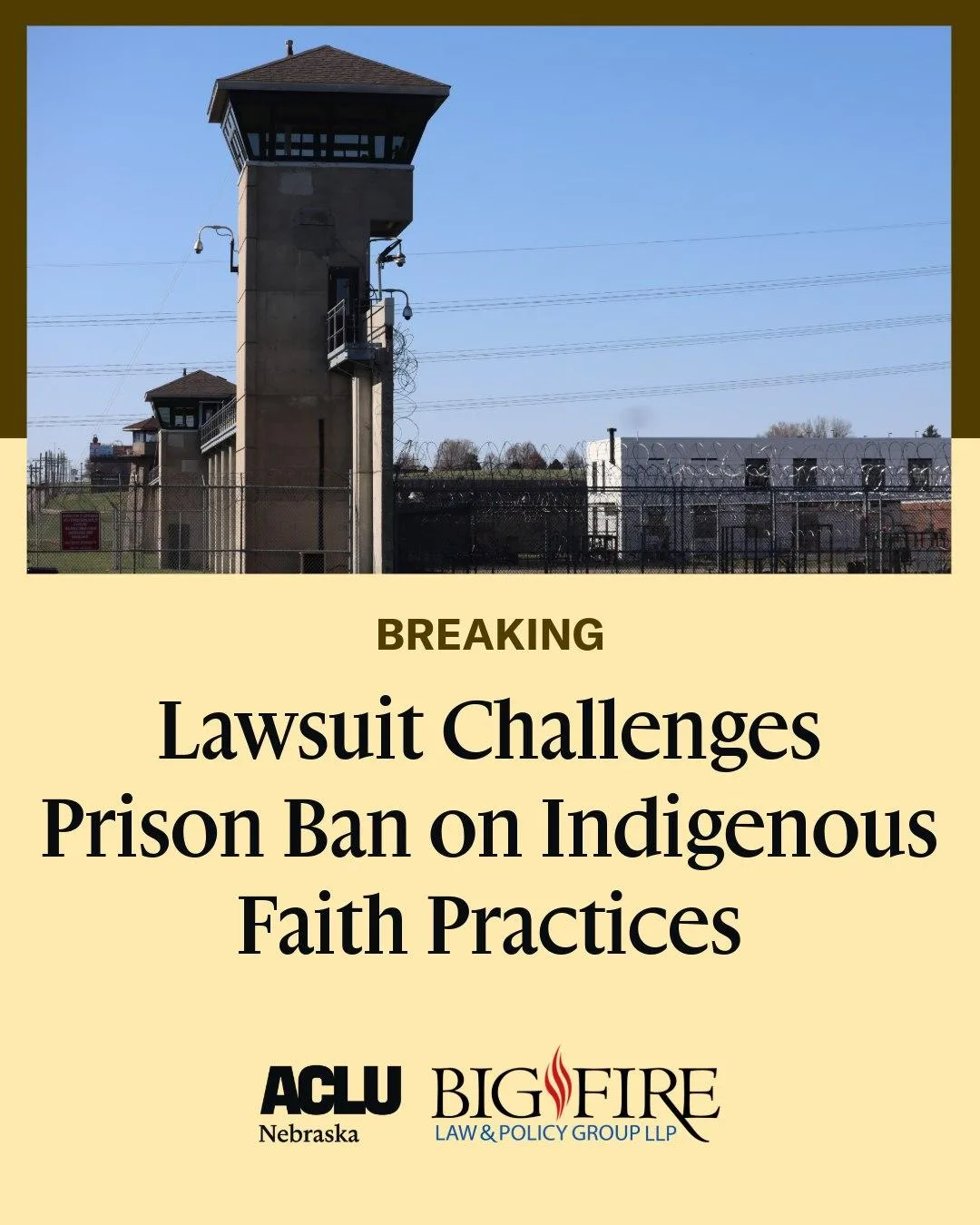
An Affirmation of Sacred Freedom: Standing with Our Relatives in Confinement in Nebraska.
There are moments when a society must look deeply at itself—not through the lens of law alone, but through the measure of its spirit. What is happening to our Indigenous relatives at the Nebraska State Penitentiary is one of those moments.
At the foundation of the United States stands the promise of freedom—among the most sacred of these is the freedom of belief, protected by the First Amendment to the United States Constitution. This protection is not conditional. It does not disappear at the prison gate. It does not belong only to the majority. It belongs equally to all human beings, including those who are incarcerated.
The Constitution makes this clear: the government shall not prohibit the free exercise of religion. And yet, when Indigenous men are denied access to the only place where they can pray in their own way—through smudging, through the sacred pipe, through the sweat lodge—then something deeper than policy is being broken. The spirit of the law itself is being wounded.
This is why Congress enacted the Religious Land Use and Institutionalized Persons Act (RLUIPA)—to ensure that even within institutions of confinement, the human spirit would not be confined. This law sets a high standard: the state may not impose a substantial burden on religious practice unless it is the least restrictive means of achieving a compelling interest. A blanket ban on Indigenous ceremonies—especially when those affected are not responsible for any alleged wrongdoing—fails this test in both law and conscience.
In addition, the American Indian Religious Freedom Act affirms what Indigenous peoples have always known: that our ceremonies are not optional. They are essential. They are the breath of our identity, the pathway of healing, the connection between the physical and the spiritual worlds.
Those who have worked within correctional systems understand something that policy alone often forgets: true rehabilitation is not achieved through punishment alone, but through transformation. And transformation comes from within.
Across many institutions, Indigenous ceremonies have proven to be among the most powerful sources of healing and renewal. The sweat lodge is not simply a ritual—it is a place of purification, humility, and rebirth. Smudging is not merely symbolic—it is a way of clearing the mind and heart, restoring balance, and reconnecting to a higher purpose. These practices guide individuals away from destructive paths and toward responsibility, dignity, and a good way of life.
To remove these ceremonies is not to create order—it is to remove one of the very tools that fosters it.
Imagine, as was rightly said, if Christian inmates were told that they could no longer gather for prayer, sing hymns, or read the Bible because of an incident they had no part in. Such a restriction would be unthinkable. Yet this is precisely what is being imposed upon Indigenous men.
This is not equality. This is not justice. This is a failure to honor the very principles the Constitution was meant to uphold.
But beyond law, there is a deeper truth—one that Indigenous peoples have carried across generations. Our spiritual ways are not separate from our lives. They are the foundation of who we are. They teach us how to walk in balance, how to take responsibility, how to heal ourselves so that we do not harm others. In places where despair can take root, these ceremonies bring light. In places of isolation, they restore connection—to self, to community, and to the Great Mystery.
To deny these practices is to deny the possibility of healing.
And so we must say clearly: this ban is not only a legal violation—it is a moral one. It contradicts the promise of religious freedom. It undermines the purpose of rehabilitation. And it disregards the sacred humanity of those who are seeking to walk a better path.
The men who have brought this forward are not asking for privilege. They are asking for what is already theirs by right—the freedom to pray, to heal, and to live according to their sacred traditions.
A just society does not fear its people's spiritual strength. It nurtures it.
And in honoring these ceremonies, we do more than uphold the Constitution—we uphold the deeper law that binds all human beings: that every person deserves the chance to heal, to grow, and to return to the circle of life in a good way.