
My Beloved Relatives,
I want to thank Professor Jeffrey Sachs for the beautiful sharing he offered at the House of Lords on October 27, 2026, during the CC Forum here in London. Speaking to people entrusted with considerable wealth and influence, he began with a child. If we want to know where an investment can do the most good, he told us, help a child get a good education. I was touched that, in a room where he could have begun with any great institution of the world, he asked us first to think about the future of one young person.
Professor Sachs spoke of what our Human Family must learn to achieve together. People everywhere should be able to live in prosperity, be treated fairly, enjoy a healthy natural world, and live in peace. He welcomed the fact that hundreds of millions of people in China had been able to leave poverty behind. Why should a family finding its way out of poverty in one country be cause for fear in another? I share his conviction that the well-being of one people can contribute to the well-being of all. Diplomacy gives us a way to act on that understanding, and every dollar we devote to the work of peace can accomplish something that war never will.
Professor Sachs described six great transformations that can bring this vision within reach. I want to share all six, in the order he gave them, and what I hear in them from my own experience. I would like to offer a seventh.
The first transformation is education for all. Professor Sachs spoke of the extraordinary capacity of the human mind and of the young people in our universities who are eager to do something of consequence with what they are learning. I think also of a child learning the name of a river in her own language and hearing from her grandmother what that name means. When she goes to school, that knowledge should have a place there. Imagine what becomes possible when she can bring the questions she learned to ask at home into a science classroom, and bring what she learns there back to her people.
The second transformation is health care for all. Professor Sachs spoke about his wife Sonia’s years of work in public health and what she and her colleagues witnessed in some of the poorest communities in the world. Modest investments, wisely directed, could save lives and give people the opportunity to live out their years. For me, this is also a question of who can be there when a family needs help. A community needs skilled health workers it can count on, care close enough to reach, and people who understand its language and ways. Our Elders have taught us to care for the whole person, including the grief a person carries and the relationships that give them the strength to heal.
The third transformation is the transition to clean energy. Professor Sachs acknowledged what coal, oil, and gas made possible during the industrial age and spoke plainly about the warming that burning them brings. Then he offered a story from his own life. He and his wife Sonia had traveled some 15,000 kilometres in electric vehicles from Rome to Hong Kong. Their drivers knew where to charge along the way, and along the road they saw solar fields and wind turbines. That journey gave a human scale to his point. Much of what we need is already working somewhere. The challenge for those directing investment is to help it reach more people, more quickly.
The fourth transformation concerns agriculture, forests, and the way we care for the land. Professor Sachs described farmers in Uttar Pradesh learning to use drones to put fertilizer more precisely where their crops needed it. He also asked us to understand something about a rainforest that is easy to overlook on a map.
Water rises from the trees and travels through the air to fall again as rain farther on. When part of a forest is cleared, the consequences reach trees, farms, and communities far beyond the clearing. To my ears, this is a teaching about relationship. A decision made on one piece of land can change whether rain comes to a relative who lives downwind.
The fifth transformation is to build cities where people can live well. Professor Sachs asked us to think ahead to the great numbers of people who will make their homes in the growing cities of Africa and Asia. Decisions about housing, water, public transportation, green space, and safety will shape daily life for generations. I would begin the planning with a grandmother and a young parent who live there. Can the grandmother reach her clinic? Can the children get to school safely? Can the family afford a home near the people they depend on? The answers would tell an investor a great deal about what that city needs.
The sixth transformation is to guide digital technology and artificial intelligence wisely. Professor Sachs questioned the judgment of people who acknowledge that a technology could endanger humanity and then hurry to bring it to market. He called for responsible governance. He also offered a possibility I find especially hopeful. He had encouraged young leaders to organize a global youth assembly online, deliberate together across national boundaries, and carry their own proposals to the United Nations. I can imagine what that would mean for a young person in a remote community who has something to say about the future of their homeland. For that young person, the promise of digital communication is fulfilled when someone on the other end listens, answers, and acts.
The seventh transformation I would add is to recognize and support Indigenous Peoples as self-determining Nations and as leaders in the care of Mother Earth. This belongs within every one of the six transformations. Our relatives have knowledge to contribute to education, healing, energy, food, the design of human settlements, and the wise use of technology. We also have decisions of our own to make. A Nation must be free to choose what happens on its lands and waters, what knowledge it wishes to share, and what future it wants for its children.
I think back to 1968 on Standing Rock, when an Elder asked my grandfather what scientists meant by the word ecology. My grandfather explained that scientists had come to understand how everything is interconnected. When you pollute the water that living beings drink and our The Elder smiled and said, “I was wondering when they would figure that out.” Then he asked what would happen if we kept tearing our Mother’s skin and drawing the blood from her body. He brought the whole question home in words I have carried ever since. “And if she dies, we die.”
For our friends in government, finance, and philanthropy, there is a practical place to begin. Before a proposal is drawn up, sit down with the Nation whose homeland it concerns. Ask what the people are already working toward. Give their Elders, young people, and leadership the time and resources to deliberate in their own way. Seek their free, prior, and informed consent, and honor the answer they give. When a Nation brings forward its own plan to restore a watershed, build homes, or educate its children, be ready to put resources directly behind that vision and trust the people to lead it.
Professor Sachs closed by asking us to plan ahead, cooperate with our neighbors, and make our global institutions worthy of the work we need them to do. A watershed gives us a good place to practice all three. A river may run through several Nations before it reaches the sea. Each people along its banks has knowledge the others need, and the children downstream will live with the decisions made upstream. Bringing those relatives together around the same table is work we can begin today.
Professor Sachs, thank you for your generosity and for the six transformations you set before us in London. I offer this seventh in the spirit of kinship. Mother Earth is the foundation of our economy. When our grandchildren stand beside the waters we have known and loved, may they find the fish returning, hear their own languages spoken along the banks, and know that when it was our turn to decide, we remembered them.
With Warm and Loving Greetings,
Brother Phil
Hereditary Chief Phil Lane Jr.
Chickasaw and Ihanktonwan Nations, White Swan Oyate
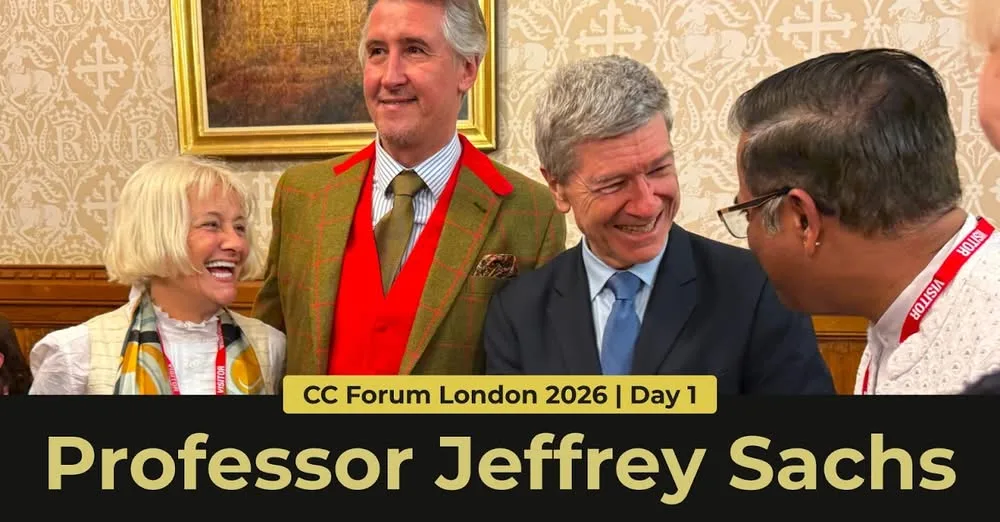
Jeffrey Sachs’ Speech at the UK Parliament (House of Lords Reception), 27 October 2026