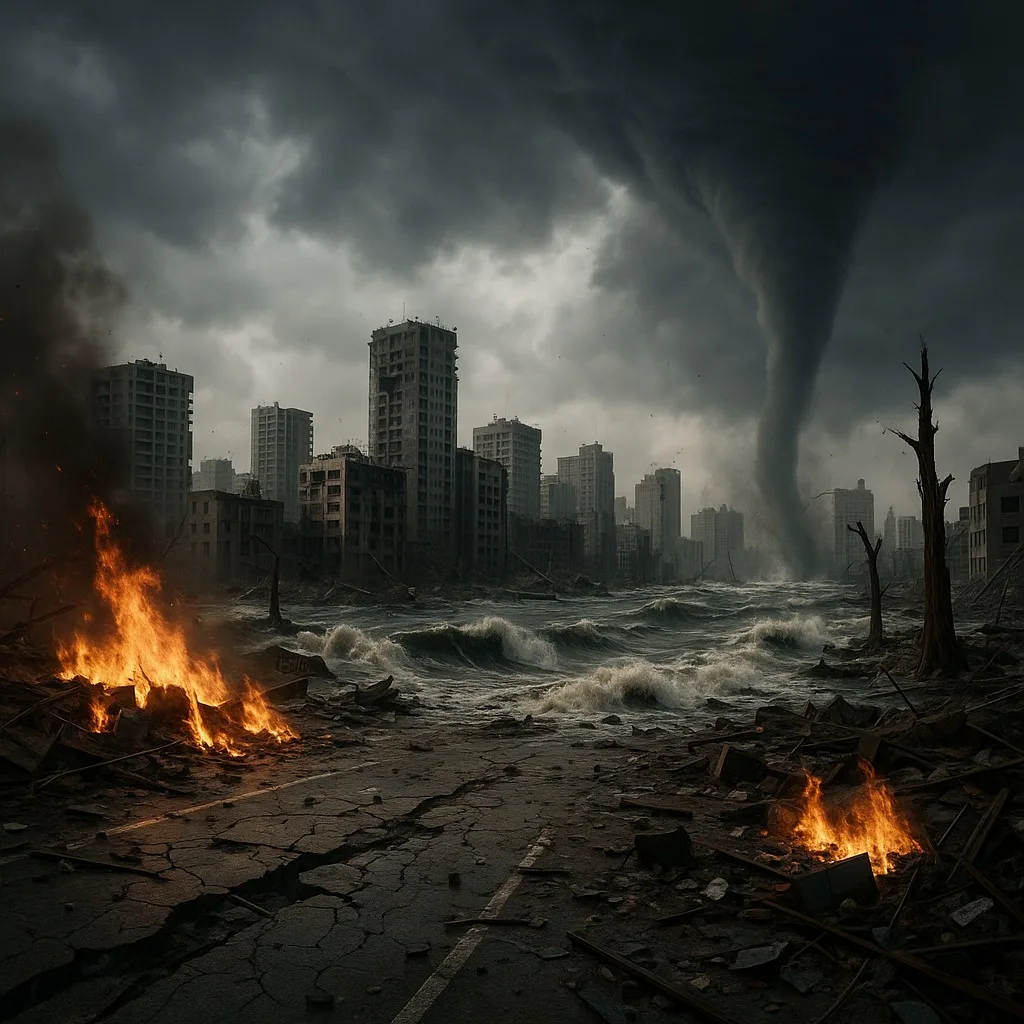
Simple Math- This the road we are on:
Without a change in our current trajectory, the frequency and severity of disasters will only escalate. Each passing year, the toll of storms, floods, heatwaves, and fires grows, with 2024 alone witnessing economic losses of approximately $320–$368 billion due to natural catastrophes—well over 90% of which were weather and climate-related, and only about 40% insured. This is the road we are currently on.
According to reinsurers’ own ledgers, insured catastrophe losses have been rising by ~5–7% per year (in real terms). They now warn that a single “peak year” can deliver insured losses on the order of $300 billion—and 2025’s first half already ran far above the 10-year average. This is the rate we’re going now. Swiss Re+2Swiss Re+2
How it feels on the ground
For communities, the impact of these disasters is deeply felt. A hurricane may strip away roofs, only to be followed by a heatwave that further inflames the region, and then a swollen river season that overcomes weakened levees. The recovery time shrinks, and the trauma accumulates.
The financial strain is evident. Public treasuries are burdened with larger repair costs, while private insurance either withdraws or becomes unaffordable, leaving families and small nations vulnerable.
Food and water are stressed. Heat–drought “compound events” cut yields and raise prices, pushing more households toward hunger and migration. IPCC
The numbers keep climbing. If losses merely hover around today’s average, the world will still spend trillions by 2050 on disasters alone; if the recent 5–7% growth rate continues, totals will push dramatically higher, and insurance gaps will widen further. Aon AssetsSwiss Re
What 2050 looks like on this track
Chronic coastal flooding has become a routine budget item for many cities; billion-dollar disaster counts continue to set records (the U.S. logged 27 such events in 2024). NCEI+1Climate.gov
Repricing of place. Insurance availability, mortgage terms, and even retiree migration shift with hazard maps; wealth gaps widen where protection is least. Kiplinger
Protection gap persists. A significant portion of losses remains uninsured—meaning families, communities, and governments bear the burden directly. Swiss Re
The Indigenous way forward
Our teachings say transformation begins within and radiates outward. To step off this escalating path, we invest in relationship and reciprocity:
Heal the land, and it heals us—wetlands and forests restored as living infrastructure; fire-wise landscapes; regenerative agriculture that cools and holds water.
Build for the future we want—elevated homes and roads where needed, living shorelines over rigid walls, community-led hazard planning that honors local knowledge.
Rebalance resources—redirect from war and waste toward resilience, food sovereignty, and local capacity. That is how we turn rising losses into rising strength.
This is not only climate policy—it is a moral choice to protect the hoop of life. If we embody the change now, the curve bends.
Web search results (sources)
Aon – 2025 Climate & Catastrophe Insight (global losses $368B in 2024; ~60% uninsured) – Annual forensic review of international disasters and losses. Aon Assets
Swiss Re sigma 1/2025 – Natural catastrophes (economic losses $318B; protection gap $181B; 5–7% insured-loss trend) – Global loss trends and long-run growth rates. Swiss Re
Munich Re – 2024 natural disaster figures (total losses ~$320B; >90% weather-related) – Annual global tally and drivers. Munich Re
NOAA NCEI – U.S. 2024 billion-dollar disasters (27 events; ~$183B) – Official U.S. assessment and costs. NCEI
NOAA “Billion-Dollar Disasters” dashboard – Time series and event catalog. NCEI
Swiss Re press note – Peak-year insured losses could reach $300B – Peak-year risk estimate. Swiss Re
Swiss Re – H1 2025 insured losses $80B (well above 10-yr avg) – Confirms escalation into 2025. Swiss Re
IPCC AR6 WGII – Summary for Policymakers – Risks rise with warming; compounding extremes. IPCC
Reuters Breakingviews – Insurers and climate costs (coverage gaps, rising losses) – Market impacts as hazards intensify. Reuters