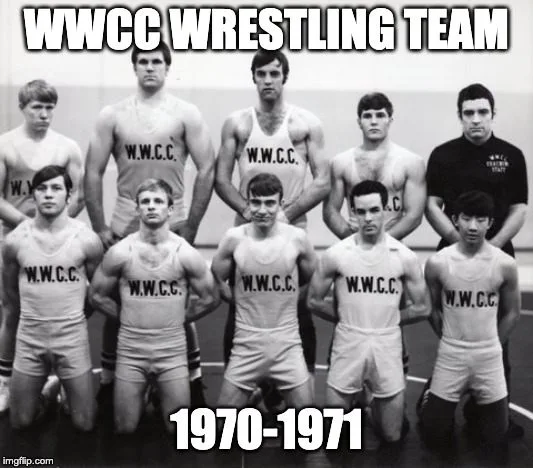
In my old coaching days, with a great, great team. I will always remember the night this WWCC Wrestling Team wrestled the Washington State Champions, Moses Lake Junior College, who dominated Jr. College Wrestling.
My first year as WWCC Wrestling Coach, 1969-1970, we had no uniforms, an old mat, but very dedicated wrestlers, some still learning. The first year we went to Moses Lake to wrestle. Except for Greg Scott, standing on my right, and Dan Huntley, on the far-right, were our only winners that night, and our hosts, both the Team and Community, too great demonstrated joy in beating us as much they could. This I did not take gracefully.
At the end of the Match when I shook hands with the Moses Lake Coach, and looked deeply in his eyes, and said with a big smile and fire in my eyes, and said, " We look very forward to hosting you in Walla Walla next year." Then I smiled some more and turned and walked away.
That was a tough season, but we all learned about our strengths and weaknesses, both as a coach and a team. You can not take anyone where you have not been or seen. As I learned from my beloved father, " Every member of your team is unique and has spiritual gifts that unfold in both victory and defeat. Be a Coach but also like a loving older brother. " This is what I always tried to do.
Thankfully, through my good brother, Gene Bates, WWCC Athletic Director and Head Football Coach, we got uniforms, a new mat, dedicated work-out space on the stage of the old Wa-Hi Gym, 1962, and most of five-full tuition scholarships, the opportunity to do part-time work, if needed.
So the only material value was full-tuition. Full-Scholarships is what all the major colleges and university were able to offer to the best graduating High-School Wrestlers.
This was a challenge, but something, within told me you can do this, and I remembered what I told the Coach from Moses Lake. I had a small office at the Community College and from there, I begin to use every communication means possible to research the best graduating High School wrestlers. I especially focused on Oklahoma, Nebraska, Utah, Oregon, and Washington State/Walla Walla Standouts, like Greg Scott, Tom Huntley, and Randy Mcdougall.
We also had our most inspiratinational wrestler, Dan Angotti who lost all but one match but was never defeated spiritually, no matter what. That is why he was voted Most Inspirational Wrestler.
We also recruited an Oregon State Champion, from Prineville, Oregon, Dean Williams, and Charlie Finnell, who was 3rd in the State of Oklahoma.
There is more to this story, but I will finish, for now, with our hosting Moses Lake in Walla Walla. It was in January and as the year before there was snow. Moses Lake was undefeated. And we were ready.
Instead of taking in consideration the snow, they arrived about 30-minutes late and the Moses Lake Coach asked me to postpone the match for an hour because his boys needed to relax after their bus trip.
I said: " Coach, we are scheduled to wrestle beginning at 7 PM, our wrestlers are ready. The match will not be postponed. We will see you at 7: PM." And I did not see him again until the end of the match.
As there is are psychological dimensions to competition. I addressed him in a way that hit his ego and got him angry and off-balance. He carried his anger and unbalance back to his team. What made him angry was I was much younger than him and his team always won.
Well, the night was ours. Win or lose our spirit could not be beaten and when the match was over we had won. That was a great evening, and when I shook hands with the Coach from Moses Lake, all he said, with great anger," You Son of a Bitch, " I smiled, because I knew my psychological approach had worked, and said, "We will see you at the State Championships."
While they eventually won the State Champions, we were the only Team that defeated them on a Team versus Team basis for years. Two weeks after the season , the State of Washington announced, because of needed budget cuts, the State College Wrestling Program was being defunded.
Three Weeks later we arrived in Sucre, Bolivia, March 21, 1971.