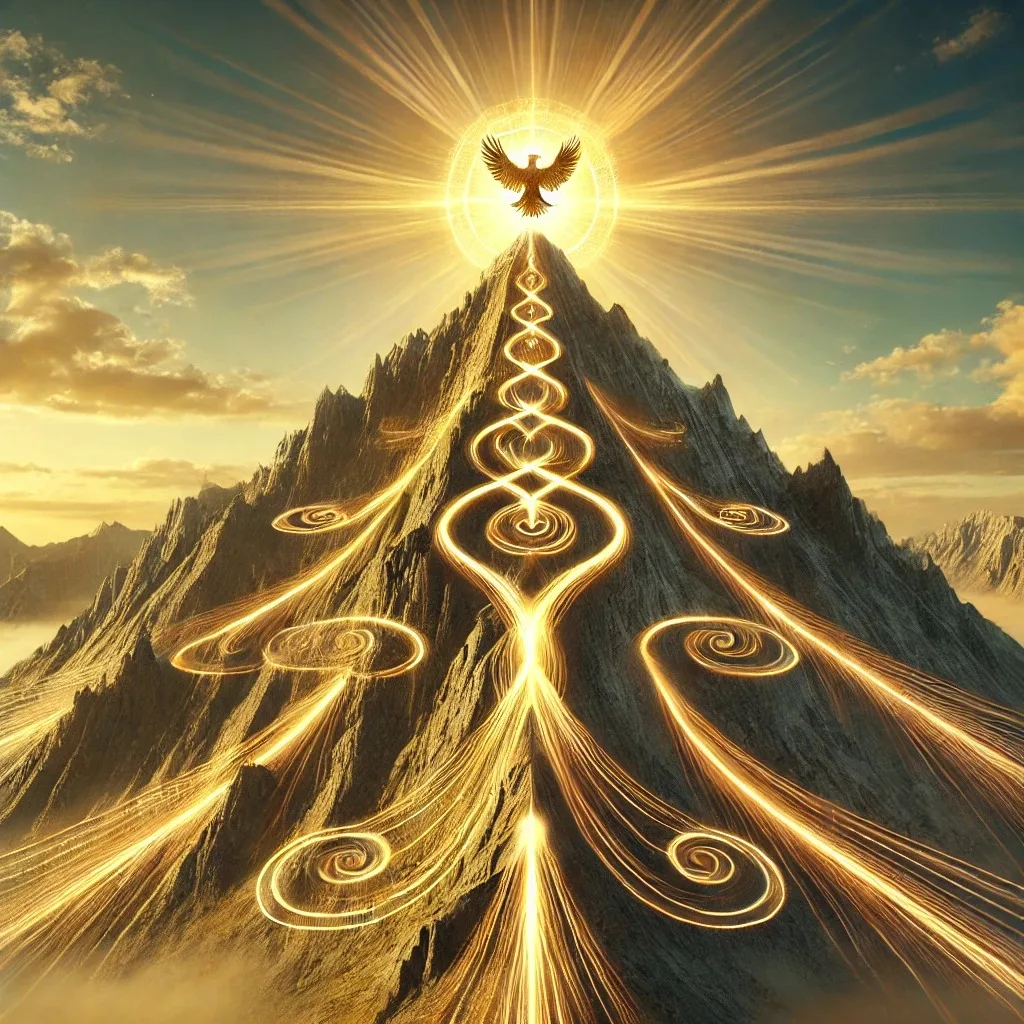
Reflections on the Great Mystery
Reflecting on the Great Mystery, we find a shared truth that transcends cultural and linguistic boundaries. This sacred truth, emerging from the depths of human experience and spiritual awakening, is echoed by voices from every corner of the Human Family. It is the same eternal Source, the Creator, whose essence remains incomprehensible yet whose presence is felt in every part of creation's heart and corner.
In the Old Testament, the Creator declares, “Let us make man in Our image,” in the Gospel, Christ proclaims, “I am in the Father, and the Father in Me.” The Qur’án echoes, “Man is My Mystery and I am his.” Bahá’u’lláh speaks of the Great Mystery, saying, “Thy heart is My home; purify it for My descent. Thy spirit is My place of revelation; cleanse it for My manifestation.” These words unveil a profound truth that even though humanity bears the image of the divine, the Creator’s essence transcends the limitations of human comprehension.
The Dakota people say, "Wakan Tanka kin anpewicake sni," meaning "The Great Mystery cannot be fully understood." This sacred teaching reminds us that Wakan Tanka, the Great Mystery, is reflected in all creation but remains infinite and unknowable, like the vast sky that eludes the boundaries of a single gaze. Among the Chickasaw, this reverence for the divine is expressed in the phrase, "Aba’ Binni’li’ chokma' chilofa’," or "The Creator is good beyond our understanding." These teachings invite humility, urging us to honor the Creator by living in harmony with creation.
This truth is mirrored across the world’s spiritual traditions. Buddha, in the Udana, speaks of an ultimate reality that is “unborn, unbecome, unmade, uncompounded,” a Mystery beyond all conceptualization. In the Bhagavad Gita, Krishna proclaims, “I am the source of all; from Me, everything evolves,” yet declares that His origin is unknowable even to the gods. The Book of Mormon affirms, “Believe in God… that man doth not comprehend all the things which the Lord can comprehend.”
In the Avesta, Zoroaster exalts Ahura Mazda as all-knowing and beyond human grasp, and Laozi, in the Tao Te Ching, declares, “The Tao that can be spoken is not the eternal Tao.” The Upanishads describe Brahman as “subtler than the subtlest and greater than the greatest,” Rumi, the Sufi poet, reminds us that the divine is discovered not through intellect but through removing barriers in the heart.
From the wisdom of Socrates, who humbly said, “I know that I know nothing,” to the reverence of Indigenous peoples for the Great Spirit, all these teachings point us toward a shared understanding: the Creator cannot be contained by the human mind. Yet, this infinite Mystery is reflected in the beauty of creation and the sacred connection within each of us. The divine calls us to humility, reverence, and awe.
It is not for us to fully comprehend the infinite. Our primary purpose is to purify our hearts and walk in harmony with the divine purpose of the Creator. As we reflect on these sacred teachings, we see that the Great Mystery, though incomprehensible, invites us into unity with one another, creation, and the eternal Source from which all wisdom flows. The journey is not to grasp the unknowable but to live in connection with it, with gratitude for the unseen guidance that lights our way and unites us all as one Human Family.
Šúŋkmanu hé miyé do! Čhaŋúŋpa Sápa hé miyé do!
Hinhan Wicasta//Deloria Tiospaye, Iháŋktȟuŋwaŋ, and Chickasaw Nations.