Redirecting $350 Billion from War to Healing: An Indigenous Vision for Healing and Transformation
President Donald Trump's recent revelation that the United States had spent a staggering $350 billion on the war in Ukraine was a stark wake-up call. However, when we consider the broader context of U.S. war expenditures over the last 25 years, which have escalated from $531 billion in 2000 to over $1.06 trillion in 2025, this figure represents just a fraction of the total. In total, the United States has funneled an estimated $18 trillion into war and military preparations during this period, a situation that demands urgent attention and immediate action.
What does this mean for our Human Family? It means $18 trillion has been directed away from schools, hospitals, homes, clean water, and healing our Mother Earth. It means that instead of building the foundation for future generations, we have allowed resources to be consumed by destruction.
The Binding Planetary Peace Treaty to End War, signed in 2025 by Indigenous leaders and allies in Ireland, rekindles the ancient prophecies and points us toward another path. It reminds us that proper security is not measured by bombs or bases, but by the health, dignity, and unity of our peoples. Had such a treaty been in force and honored over the past 25 years, the story of the USA and indeed of humanity would have been entirely different.
The Opportunity Cost of War
In 2024, Congress allocated $825 billion for the Pentagon—more than the combined spending of the next nine nations. Each dollar sent to the war machine is a dollar denied to the well-being of the people. The $350 billion sunk into Ukraine is emblematic of this trade-off. Imagine if these resources had been invested in healing rather than in destruction.
Healthcare and Well-being: The Indian Health Service budget in 2026 was $8.1 billion, serving Native communities that have long been neglected, despite sacred treaty obligations. If even a small portion of war funds had been directed here, Indigenous peoples would have had modern hospitals, full access to doctors, and clean water. Across America, universal healthcare could have been secured, uninsured families protected, and pandemic readiness strengthened. Instead of watching lives slip through the cracks, countless lives could have been saved.
Education and Opportunity: $350 billion could have funded tuition-free public college for nearly a decade, alleviated the teacher shortage, and modernized the nation's crumbling K-12 schools. Tribal colleges and BIA schools could have been rebuilt, infused with Indigenous languages and knowledge. The next generation would have inherited not debt and despair, but the tools to live and lead with purpose.
Housing, Infrastructure, and Water: America’s homelessness crisis could have been ended many times over. Millions of affordable homes could have been built, lead pipes replaced nationwide, and every Native American household provided with running water. Roads, bridges, and broadband could have transformed daily life in both urban centers and remote reservations.
This is the face of opportunity lost. It is not abstract—it is the broken promise to a child without clean water, the despair of a veteran without housing, the suffering of a grandmother without healthcare.
A Treaty Vision: The Peace Dividend of the Last 25 Years
If the Binding Planetary Peace Treaty had been embraced by America and the nations of the world in 2000, the last 25 years could have been an era of healing rather than war. Instead of pouring $18 trillion (Just from the USA, total Global Spending was about $50 Trillion ) into weapons, those resources could have been used to create a world with universal healthcare, free education, affordable housing, clean water for all, and a sustainable future for our Mother Earth. The missed opportunities and the potential for a different, more prosperous world are stark reminders of the cost of war that we must not ignore.
Universal healthcare systems, ensuring that no mother, father, or child dies from lack of care.
Tuition-free education from preschool through college, freeing generations from crushing debt.
Affordable housing for every family, ending the scourge of homelessness.
A global clean water initiative, ensuring safe water for all, from the Navajo Nation to the villages of Africa and Asia.
Bold investments in renewable energy and climate action, securing the future of Mother Earth.
Indigenous elders teach that we must always consider the seventh generation when making decisions. The Binding Treaty embodies this teaching, making clear that the wealth of nations must be directed toward life, not war. If this vision had guided the last quarter century, humanity today would be walking a different road—one of unity, abundance, and resilience.
The Crossroads Before Us
We now stand at a sacred threshold. The $350 billion cited for Ukraine is not only an indictment of misplaced priorities, it is a mirror held up to us all. We are at a crossroads, where we must choose whether to continue the cycle of endless war or to turn toward a future where resources are bound to peace, justice, and the healing of our peoples and Mother Earth. The choice is ours, and it is a powerful one that can shape the future of our human family. We have the power to make a difference.
The Binding Planetary Peace Treaty to End War offers a covenant to reimagine security—not as domination, but as dignity; not as militarism, but as mutual care. To bind ourselves to peace is to reclaim the wealth of the world for the prosperity of all and the restoration of Mother Earth.
Imagine the possibilities: a world with universal healthcare, free education, affordable housing, clean water for all, and a sustainable future for our Mother Earth. This is the future we can create if we choose the path of peace.
The choice is ours: to remain prisoners of the past 25 years of destruction, or to embrace a new vision where the next 25 years become a story of healing, justice, and shared prosperity for the human family.
Two Roads: 2000–2025
War Expenditures vs. A Peace Dividend
The Path of War (What Happened)
From 2000 to 2025, the United States alone spent approximately $18 trillion preparing for and fighting wars. This colossal investment—growing from $531 billion annually in 2000 to over $1.06 trillion by 2025—was poured into weapons systems, foreign wars, and the maintenance of more than 750 military bases worldwide.
Healthcare Lost: Hospitals closed in rural areas, millions remained uninsured, and Indigenous peoples continued to face deadly health disparities as the Indian Health Service limped along at just $8.1 billion a year. Pandemic preparedness was inadequate, costing lives when COVID-19 struck.
Education Deferred: Public schools crumbled, teachers left the profession due to low pay, and college debt grew to more than $1.7 trillion. Tribal colleges and Bureau of Indian Education schools fell into more profound disrepair.
Housing Denied: Homelessness persisted in every significant city. Families struggled to make ends meet as housing shortages worsened. On reservations, overcrowded and substandard homes remained the norm.
Infrastructure Ignored: Lead pipes poisoned children, bridges collapsed, roads deteriorated, and whole Native nations still lacked running water. Broadband deserts cut rural and tribal communities off from opportunity.
Climate Crisis Accelerated: Fossil Fuels Dominate Investment. Renewable energy lagged. Floods, fires, and droughts worsened while military budgets soared.
This is the inheritance of the war path—an America where billions are spent on missiles while mothers bury children for lack of healthcare, where contractors grow rich while veterans sleep on the streets.
The Path of Peace (What Could Have Been)
If the Binding Planetary Peace Treaty had been adopted in 2000, those same $18 trillion would have been directed to healing and life. By 2025, the world would already look transformed:
Universal Healthcare: Every American, including every Native person, would have had guaranteed access to modern healthcare. Rural hospitals would be thriving, maternal health disparities would be eliminated, and Indigenous clinics would be fully funded and staffed. Pandemic response systems would have saved millions globally.
Education for All: Tuition-free public colleges would have been in place for nearly 25 years. Student debt would not exist. Teachers would be respected and well-paid. Every school—whether urban, rural, or tribal—would be modern, safe, and connected to broadband. Indigenous languages and cultural curricula would flourish.
Homes for Every Family: Homelessness would be a thing of the past. Millions of affordable homes would have been built, with wraparound services for those who were once vulnerable. Tribal housing shortages would have been solved, with clean, modern, culturally rooted dwellings for every family.
Infrastructure Reborn: Every lead pipe in America would be replaced. Roads, bridges, and transit systems would be safe and modern. Every Native American household would have access to clean, running water. Renewable energy grids would be widespread, rural electrification would be nearly complete, and broadband would be universally available.
Mother Earth Restored: Trillions would have fueled climate solutions. By 2025, renewable energy is expected to become the dominant source. Forests, rivers, and oceans would be recovering. Indigenous guardianship would guide conservation efforts, leading to a significant decline in carbon emissions.
This is the inheritance of the peace path—an America where the wealth of war becomes the wealth of healing, where every child grows up in dignity, and where humanity prepares for the next seven generations.
The Crossroads Now
The contrast between these two paths is stark. One leads to exhaustion, inequality, and destruction. The other is healing, justice, and unity. The Binding Planetary Peace Treaty offers humanity this second road—not as a dream, but as a covenant.
The question is no longer whether we can afford peace; it is whether we can survive without it.
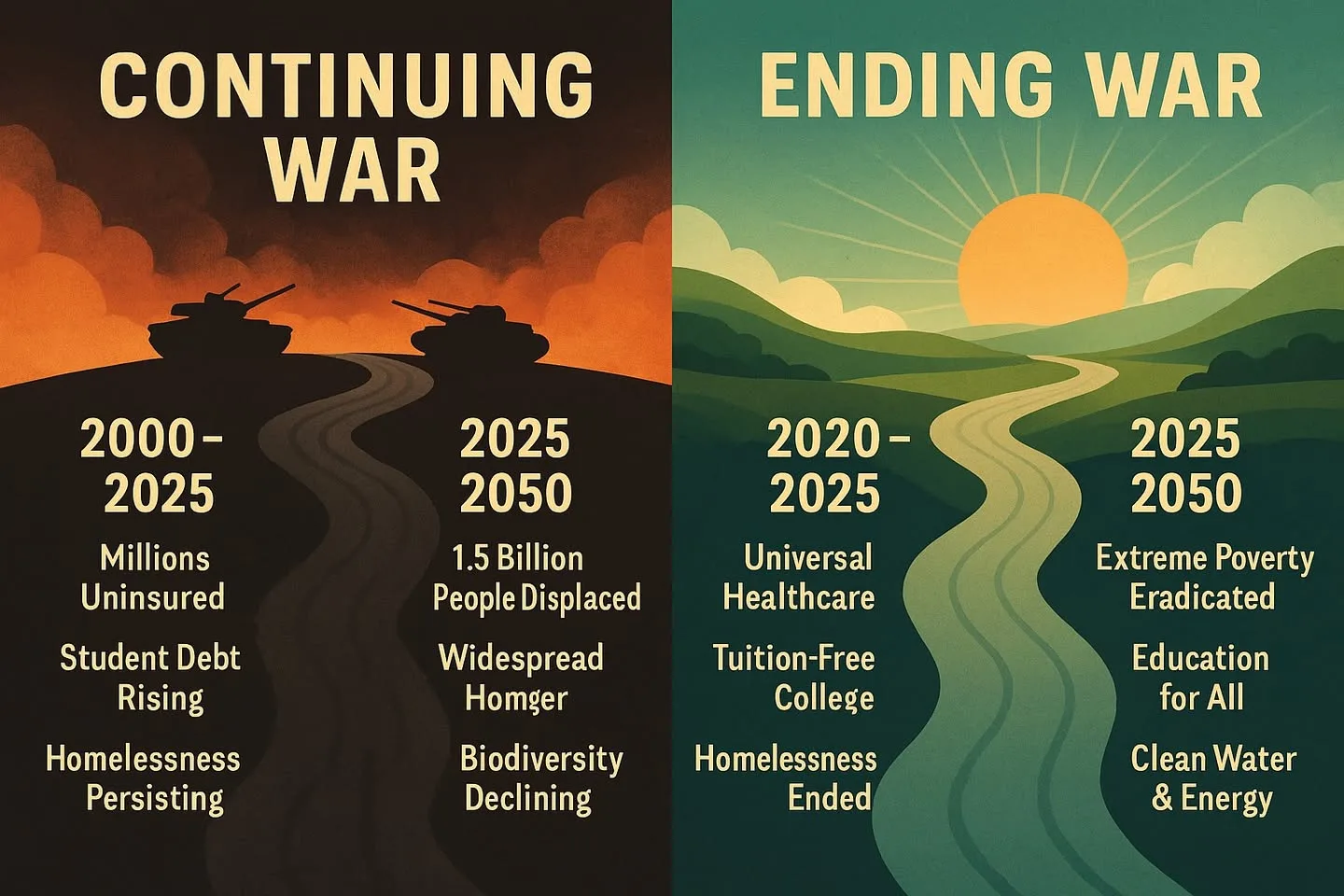
Two Roads: 2000–2050
The War Path vs. The Peace Path
2000–2025: The Story of War
Over the past quarter-century, the United States has spent $18 trillion on war and preparations for war alone. What did it yield? Endless conflicts, fragile veterans, and communities starved of resources.
Healthcare: Millions uninsured, rural hospitals shuttered, Native health systems grossly underfunded.
Education: $1.7 trillion in student debt, disintegrating schools, underpaid teachers, and Tribal colleges in decay.
Housing: Homelessness is entrenched in every city, and overcrowded and unsafe homes are on reservations.
Infrastructure: Lead-tainted water, unsafe bridges, poor rural connectivity, unpaved reservation roads.
Climate: Wildfires, floods, and droughts have intensified as fossil fuels have been prioritized over renewable energy sources.
This was the legacy of the war: broken promises, lost opportunities, and deepening inequality.
2000–2025: The Peace Dividend That Could Have Been
Had the Binding Treaty guided nations in 2000, $18 trillion would have been invested in life. By 2025:
Universal healthcare would have ended medical bankruptcy and reduced deaths from preventable disease.
Tuition-free public colleges would have been available to all; student debt would have been eliminated.
Homelessness would have ended, with millions of affordable homes built.
Every lead pipe replaced; safe, clean drinking water in every home, predominantly Indigenous households.
Renewable energy grids would already dominate, significantly reducing emissions.
In this world, children would be growing up with dignity, health, and hope.
2025–2050: If War Continues
If we extend the war path into the next 25 years, the outcome is catastrophic. By 2050, if trillions more are spent on militarism and climate change is neglected:
Displacement: More than 1.5 billion people driven from their homes by climate chaos.
Hunger: Hundreds of millions are facing chronic food shortages as soils degrade and crops fail.
Biodiversity Loss: More than 25% of species gone, coral reefs and rainforests irretrievably lost.
Public Debt Crisis: Nations drowning in debt, sacrificing futures to feed militarism.
Violence and Fragmentation: Wars over water, migration, and collapsing economies.
This is a path of global despair, where the seeds planted in 2000 grow into famine, displacement, and extinction by mid-century.
2025–2050: If the Treaty Guides Us
If the Binding Planetary Peace Treaty is embraced now, redirecting trillions to healing, the next 25 years become a story of renewal. By 2050, we could witness:
Eradication of Extreme Poverty: Every family with food, shelter, and opportunity.
Universal Healthcare worldwide, with Indigenous-led healing systems guiding holistic well-being.
Education for All: Every child on Earth in school; universal access to higher learning without debt.
Clean Water and Energy: Every household, including the most remote Indigenous villages, has running water, sanitation, and renewable energy.
Climate Healing: Net-zero carbon achieved; forests restored; oceans recovering; species protected.
Unity in Diversity: Indigenous principles of the seventh generation guiding planetary governance, with cultures thriving and Mother Earth restored.
This is the world the Treaty makes possible—a world of dignity, justice, and harmony.
The Sacred Crossroads
We are living in a moment of prophecy. Between 2000 and 2025, humanity chose war, and the cost was staggering. However, from 2025 to 2050, a different choice remains before us.
The War Path leads to collapse.
The Peace Path leads to healing and abundance for the next seven generations.
The Binding Planetary Peace Treaty to End War is not only a call—it is a covenant. To walk the peace path is to reclaim trillions once wasted on destruction and transform them into living waters of hope, flowing into every home, school, and community.
The time has come to choose, for by 2050, the path we walk will be irreversible.