
For generations, the citizens of the United States have been taught to think of its responsibilities in global terms. As a result, the United States has built military bases worldwide, entered distant wars, tried to shape governments, protected access to resources, and spent vast sums projecting power far beyond its borders.
Canada, while often presenting itself differently, has also participated in many of the political, economic, military, and extractive systems that have shaped the modern world. Yet both countries are surrounded by a truth they have too often refused to face: before attempting to reorder the world, they must help restore the hemisphere of which they are a part.
Our first responsibility is not to dominate the world. Our first responsibility is to put our own house in order, to heal the lands and peoples closest to us, and to rebuild right relationships throughout the Americas.
That begins within the United States and Canada themselves, where poverty, homelessness, addiction, violence, failing infrastructure, ecological destruction, and the continuing dispossession of Indigenous Peoples reveal that neither country is as secure or whole as it claims to be. But it cannot end at their borders.
The United States and Canada are the two most economically powerful nations in the Americas, and with that power comes a responsibility to the entire hemisphere, especially to the Indigenous Peoples whose homelands extend across the political boundaries imposed upon them.
Building walls will not rebuild the Americas. A wall may alter where suffering becomes visible. Still, it cannot heal the conditions that cause a mother to carry her child across a desert, a young person to surrender their life savings to a smuggler, or a family to flee violence, hunger, political instability, ecological disaster, and the collapse of hope.
Walls cannot stop drought. They cannot stop organized crime, corruption, economic extraction, or the movement of weapons and money. They cannot restore a village whose water has disappeared or give meaningful work to young people who see no future at home.
If we want migration increasingly to become a choice rather than an act of desperation, we must help build a hemisphere in which people have a genuine opportunity to remain safely in the lands they love.
This is not a call for the United States and Canada to rescue the rest of the Americas. The language of rescue has too often concealed control. Nor is it a proposal for a new version of the Monroe Doctrine, under which one powerful country claims the hemisphere as its sphere of influence. We must leave that old doctrine behind.
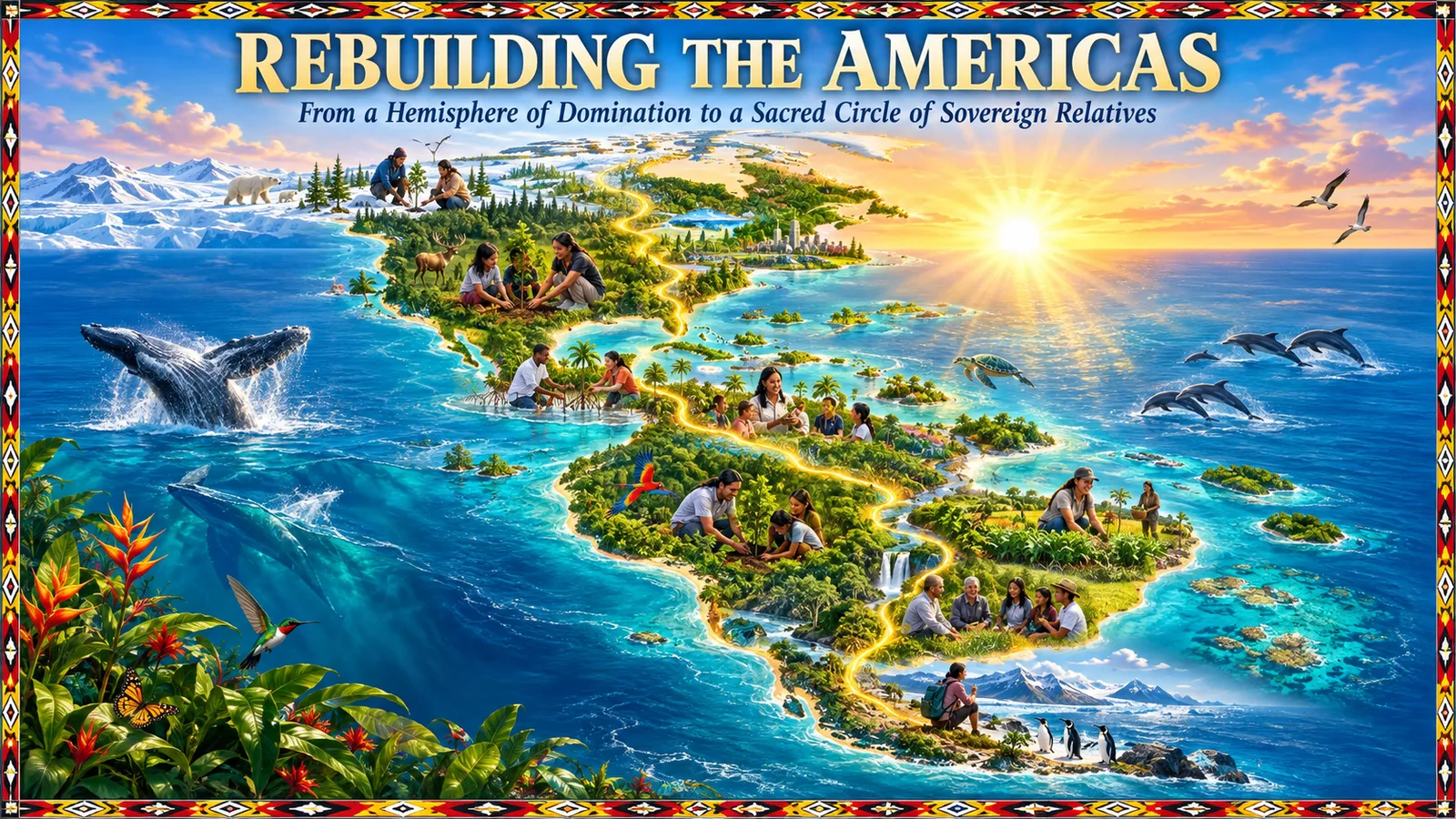
The Americas are not a sphere of influence. They are a sacred circle of sovereign relatives. Every nation, every Indigenous People, and every community has the right to shape its own future. The responsibility of the United States and Canada is not to arrive with another plan created in Washington or Ottawa, but to listen, acknowledge the damage in which they have participated, and place their considerable resources at the service of locally and regionally defined visions.
What It Means to Withdraw to the Americas
When I speak of withdrawing completely to the Americas, I do not mean abandoning the human family, closing our hearts to suffering elsewhere, or becoming indifferent to Africa, Asia, Europe, the Middle East, or the Pacific. I mean withdrawing from the belief that military reach, coercion, regime change, sanctions that punish ordinary people, and the power to destroy are the proper foundations of leadership. I mean bringing home the enormous intelligence, resources, technology, labor, and imagination now devoted to endless war and directing them toward healing life.
Withdrawal from domination is not withdrawal from relationship. It is a return to responsible relationship. The United States and Canada can remain generous members of the human family while recognizing that responsibility begins where they live. They can support the rebuilding of Africa and other regions profoundly harmed by colonization, slavery, extraction, and foreign interference, but they must do so without controlling the outcome.
Their example will carry far greater moral weight when their own cities, rural communities, reservations, reserves, watersheds, and neighboring nations are no longer neglected. At the same time, immense wealth is sent abroad for warfare.
Security must also be understood differently. Security is not merely the ability to destroy an enemy. It is the ability to prevent enemies from forming and to resolve conflict before destruction begins.
A secure hemisphere is one in which children are fed, families are housed, water is clean, communities are safe, governments are accountable, cultures are respected, and young people have a meaningful future. Rebuilding the Americas would be the greatest peace and security initiatives the United States and Canada could ever undertake.
The Unfinished History Beneath the Present Crisis
The poverty and instability found in parts of the Americas did not arise in a vacuum. For centuries, the hemisphere’s lands, minerals, forests, crops, labor, and knowledge have produced enormous wealth, but much of it has flowed away from the communities and countries that produced it. Colonial powers extracted gold, silver, timber, sugar, rubber, and countless other resources.
Enslaved Africans and exploited Indigenous Peoples paid for that wealth with their bodies and their lives. In later generations, foreign corporations, financial institutions, political interventions, coups, debt arrangements, unequal trade, and the pursuit of strategic advantage often continued the same pattern under new names.
The United States must face its history of military intervention, covert interference, imposed political outcomes, support for repressive regimes, and corporate extraction in Latin America and the Caribbean.
Canada must also look honestly at the conduct of Canadian mining and other extractive interests abroad, as well as its participation in economic arrangements that have not always protected local communities or Mother Earth.
Neither country can build trust by pretending this history is over simply because the language has changed.
Truth, however, is not sought so that one generation can remain forever trapped in blame. We tell the truth so that we can stop reproducing the injury. A truthful accounting enables us to repair relationships, transform institutions, and establish a new principle: resources taken from a land must first contribute to the enduring well-being of that land’s people and living systems. Development must no longer mean removing wealth from one place so that prosperity can accumulate somewhere else.
Indigenous Peoples at the Heart of Hemispheric Renewal
Rebuilding the Americas must begin with the First Peoples of the Americas. From the Inuit homelands of the Arctic to the forests and plains of North America, through Mexico, Central America, the Caribbean, the Amazon, the Andes, and south to Tierra del Fuego, Indigenous Peoples have carried languages, laws, spiritual responsibilities, agricultural knowledge, healing traditions, ecological sciences, and systems of collective life rooted in these lands for thousands of years.
Indigenous Peoples must not be placed at the edge of a hemispheric initiative as cultural advisers invited to bless plans already made. They must stand at the center as full governing partners. This means respecting treaties, land rights, sovereignty, free, prior, and informed consent, and Indigenous nations’ authority to determine what development means within their own territories. It means direct access to capital, technology, education, health resources, and international decision-making—not resources filtered through institutions that have historically controlled them.
It also means learning from Indigenous knowledge without extracting it. The knowledge of seeds, medicines, forests, fire, water, soil, climate, community healing, peacemaking, and the relationship between human beings and Mother Earth cannot be treated as free intellectual property for governments or corporations to appropriate. It belongs within living relationships, cultural protocols, languages, and responsibilities. When Indigenous Knowledge and Western knowledge are braided respectfully, neither has to be diminished. Together they can produce new understanding and new capacities greater than either could create alone.
Restoring Indigenous lands, languages, economies, and governing authority is not a special-interest project separate from rebuilding the hemisphere. It is one of its essential foundations. The lands with the greatest remaining biological diversity are often lands Indigenous Peoples have protected despite immense pressure. Supporting their leadership is therefore inseparable from protecting water, forests, food systems, climate stability, and the future of all peoples.
A Covenant of the Americas
What is needed is a Covenant of the Americas for Healing, Peace, and Shared Prosperity. Such a covenant could not be declared unilaterally by the United States or Canada. It would have to be shaped through a genuine process involving all nations of the hemisphere, Indigenous governments and confederacies, local communities, women, youth, workers, farmers, educators, healers, spiritual leaders, civil society, and responsible enterprise.
The covenant would begin by renouncing domination. Participating countries would commit themselves to resolving disputes through diplomacy and regional law, refusing regime change and covert destabilization, protecting civilians, and ending the use of economic suffering as a political weapon. Human rights would remain essential, but they would be upheld consistently rather than invoked selectively against political opponents.
The covenant would also establish development as a process arising from within. No community can be sustainably developed by someone else. Outside assistance can remove barriers, provide resources, share knowledge, and strengthen capacity, but the vision, leadership, ownership, and continuing responsibility must belong to the people themselves. True development begins within the human being, the family, the community, and the culture, and then moves outward into institutions and material conditions.
This approach would replace dependency with capacity. Instead of trapping countries in cycles of debt or forcing them to export raw resources while importing costly finished goods, the hemisphere could invest in locally owned manufacturing, regenerative agriculture, clean energy, community banking, cooperatives, digital infrastructure, public health, education, housing, water systems, and small and medium-sized enterprises.
Trade agreements would be measured not only by how much commerce they generate, but by whether they strengthen workers, protect Mother Earth, circulate wealth locally, and reduce the distance between abundance and need.
The United States and Canada could redirect a substantial portion of the money now devoted to war toward a democratically governed hemispheric restoration fund. They should contribute heavily because they possess the greatest financial capacity, but they must not control it. Its governance should be shared, transparent, accountable, and protected from corporate capture. Communities should be able to see where the money goes, who benefits, what was promised, and whether the results endure.
Healing the Living Systems That Unite Us
Political borders divide the map, but they do not divide the living world. Rivers cross borders. Birds and animals migrate across them. Smoke from fires travels across them. Storms, drought, pollution, disease, and climate disruption recognize no customs post. The restoration of the Americas must therefore be bioregional, not just national.
Imagine a hemispheric commitment to restore the great watersheds, forests, grasslands, wetlands, coastlines, coral systems, and agricultural lands that sustain us. Imagine millions of young people serving in locally led projects that restore rivers, regenerate soil, protect forests, reduce wildfire danger, renew fisheries, build clean-energy systems, strengthen food sovereignty, and prepare communities for disasters. Such work would create employment, rebuild dignity, improve health, reduce displacement, and restore the living systems upon which every economy ultimately depends.
The Amazon, the Arctic, the Great Lakes, the Mississippi-Missouri system, the Caribbean, the Gulf of Mexico, the forests of Central America, and the hemisphere’s mountain and coastal watersheds must be understood as parts of one interconnected living body. Damage in one region eventually touches the others. Mother Earth has already drawn the map of our interdependence. Our political and economic systems must learn to follow it.
Migration, Violence, and the Conditions of Hope
The migration crisis will not be resolved at the border because the deepest causes do not begin there. People move for many reasons, including love, work, education, family, curiosity, and aspiration. Movement itself is not a problem to be eliminated. But no one should be forced from home by terror, hunger, ecological collapse, political persecution, or the absence of any path forward.
The hemisphere needs humane and lawful pathways for migration, fair asylum systems, family reunification, protection from trafficking, reciprocal labor agreements, and recognition of the contributions migrants make wherever they live. At the same time, it must confront the forces that make migration desperate: organized crime, corruption, weapons trafficking, addiction, concentrated land ownership, ecological destruction, and economies that exclude millions of young people.
The militarized war on drugs has inflicted terrible damage without ending either addiction or the criminal economy. A new approach must include prevention, treatment, mental health care, community healing, economic opportunity, accountable policing, protection for journalists and human-rights defenders, and determined action against money laundering and the financial networks that profit from suffering.
The United States must acknowledge both its enormous demand for illegal drugs and the flow of weapons southward. Canada must also face its demand, financial systems, and public-health responsibilities. No nation can honestly address the violence while denying its own place in the cycle.
People remain where life is possible, where dignity is protected, and where hope has roots. Rebuilding the Americas would not end all migration, nor should it. It would give millions of people something more precious than confinement on either side of a wall: the freedom to stay, the freedom to move safely, and the possibility of returning home.
From Military Presence to Shared Service
One of the clearest signs of transformation would be a change in who represents the United States and Canada throughout the hemisphere. Instead of soldiers, covert operatives, extractive companies, and distant financial institutions being the most visible faces of northern power, imagine a reciprocal Hemispheric Peace and Service Corps made up of teachers, builders, doctors, nurses, engineers, farmers, mediators, artists, language workers, emergency responders, ecological restoration crews, and young people from every part of the Americas.
This corps would serve only where invited and under local leadership. It would be reciprocal rather than paternalistic: people from across the Americas would teach, study, build, heal, and serve across the hemisphere, including in the United States and Canada.
A water engineer from Peru might help a northern community while an Indigenous firekeeper from California works beside forest guardians in Central America. A physician from Cuba might serve in an underserved rural region while Canadian specialists help train local health workers elsewhere. Knowledge would travel in every direction because every person has gifts and every people has needs.
Shared service creates relationships that policy papers cannot. It enables people to live and work together long enough to overcome stereotypes, understand one another’s histories, and discover that mutual dependence is not weakness. Over time, shared service could replace military presence as the most visible expression of hemispheric relationship.
Our Responsibility Beyond the Americas
Rebuilding the Americas does not release the United States, Canada, or the former colonial powers from their responsibilities to Africa and other regions damaged by colonization. On the contrary, it shows us how to fulfill those responsibilities.
Africa does not need another theft of its minerals, land, labor, or strategic position. It does not need outsiders deciding what its development should become. African nations and peoples possess their own knowledge, leadership, creativity, resources, and visions. Wealthy countries have a responsibility to stop extracting unfairly, return what is not theirs, reform financial and trade systems, support locally determined development, and share resources without imposing control.
The same principle applies everywhere: repair without domination, partnership without possession, assistance without erasing sovereignty. By beginning in the Americas, the United States and Canada can develop the humility, institutional practices, and moral credibility required to support restoration elsewhere. They can demonstrate that a powerful nation does not become smaller when it ceases to dominate. It becomes more trustworthy.
A New Measure of Greatness
The greatness of a country cannot be measured only by the size of its economy, the reach of its weapons, or its ability to compel others. A truly great country can heal its own wounds, honor its agreements, care for its children and elders, restore the lands and waters that sustain it, and build relationships in which its neighbors also thrive. No nation is secure when the hemisphere around it is wounded. No nation is prosperous when its prosperity depends upon the continuing poverty of others.
The United States and Canada now face a choice. They can continue to fortify borders while the conditions beyond and within those borders deteriorate, continue to spend immeasurable wealth preparing for wars, and continue to treat suffering as someone else’s failure. Or they can accept a larger responsibility grounded in humility, truth, restitution, cooperation, and service.
This work must begin at home, but home is larger than the territory enclosed by a national border. Home is the river system, the migration route, the foodshed, the atmosphere, the ancestral homeland, and the web of relationships that has always connected the peoples of this hemisphere. For the United States and Canada, home is also the Americas.
Before we attempt to rebuild the world, let us rebuild the Americas. Let us rebuild the United States and Canada from within, fulfill our sacred obligations to Indigenous Peoples, stand beside our neighbors as equals, and transform this hemisphere from a history of conquest and extraction into a living covenant of healing, peace, and shared prosperity.
Then, with greater humility and cleaner hands, we can join Africa and all other peoples who are rebuilding from colonization, not as rulers, rescuers, or owners, but as relatives within one human family and children of one living Mother Earth.
— Hereditary Chief Phil Lane Jr. Chickasaw and Ihanktonwan Nations, White Swan Oyate