On October 2, 2026, King Willem-Alexander received the independent study into the role of the House of Orange-Nassau in Dutch colonial history. His words that day- that the findings were unvarnished and deeply confronting, and that the study’s completion is not an ending but an encouragement- were received with respect.
The King’s 2023 apology for the history of slavery was itself a historic act, and his lifelong work on water stewardship has earned genuine admiration worldwide. These are not small things.
The study’s deep engagement with slavery is necessary and commendable. It is a foundation worth building upon. The scale of what was taken is staggering. The House of Orange-Nassau itself earned the equivalent of nearly €576 million from colonialism — almost all of it, around €566 million, from the former Dutch East Indies.
But the royal family’s share was a fraction of the whole. Economist Alec Gordon’s estimate of Indonesia’s colonial surplus alone, the wealth extracted between 1878 and 1942, runs to roughly €130 to €175 billion in today’s terms; that is about $150 to $200 billion. In the 1920s and 1930s, income from the Indies accounted for about 14 percent of the entire Dutch national income, and colonial investments represented roughly a third of all Dutch private wealth.
In the 1770s, Atlantic slavery generated over 5 percent of Dutch GDP, more than 10 percent in the province of Holland, and about 40 percent of Holland’s economic growth in those decades traced back to slave-based production. Indonesian President Prabowo has cited €28 trillion in wealth extracted from Indonesia; that is about $31 trillion, though historians have not been able to verify that number.
What is documented is only part of the picture. What happened in Suriname, the Caribbean, New Amsterdam, West Africa, and beyond is not fully captured in these figures, so the true total must be far greater.
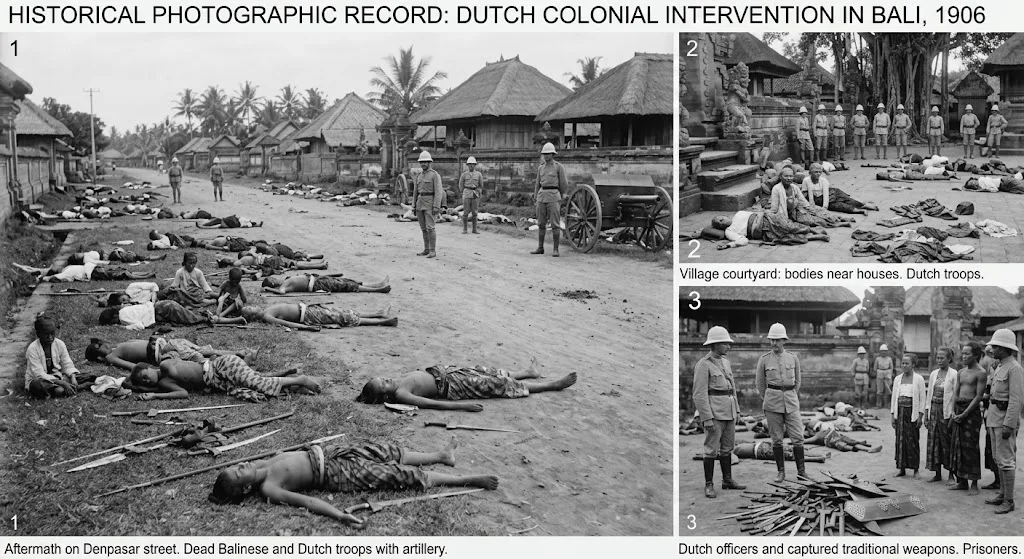
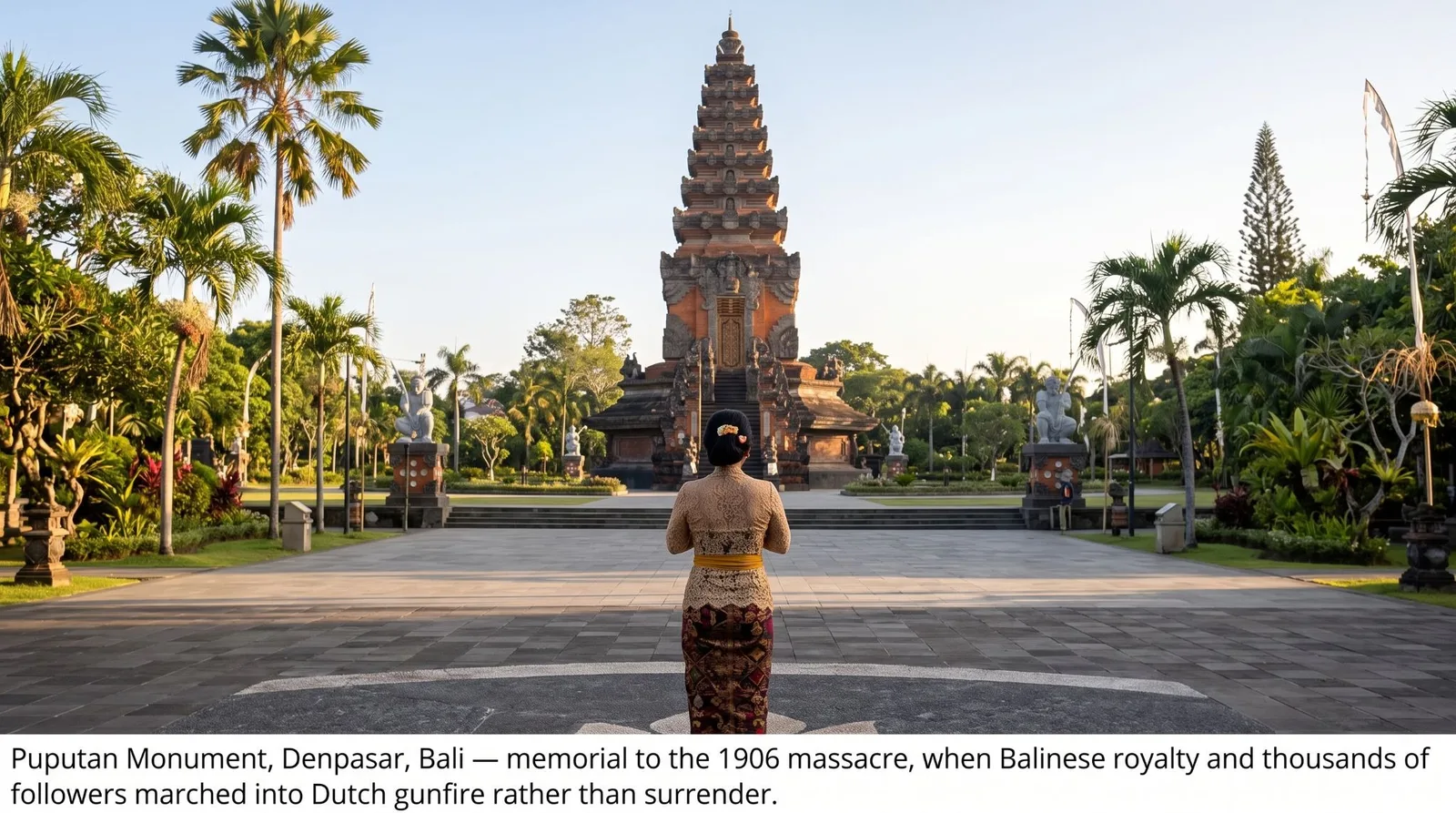
Bali offers a stark example of what the study’s financial ledgers leave out. In 1906 and 1908, the Dutch conquest of the southern Balinese kingdoms ended in the puputan, in which Balinese royalty and thousands of followers marched into Dutch gunfire rather than surrender.
The Dutch then ruled for roughly forty years, imposing forced labor and executions, until the Japanese occupation from 1942 to 1945 brought its own internment camps and brutality. After the war, the Dutch fought a bloody campaign to keep Bali and the rest of Indonesia, the Indonesian National Revolution, until independence in 1949.
Yet among Indigenous representatives from territories touched by Dutch colonialism, from the Americas to the East Indies, from Suriname to the Caribbean, a further question is being asked, gently but insistently: where does the study reference the other colonial acts?
The invasion of Indigenous lands. The suppression of resistance. The violence documented under Dutch rule in New Amsterdam and Suriname. The sweeping impacts across the Dutch East Indies—Indonesia, Maluku, and Papua —and the historical footprint across Africa and Asia.
What has the research revealed about the intergenerational trauma these acts left behind, and what feedback has been gathered from the Indigenous communities and descendants in every place where the Dutch were historically involved?
This is not a condemnation. It is an invitation. When colonial history is investigated primarily through the institutions and archives of the colonial power, the truth that emerges risks remaining incomplete. The stories of original peoples live in their memories, languages, and oral traditions — not only in the records of empire.
Some Indigenous representatives have expressed a profound sorrow: that their original communities have not yet been fully included in this historical narrative. They ask that the evaluation account for the invasion of Indigenous lands and center the voices of those original communities globally.
We bring this forward in a good way, recognizing the immense difficulty of this undertaking and praising the necessary, noble work already underway. Acknowledging the full scope of these colonial acts and seeking direct feedback from peoples in all affected territories worldwide is a powerful next step—to ensure those who lived on these lands are no longer treated as marginal to the telling of their own history.
And we must look beyond the immediate work of reconciliation itself. Whatever colonial nation steps forward with the courage you have shown opens the door to something larger: the trustful restoration of trade relationships between nations and peoples.
We seek to renew these relationships in the spirit of love, prayer, and informed consent. When trust is rebuilt on that foundation, the Netherlands can re-establish trustful trading relations with Indigenous peoples and others across Mother Earth — a planetary relationship far greater than the immediate cost of this undertaking.