
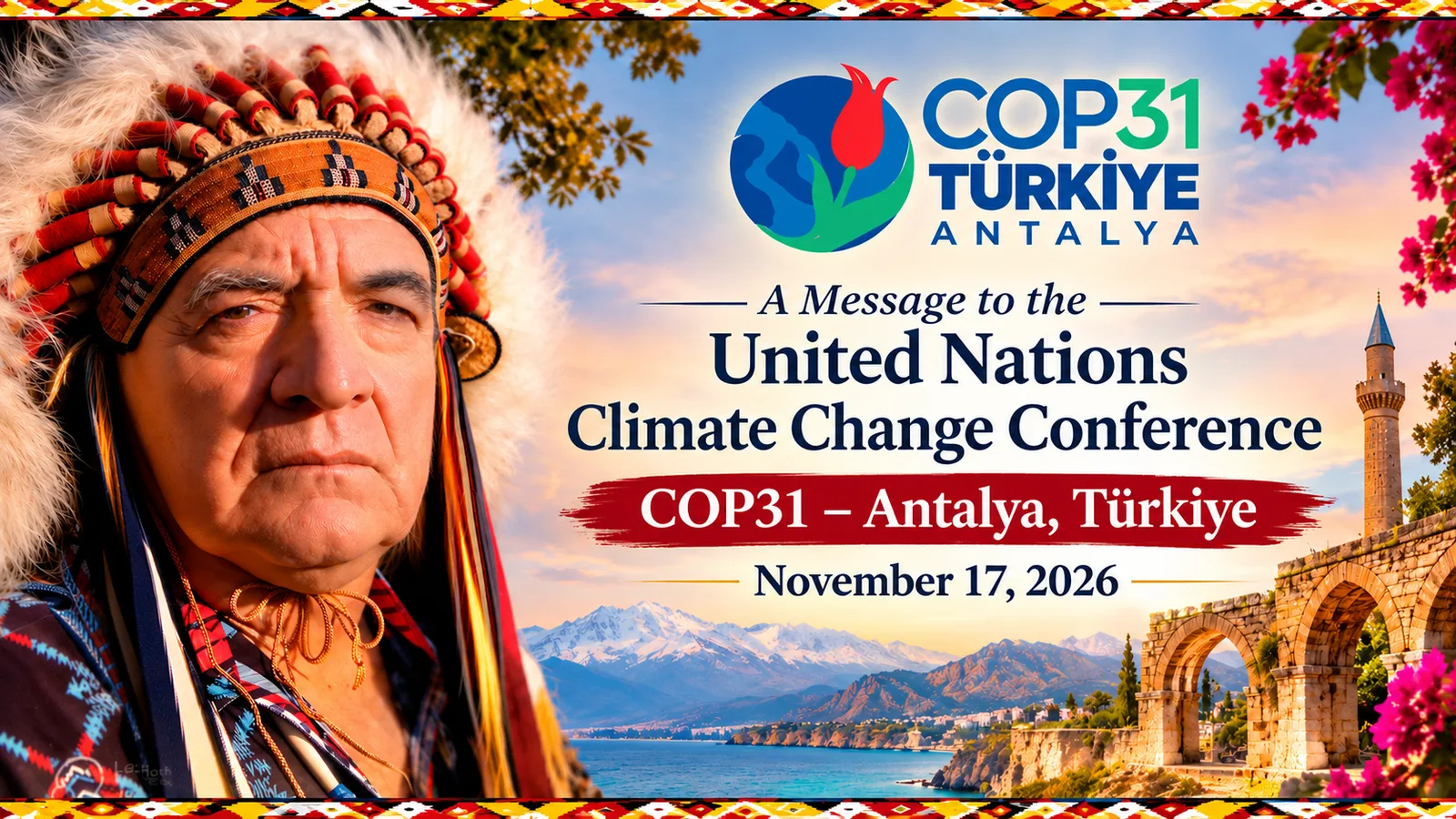
Presented by Hereditary Chief Phil Lane Jr., Chickasaw and Ihanktonwan Nations, White Swan Oyate, on behalf of the Union of the Condor, Hummingbird, Quetzal, and Eagle; the Four Worlds International Institute; Four Worlds Europe; Compassion Games International; and other Indigenous and international partners listed below.
EXECUTIVE SUMMARY
The November 2026 Climate Action Tracker assessment projects approximately 2.7°C of global warming by 2100 under current policies, and approximately 2.1°C if all announced pledges and long-term targets are achieved (with the most optimistic scenario at roughly 1.9°C). These figures expose an urgent gap between international commitments and the actions required to limit warming. Every fraction of a degree avoided matters. Emissions reductions must be paired with protecting the functions of ecological systems essential to climate stability, freshwater security, biodiversity, and human well-being.
We propose that the international community strengthen coordinated protection of three globally significant regions: the Arctic, the Amazon Basin, and the Congo Basin. We also call for sustained attention to the Hindu Kush Himalaya, Antarctica, oceans, and other threatened environments, together with** immediate assistance to communities already facing water shortages and climate-related disasters.**
Our perspective draws on more than four decades of work through the Four Worlds International Institute, the Sixteen Guiding Principles, and the Four Worlds Model. It emphasizes Indigenous rights and leadership, integrating science and local knowledge, responsible governance, community development, education, financing, and independent evaluation.
Beloved Relatives, Distinguished Leaders, Delegates, Indigenous Representatives, and Respected Members of Our Human Family,
We extend our greetings and appreciation to all gathered at COP31 in Antalya and to those working worldwide to address climate change. We recognize the substantial efforts already underway and the difficulty of reconciling urgent environmental responsibilities with the legitimate development, energy, and economic needs of nations and communities.
We bring perspectives shaped by more than five decades of Indigenous leadership and international human and community development, as well as related initiatives and networks around Mother Earth. Since the establishment of the Four Worlds International Institute in 1982, our work with Elders, communities, universities, governments, and civil society has shown that lasting change depends on a shared vision, sound principles, meaningful participation, capable institutions, and sustained evaluation.
Scientific knowledge and financial resources are indispensable, yet neither delivers lasting results without relationships of trust, responsible decision-making, and communities’ capacity to shape their own futures.
The climate crisis demands that we apply these lessons at an unprecedented scale. Our purpose is to draw attention to critical living systems, strengthen cooperation among those who steward them, and propose a practical path to translate shared responsibility into measurable action.
THE CLIMATE WARNING AND THE DEVELOPMENT CHALLENGE
The Climate Action Tracker assessment issued November 12, 2026, projects warming of approximately 2.7°C above pre-industrial levels by the end of the century under current government policies. Fulfilling all announced pledges and long-term targets would still leave a projected increase of about 2.1°C, with the most optimistic implementation scenario at roughly 1.9°C. These outcomes remain above the Paris Agreement’s 1.5°C objective and reveal the gap between current policies and the reductions required.
We already see the consequences in extreme heat, damaging fires, floods, droughts, disrupted agriculture, threatened freshwater supplies, rising seas, and mounting costs to public health and infrastructure. Those consequences are not evenly distributed. Indigenous Peoples, small island states, low-income communities, and many developing countries face severe risks despite having contributed relatively little to historic emissions. Climate action must therefore be understood as a matter of justice, institutional capacity, economic security, and the rights of present and future generations.
For Indigenous Peoples, the relationship between the health of the land and the well-being of the people is not a recent discovery. Our Elders have long taught the importance of maintaining reciprocal relationships with water, forests, soils, animals, and the larger environment. Contemporary climate and ecological science provides detailed evidence of these interdependencies. These knowledge systems need not be set against each other; each can contribute to more informed and responsible action.
The crisis also exposes limitations in conventional measures of progress. Harvesting a forest may be counted as economic production, while the services provided by a healthy standing forest—water regulation, biodiversity, carbon storage, and erosion prevention—are often undervalued. Extracting resources may generate immediate revenue while transferring environmental costs to communities and future generations. This is not an argument against economic development. It is an argument for development that accounts for its full consequences and preserves the conditions on which lasting prosperity depends.
Our economy is not the foundation of Mother Earth. Mother Earth is the foundation of our economy. This is a practical proposition: every economy requires water, productive land, functioning ecosystems, and sufficiently stable climatic conditions. Public policy and investment must increasingly reward efficiency, harm prevention, ecological restoration, community resilience, and benefits that endure beyond a financial or electoral cycle.
THE FOUR WORLDS INDIGENOUS CONTRIBUTION
Through the Sixteen Guiding Principles of Building a Sustainable and Harmonious World, we have emphasized that people can transform their circumstances, that the hurt of one is the hurt of all, that justice is fundamental to development, and that sustainability must guide decisions. Two further principles are especially relevant: move toward the positive by strengthening effective solutions, and be the change we wish to see through credible action rather than declarations alone.
The Four Worlds Model links development, learning, governance, and evaluation with the physical, intellectual, relational, and values-based dimensions of community life. We do not propose it as a substitute for climate science or established international mechanisms. Its contribution is a tested way of thinking about implementation: involve affected communities, integrate different kinds of knowledge, define responsibilities, develop local capacity, and assess environmental and human outcomes together. These considerations become especially important when work crosses cultures, jurisdictions, and generations.
THREE INITIAL REGIONS OF COORDINATED ACTION
We propose immediate and coordinated attention to the Arctic, Amazon Basin, and Congo Basin. Their ecological roles are distinct, yet all are critical to climate regulation, freshwater systems, and biodiversity, and all are places where Indigenous Peoples and local communities hold rights, knowledge, and major responsibilities. Naming them as initial focal regions does not imply that other places are less important or that action elsewhere should wait. It provides a practical basis for partnerships with clear objectives.
THE ARCTIC
The Arctic is warming several times faster than the global average. Declining snow and sea ice reduce the reflection of solar energy; permafrost thaw threatens stored carbon and infrastructure; and mass loss from the Greenland Ice Sheet contributes to sea-level rise. Greenland’s freshwater ice must be distinguished from sea ice, which is frozen seawater and affects the climate primarily through different mechanisms. Changes across the Arctic affect ecosystems, ocean conditions, food security, safety, and livelihoods far beyond the region itself.
This is also a homeland, not an unoccupied environmental laboratory. Inuit Nunaat extends across Greenland, northern Canada, Alaska, and Chukotka. The wider Arctic is home to Sámi, First Nations, and numerous other Indigenous Peoples with distinct rights and institutions. Effective action must combine deep emissions reductions, scientific and Indigenous-led monitoring, ecosystem protection, climate adaptation, and responsible decisions concerning resource development. Inuit and other Arctic Indigenous Peoples must participate as rights-holders and decision-makers, not merely as observers.
THE AMAZON BASIN
The Amazon contains the world’s largest tropical rainforest and the largest river system by discharge. Its forests circulate atmospheric moisture through evapotranspiration, contributing to rainfall across the basin and surrounding regions. Its role in water cycling joins other crucial functions, including biodiversity, carbon storage, soil protection, and the support of Indigenous and local communities. Deforestation, fires, destructive extraction, pollution, and drought threaten these functions and can weaken the forest’s capacity to sustain itself.
Hundreds of Indigenous Peoples maintain profound relationships with these territories, and their stewardship makes a major contribution to conservation. International cooperation should support territorial rights, prevent further forest loss, protect rivers from contamination, restore degraded areas, support environmental monitoring, and promote sustainable local livelihoods. Protecting the Amazon is essential not only to its inhabitants but also to the water and climatic conditions on which much of South America depends.
THE CONGO BASIN
The Congo Basin contains the world’s second-largest tropical rainforest, extensive river and wetland systems, and highly important peatlands. The United Nations Environment Program estimates that approximately 29 billion tonnes of carbon are stored in Congo Basin peat swamp forests. Disturbance through drainage, burning, or destructive development can put portions of these stores at risk, while deforestation and other pressures threaten biodiversity, water systems, and local livelihoods.
Protecting these ecosystems must go hand in hand with respect for the rights of Indigenous Peoples and forest-dependent communities, improved governance, sustainable livelihoods, and fair access to finance. Africa must not be regarded solely as a region vulnerable to climate change. Africa is also home to ecosystems essential to global solutions. At the same time, support is urgently needed for adaptation and freshwater security in the Sahel, the Horn of Africa, and other regions affected by drought, flooding, and food insecurity.
THE HIMALAYA, ANTARCTICA, AND THE WIDER PLANET
The Hindu Kush Himalaya is a source of seasonal snow and glacial meltwater contributing to major Asian river systems, including the Indus, Ganges, and Brahmaputra. Glacier retreat and changes in snowfall create hazards from glacial lakes and can alter the timing and reliability of water supplies. Stronger monitoring, early-warning systems, watershed management, regional cooperation, and community-led adaptation are necessary.
Antarctica contains Mother Earth’s largest store of frozen freshwater, and the stability of its ice sheets is vital to long-term sea levels. Its distinct governance through the Antarctic Treaty System calls for continued scientific cooperation, robust environmental safeguards, and the global emissions reductions required to limit further ice loss. We also recognize the urgency of protecting oceans, Southeast Asian forests and peatlands, wetlands, coral reefs, grasslands, and other systems. A focused initial initiative must complement, never displace, action in these regions.
FRESHWATER AS A CONNECTING PRIORITY
Freshwater security is a central thread running through this proposal. The polar ice sheets, the Asian mountain systems, and the tropical forest basins influence the global or regional water cycle in different ways. Their contributions cannot be reduced to a single measure: polar ice loss is not a new drinking-water supply, forest rainfall recycling cannot be replaced by reservoirs alone, and glacier retreat creates distinct seasonal risks. Sound policy must recognize these differences while protecting the natural systems that sustain water availability and quality.
Water security also requires practical investments in drinking-water systems, sanitation, pollution prevention, watershed restoration, agricultural efficiency, monitoring, and disaster preparedness. Communities facing immediate shortages or contaminated supplies cannot be asked to wait for broader ecological strategies to mature. From an Indigenous perspective, water carries obligations that extend beyond its price or utility; from a public policy perspective, this translates into stewardship, fair access, and responsible long-term management.
INDIGENOUS NETWORKS AND INCLUSIVE PARTNERSHIPS
Across the Americas, Indigenous Peoples are connected through traditional councils, regional alliances, and many interrelated networks. The Union of the Condor, Hummingbird, Quetzal, and Eagle is one such effort to strengthen cooperation across distinct Nations, languages, and territories. We do not invoke prophecy or claim that any network speaks for all Indigenous Peoples. We see a practical opportunity to share knowledge and build partnerships from the Arctic through Central and South America, while respecting each Nation’s sovereignty and independent decisions.
The same spirit of cooperation must extend to Indigenous and forest communities in Africa, mountain communities in Asia, Pacific Island peoples, and others whose lives are threatened by climate impacts. It should also include non-Indigenous populations experiencing poverty, displacement, environmental contamination, exclusion, or other forms of marginalization. Partnerships must not presume endorsement or representation. They must be developed through consultation, rights-based participation, and mutually agreed responsibilities.
An especially important investment is in young people: their education, scientific training, leadership, access to technology, and opportunities for meaningful work. Indigenous knowledge and contemporary science can contribute complementary insights when shared with consent, respect, and appropriate protection of knowledge. By connecting existing institutions rather than duplicating them, we can strengthen local capacity and help successful approaches travel between regions without erasing their cultural and ecological specificity.
FINANCING RESTORATION AND COMMUNITY WELL-BEING
Climate protection and adaptation require dependable finance. Existing mechanisms remain difficult for many Indigenous Nations and local communities to access, while long-term restoration often struggles to attract support because its benefits extend across sectors and generations. The emerging Sovereign Living Commons concept proposes exploring ways to recognize verified value from improved efficiency, healthier watersheds, lower disaster risks, and ecological recovery, and to reinvest appropriate returns in the communities responsible.
Potential mechanisms include restoration bonds, community investment arrangements, public partnerships, and outcome-based financing. These require careful design: credible measurement, independent verification, transparent decision-making, clear ownership and benefit-sharing, and respect for Indigenous and community rights. No restoration finance mechanism should allow avoidable emissions or damage elsewhere to continue under an unsupported claim of compensation. Prevention, emissions reductions, and restoration must remain complementary responsibilities.
A PLANETARY LIVING SYSTEMS AND FRESHWATER STEWARDSHIP INITIATIVE
We therefore propose exploring a Planetary Living Systems and Freshwater Stewardship Initiative, beginning with the Arctic, Amazon, and Congo Basin, and connecting relevant programs in the Himalaya, Antarctica, and other regions such as British Columbia. Its purpose would be to improve collaboration among existing Indigenous Nations, governments, UN agencies, regional institutions, scientific bodies, universities, financial partners, and civil society. It would not establish a new authority over territories or replace established treaties and institutional mandates.
The proposed work would integrate six areas: Indigenous rights and leadership; ecological protection and restoration; freshwater security and climate adaptation; education and capacity building; responsible finance; and monitoring, evaluation, and accountability. These are not separate silos. A successful watershed or forest project, for example, must be ecologically sound, locally supported, appropriately financed, and able to demonstrate both environmental improvement and community benefits.
We recommend beginning with an invited consultation among interested rights-holders and institutions to map existing work, identify gaps, and select a small number of feasible demonstration projects. Each project should have defined governance, consent procedures, objectives, funding, milestones, and independently reviewable indicators. The initiative’s usefulness should be judged by whether it strengthens what already works, fills neglected needs, and produces results that can be sustained.
A CALL TO INVESTORS IN SUSTAINABLE DEVELOPMENT: FINANCING THE FOUNDATIONS OF ENDURING PROSPERITY
We extend a particular invitation to the world’s investors, financial institutions, development banks, sovereign wealth funds, family offices, business leaders, and philanthropic organizations who invest in sustainable development. The choices made by those who direct capital will profoundly influence whether humanity accelerates ecological decline or creates the conditions for a more sustainable and harmonious future. Investment is not simply a financial transaction. It is a decision about which possibilities for our collective future will be strengthened and brought into existence.
The economic consequences of environmental degradation are becoming increasingly difficult to separate from the responsibilities of financial leadership. Climate-related disasters, water insecurity, declining agricultural productivity, damaged infrastructure, and rising insurance costs are affecting communities, governments, and markets. These pressures do not remain confined to the places where they originate. In an interconnected global economy, ecological instability becomes financial instability, and financial instability can deepen human suffering. Investors therefore have both a responsibility and a long-term economic interest in addressing the conditions that generate these risks.
We invite the investment community to recognize that sustainable development is not charity or an obligation separate from economic prosperity. It is an essential foundation of enduring prosperity. Investments in healthy watersheds, regenerative agriculture, forest protection, ecological restoration, clean energy, resilient infrastructure, and capable local institutions can create benefits that extend far beyond immediate financial returns. When designed responsibly, such investments can reduce long-term risks while strengthening productive capacity, environmental security, and community well-being.
Yet the true value of an investment cannot be measured solely by the financial return its owners receive. We must also consider the consequences experienced by those whose lands, waters, livelihoods, and futures are affected. A profitable enterprise that transfers environmental damage or social costs to surrounding communities has not eliminated those costs; it has shifted them to others, often including generations yet unborn. Responsible investment must account for the full human and ecological consequences of the wealth it creates.
This requires more than additional financial instruments. It calls for a transformation in how investment priorities are established and how success is evaluated. Indigenous Nations and local communities must be recognized as rights-holders, knowledge-holders, and essential partners in development, with meaningful authority over decisions affecting their territories and futures.
Their participation must extend beyond consultation to appropriate governance, benefit-sharing, capacity development, and long-term stewardship. The strongest investments help communities become increasingly capable of shaping and sustaining their own prosperity.
The accelerating development of artificial intelligence adds another dimension to this responsibility. These technologies have enormous potential to improve environmental monitoring, resource efficiency, education, scientific understanding, and disaster preparedness. They also introduce risks involving concentrated power, unequal access, environmental demands, and inadequate accountability.
The inner development of human beings, including our ethical judgment and sense of responsibility, must keep pace with the growing power of our technologies. The question is not simply what technology can accomplish, but what purposes we choose to serve through its development and investment.
Our Indigenous understanding of responsibility to the seventh generation offers a practical perspective on long-term financial stewardship. Investments made today should be evaluated not only against quarterly earnings or immediate institutional objectives, but also against their capacity to preserve the natural, social, and economic foundations upon which future prosperity depends. Patient capital, responsible governance, transparent measurement, and sustained relationships can become powerful advantages in a world where short-term gains increasingly carry long-term consequences.
We therefore encourage investors and financial institutions participating in COP31 to make specific, measurable commitments to financing ecological restoration, freshwater security, climate resilience, and sustainable community development. These commitments should include meaningful Indigenous and community participation, credible environmental and social safeguards, clear accountability, and independent evaluation of results.
The measure of responsible capital is not only the wealth it generates, but also the conditions for life and prosperity that it helps preserve and strengthen.
The question before the investment community is both straightforward and profound: Will we continue financing activities that deepen the instability of our living systems, or will we direct our resources toward strengthening the foundations of enduring prosperity? We have the financial resources, scientific knowledge, technologies, and human capacities to choose differently. What remains is the collective determination to align them with our responsibilities to one another, to Mother Earth, and to the generations who will inherit the consequences of our decisions.
Let future generations inherit more than the wealth we accumulate. Let them inherit the living evidence of our wisdom, responsibility, and love.
IMMEDIATE ACTIONS FOR COP31 AND PARTNERS
The first obligation is to accelerate greenhouse gas emissions reductions through credible national policies, renewable energy and efficiency, methane reduction, and a just transition away from fossil fuels. Ecological restoration cannot substitute for these measures. At the same time, interested international institutions should examine how coordinated protection of the Arctic, Amazon, and Congo Basin could reinforce existing climate, biodiversity, and freshwater commitments, while supporting action in other vulnerable regions.
We suggest the convening of a preliminary consultation with Indigenous Nations, regional bodies, scientific and development institutions, and community organizations; identifying demonstration opportunities; improving access to existing climate and development financing; and establishing shared measures of ecological and human well-being. Consultation should be followed by clear decisions, implementation, transparent reporting, and course correction. A just transition must also protect workers and families whose livelihoods are affected by economic change.
ACCOUNTABILITY AND FUTURE GENERATIONS
We measure leadership not by the number of commitments announced, but by improvements achieved and sustained. Are emissions declining? Are forests, watersheds, and peatlands protected? Are communities becoming more resilient? Are Indigenous rights being respected? Are resources reaching those for whom they are intended? These questions should guide institutions well beyond a single conference or political term.
Our concern for the seventh generation expresses a straightforward responsibility: present decisions must not unnecessarily diminish the possibilities available to those who follow. Future generations cannot participate in current negotiations, but they will inherit their consequences. We owe them more than financial wealth. We owe them healthy ecosystems, dependable water, capable institutions, cultural continuity, and a fair opportunity to shape their own lives.
OUR COLLECTIVE INVITATION
Beloved Relatives, we recognize both the urgency of the scientific warnings and the capacities already present within our international community. Governments, researchers, Indigenous Nations, financial institutions, educators, and civil society organizations possess essential parts of the response, but no single institution possesses the whole. Our task is to bring these contributions together with respect, disciplined cooperation, and a commitment to verifiable results.
The transition we seek is from short-term extraction to long-term restoration, from fragmented initiatives to coordinated implementation, and from promises alone to accountability. The extractive approach has too often asked how much more can be taken without full regard for the consequences. A restorative approach asks what can be protected, renewed, and strengthened so that human communities and ecological systems may flourish together.
We invite COP31 and interested international partners to consider this proposal as a starting point for consultation, not an already established program. We offer the experience of the Sixteen Guiding Principles, the Four Worlds Model, and our interrelated networks as possible contributions to the collective work, while respecting the independence and responsibilities of every participating Nation and organization.
Our economy depends on a healthy Mother Earth, our communities depend on functioning ecosystems, and future generations depend on the decisions we make now. We have much of the knowledge and capacity required. Let us organize it with the seriousness, fairness, and continuity the situation demands, and move together from concern to effective action.
Mitákuye Oyás’iŋ — All My Relations.
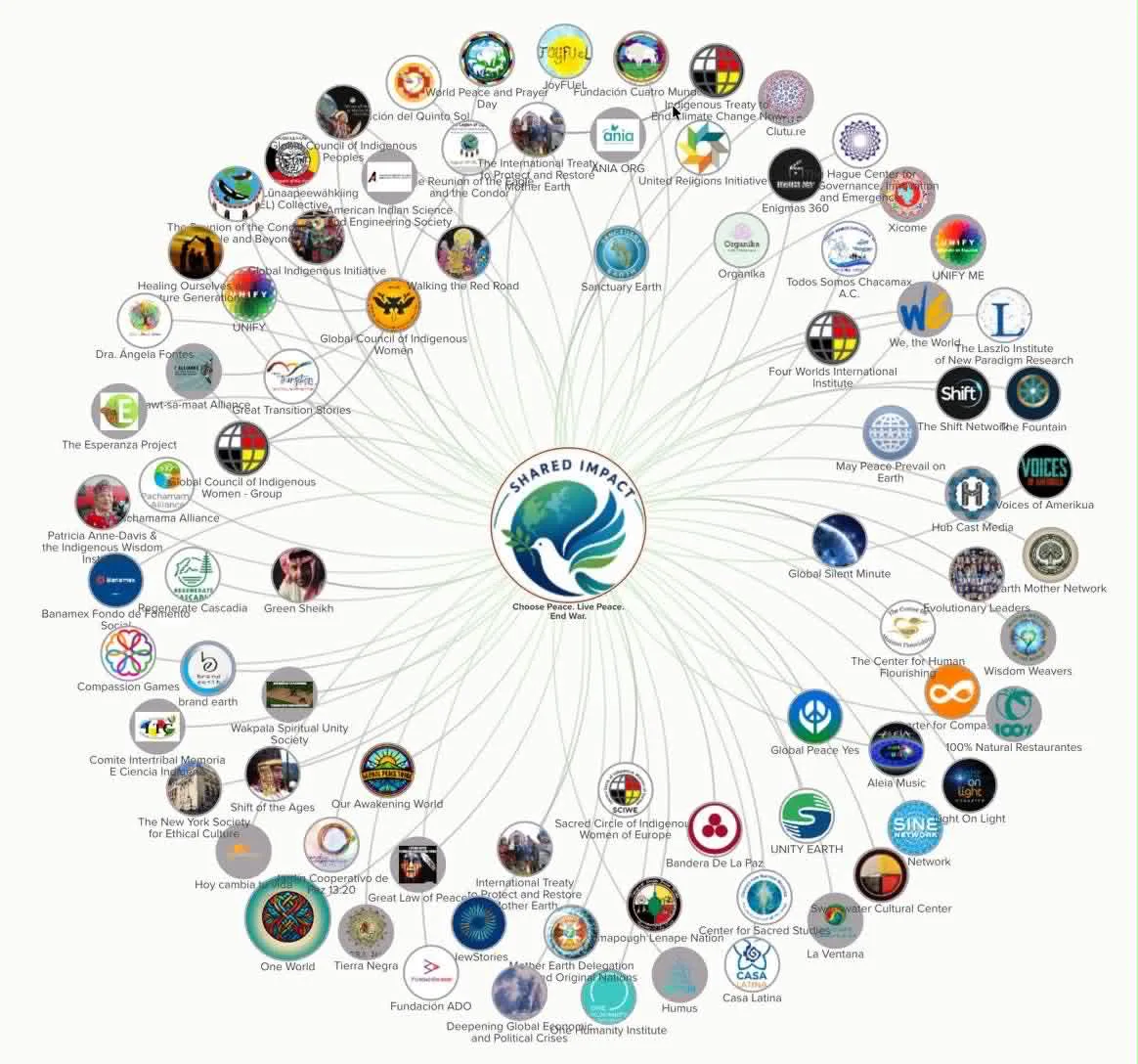
**PRESENTED BY **Hereditary Chief Phil Lane Jr. Chickasaw and Ihanktonwan Nations, White Swan Oyate, and our Friends and Relatives of the SINE Network below:
PRINCIPAL REFERENCES
Climate Action Tracker, Global Warming Projections Update (November 2026)
ICIMOD, Hindu Kush Himalaya research
United Nations Declaration on the Rights of Indigenous Peoples