
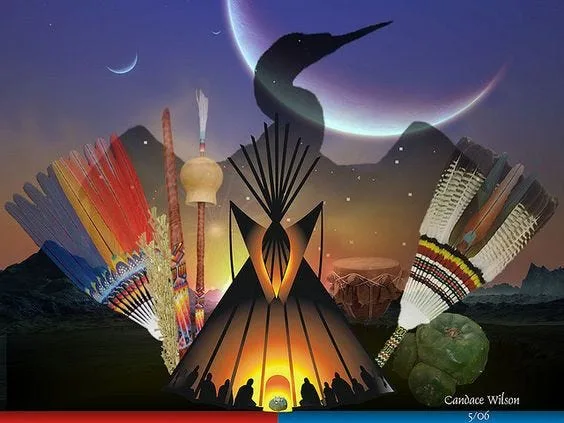
Peyote, when used within the disciplined, prayerful, and spiritually grounded ceremonies of the Native American Church, should not be classified or understood as a recreational drug. It is a sacred medicine—a sacrament, a teacher, and a relative—held within an Indigenous healing system developed and refined through generations of lived experience. Its purpose is not amusement, escape, intoxication, or the pursuit of unusual sensations. Its purpose is prayer, healing, sobriety, spiritual understanding, moral renewal, and restoring right relationships.
The healing cannot be attributed to peyote alone. It arises through the whole ceremonial circle: the Roadman, Water Woman, drummer, firekeeper, singers, relatives, prayers, sacred fire, water, cedar, tobacco, songs, silence, testimony, discipline, and the community’s loving support. These are not decorations surrounding the medicine. They are inseparable parts of the medicine and the healing process.
A Native American Church ceremony does not simply give someone a substance and leave that person alone with its effects. The participant is held throughout the night within an organized spiritual environment guided by experienced ceremonial leaders. Grief can be expressed, wrongdoing acknowledged, forgiveness sought, relationships reconsidered, and commitments renewed. The ceremony calls people back to sobriety, responsibility, service, humility, family, community, Mother Earth, and the Creator.
Western science frequently isolates mescaline—the principal psychoactive component of peyote—and asks what that chemical does to an individual brain. That is a legitimate but incomplete question. It does not adequately measure what happens when sacred medicine is joined with prayer, cultural identity, spiritual leadership, family participation, moral accountability, community support, and many years of continued ceremonial life.
Modern psychedelic science increasingly acknowledges that the effects of these medicines depend greatly upon intention, preparation, expectation, environment, trusted guidance, and what happens afterward. Researchers call these factors “set, setting, and integration.” Indigenous ceremonial traditions understood and practiced these principles for generations before Western science developed terminology for them.
The most important direct scientific study of long-term ceremonial peyote use was published in Biological Psychiatry in 2005 by researchers associated with Harvard Medical School and McLean Hospital. The researchers studied 61 Navajo Native American Church members who regularly used peyote, 36 Navajo people with a history of alcohol dependence who were then sober, and 79 Navajo people reporting little or no use of peyote, alcohol, or other substances.
Participants completed standardized assessments of mental health, memory, attention, and executive functioning. The Native American Church members showed no significant psychological or neuropsychological deficits compared with the group reporting minimal substance use. Furthermore, the total amount of peyote consumed over their lifetimes was not associated with poorer neuropsychological functioning.
The researchers concluded that they found no evidence of psychological or cognitive impairment among Native Americans who regularly used peyote in a religious setting. They also warned that their findings should not automatically be generalized to illicit or recreational hallucinogen users. Their study therefore recognized an essential truth: ceremonial peyote use and recreational drug use are not scientifically, culturally, or spiritually interchangeable. (Halpern and colleagues, 2005)
This research does not establish that peyote will heal every person or cure every medical condition. It does, however, directly challenge claims that long-term ceremonial peyote use inevitably damages the brain, weakens the mind, or produces widespread psychological deterioration. If regular ceremonial participation were commonly causing cumulative cognitive injury, some evidence of that deterioration should have appeared among long-term participants. It did not.
The role of the Native American Church in healing alcoholism is especially important. For generations, Native families have testified that participation in peyote ceremonies helped relatives stop drinking, face the suffering caused by alcohol, restore family relationships, and return to responsible community life. Earlier clinical and anthropological studies also documented the use of Native American Church ceremonies in recovery from alcohol and other substance misuse.
A 2023 scientific review of psychedelic approaches to addiction recognized the Native American Church’s long history of using peyote ceremonially to support recovery. It reported an earlier retrospective study in which 48 of 72 people experiencing alcohol addiction and 58 of 85 people experiencing other drug problems reportedly improved after mescaline-related experiences. These were not modern randomized clinical trials, but the findings are consistent with generations of testimony concerning sobriety and healing within Native American Church communities. (Review of psychedelic therapy in addiction, 2023)
A large 2023 study analyzed data from 56,276 participants in the United States National Survey on Drug Use and Health. After statistically accounting for demographic characteristics, mental-health factors, and other substance use, researchers found that people who had previously used peyote or mescaline had approximately 32 percent lower adjusted odds of experiencing a current substance-use disorder than people who had never used psychedelics.
The same association was not found for LSD or psilocybin. The researchers therefore raised an important question: did the difference arise from mescaline’s pharmacology, or from the traditional ceremonial and cultural settings in which peyote is often taken? The study could not answer that question, but its findings provide substantial reason to investigate the protective and healing power of ceremonial context. (Rabinowitz, Lev-Ran and Gross, 2023)
Because this was a cross-sectional population study, it cannot prove that peyote directly caused the lower rate of substance-use disorder. Native American Church members may also benefit from stronger family support, spiritual discipline, cultural identity, ceremonial participation, and community accountability. Yet that does not weaken the argument. It strengthens the understanding that healing occurs through an interconnected ceremonial and community system rather than through an isolated chemical acting alone.
Research into naturalistic mescaline use has also produced encouraging findings concerning depression, anxiety, post-traumatic stress, alcohol misuse, other drug misuse, and general well-being. In a 2021 study, many participants who reported these conditions also reported improvement following their most meaningful mescaline experience. Between 35 and 50 percent described the experience as either the single most spiritually significant or one of the five most spiritually significant experiences of their lives. (Agin-Liebes and colleagues, 2021)
These findings were based upon personal reports and included different forms and contexts of mescaline use. They cannot be presented as direct proof of Native American Church healing. They do, however, support the understanding that a spiritually meaningful experience can help a person encounter grief, reconsider trauma, recover hope, renew a sense of purpose, and make lasting changes in conduct.
The most current major review, published in March 2026, examined the scientific literature concerning mescaline and traditional mescaline-containing medicines. Researchers screened 2,770 references, although only ten studies met the standards for detailed analysis. The available studies reported improvements in depression, general well-being, nicotine dependence, alcohol use, and obsessive symptoms.
The review concluded that the evidence remains limited and uneven in quality, preventing definitive clinical conclusions. It also identified nausea, vomiting, headache, and temporary increases in blood pressure among commonly reported physical effects. Importantly, the authors recommended future research conducted in genuine collaboration with the Native American Church rather than research merely conducted upon Native people. (Shaw and colleagues, 2026)
Peyote does not display the ordinary characteristics of an addictive drug. Mescaline does not normally produce compulsive daily consumption, a classic physical-withdrawal syndrome, or the escalating drug-seeking behavior associated with alcohol, nicotine, opioids, cocaine, or methamphetamine. Its effects last many hours, and repeated use over consecutive days rapidly produces tolerance rather than an endlessly increasing appetite for more.
Peyote is also extraordinarily bitter. It commonly causes nausea and sometimes vomiting. Scientific reviews have identified its intense bitterness, nausea, long duration, and relatively low potency as reasons its recreational abuse has remained much lower than might otherwise be expected. These qualities make the popular image of people casually walking around “popping peyote buttons” profoundly misleading. (Scientific review of mescaline pharmacology)
It would be too absolute to claim that recreational misuse never occurs. Almost any sacred medicine can be removed from its proper context and misused. The evidence shows, however, that recreational peyote use is uncommon and fundamentally different from Native American Church practice.
A 2019 study involving 3,861 American Indian youth found that approximately 7 percent reported spiritual peyote use, while only about 2 percent reported recreational use. Spiritual use was associated with stronger cultural identity and religious commitment. Recreational use was much rarer and more closely associated with alcohol and marijuana consumption. This research demonstrates that spiritual and recreational peyote use are distinct behaviors, with different intentions, relationships, and social environments. (Prince and colleagues, 2019)
The healing efficacy of Native American Church ceremony may arise through several interconnected processes. Peyote can temporarily loosen rigid patterns of thought, fear, and self-protection. Memories, grief, shame, and unresolved conflicts may become accessible in a different way. Prayer and spiritual intention give direction to that opening and meaning to that person, so it does not enter a meaningless chemical disturbance, but a sacred encounter with truth, responsibility, relationship, and the Creator.
The ceremonial circle provides protection and human connection. Songs, drumming, fire, water, cedar, silence, prayer, and the steady presence of experienced relatives help carry the participant through the night. The person is not abandoned when fear, grief, memory, or difficult truths arise. The ceremony provides a pathway through those experiences and back toward balance.
Healing also takes place relationally. Addiction, trauma, shame, and despair frequently isolate people from family and community. Ceremony brings the individual back into the circle, where suffering can be witnessed, prayers can be offered, commitments can be made, and the person’s return to responsible living can be supported.
A single ceremony may open a door, but the Native American Church provides continuing integration through years of prayer, ceremony, service, teaching, and responsibility. Roadmen, Water Women, drummers, singers, firekeepers, elders, relatives, and entire families help carry the healing forward. Insights received during one night are tested through daily conduct: sobriety, truthfulness, service, compassion, family responsibility, and care for the people.
Ceremonial participation can also restore cultural identity. Colonization attempted to separate Indigenous peoples from their spiritual ways, languages, families, lands, ceremonies, and sources of collective identity. Returning to a respected Indigenous spiritual way can therefore heal at both the personal and collective levels. It reminds the participant that no one stands alone: every person belongs to a family, a people, a spiritual lineage, the ancestors, the unborn generations, Mother Earth, and the great circle of life.
For these reasons, extracting mescaline, placing it in a capsule, and administering it in a clinical room cannot be assumed to reproduce the healing of a Native American Church ceremony. The molecule may help create an opening, but the prayers, songs, relationships, cultural memory, ceremonial discipline, spiritual leadership, and long-term accountability help determine where that opening leads.
Randomized controlled trials have compared ceremonies with conventional treatments. Such studies would be extremely difficult to conduct without disrupting the ceremony, violating its spiritual integrity, or disregarding Indigenous religious sovereignty. The absence of those trials does not demonstrate an absence of healing. It reflects a history of prohibition, persecution, limited funding, cultural misunderstanding, and the limitations of Western experimental methods when applied to a sacred and relational Indigenous practice.
Several streams of evidence now converge: generations of consistent Native testimony; documented use in sobriety and addiction recovery; observational evidence of emotional, psychological, and spiritual benefit; population evidence associating peyote or mescaline with lower odds of substance-use disorder; and direct neuropsychological evidence finding no cognitive or psychological deficits among long-term ceremonial users.
No single stream of evidence is conclusive by itsetogether, however, it is a serious body of evidence that cannot honestly be dismissed as superstition, recreational drug use, or hallucination. The findings justify further respectful research while already providing substantial support for the safety and potential of peyote in the Native American Church.
Peyote, as held within the Native American Church, must be understood as part of a complete Indigenous healing system. Its efficacy cannot be measured only by examining what mescaline does to an isolated brain. It must also be evaluated by what happens when a suffering person is surrounded through the night by prayer, sacred songs, fire, water, cedar, disciplined leadership, family support, cultural identity, moral reflection, spiritual experience, and an invitation to return to sobriety and responsibility.
The medicine may open the heart and mind, but the ceremony directs that opening toward healing. The community receives the person back. The years that follow reveal whether the experience becomes a transformed life: whether alcohol and destructive substances are left behind, relationships are repaired, responsibilities are accepted, families are strengthened, and the person begins serving the people with greater humility and compassion.
These are not secondary or incidental outcomes. They are among the deepest measures of healing. The real question is not simply whether peyote works as an isolated chemical. The deeper question is what becomes possible when sacred medicine, prayer, spiritual discipline, loving relationships, cultural identity, community accountability, and personal responsibility work together.
Both the available scientific evidence and the accumulated experience of Native American Church families provide substantial reason to conclude that profound healing is possible within the Native American Church. This honors the honesty of the evidence and the strengths of the tradition, rather than erasing what people have already observed, tested, protected, and lived.