
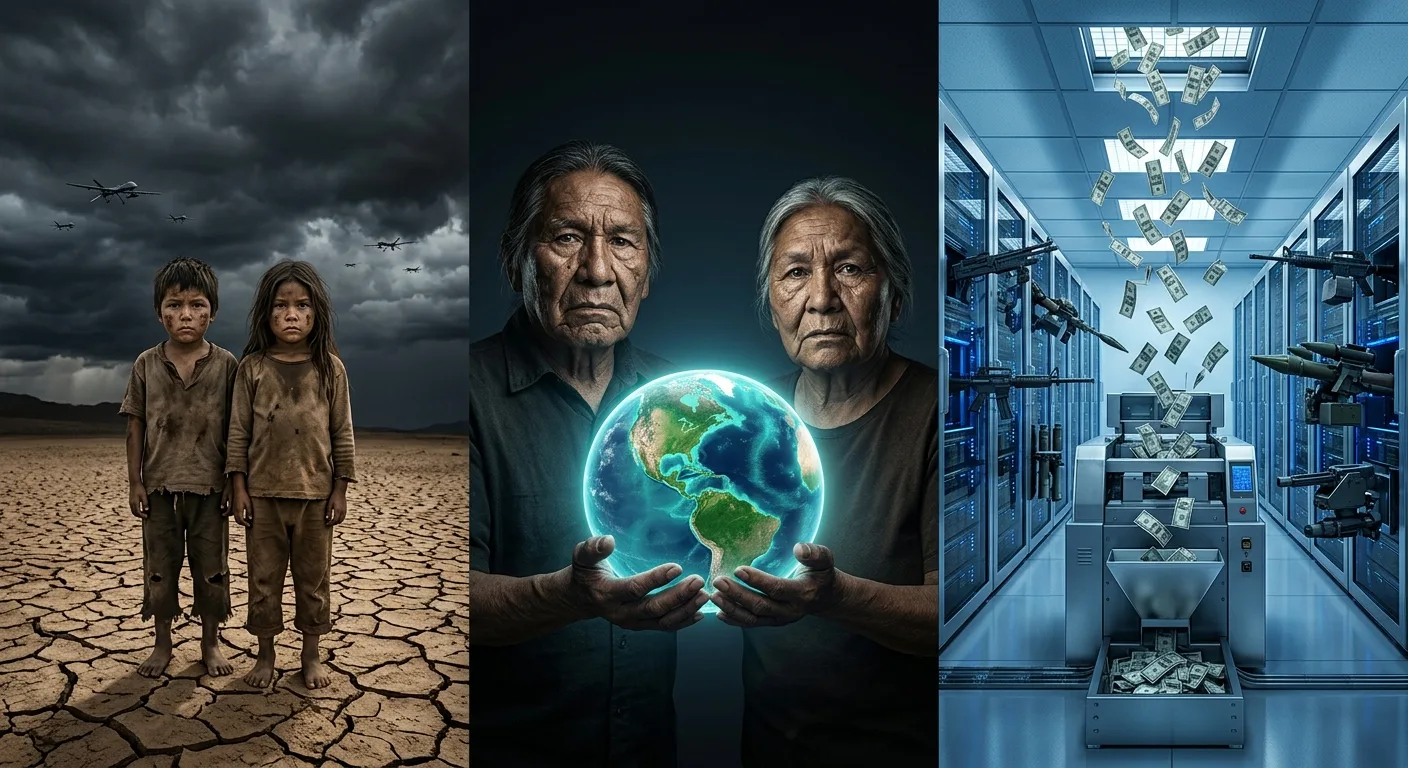
**The AI Investment Explosion, Global Military Spending, and the Case for a Global AI Commons **
Before the generative AI boom, global investment in AI was relatively modest. In the years leading up to 2022, annual private investment in AI hovered around $60–90 billion worldwide. Then came the inflection point. From 2023 onward, spending accelerated dramatically. By 2025, global corporate AI investment had reached roughly $580 billion, with infrastructure and capex accounting for the largest share. Projections for 2026 now point to $1 trillion or more in total AI-related spending globally, with the United States accounting for close to $580–600 billion of that alone.
This is not incremental growth — it is a tenfold leap in capital deployment in just a few years. The United States is outspending China by roughly 8 to 10 times on AI infrastructure and hyperscaler capex. American tech giants are pouring hundreds of billions into massive data center builds, specialized chips, and power infrastructure. China, by contrast, achieves comparable or competitive model performance at a fraction of the cost — often 5–10x cheaper on both training and inference.
The result is massive duplication of effort. Multiple leading labs in the US and China are racing to build similar frontier-scale clusters, train overlapping foundation models, and solve nearly identical technical challenges. Talent is fragmented, energy consumption is skyrocketing, and enormous amounts of capital are being spent in parallel on fundamentally redundant work.
What a Global AI Commons Actually Means
A Global AI Commons would treat foundational AI models, key datasets, and core research breakthroughs as shared infrastructure for humanity — like the internet protocols, GPS, or scientific knowledge itself. Instead of every company and country racing to build their own version of the same foundational capabilities, we would create open, collaboratively governed systems that anyone could build upon.
This isn’t naive idealism. It’s pragmatic efficiency. The current model is like every country building its own separate internet from scratch. The duplication is staggering. A commons approach would allow the world’s best minds to focus on genuinely novel problems — meaning entirely new challenges that no one is seriously working on right now because everyone’s stuck reinventing the same basic tools. Instead of building yet another large language model, researchers could tackle things like: AI systems that can truly reason about scientific hypotheses and design experiments; models that help developing nations optimize their agriculture for both climate resilience and local food security; or AI that can accurately model the complex interactions between climate systems, ecosystems, and human societies to predict tipping points before they happen.
These are the kinds of breakthrough applications that get pushed aside when trillions are spent on duplicated frontier model development.
The Interlocking Crises: War, AI, Inequality, and the Imperative of Peace
Two powerful forces are accelerating global inequality. While a small number of individuals and corporations accumulate unprecedented wealth, hundreds of millions remain trapped in poverty.
Today, 847 million people live in extreme poverty on less than $2.15 per day. Even more starkly, roughly 3.5 billion people — about 44% of humanity — are living on less than $6.85 per day. These numbers have barely improved in decades.
Recent conflicts, including the war involving Iran, have made the situation worse. Economic modeling shows the conflict has already pushed an additional 20 to 21 million people into poverty across vulnerable countries through higher food, fuel, and fertilizer prices.
At the same time, global military spending reached $2.89 trillion in 2025 — up nearly 46% since 2020. AI is being rapidly integrated into weapons systems, autonomous targeting, intelligence, and cyber operations, creating a dangerous fusion of these two massive capital flows.
These expenditures come with a high human cost. Resources that could address poverty, healthcare, education, and climate resilience are instead diverted to preparing for conflict, even as extreme weather events become more frequent and destructive.
A powerful step toward change occurred on July 20, 2025, at Dripsey Castle in Cork County, Ireland, where the Binding Planetary Peace Treaty to End War was signed. This covenant calls for the complete renunciation of war as an instrument of policy and is open for signing by all nations and peoples. It represents a growing global movement to end armed conflict permanently.
As Chairperson of Compassion Games International, we initiated the global call to Choose Peace, Live Peace, End War on June 21st, 2026. We stand with a growing movement that includes the Global Peace Activation on August 8th, 2026, the Binding Planetary Peace Treaty signed at Dripsey Castle, Women Wage Peace, World BEYOND War, Unity Earth, the International Peace Bureau, and many other aligned organizations worldwide.
Together, we are rising — and we are ready to help build the solution.
We now face a clear choice between two paths.
Path One — Continued Fragmentation and Conflict: Military spending climbs toward $3 trillion annually while AI infrastructure investment surpasses $1 trillion per year. The combination of runaway defense budgets, AI militarization, and duplicated commercial AI development consumes vast resources. Inequality widens, climate action stays underfunded, and extreme weather intensifies. The result is a more unstable, divided, and impoverished world.
Path Two — Choosing Peace and Cooperation: By embracing the spirit of the Dripsey Castle treaty — a binding global commitment to end armed conflict between nation-states — we open the door to a Global AI Commons. The world’s best scientific talent can work together on foundational AI for humanity’s benefit rather than as a strategic weapon. Hundreds of billions of dollars each year can be redirected toward regenerative infrastructure, poverty alleviation, and climate solutions.
A Direct Call to World Leaders and Decision-Makers
To every President, Prime Minister, Head of State, and all those in positions of influence and authority over the future of humanity:
What we are doing is morally indefensible.
While 847 million people struggle to survive on less than $2.15 a day, and 3.5 billion human beings — nearly half of humanity — live on less than $6.85 a day, we are collectively spending $2.89 trillion on war and military systems every year, and over $1 trillion on AI infrastructure — much of it being turned into weapons of control and destruction.
This is not leadership. This is madness.
The Binding Planetary Peace Treaty to End War, signed at Dripsey Castle on July 20, 2025, offers us a clear and honorable path out of this insanity. We call on you — without delay — to sign this treaty, bring it before the United Nations, and commit your nations to permanently ending armed conflict between states.
Choose peace. Live peace. End war.
The eyes of the materially poor, the future of our children, and the survival of our planet now rest squarely on your conscience. History will not be kind to those who had the power to stop this madness and chose to look away.
The time for silence and excuses is over.