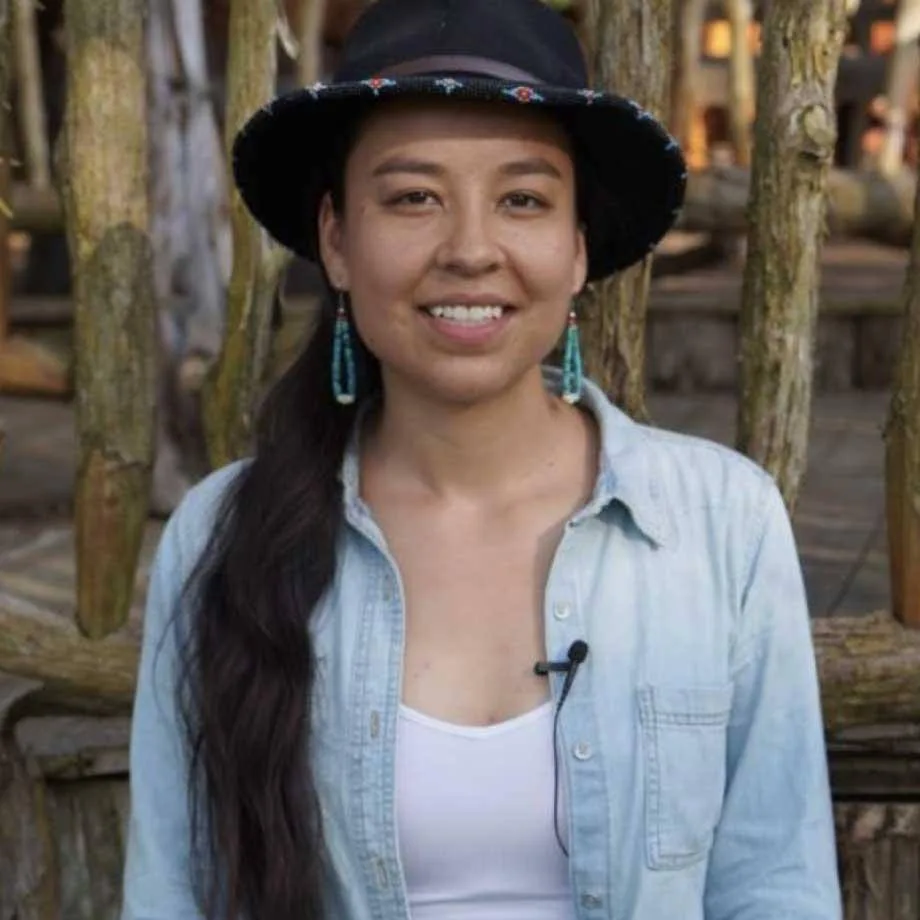
Two of the Most Brilliant Young Minds and Souls on Mother Earth Today,
In the lives and work of Tonja’s Dr. Lyla June Johnston and Dr. Tamsin Woolley-Brarker, we meet two young women who are reading the living world with remarkable clarity, each from a different doorway, yet walking toward the same lodge of understanding.
Tonja Lyla June, a Diné and Tsétsêhéstâhese scholar, musician, and community organizer, has devoted her doctoral work, Architects of Abundance, to uncovering the “hidden history” of Indigenous regenerative food and land management systems across the Americas. She shows that what some have called “wilderness” was, in truth, a vast, sophisticated mosaic of Indigenous agro-ecosystems—food forests, polycultures, and carefully tended landscapes designed to nourish not only human communities, but the entire web of life. In talks like “3000-year-old Solutions to Modern Problems,” she reveals how these land-care systems generated abundance, biodiversity, and social balance over thousands of years, guided by ceremony, kinship, and reverence for Mother Earth.
Tonja Tamsin Woolley-Barker, an evolutionary biologist and biomimicry pioneer, stands on another hillside looking at the same valley. In her book Teeming: How Superorganisms Work Together to Build Infinite Wealth on a Finite Planet, she studies ants, bees, termites, fungi, forests, and other “superorganisms” to distill the principles by which life organizes itself successfully over deep time. She shows that thriving species and societies are those that learn to fit into larger ecological systems: distributed decision-making, constant feedback, mutualism, and continuous adaptation. For her, the most resilient organizations and economies are those that imitate the logic of living systems—reinvesting surplus into the commons, strengthening relationships, and enhancing the health of the whole.
When we listen to them side by side, their teachings braid together into a single strong strand. Both insist that we must let living systems lead. Tonja Lyla June teaches that forests, grasslands, wetlands, and rivers are not resources but relatives, and that pre-colonial Indigenous societies designed food systems as communities of kin—corn, beans, squash, trees, waters, pollinators, soils, and people, all supporting each other.
Tonja Tamsin describes superorganisms as networks of countless individuals acting as one coherent being through local signals and shared memory. Whether we speak of tribal kinship or superorganisms, both portray life as a tapestry of highly cooperative, relational networks. Real resilience, they remind us, arises not from isolated individuals or isolated firms, but from communities where everyone and everything is nested in relationships of mutual care.
Both also challenge the modern obsession with extractive “growth.” Tonja Lyla June’s research shows Indigenous food systems that increased soil fertility, biodiversity, and abundance over millennia, leaving the land richer with each generation. She measures wealth in clean water, healthy soil, vibrant cultures, intact languages, and right relationship.
Tonja Tampsin reframes wealth as the capacity of a living system to keep generating value for all its members on a finite planet—“infinite wealth on a finite planet” when we follow nature’s rules. In her vision, superorganisms do not hoard; they reinvest surplus into the commons—into soil, structure, offspring, resilience. Together, they speak with one voice: abundance is not more extraction; abundance is when the land, the people, and the community all grow healthier together.
Their visions of leadership also converge. Tonja Lyla June lifts up community-rooted leadership: councils, strong women’s leadership, consensus shaped by ceremony and accountability to land and ancestors. Leadership, in her understanding, is a sacred service, guided by prayer, humility, and deep listening.
Tonja Tamsin points out that, in superorganisms, intelligence is distributed—no single ant or bee commands the colony. Local actions, attuned to feedback, create global order. She calls for human organizations to move away from rigid pyramids and toward flat, teeming networks of many small, empowered units. Both teach that the healthiest systems decentralize power and invest intelligence in relationships and feedback, not in a single commander. From the council fire to the superorganism, they remind us that truly regenerative systems rely on distributed, humble leadership.
Finally, both women ask us to step back into deep time and into a more mature ethic. Tonja Lyla June speaks of 3,000-year-old agro-ecosystems, multi-generational stewardship, and decisions made in the presence of ancestors and future generations—choices that must still be good seven generations from now.
Tonja Tamsin thinks in evolutionary time: millions of years of trial and error across species and ecosystems. If a strategy has survived that long, she suggests, it carries a profound wisdom. Whether we call this “ancestral memory” or “evolutionary history,” both perspectives challenge the short horizons of quarterly earnings and election cycles, and both root us in responsibility, reciprocity, and relationship. Every gift from the land calls for a gift in return. Every insight into life’s patterns binds us morally, because we now know better.
Taken together, the work of Tonja’s Dr. Lyla June Johnston and Dr. Tamsin Woolley-Barker offers a beautiful, cutting-edge understanding of the world we live in—one that is at once ancient and urgently contemporary. One speaks from the fire of Indigenous ceremony, the other from the lens of evolutionary science; yet they are describing the same living pattern from two directions.
Both invite us to see ourselves not as masters of a dead planet, but as participants in a vast, intelligent, self-organizing community of life. Both call us to redesign our food systems, our economies, our organizations, and our cultures so that they behave more like healthy forests—rooted in reciprocity, guided by deep time, and devoted to the flourishing of all our world community.