
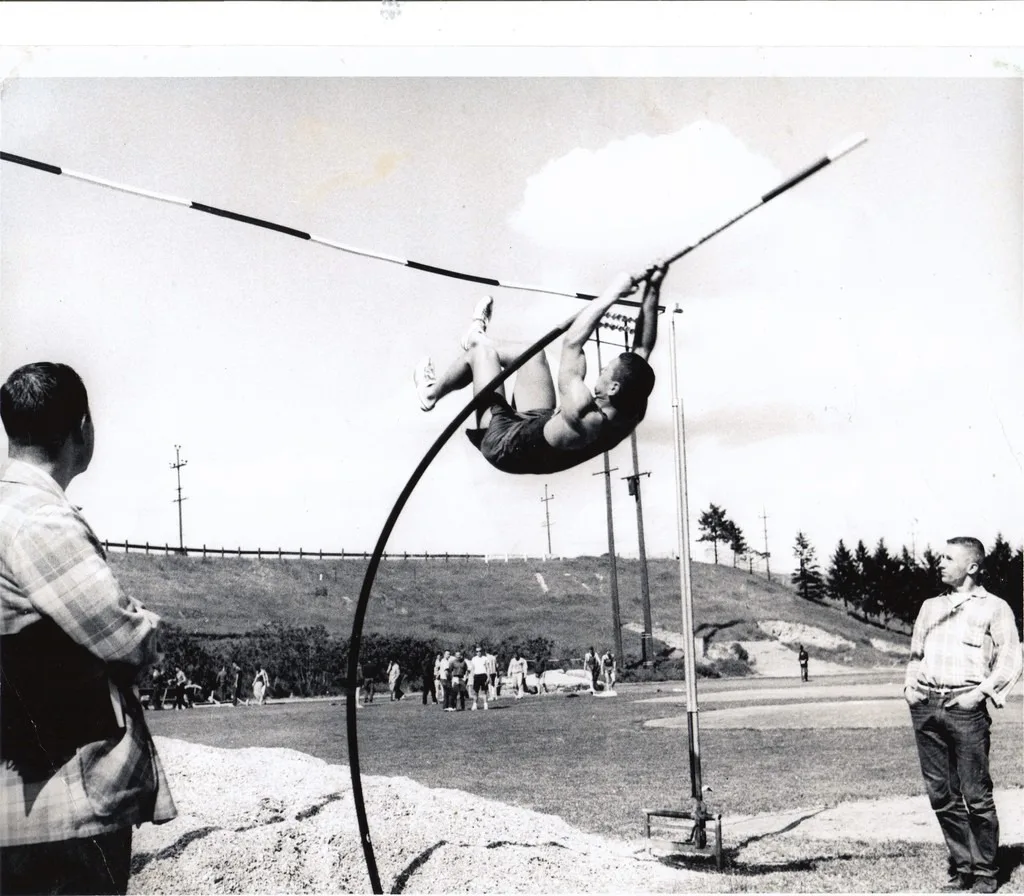
It began in the early 1950s, when our family got a new rug. In those days, if you ordered a rug from the Sears and Roebuck catalog, it arrived rolled around a long bamboo pole. To most people, that pole was simply part of the packaging. To my father, who did some pole vaulting at Haskell, it was an opportunity. He decided to teach me how to vault.
My father knew that bamboo poles could split or shatter and seriously injure a vaulter, so before I ever used it, he carefully wrapped white surgical tape around every joint. He wanted me to learn to vault, but he also wanted me to be safe. He found a long, thin piece of wood for a crossbar, built a pair of wooden standards, and brought home several bales of straw to make a landing pit. It was a very simple beginning, but to me it became a whole new world.
To motivate me, Dad promised that when I cleared six feet, he would take me to Pendleton, about fifty miles away, to see Rob Roy, the Highland Rogue. I loved films in which oppressed people stood against their oppressors, people who struggled for freedom and dignity and who, whether they won or died trying, acted with courage and honor.
Another film I loved was Gunga Din, which I saw when we lived in McNary, Oregon. It was an older black-and-white film, and admission to the Saturday-afternoon matinee was only ten cents. The show was not held in a regular movie theater. It took place in a large community room filled with folding chairs. The program usually began with a cartoon or a Three Stooges or Abbott and Costello short, followed by the main feature. Going to those Saturday shows was a great event for us. I still remember how exciting it was when Abbott and Costello began making full-length movies.
With Rob Roy waiting at the end of my effort, I practiced pole vaulting every day. I was bound and determined to clear six feet and make that trip to Pendleton. Finally, I did it. I ran to get my father so that he could verify it with a measuring tape. I remember my next vault over six feet very clearly. Dad smiled, clapped his hands, and said, “Dugo, you did it! We will go see Rob Roy next Saturday.” And we did.
My father made the same promise to a young friend who sometimes joined me during my daily practice. My friend never quite cleared six feet, but Dad took him to the movie with us anyway. That taught me something about my father. The goal helped us work and grow, but love was not a prize to withhold. The measurement mattered, yet the relationship mattered more.
From then on, I pole vaulted every spring. I won my first gold medal in the sixth grade. That victory meant a great deal to me because the Umatilla County Track Meet required me to compete against students as old as the eighth grade.
I loved pole vaulting so much that one summer my father shipped my pole to Sherwood Corners, near Wakpala, on the Standing Rock Reservation, where he was born. I spent some summers there with my Unchi Martina and the Sherwood family. Those summers were filled with horseback riding, rounding up cattle for branding, and helping with the haying.
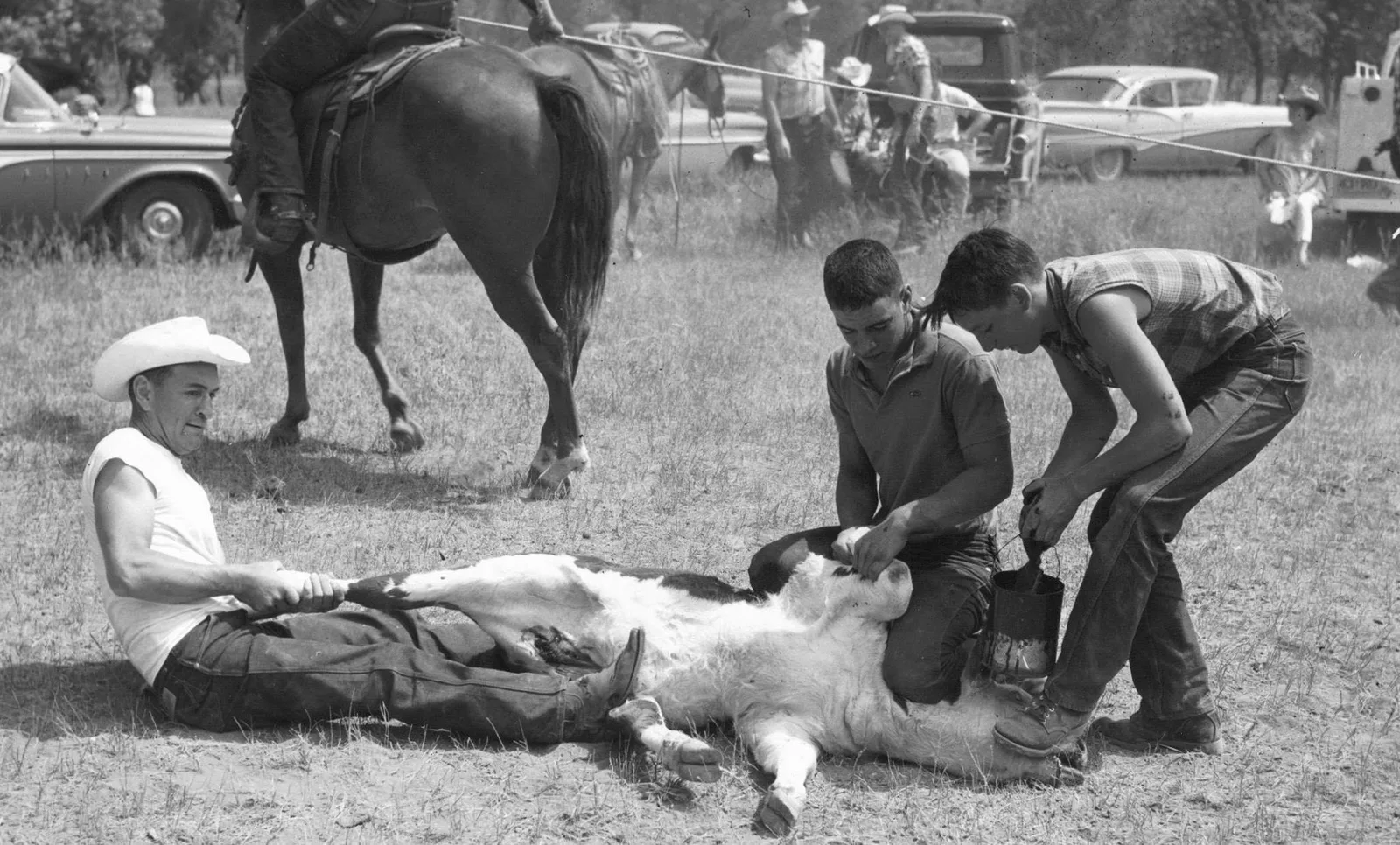
I did not especially enjoy riding the bale sled. It meant standing behind a tractor, lifting and stacking bale after bale while a continuous stream of dirt, dust, chaff, and other debris blew into your face. Every so often, we caught a live rattlesnake and baled it with the hay, so we had to inspect each bale carefully before grabbing it. That was a different kind of athletic training: hard work, watchfulness, balance, and respect for what might be hidden right in front of you.
With the help of my younger Tahansi, Greg Sherwood, I built another makeshift runway, pit, and set of standards near the corrals. Greg was my only fan and my faithful helper. Every day I vaulted, he came down to watch and catch the pole after each attempt. He did not receive a medal or appear in the record book, but he was part of every vault I made that summer. Looking back, I understand more clearly that none of us rises entirely alone. Behind every visible achievement are people whose loyalty, encouragement, and quiet service made it possible.
I was not a naturally gifted athlete in the way my daughters were: Joslynn in soccer, Shannon in long-distance running, Lisa in volleyball and basketball, and Deloria in football, basketball, and the 100-, 200-, 400-, 800-, and 1,500-meter races. What I had was determination. I trained hard, studied every sport I participated in, and was intensely competitive.
After using different bamboo poles, I graduated to a Swedish steel pole. Then, during my senior year of high school, I got my hands on a fiberglass pole. I had been reading about this new technology and immediately began looking for a way to order one. I can still remember the excitement I felt when that long shipping tube finally arrived.
The fiberglass pole changed the event. I didn’t have the exceptional speed or height to continue far beyond high school, but the new pole opened a window of opportunity. I thought, if I could understand and master its flexibility before most other vaulters did, I might be able to go higher than my natural physical abilities alone would have taken me. Along with running Joe Gomez for Student Body President (He did not exist), I made learning to use that pole my great passion that spring.
No coach taught me. At the time, most high school and university coaches didn't yet understand fiberglass poles. I was on my own. I had to observe, experiment, fail, make adjustments, and try again.
I quickly discovered that learning to vault with a fiberglass pole was like riding a wild horse. The pole stored tremendous energy, but you had to approach it with respect. Time after time, it threw me everywhere except over the crossbar. Sometimes I landed upside down in the pit. Sometimes I landed entirely outside it. I failed far more often than I succeeded. Yet, little by little, day after day, my body began to understand what my mind was trying to learn.
I learned I couldn’t overpower the pole. I had to work with it. My run, stride, plant, takeoff, swing, turn, and release had to become one continuous movement. If I hesitated, resisted, or tried to control every instant through force, the vault failed. I had to prepare with discipline and then, at the decisive moment, commit myself completely. I had to trust what I had practiced, allow the pole to bend, and let its stored energy carry me upward.
That was more than an athletic lesson. Many years later, I would recognize the same truth in community development, healing, leadership, and spiritual growth. Real transformation cannot simply be forced upon people from the outside. Preparation, timing, trust, participation, and aligned forces are required. A leader cannot merely command a community to rise. The people, the purpose, the relationships, and the moment must come into harmony. When they do, energy that seemed to bend under pressure can become the power that lifts everyone higher.
By the beginning of the track season, I was clearing the bar on about sixty percent of my attempts. I was the only vaulter in our high school league using fiberglass, and for a while that gave me an advantage.
My strongest challenger was my friend Doyle Clapper of Pasco High School. Doyle was an excellent pole vaulter and a fierce competitor. We competed against one another in football, wrestling, and track. Pasco never defeated our Blue Devils football team, and Doyle never defeated me on the wrestling mat. But once he got hold of a fiberglass pole, he beat me in the vault more often than I beat him.
Competition with Doyle helped me grow. A worthy competitor is not merely someone standing in the way of victory. That person can call forth capacities in us that might otherwise remain undeveloped. Doyle made me work harder, think more carefully, and reach more deeply. We challenged one another, but we were also friends. I learned that competition can be honorable when it does not deny relationship or diminish another person’s dignity.
At the last track meet of the season, the Inland Empire Junior Olympic, all my practice and experimentation finally came together. It was a beautiful, warm, sunny day in June 1962. For the first time, the fiberglass pole and I seemed to become one. My speed, the exact number and length of my steps, the planting of the pole, the drive and arch of my body, the turn, the push away, and the pole’s springing action came together in a single harmonious movement.
That was the last pole-vault competition of my life. I cleared twelve feet, seven inches, won the event, and set a new Inland Empire Junior Olympics record.
Yet the most beautiful part of that day was not the record. My father and mother sat in the stands, as they so often did, watching me. After I cleared the record height on my final attempt, they were the first people I looked for. That achievement belonged to them, too: to my father, who had wrapped that first bamboo pole in surgical tape, built those wooden standards, and measured my first six-foot vault, and to my mother, whose steady presence and support had accompanied me through the years.
After my final vault, the officials asked whether I wanted the bar raised to twelve feet, eight inches. I said, “No, that is enough for today.” Then I walked over, embraced my parents, and we went home.
There are moments in life when we must keep going, even when we are tired, discouraged, or repeatedly thrown outside the pit. But there are also moments when wisdom tells us that something is complete. On that June day, I felt entirely satisfied, not because I had become a record-breaking vaulter, but because I had reached an extraordinary summit within myself. I had taken my abilities, discipline, courage, and opportunity as far as I needed to. I was grateful, at peace, and able to walk away.
That is an important distinction. Giving up because we are frightened or discouraged is not the same as letting go because a season has fulfilled its purpose. One is surrender to fear. The other can be an act of freedom. Life requires the courage to persevere, but it also requires the wisdom to recognize when something is complete. If we cling too long to yesterday’s achievement, it can become an obstacle to tomorrow’s service.
In later years, I occasionally encountered young vaulters struggling to clear nine or ten feet. Just for fun, I would ask if I could try their pole. I would take off my shoes, run down the runway barefoot, and soar over the bar. Then I would tell them a little of my story and assure them that they were going to vault much higher than I ever had. And they did.
That brought me a different kind of joy. When we are young, we may measure success by how high we rise. As we grow older, we begin to understand that another measure of success is how many people we encourage to rise beyond us. The purpose of experience is not to place ourselves above the next generation. It is to give them confidence, share what we have learned, and help them begin from a higher place.
As it turned out, walking away after my peak performance was a wise decision. Within a year, many stronger junior and senior high school athletes had begun mastering the fiberglass pole. The record I set in June 1962 was eventually broken many times.
Today, elite high school vaulters surpass what seemed almost unimaginable in my youth, and the world’s finest athletes have carried the event into an entirely different realm. As of 2026, the men’s world record stands at 6.31 meters—about 20 feet, 8½ inches- while the women’s world record is 5.06 meters, about 16 feet, 7 inches.
Records are meant to be broken. That does not diminish the people who set them. Each generation inherits the knowledge, tools, courage, and achievements of those who came before and then adds something of its own. The bamboo pole prepared the way for steel. Steel prepared the way for fiberglass. One athlete’s breakthrough became another athlete’s starting point. This is how human development should unfold: not by erasing the past, but by honoring it, learning from it, and then reaching farther.
When I look back now, I see that my father’s first lesson contained almost everything that followed. He respected the old knowledge he had gained at Haskell, yet he adapted what was available. He saw possibility in an ordinary bamboo pole that others might have thrown away. He prepared it carefully so that innovation would not become recklessness. He built what we needed with his own hands. He gave me a goal worth striving for. He celebrated when I achieved it. And when my young friend fell short of the measurement, he brought him along anyway.
The fiberglass pole taught me to remain open to new ways of thinking, praying, learning, and acting. Innovation often appears strange or threatening before it becomes familiar. We should not embrace every new thing merely because it is new, but neither should we reject it simply because it is different. We must examine it carefully, test it, understand its risks, and discover whether it can serve life. The future belongs neither to those who unquestioningly worship innovation nor to those who fear it. It belongs to those who unite enduring values with courageous experimentation.
The vault also taught me about pressure. A fiberglass pole bends deeply before it lifts the vaulter. From the outside, bending may look like weakness or impending failure. But under the right conditions, the bend is storing energy. Human beings and communities also pass through times when they feel bent by hardship, injustice, grief, or struggle. We should never romanticize suffering, but we also shouldn’t assume that being bent means being broken. With support, purpose, healing, and faith, pressure can become strength and upward movement.
Most of all, pole vaulting taught me that rising requires both effort and surrender. I had to run with all my strength, strike the plant accurately, and commit myself without hesitation. But once the pole bent, I could not remain attached to the ground or insist on controlling the journey. I had to trust, rise, turn, release, and cross into open space.
So the lessons that have stayed with me are these:
Never give up merely because learning is difficult or because failure has thrown you somewhere you did not intend to land. Study carefully. Practice faithfully. Make adjustments. Try again.
Honor those who helped you rise. No achievement is entirely individual. Parents, grandparents, relatives, teachers, friends, competitors, and quiet helpers all place something beneath us that makes the ascent possible.
Welcome innovation, but unite it with wisdom, discipline, and a moral purpose. New tools can extend our abilities, but only values can determine how those abilities should be used.
Do not confuse bending with breaking. Sometimes life’s pressures gather strength for transformation.
Know when to persevere, and know when a season is complete. Walk away gracefully when your heart and spirit tell you that you have reached your summit and that another path of service is calling.
And when you have learned how to rise, do not spend the rest of your life guarding your height. Turn toward the young people. Share what you know. Encourage them. Tell them that they will go higher than you did, and rejoice when they do.
Always look for the light, no matter how the lampshade may look. Sometimes a discarded bamboo pole becomes the beginning of a lifelong lesson. Sometimes a pole bending nearly to the ground becomes the means by which we rise. And sometimes the greatest victory is not the height of the bar we clear, but the wisdom, gratitude, courage, and generosity we carry with us when we return to our Mother Earth.