The Larger Context
Humanity has reached a decisive turning point. The economic, environmental, technological, and social systems inherited from earlier stages of civilization can no longer meet the realities of an increasingly interconnected world. Climate instability, widening inequality, persistent poverty, armed conflict, social fragmentation, and the rapid development of artificial intelligence are converging in ways that affect every nation, market, community, and investor.
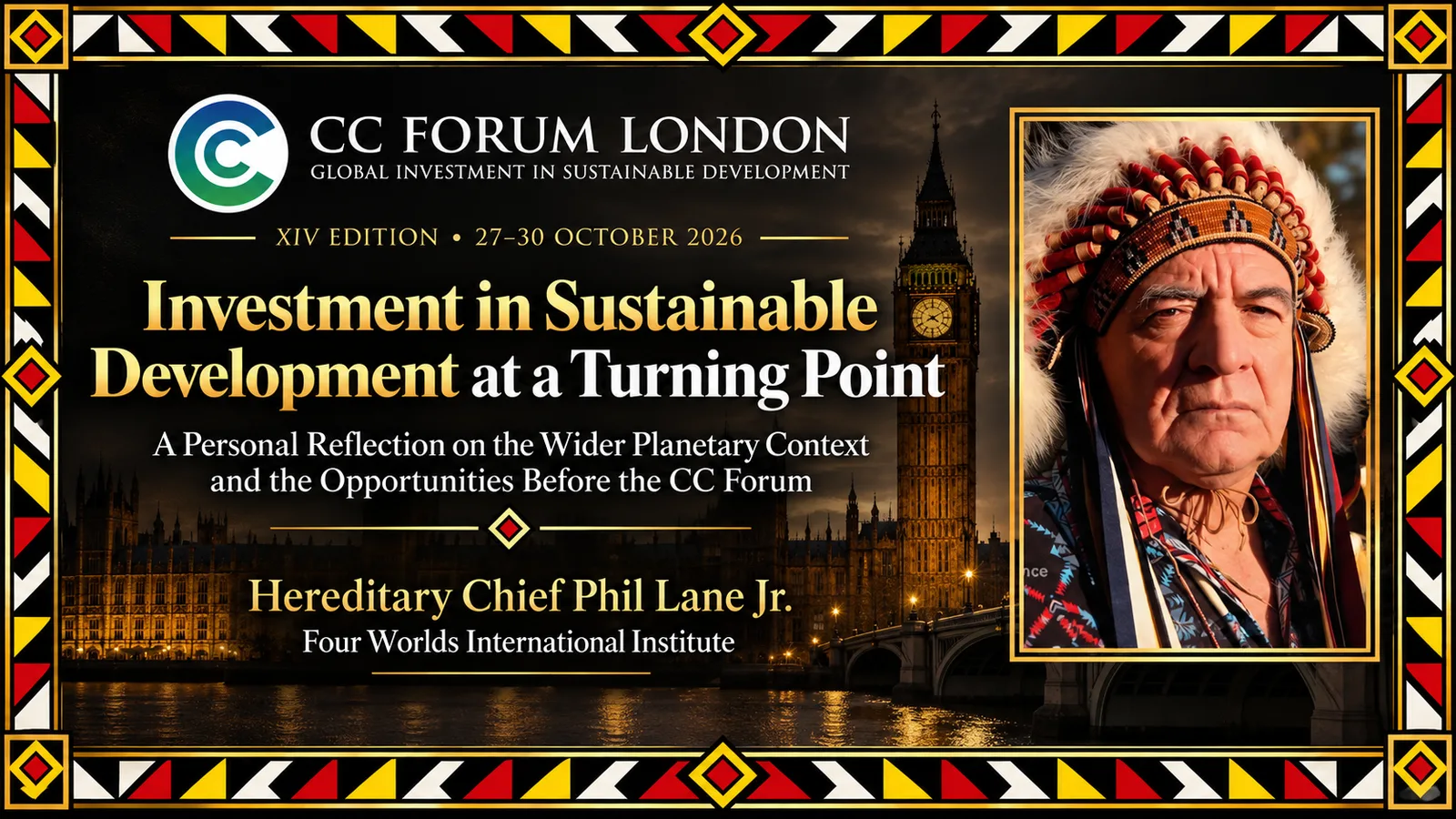
These challenges provide the larger context for CC Forum London, October 27–30, 2026, and its central focus on investment in sustainable development.
The purpose of considering this wider context is not to burden the Forum with every problem confronting humanity. It is to recognize that investment decisions do not occur in isolation. Where capital flows, which technologies it supports, whose capacities it develops, and what values guide its use will strongly influence the kind of future now being created.
Sustainable development investment must therefore be understood as more than financing environmentally responsible products or attaching social objectives to conventional investment practices. It represents an opportunity to reconsider the deeper purpose of economic development itself.
Material prosperity remains indispensable. Every person and community should have access to food, shelter, clean water, health care, education, energy, safety, and meaningful economic opportunity. Yet economic growth and material accumulation cannot be regarded as ends in themselves. Their highest value lies in providing the conditions through which people can develop their abilities, strengthen their communities, participate in economic life, and contribute to society’s advancement.
Developing Human Capacity
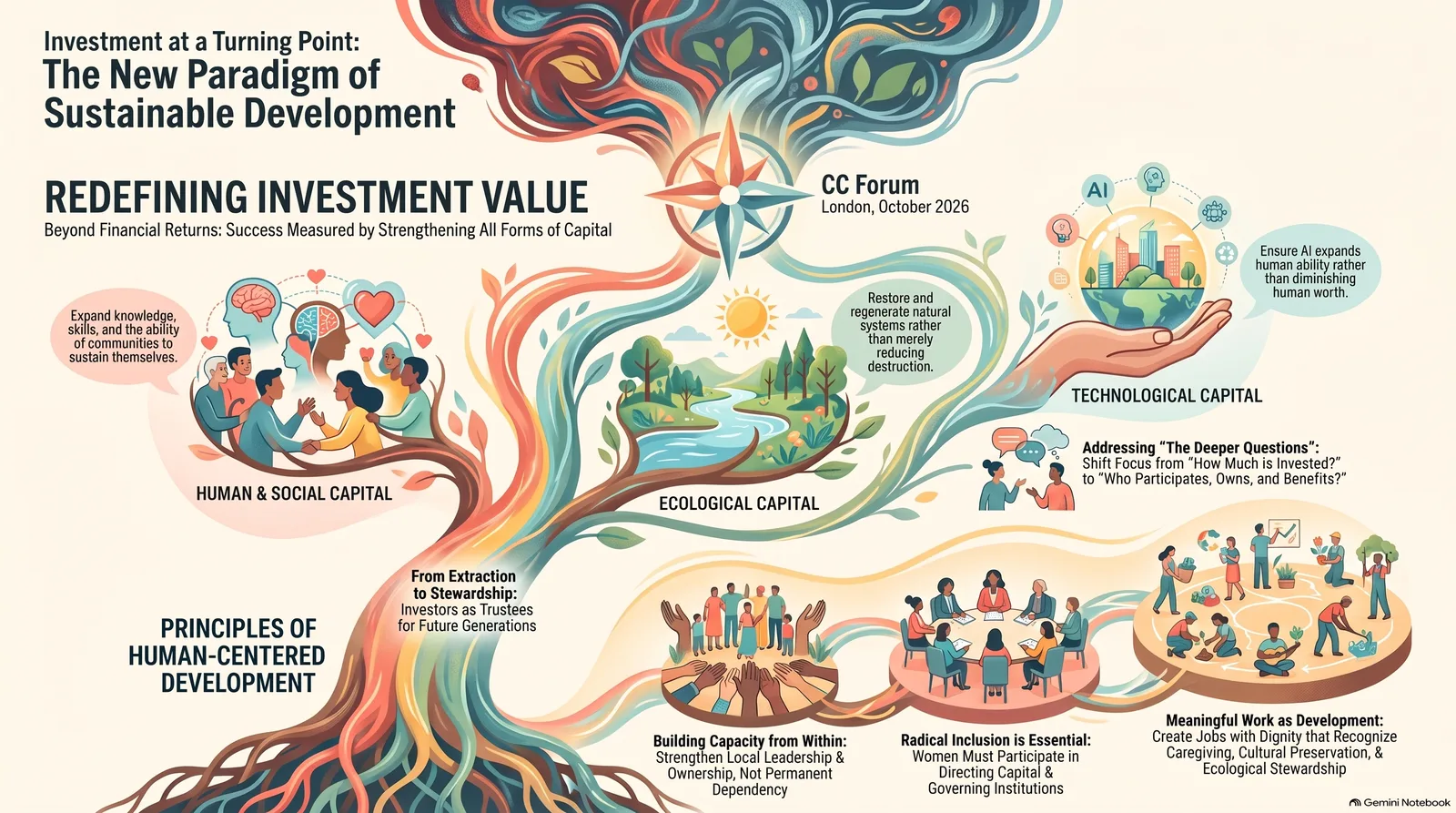
The central purpose of development is building human capacity. Investment should not only produce goods, infrastructure, technology, and financial returns. It should expand knowledge, skills, confidence, responsibility, creativity, ownership, cooperation, and the ability of people and institutions to shape and sustain their own future.
This principle is especially important in communities and regions that have historically experienced poverty, exclusion, colonization, displacement, conflict, or economic exploitation. Such communities must not be seen merely as recipients of aid, sources of labor, consumer markets, or locations from which resources can be extracted. Every community possesses knowledge, cultural intelligence, relationships, experience, creativity, resilience, and unrealized human potential.
Genuine development begins from within. Outside investment can provide essential capital, technology, infrastructure, market access, training, and professional support. However, it should strengthen, not replace, local vision, leadership, knowledge, ownership, and responsibility. The most successful sustainable investments will bring financial resources into respectful partnership with the capacities already present among the people.
This understanding requires a broader definition of investment value. Financial return remains necessary for most investment undertakings, but financial performance alone cannot fully measure success. A project may generate substantial short-term profit while weakening communities, exhausting natural resources, increasing dependency, or transferring hidden costs to future generations. Such an undertaking may be financially profitable while remaining developmentally and environmentally destructive.
A more complete approach recognizes multiple forms of capital: financial, human, social, cultural, intellectual, technological, and ecological capital. Sustainable investment should seek to strengthen these forms of wealth together. The objective is not to abandon profitability, but to produce responsible returns through activities that also build human capacity, regenerate natural systems, strengthen communities, and create enduring value.
Poverty demonstrates why such a reorientation is necessary. Humanity possesses the scientific knowledge, technological capacity, productive ability, and material resources required to eliminate the most extreme forms of deprivation. Yet poverty persists because investment and innovation do not reach the places of greatest human need.
Technologies capable of transforming agriculture, health care, water systems, education, housing, renewable energy, transportation, and local enterprise remain unavailable to many communities because conventional investment models do not consider them profitable or secure enough.
Investment in sustainable development can help bridge this divide. Patient capital, blended finance, cooperative ownership, locally rooted enterprise, community-controlled development, appropriate technology, and partnerships between investors and trusted local institutions can turn neglected human needs into opportunities for responsible and lasting development.
The question is not simply how much money is invested. The deeper questions are: Who participates in deciding how it is invested? Whose capacities are strengthened? Who owns what is created? Where do the benefits flow? What happens after the initial investors and developers leave?
Sustainable investment must enable communities to become stronger, more knowledgeable, more self-reliant, and better able to continue their own development. It should not create permanent dependency upon outside institutions. The purpose of investment is not merely to deliver a project to a community, but to build the human and institutional capacity through which people can sustain, govern, adapt, and expand what has been created.
Technology, Meaningful Work, and Equal Participation
The rapid development of artificial intelligence makes this human-centered approach particularly urgent. AI offers extraordinary possibilities for education, health care, translation, scientific discovery, financial inclusion, environmental restoration, coordination, and access to knowledge. It can help trustworthy people, projects, resources, technologies, and investment opportunities find one another across cultures and languages.
At the same time, AI may deepen inequality if its ownership, infrastructure, knowledge, and financial benefits remain concentrated among a small number of companies and countries. Sustainable development investment must therefore ensure that technology expands human ability rather than diminishing human worth. Artificial intelligence must remain a servant of human conscience, not a substitute for human responsibility.
The future of work is closely connected to this challenge. Work cannot be understood solely as a means of earning enough money to consume available goods. Through meaningful work, people develop and express their capacities, support their families, serve their communities, create knowledge, and help advance civilization.
Investment should help create work that carries dignity, purpose, fair compensation, and opportunities for continuing development. It should also recognize valuable contributions that conventional economic measurements often overlook, including caregiving, community service, cultural preservation, ecological stewardship, education, healing, and peacebuilding.
The full equality and participation of women must also be recognized as an essential condition of sustainable development. This is not a separate issue added to an investment strategy after its major decisions have been made. Women must participate in establishing priorities, designing initiatives, directing capital, governing institutions, evaluating results, owning enterprises, and sharing in the benefits created.
Women often stand closest to the daily realities of families, food security, health, education, caregiving, water, community well-being, and protecting future generations. Sustainable investment is strengthened when this knowledge and experience participate directly in decision-making. A development strategy that excludes women from authority and ownership excludes an enormous proportion of humanity’s intelligence and creative capacity, and will fail.
The same principle applies to young people, local leaders, traditional knowledge holders, and those most directly affected by investment decisions. Meaningful participation builds trust, improves decision quality, identifies risks outside institutions may miss, and strengthens the legitimacy and durability of development initiatives.
From Extraction to Stewardship
The environmental dimension is fundamental. No economy can remain healthy while destroying the natural systems upon which all economic and human life depends. Mother Earth cannot be treated as an unlimited source of raw materials or an unrestricted destination for waste. Sustainable development must restore and regenerate wherever possible, not merely reduce the rate of destruction.
This requires a shift from extraction to stewardship. Investors and enterprises must consider the full life of what they finance: where materials originate, how workers and communities are treated, how much energy and water are consumed, what waste is produced, what ecosystems are affected, and what consequences will remain for future generations.
The principle of stewardship requires a longer view of prosperity. An owner may assume the right to use a resource according to immediate interests. A trustee recognizes a responsibility to protect, renew, and pass forward what has been entrusted. This is the heart of seven-generational thinking: decisions must be evaluated not only by what they provide today, but by what they leave for generations whose faces we will never see.
This approach does not require every investor or enterprise to address every global problem. It asks each investment to understand its place within the larger whole and to apply principles appropriate to its purpose.
A sustainable development investment should be able to demonstrate that it addresses a genuine need, has a credible path to financial sustainability, protects Mother Earth, strengthens human and institutional capacity, includes those affected by its decisions, expands opportunities for women and young people, and produces benefits that can endure beyond the immediate investment period.
These considerations do not oppose sound business practice. They strengthen it. Community trust reduces risk. Local capacity improves continuity. Women’s participation expands knowledge and leadership. Ecological responsibility protects long-term value. Transparency builds confidence. Shared ownership encourages commitment. Meaningful work strengthens families and communities. Investments rooted in these principles are better prepared to withstand political, environmental, technological, and economic change.
The Opportunity Before CC Forum London
CC Forum brings together leaders with the resources, technologies, networks, experience, and influence needed to demonstrate a new direction. Its importance lies not only in the financial agreements that may be reached, but in the potential to create relationships between capital and purpose, innovation and responsibility, and global opportunity and locally led development.
The central opportunity before CC Forum is to help direct investment toward enterprises and partnerships that are financially responsible, environmentally regenerative, socially inclusive, technologically appropriate, and capable of releasing human potential.
Humanity does not lack knowledge, resources, technology, or creative ability. What is needed is the will to align them around a shared purpose. Sustainable development investment can become one of the most powerful instruments for accomplishing this alignment.
Investment can help create a world in which prosperity is not separated from justice, innovation is not separated from conscience, economic development is not separated from environmental responsibility, and financial return is not separated from the well-being of people and future generations.
The future will be shaped by the priorities humanity finances today. Where capital flows, the future follows. The responsibility and opportunity before CC Forum London are to help ensure that capital flows toward a future in which enterprise serves life, technology develops human capacity, communities become active partners in their own development, women and men participate equally, Mother Earth is protected, and prosperity is shared across generations.