
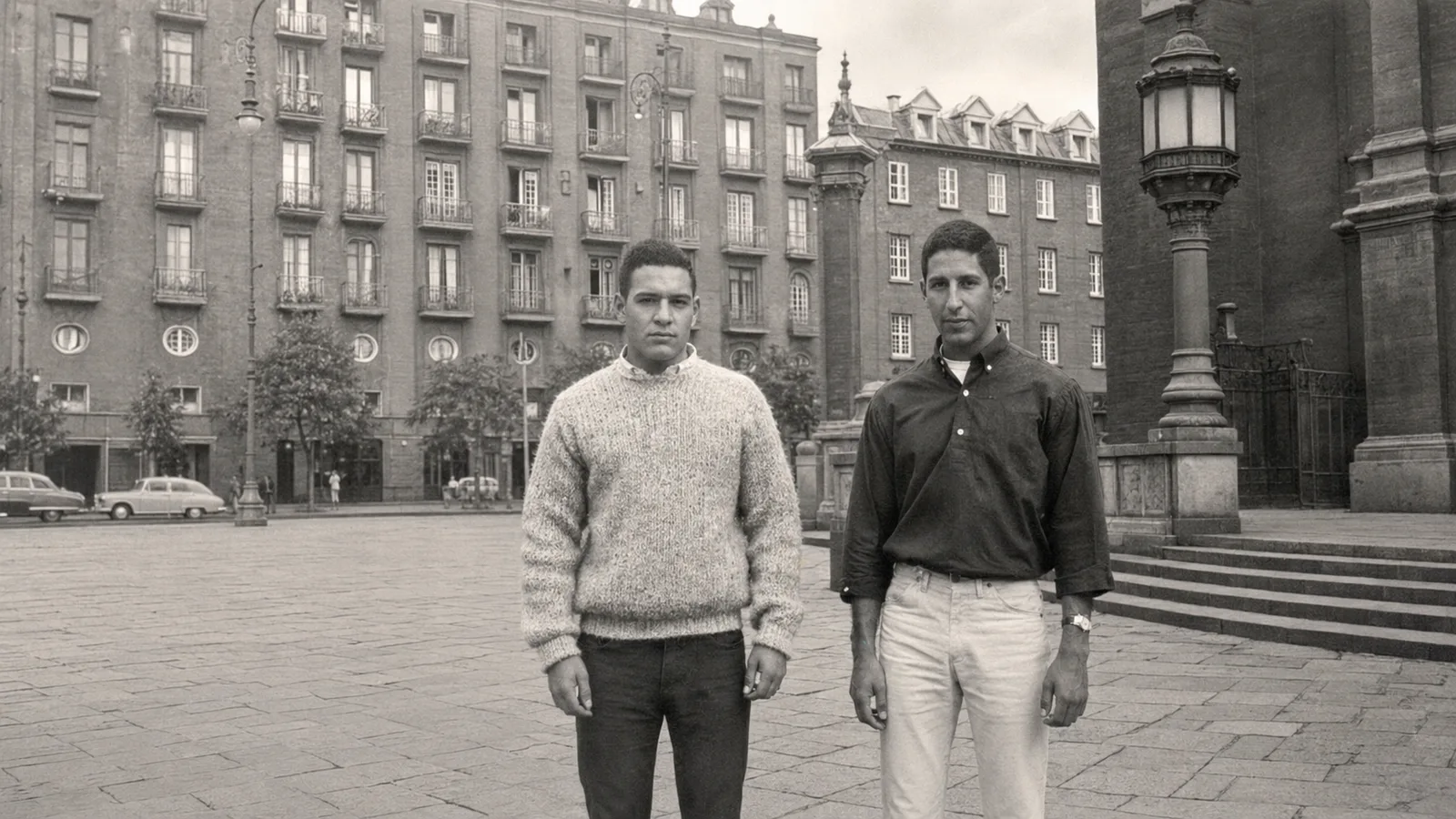
When I hitchhiked across Europe in 1962 and 1963, at the age of eighteen, one question remained constantly in my mind: What had caused some of our European relatives to do what they did to Indigenous Peoples in the Americas?
At that age, I did not yet possess the historical understanding I would gain later in life. I had not yet studied deeply what European colonial powers had done across Africa, Asia, the Pacific, the Middle East, and other parts of the world. But during that year in Europe, I began to witness some of the underlying attitudes firsthand.
I saw prejudice and classism operating between Europeans themselves. I saw how Roma people and other minorities were treated. I saw people judged and diminished because of their nationality, ethnicity, language, poverty, or social position.
It became clear to me that the attitudes used to justify colonization abroad had also existed within Europe: the belief that some peoples were naturally superior and others inferior, that some were entitled to rule while others were expected to serve.
For two months, my traveling companion, Mike Friedman, who I went to school with in Walla, lived and worked in an Arbeitslager, a large workers’ camp just outside Munich in West Germany. Several hundred Italian migrant laborers lived there, alongside workers from Yugoslavia and several other countries.
The camp was managed by a Yugoslav Communist, who, by the way, was a very good man. This was during West Germany’s rapid postwar reconstruction and economic expansion, when migrant workers supplied much of the difficult physical labor required to rebuild and modernize the country.
The work was very physically demanding. We helped lay the foundation for a school with a pickaxe and shovel. We also helped replace part of the roof of Munich’s renowned Deutsches Museum of Science and Technology.
All day long, I swung a heavy sledgehammer, breaking apart sections of the old roof. It was exhausting work, but after two months of it, I was in tremendous physical condition.
We earned seventy-five cents an hour, along with food and a very humble place to sleep. Because we spent almost nothing, Greg and I eventually left Munich with approximately four hundred dollars each. We traveled on to Rome, where we danced in the film The Forbidden Cities.
Remarkably, I recently discovered on YouTube, after more than sixty years, some footage of us dancing in that film. Watching myself dancing across the screen was like suddenly opening a window into another lifetime.
When we first arrived at the workers’ camp, many Italian workers didn’t like us because we were Americans. Their resentment didn’t come out of nowhere. They were migrant workers living in poverty, performing hard labor in a country that looked down upon them.
To them, Americans represented a powerful and privileged nation, even though we were young, nearly penniless hitchhikers trying to make our way across Europe.
Tension was between us, and we did not share a common language. But the Italian workers loved to arm wrestle.
My father had taught me that, in certain situations, the only way to change how a group treated you was to face its strongest member. That was part of the world in which I had been raised. Among young men, especially in physically demanding environments, physical strength was often its own language.
On our first Sunday at the camp, after working for six-days, I entered the arm-wrestling contest. I had watched the men very carefully, as my father taught me, and I knew who the champion was.
He was not only the strongest arm wrestler in the camp. He was also the informal leader of the Italian workers. From the moment Greg and I arrived, he tried to lord it over us, so I knew I had to slam his arm to the table decisively.
What they could not have known was how much physical preparation lay behind my eighteen-year-old body.
Starting at age twelve, I worked every summer in agriculture to save money for school. By fourteen, I was working twelve hours a day, doing such work as lifting and stacking hundred-pound bales of wheat and pea hay, including riding a bail sled, under the heat of the South Dakota sun.
When I was 14, I drove a Pea Vine Spreader for 36 hours straight, for two nights and one day. Thankfully, it was for two nights, because in Walla Walla, during pea harvesting, it was over 100°F. It wasn’t that cool at night, but it was much better.
During the school year, since I was 12, I trained intensely in football, wrestling, and track. By eighteen, I was solid muscle.
But I was carrying something else as well. I carried intergenerational wounds, anger, pain, and a fierce instinct for survival that I did not yet fully understand. Those wounds could make me extremely intense, and when I felt threatened, they could make me very mean.
At that stage of my life, I had learned how to protect myself physically, but I had not yet learned how to heal what I was carrying within me.
I got into several small street fights while traveling through Europe. But the one in Stuttgart changed the way I approached fighting.
Mike and I had found temporary work washing cars. One evening, we were in a GI Bar with some United States Army soldiers we had come to know. A group of American paratroopers entered loudly and began insulting the regular soldiers, contemptuously calling them “Legs,” the term that airborne soldiers used for those who were not paratroopers.
I immediately got angry, stood up, looked him straight in the eye without fear, and said, “I am not a leg.” The confrontation immediately escalated, and I ended up fighting a paratrooper who was considerably larger than I was.
I knew I couldn’t defeat him by boxing, but my wrestling training gave me another option. When he said, “Do you want to get fogging, shorty,” I immediately took him to the bar floor with a double-leg takedown that he didn’t expect and put him in a guillotine. From that position, he could not hit me, while I could hit him at will.
After a few hits to his face, he had no choice but to give up. Following what I thought of as the Walla Walla protocol, the understanding that when a man gives up, the fight is over, I released him and allowed him to stand.
When I turned away, however, he struck me three times in the back of the head with a large German beer bottle. As I fell, the blows sounded and felt like someone striking a watermelon. I had shown him mercy, and he had used that moment to attack me from behind.
Something hardened within me after that. I decided that I would never again release an opponent while he was still capable of attacking me. From then on, when I fought, I showed no mercy. I made certain, if I could, that the other person could not get back up and hurt me again.
I do not tell these stories to glorify violence. I tell them because they reveal who I was then and how unresolved wounds can shape a young person’s understanding of strength, danger, and survival. Violence may protect us in a particular moment, but it also leaves consequences that can last for a lifetime.
Thankfully, by the age of twenty-three, I stopped street fighting and had begun doing my best to walk the Red Road.
My last fight was with a Marine who had recently returned from Vietnam. I used the same wrestling tactics, a double-leg takedown and guillotine, I had learned to rely on, but this time I did not release him until he could no longer continue.
After I stopped and stood up, another man who was present, an Army soldier who, for some reason, carried a deep grudge against Marines, stepped forward and kicked the Marine in the head while he was already down.
This was not good. From my perspective, it was cowardly, and another act of unnecessary violence added to everything that had already happened. The Marine was in very rough condition and later lost one of his eyes.
My best friend Greg Mulhair, from Walla Walla, and I took him to the hospital. Greg was a very kind, soft-hearted human being. He told me that no matter who caused the fight, we could leave the man there without help.
The man’s mother came to the hospital. She looked at me and asked, “Who did this?” I answered, “I did, but he started the fight.” She then told me that she was sorry for what had happened.
She told me her son had returned from Vietnam only to discover that his wife had betrayed him and, without telling him, had left with one of his best friends. The betrayal wounded him deeply, and he carried that pain and anger.
Hearing his mother’s words changed how I understood the man I had fought. Although he had started the fight, I have regretted what happened ever since. I began to understand that he, too, had entered that fight carrying wounds I could not see.
The Seattle police came to investigate. After interviewing the people who had witnessed the fight, they concluded that the Marine had started it, which he had. They could also see that he was much larger than I was.
What he could not have known was that I was wrestling competitively at the University of Washington then. I was smaller, but exceptionally fit, highly trained, lean, and, at that point in my life, very mean when threatened.
The loss of that man’s eye remained a serious consequence. I do not know whether it was one of my nine hits to his face, or the Army soldier’s kick to his head that caused the injury, and I do not believe anyone could say with certainty which particular blow did it. It was not all caused by me alone, but I accept responsibility for my part in the violence that placed him in such terrible condition.
Whether or not I had started the fight, another human being carried that injury for the remainder of his life. Experiences such as this taught me that being legally justified or physically victorious does not mean no harm has been done. In encounters like this, everyone leaves wounded.
Now, looking back across my eighty-two years, I recognize something I could not fully understand when I was young: the two most violent fights of my life were both against members of the United States military.
Even in competitive athletics, the history carried within me was never far away. When I played football, I always imagined that I was fighting against the Seventh Cavalry. When I wrestled, in my mind and heart, my opponent was General George Armstrong Custer. That inherited story gave me an intensity far greater than the contest itself required. And I wanted to hurt and humiliate my opponents.
Yet I could not summon that same aggression when facing relatives whose histories of suffering I instinctively recognized.
In all my years of wrestling, I faced only one African American wrestler and two Indigenous wrestlers, Joe Hoptowit of the Yakama Nation and Vernon Sixkiller of the Cherokee Nation, and I simply could not become very fierce against them. Something within me knew that they were not the historical enemy I had been fighting in my heart and imagination.
I can now see that intergenerational trauma was expressing itself through my body long before I had the language to name it. The young man fighting those soldiers was not confronting only the men standing before him. He was also fighting against generations of invasion, military violence, dispossession, and grief carried within our Indigenous peoples.
This does not excuse the harm I caused, but it helps me understand its deeper roots. Healing began when I recognized that I could not continue fighting history through the bodies of people in front of me.
A spiritual teaching I received later in life helped me better understand this even more clearly: “If two sides fight and contend, differing and disputing, both are wrong.”
In plain language, when two individuals, two families, two communities, or two nations enter into anger, hostility, and violence, it no longer matters only who started the fight or who believes they are right. Once both sides choose conflict, fueled by anger, hurt, and ego, both have departed from the path of unity.
This does not mean that injustice should be forgotten or that both sides always carry equal responsibility. It means that answering harm with further harm enlarges the circle of suffering.
The greater challenge is not to defeat or humiliate the other side, but to stop the conflict, establish the truth, restore respect, repair what has been broken, and find a path toward healing and reconciliation.
This does not mean we should remain silent in the face of injustice or fail to protect those being harmed. We must stand firmly for truth and justice, but there are ways to do so without allowing hatred and violence to take control.
The primary path is genuine consultation: sitting down together in a spirit of respect, listening deeply to one another, seeking to understand where each person, family, community or nation is coming from, and searching together for a solution that serves everyone concerned.
Consultation does not require us to surrender the truth. It asks us to pursue truth without dehumanizing one another, so that justice can lead not to further division, but to healing, reconciliation and lasting peace.
After that, I never again struck another man like this. The only man I ever hit again was the man who raped my wife while we were living in Sucre, Bolivia, on December 4, 1970.
That was not an act I had sought, nor is it something I remember with pride. It arose from the anguish, rage, and protective instinct of a husband confronting a terrible violation of someone he loved.
Walking the Red Road did not ask me to pretend that these things had never happened. It asked me to look at them honestly, accept responsibility for the harm I had caused, understand the wounds that had driven me, and choose another way of living.
I came to understand that true strength is not merely the ability to defeat another person. At 82 winters, it is very clear to me: true strength is the ability to master the anger within oneself, to protect without becoming cruel, and to prevent yesterday’s wounds from determining tomorrow’s actions.
All of this formed part of the young man who entered the arm-wrestling contest at the workers’ camp outside Munich.
Our Italian relatives had not been given the same opportunities I had received. Only 18 years had passed since the end of World War II, and they had been born in war and deep poverty. They had traveled to West Germany because hard physical labor offered one of the few available ways to support themselves and their families.
Although they loved soccer and were strong from years of labor, they had not received the organized training in wrestling, football, track, and weightlifting that had shaped my body since I was 12. I entered that Sunday’s contest carrying advantages they could not see.
I quickly crushed every opponent, including the camp champion.
He spoke no English, and I spoke no Italian. Yet when our hands separated and our eyes met, something between us had changed. The hostility disappeared. From that moment onward, he and I became good friends, as I did with many of the other Italian workers.
Looking back, I understand that defeating another person does not establish anyone’s superiority, nor should anyone have to prove their physical strength to be treated with dignity. We were young men shaped by different histories, wounds, cultures and circumstances. We had not yet found another language through which to understand one another. That contest became the language available to us.
Once the barrier broke, we could begin to recognize the human beings standing on the other side. The champion no longer saw me simply as an American, and I no longer saw him simply as the man who had tried to dominate us. We began to see one another as human beings.
That experience taught me something I would understand much more deeply throughout my life: beneath nationality, class, language, and inherited prejudice, people are often waiting for a way to meet one another with respect and dignity.
Sometimes that opening comes through conversation. Sometimes it comes through working, eating, laughing, traveling, or struggling together. In our case, strangely enough, it came through arm wrestling.
Throughout our year-long journey across Europe, I witnessed more than considerable prejudice, especially toward Italians, Eastern Europeans, Roma, and North Africans, especially our Moroccan relatives.
I saw how quickly human beings could place one another into categories: superior and inferior, civilized and uncivilized, worthy and unworthy. These were some of the same divisions that European colonial powers had carried into Africa, Asia, the Pacific, the Middle East and the Americas.
Colonialism did not begin when the ships crossed the ocean. It began earlier, in a way of thinking that separated the human family into those believed entitled to command and those expected to obey; those whose lands and lives were considered sacred and those whose lands, labor, cultures, and even children could be taken from them.
Yet I also learned that prejudice never tells the whole story of any people. Not every European we encountered carried those attitudes. Everywhere we traveled, we also met good-hearted relatives who welcomed us, fed us, gave us places to sleep, offered us work, protected us, and helped us when we were strangers far from home.
They reminded me that cruelty is not carried in the blood of any people, nor does compassion belong exclusively to any nation, race, religion, or culture. Human beings inherit histories, but we are not condemned to repeat them. We can examine what we have been taught, heal what has been passed down to us, and choose a different way of relating to one another.
Prejudice is learned, but so are friendship, respect, courage, compassion, and human solidarity.
The walls created by history can begin to fall when people meet one another directly and recognize their shared humanity. That lesson stayed with me long after I left the workers’ camp outside Munich.
Slowly but surely, I began to understand that spiritual transformation begins when we stop seeing one another as different categories and start seeing one another as human beings. I am still learning the details of this today.