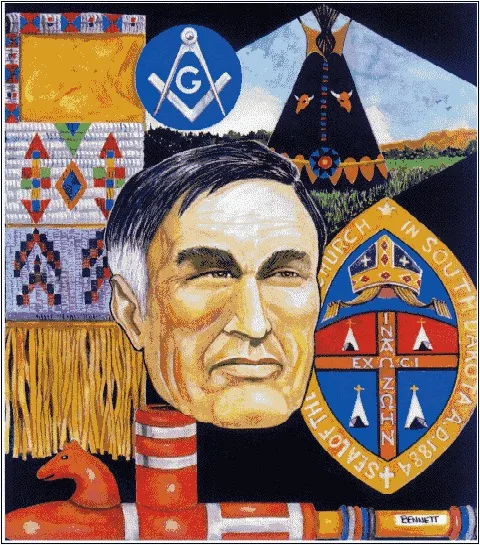
Honoring the 95th Anniversary of the Passing of Tipi Sapa, Black Lodge, Philip Joseph Deloria
Philip Joseph Deloria stands among the great spiritual leaders of the Ihanktonwan Dakota people: a hereditary chief, a bridge-builder, a man of prayer, and the most powerful Native evangelist of his generation.
His life cannot be understood only as the story of one man. It is the story of the People of Tipi Sapa, the Yankton Dakota, the White Swan people, the relatives who carried ancient teachings, sacred kinship, suffering, courage, and renewal through one of the most difficult turning points in the history of the Oceti Sakowin.
Before we can fully understand Tipi Sapa, we must first honor his father, Hinhan Wicasa, Owl Man, Saswe, Frank Deloria. He was the leader of the Holy Man’s Society and Itancha (Chief) of the White Swan Dakotas, remembered for his sacred healing powers and spiritual authority.
In his vision of Medicine Butte, Hinhan Wicasa entered a black tipi filled with the sick and dying. When he touched them, they were healed.
From this vision came the sacred name Tipi Sapa, Black Lodge, given to his son, and from this vision we can understand the deeper spiritual meaning of the family line: a lodge of darkness transformed into a place of healing, restoration, and life.
From a young age, Tipi Sapa was prepared to become a leader of his people. He was known for intelligence, bravery, dignity, and natural authority. At only 17 years of age, he was formally raised in a great chieftainship ceremony at a White Swan camp along the Missouri River.
A Presbyterian minister who witnessed the ceremony later wrote of the powerful impression made by this young leader, recognizing the extraordinary figure he already was among his people.
This ceremony confirmed Tipi Sapa’s hereditary role and publicly acknowledged that he was being prepared to carry the leadership of his father, Hinhan Wicasa, and the White Swan people.
This is one of the keys to his whole story. Tipi Sapa was not made great by the Church. He was already great among his own people. He was already a Dakota chief, already recognized in ceremony, already carrying the responsibilities of kinship, protection, and leadership.
When he later became Philip Joseph Deloria, deacon, priest, and evangelist, he did not cease being Tipi Sapa. He never gave up his chieftainship. He carried his chieftainship into every sermon, every mission, every journey, and every act of service.
An Itancha is the last to eat, the last to sleep, and the first to die, if needed, to protect the People.
In 1870, while riding near the Episcopal mission church at Greenwood, South Dakota, Tipi Sapa heard the people singing “Guide Me, O Thou Great Jehovah.” Something in those words reached him deeply. He stopped to listen. Later, he returned and heard the hymn again, and when he left, he had memorized the first stanza.
That song became a doorway. It touched something already alive inside him, a longing for guidance, a willingness to walk a new and difficult road, and a sense that the Great Mystery was calling him into another form of service.
That decision came with a high cost. To walk the Christian path in that time meant facing pressure to give up visible signs of Dakota warrior identity, including cutting his long hair and changing his outward appearance.
Many of his own people ridiculed him and scorned him for taking this road. Yet Tipi Sapa did not abandon who he was. He accepted baptism, but he did not surrender his hereditary chieftainship.
On Christmas Day 1870, Tipi Sapa and his father were baptized together. Tipi Sapa took the Christian name Philip Joseph Deloria, while Hinhan Wicasa became known as Frank Deloria.
From that time forward, Tipi Sapa carried two worlds within one body. He remained a Dakota chief while becoming a priest, teacher, and spiritual guide. He became a lay reader, then a deacon, and in 1890 was ordained as a priest of the Episcopal Church at Wakpala, on the Standing Rock Sioux Reservation.
His ministry carried him across the great circle of the Niobrara jurisdiction, including Ponca, Yankton, Crow Creek, Lower Brule, three missions on the Cheyenne River, Red Cloud’s Agency, Spotted Tail’s Agency, and the Shoshone and Bannock in Wyoming.
His work reached across what are now South Dakota, North Dakota, Nebraska, and Wyoming, carrying him far beyond one mission station.
Twenty Years Before the Parliament: An Indigenous-Led Ecumenical Vision
In 1873, twenty full years before the 1893 Parliament of the World’s Religions in Chicago, Tipi Sapa — Black Lodge — Philip Joseph Deloria and two other young Ihanktonwan Dakota men had already begun creating a movement of spiritual unity among the Oceti Sakowin. They formed the Corn Planting Society, which later became the Brotherhood of Christian Unity, because
Tipi Sapa could see that different Christian denominations were dividing the people. His purpose was not to create another church faction, but to protect the sacred circle of kinship and keep relatives together in a time of tremendous disruption.
This deserves deep recognition. While there were earlier interfaith and ecumenical efforts in other parts of the world, Tipi Sapa’s work is the first recorded Indigenous-led grassroots ecumenical movement in the Americas. It arose not from empire, wealth, or institutional power, but from a colonized people struggling to keep prayer, kinship, and unity alive.
Twenty years before the Parliament of the World’s Religions, Indigenous people had already understood that faith must bring relatives together, not divide them.
The Brotherhood of Christian Unity was therefore a prophetic movement. It showed that the Oceti Sakowin were not late to interfaith understanding. They were already living it. They had already recognized that Wakan Tanka, the Great Mystery, could not be owned by one denomination.
They had already seen that spiritual division could become another weapon against the people. Tipi Sapa answered that danger with unity, service, and a wider circle open to all who sincerely sought the Creator.
The Brotherhood of Christian Unity did not disappear into history. The sacred impulse that began with Tipi Sapa and the Corn Planting Society in 1873 continued through the generations, carrying forward the same purpose: to protect unity, strengthen relatives, and keep spiritual service rooted among the people.
In later generations, the Brotherhood continued to be remembered and practiced through the life of the Episcopal Diocese of South Dakota, the Niobrara circle, and the living service of Dakota and Lakota Christian relatives.
This continuing life is deeply important. A later diocesan publication records that the Brotherhood of Christian Unity, BCU, and the Niobrara Council helped renovate the Deloria Center, and that members of the Deloria family were inducted into the BCU at that dedication.
More recently, the Diocese of South Dakota reported that BCU helped distribute clothing, blankets, and essential items to homeless relatives, demonstrating that the Brotherhood’s original spirit of practical service, unity, and compassion remains alive in community care.
From 1873 until today, the Brotherhood of Christian Unity carries a sacred continuity. It began as an Indigenous-led response to religious division, but it became something larger: a living witness that spiritual paths must serve kinship, not separation.
Tipi Sapa and his relatives saw this truth twenty years before the Parliament of the World’s Religions. They understood that the Creator’s circle is wider than any denomination and that the people must never allow religion to become another force that breaks the sacred hoop.
iament: An Indigenous-Led Ecumenical Vision” and before the drums and death songs section. It deepens the same theme: Tipi Sapa and the Oceti Sakowin were not only protecting unity among themselves; they were extending compassion outward to suffering peoples across the world.
Generosity After Great Suffering: The Oceti Sakowin’s Sacred Duty to Help Others
The same spirit of unity that moved through the Corn Planting Society and the Brotherhood of Christian Unity also appeared in the remarkable generosity of the Standing Rock Sioux, the Yankton Sioux, and the wider Niobrara circle. Even after broken treaties, massacres, forced changes, humiliation, hunger, and the suppression of sacred ways, the people did not allow their hearts to become closed. They did not forget the sacred duty to help those who were suffering. Their compassion reached far beyond their own communities.
During the early days of World War I, before the United States entered the conflict, the Sioux generously contributed to relief efforts for the Belgians and Armenians. Earlier, they had made dramatic contributions to the victims of the 1906 San Francisco earthquake, and later gave to flood victims in Ohio and Pennsylvania.
Their charitable efforts also reached across the ocean to support Chinese relief programs. These acts were not made in abundance. The record says that many of the Christian Sioux were extremely poor, and that giving to charity required real personal sacrifice. Yet they gave willingly.
This is spiritually profound. Only a short time after the terrible wounds inflicted upon the Oceti Sakowin — including the massacre at Wounded Knee and the many assaults on their lands, ceremonies, families, and freedom- the people still responded to the suffering of others with generosity. They could have turned inward in bitterness.
They could have said, “The world did not help us, so why should we help the world?” But they did not. They continued to live by the higher law of kinship, compassion, and responsibility.
By 1917, every Sioux resident of age at the Standing Rock Agency and the Yankton Sioux Agency was a member of the Red Cross, and 5,000 young Oceti Sakowin men were serving in the United States Army that year.
The people also contributed to the building of the National Cathedral in Washington, D.C., where Tipi Sapa’s statue would later be enshrined as one of the Saints of the Ages. The record says that generosity and helping the less fortunate were among the highest qualities and duties of the Oceti Sakowin.
This must be remembered as part of Tipi Sapa’s larger spiritual world. The people were not passive victims of history. They were moral actors. They were relatives of the Human Family.
Even while carrying their own grief, poverty, and injustice, they reached out to Belgians, Armenians, Chinese families, earthquake victims, flood victims, and others in need. Their giving was a living sermon. It showed that the sacred hoop of compassion could not be broken by colonial violence.
In this way, the charitable work of the Oceti Sakowin belongs beside the Brotherhood of Christian Unity as one of the great signs of Indigenous spiritual leadership. The Brotherhood sought to stop religion from dividing the people. The charitable work showed that the people’s compassion extended beyond tribe, nation, race, and continent.
Together, these acts reveal a great truth: the Oceti Sakowin were already living a global ethic of unity, service, and human kinship long before the wider world fully understood the meaning of interfaith and international compassion.
Tipi Sapa and Dakota Culture
One of the most important truths about Tipi Sapa is that he never disrespected his Dakota culture, nor did he reject the sacred cultural life that had formed him. He was supportive of his people, respectful of their ways, and deeply aware that the old songs, the drums, the ceremonies, and the people's spiritual inheritance still carried sacred meaning.
Down below St. Elizabeth’s Church, singers and drummers would gather, and when Tipi Sapa came by with his team and wagon, he would stop. He would pause there and listen respectfully. He said nothing. He respectfully listened. In that listening, he let the people know that their songs still mattered.
It is also remembered that, before he died, thirty-three men entrusted their death songs to Tipi Sapa. This was a profound sign of confidence, reverence, and sacred trust.
A death song is not an ordinary song. It carries a person’s courage, identity, final prayer, and spiritual readiness. For thirty-three men to give their death songs to Tipi Sapa shows that they knew he honored them. They trusted him not only as a Christian priest but as a Dakota chief, a relative, and a keeper of sacred memory.
One of the most powerful chapters in his life was his sacred relationship with Chief Gall, the great Hunkpapa Lakota war leader. Gall came to hear Tipi Sapa preach at St. Elizabeth’s Mission in Wakpala, on Standing Rock. At first, he listened silently and sternly, but over time, he was moved.
After deciding to follow the Spiritual Path of Tipi Sapa, Gall honored Tipi Sapa through a traditional Hunka, Making of Relatives Ceremony, adopting him as his younger brother. Gall’s adoption strengthened relations between the Yankton and Hunkpapa peoples and brought real support to St. Elizabeth’s Mission and school, including land, horses, cattle, and other resources.
The sacred symbols around him also carried deeper meaning. Behind the high altar at St. Elizabeth’s, the carved cross was not simply a narrow Christian sign. Its shape evoked the medicine wheel, with equal arms reaching toward the four directions.
In this Dakota understanding, it could be seen as a medicine sign, a sign of the four directions, balance, sacred order, and the Great Mystery moving through all creation. The sign of Jesus was therefore seen not only as a church symbol, but as a medicine sign of the four directions.
But Tipi Sapa’s life was also marked by deep sorrow. He suffered losses that would have broken many hearts. He lost two beloved wives. He lost his young son, Philip, whom he deeply loved. He lost his daughter Lyma, who died of tuberculosis,s and left behind young children. He also endured the loss of his oldest daughter. These were wounds in the center of his lodge, losses that touched his daily life, his prayers, his family, and his spirit.
Yet he continued. This is one of the greatest teachings of Tipi Sapa’s life: he did not become great because he was spared suffering. He became great because he carried suffering with dignity, prayer, and service.
Like the black lodge of his father’s vision, his life became a place where grief, sickness, loss, and death were brought into the presence of healing. He did not deny pain. He transformed it into compassion, ministry, and care for the children and the people.
After the death of his daughter Lyma, Tipi Sapa helped carry forward the next generations. He raised his grandson Philip, who was named after him. He gave him the name Mato Gi, Brown Bear, after Philip’s uncle, who fulfilled the White Swan Oyates prophecy of the Sacrifice of the White Buffalo.
This prophecy promised that, despite enduring great suffering, future generations would rise in justice, restoration, and unity.
In this way, the spiritual line continued. from Hinhan Wicasa to Tipi Sapa, from Tipi Sapa to the children and grandchildren who carried the family forward. The story of Tipi Sapa is therefore not only a story of the past. It is a living stream of ancestry, responsibility, and sacred remembrance, until today, and into the future.
In 1925, after six decades of serving the People, Tipi Sapa was honored upon his retirement from Standing Rock. More than 2,500 Oceti Sakowin traveled to the Yankton Sioux Reservation to witness the ceremony.
Later, he was recognized as one of the “Saints of the Ages” at the National Cathedral in Washington, D.C., where his statue stands behind the High Altar. He is remembered as the only Native American so honored in that sacred setting.
Tipi Sapa passed away on May 8, 1931, at the age of 77. But in truth, he belongs to more than one date, one church, one nation, or one historical account.
He belongs to the ages because he carried a sacred contradiction with courage: he was a Dakota chief and a Christian Minister, a man of ancient kinship and a man of missionary service, a sufferer and a healer, a father and grandfather, a prince of his people and a servant of the Great Mystery.
To honor Tipi Sapa is to honor the people who shaped him, the women and children he loved, the relatives he lost, the communities he served, and the sacred fire he kept alive through times of great upheaval.
His story reminds us that true leadership is not domination. It is sacrifice, vision, humility, endurance, and love.
Tipi Sapa’s life says to us: when the winds of history are fierce, stand rooted. When grief comes, keep serving. When worlds collide, become a bridge. When the people suffer, make your own life a lodge of healing.